
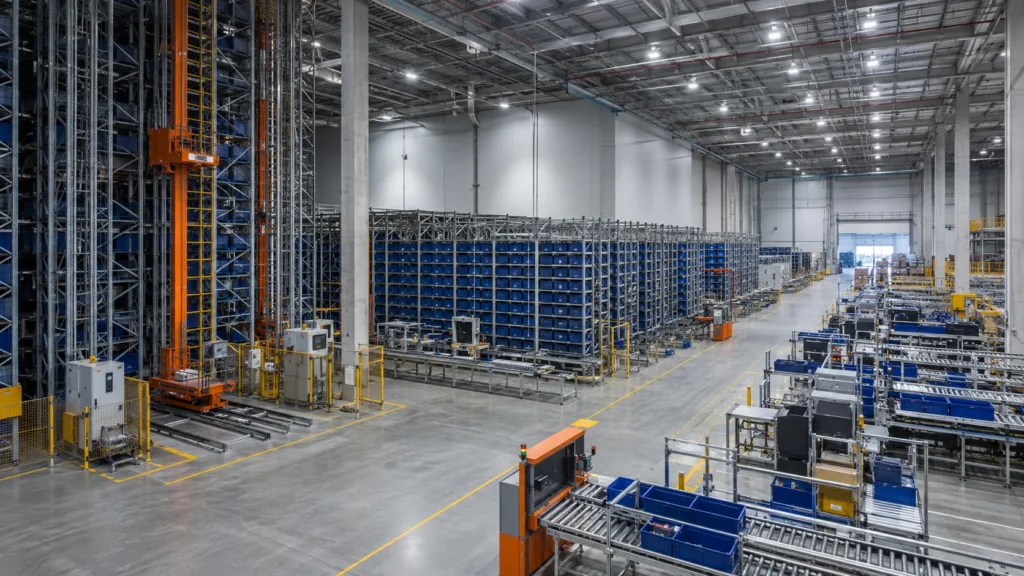
An ASRS warehouse is a warehouse where automated storage and retrieval systems handle part or all of the storage and retrieval work that manual operators, forklifts, or reach trucks would otherwise perform. The goal is not to remove every person from the building. The goal is to make inventory easier to store, easier to find, faster to retrieve, and safer to move through the warehouse.
This matters because the warehouse is no longer just a storage room. For many manufacturers, retailers, 3PLs, and ecommerce operators, the warehouse is the place where customer promises either hold or break. If inventory cannot be found, retrieved, picked, replenished, packed, and shipped on time, the rest of the business feels it.
Short answer: An ASRS warehouse combines high-density storage equipment, automated retrieval machines, goods-to-person or conveyor workflows, and warehouse software. A good ASRS warehouse layout is built around load type, SKU velocity, order profile, throughput target, safety zones, and integration with WMS, WES, WCS, ERP, and downstream packing or production lines.
This guide explains what an ASRS warehouse looks like, which systems fit different layouts, how to plan the physical flow, and what mistakes to avoid before committing to automation.
What Is an ASRS Warehouse?
An ASRS warehouse is a facility that uses automated storage and retrieval systems to store and retrieve pallets, totes, cartons, trays, bins, or other load units from defined storage locations. The automation may be a pallet stacker crane, a mini-load crane, a shuttle system, a vertical lift module, a bin robot system, or a hybrid design with conveyors and mobile robots.
The common thread is control. Inventory is not stored wherever an operator finds open space. The system assigns a location, records the position, retrieves the load when needed, and confirms the movement through software.
MHI describes automated storage and retrieval systems as computer-controlled systems that place and retrieve loads from defined storage locations with precision, accuracy, and speed. That definition is useful because it keeps the focus on the full system: equipment, controls, storage structure, and operating logic.
In practical warehouse language, ASRS changes four things:
- Storage density: More inventory can fit into the same building footprint.
- Retrieval path: Workers no longer walk or drive to every storage position.
- Inventory control: The system records where every pallet, tote, or bin is located.
- Flow design: Storage, picking, replenishment, packing, and shipping must be planned as one connected process.
If you are new to the category, start with our full definition of what ASRS means and the comparison of types of ASRS systems.
ASRS Warehouse vs Traditional Warehouse
The difference is not only the equipment. It is the operating model.
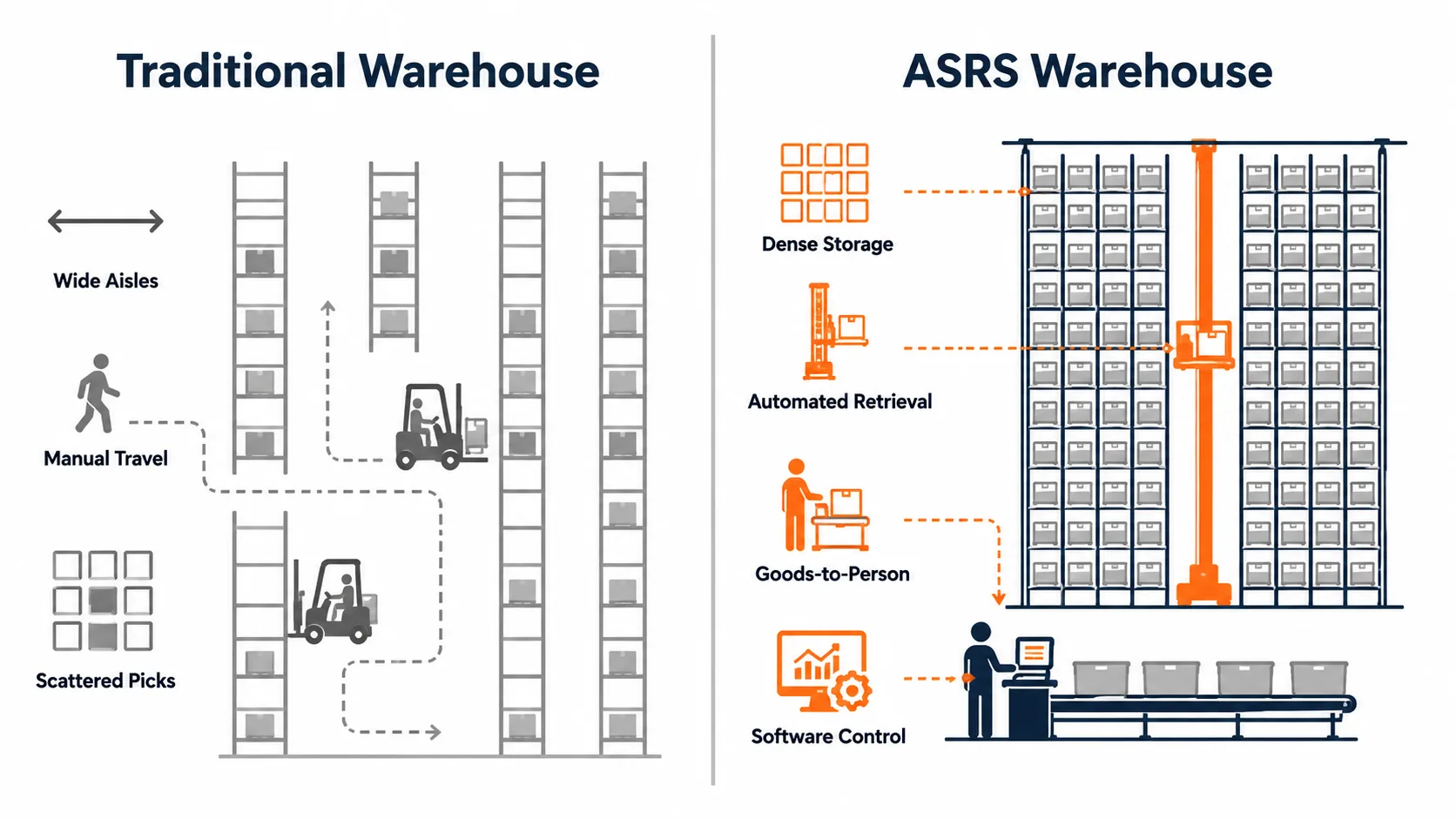
In a traditional warehouse, people and forklifts do most of the movement. Operators search locations, travel aisles, pick items, scan labels, and move inventory to staging areas. This can work well when SKU count is low, order volume is stable, labor is available, and the building has enough space.
In an ASRS warehouse, the system absorbs much of the travel and search work. Operators still matter, but they work at receiving stations, picking stations, exception zones, packing lines, maintenance areas, and control desks. Their time shifts from walking and driving to decision-making, quality checks, replenishment, exception handling, and system monitoring.
| Area | Traditional warehouse | ASRS warehouse |
|---|---|---|
| Storage | Wide aisles, manual rack access | Dense racks, automated access |
| Retrieval | Forklift or operator travel | Crane, shuttle, robot, or lift |
| Picking | Person-to-goods | Often goods-to-person |
| Inventory accuracy | Depends on scan discipline | Location control is system-driven |
| Space use | Limited by aisle width and reach height | Higher vertical cube utilization |
| Safety profile | Forklift and pedestrian interaction | More separated automation zones |
| Scaling method | Add people, aisles, shifts | Add stations, aisles, robots, or software capacity |
Traditional warehouses are flexible at low volume. ASRS warehouses become stronger when volume, SKU count, accuracy requirements, space pressure, or labor constraints create repeatable work that automation can absorb.
For a deeper comparison, see ASRS vs traditional warehousing.
Core Components of an ASRS Warehouse
Most ASRS warehouses are built from six layers. The exact technology can vary, but the architecture is usually similar.
Storage Structure
The storage structure is the physical rack, shelf, bin grid, tray system, or pallet rack that holds inventory. It determines storage density, load limits, aisle spacing, fire protection strategy, and maintenance access.
For pallet operations, the structure may be a high-bay rack with stacker crane aisles. For tote or carton operations, it may be a shuttle rack, mini-load rack, or bin robot storage grid. For small parts, it may be a vertical lift module or compact goods-to-person system.
The storage structure should not be designed only around maximum capacity. It also needs to support throughput, replenishment, emergency access, fire code, sprinkler strategy, and future expansion.
Storage and Retrieval Machine
The retrieval machine is the moving equipment that places and retrieves inventory. Common examples include stacker cranes, mini-load cranes, shuttle carriers, lifts, AMRs, AGVs, bin robots, and vertical lift extractors.
The machine selection depends on load unit and movement pattern. Pallets need different equipment than cartons. Slow-moving spare parts need a different design than ecommerce fast movers. A frozen warehouse needs different controls and components than an ambient apparel operation.
Conveyor or Handoff System
ASRS does not end when the load leaves the rack. It needs a handoff path. That handoff may be a conveyor line, transfer car, AGV pickup point, AMR zone, pallet station, tote lift, or goods-to-person workstation.
Many poor ASRS designs fail here. The storage system can retrieve inventory fast enough, but the outbound conveyor, picking station, packing line, or shipping sorter cannot absorb it. The bottleneck simply moves downstream.
Workstations
Workstations are where people interact with the automated system. These may include receiving, decanting, quality inspection, picking, replenishment, returns, packing, kitting, sequencing, or maintenance stations.
The workstation design affects throughput more than many buyers expect. A shuttle system may deliver hundreds of totes per hour, but if the operator must twist, reach, scan twice, walk three steps, or wait for labels, the station becomes the limiting factor.
Good workstation design considers ergonomics, screen prompts, barcode placement, tote presentation height, lighting, reject flow, empty container flow, and exception handling.
Warehouse Software
An ASRS warehouse needs software at multiple levels:
- WMS: inventory ownership, orders, receiving, allocation, and warehouse records.
- WES: task orchestration, wave management, station balancing, robot dispatch, and real-time priority control.
- WCS: machine-level control for conveyors, cranes, shuttles, lifts, PLCs, and sensors.
- ERP or OMS integration: order demand, purchase orders, production plans, customer requirements, and shipping commitments.
If the software layers are unclear, the physical automation will not perform well. The system may move inventory correctly but still make poor decisions about priority, sequencing, or labor allocation.
Our article on WES vs WMS vs WCS explains these layers in detail.
Safety and Maintenance Zones
An ASRS warehouse is safer when forklift and pedestrian movement are reduced, but automation still requires disciplined safety design. OSHA's warehousing guidance calls out hazards around powered industrial trucks, ergonomics, material handling, slips, falls, and robotics. Those risks do not disappear automatically when equipment is automated. They need to be designed out of the process.
Typical safety and maintenance requirements include machine guarding, light curtains, fenced access zones, lockout procedures, emergency egress, clear pedestrian routes, rack inspection, fire protection coordination, and access space for technicians.
An ASRS warehouse layout should show safety and maintenance zones from the first concept drawing, not after the storage density target has already consumed every square meter.
Common ASRS Warehouse Layouts
There is no universal ASRS warehouse layout. The right layout depends on product type, throughput, building shape, receiving and shipping doors, labor plan, and software control model. These are the patterns we see most often.
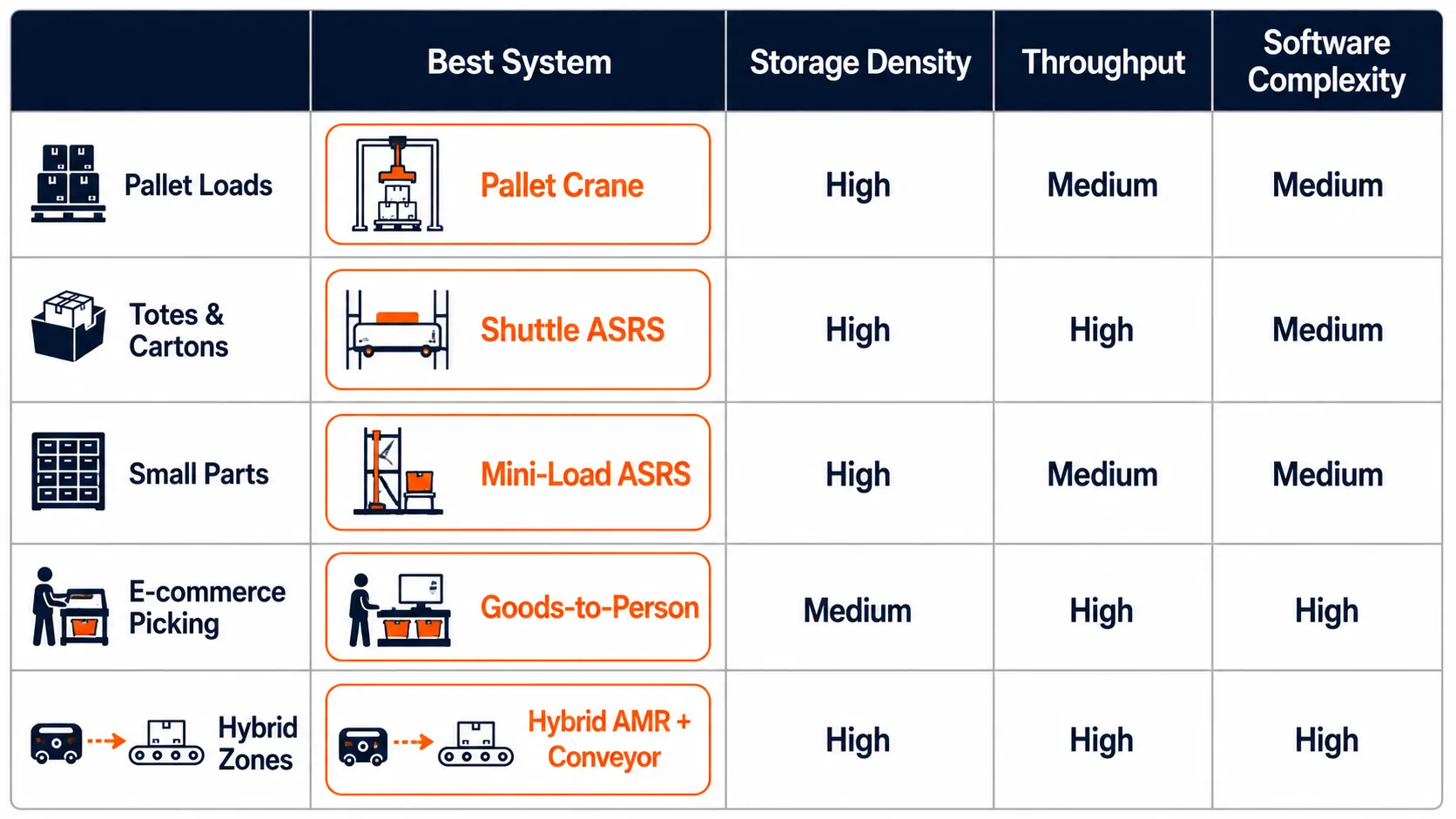
1. High-Bay Pallet ASRS Warehouse
This layout uses tall pallet racks with stacker cranes running in narrow automated aisles. It is common in manufacturing, food and beverage, cold storage, chemicals, building materials, and reserve inventory operations.
Best fit:
- Full pallets or heavy unit loads
- High storage density requirement
- Stable inbound and outbound flow
- Limited building footprint
- Cold or controlled environments where labor reduction matters
Typical flow:
1. Pallets arrive at receiving or production. 2. Pallets pass dimension, weight, and barcode checks. 3. Conveyor or transfer vehicle moves pallets to the ASRS input station. 4. Stacker crane stores pallets in assigned rack locations. 5. System retrieves pallets for production, shipping, replenishment, or case picking.
For deeper system details, see our pallet ASRS guide.
2. Shuttle ASRS Warehouse for Totes and Cartons
This layout uses shuttle carriers to move totes or cartons through multi-level rack aisles. Lifts connect the levels to input/output stations. It is common in ecommerce, apparel, electronics, pharmaceuticals, spare parts, and omnichannel fulfillment.
Best fit:
- High SKU count
- Tote, carton, bin, or tray loads
- Goods-to-person picking
- High order line volume
- Frequent retrieval and putaway cycles
The key design question is not only how many totes the storage system can hold. It is how many totes per hour the complete flow can present, pick, replenish, and return without starving stations or creating congestion.
For technology comparison, see shuttle ASRS vs crane-based ASRS.
3. Mini-Load ASRS Warehouse
Mini-load ASRS uses cranes or compact retrieval machines for totes, cartons, trays, or small parts. It often fits warehouses that need high accuracy and moderate-to-high throughput but do not require the extreme speed of a large shuttle system.
Best fit:
- Spare parts
- Electronics
- Medical supplies
- Industrial components
- Slow and medium movers
- Manufacturing line replenishment
Mini-load systems are often easier to justify when SKU control and storage density matter more than maximum line-per-hour picking speed. They can also work well as a buffer between receiving, production, and assembly.
Read the mini-load ASRS guide for a more detailed breakdown.
4. Goods-to-Person ASRS Warehouse
In a goods-to-person ASRS warehouse, the system brings inventory to a stationary operator. This removes walking time from the picking process and improves scan discipline because every pick occurs at a controlled station.
Best fit:
- Ecommerce fulfillment
- Apparel and footwear
- Beauty and personal care
- Spare parts
- High-SKU retail
- Multi-client 3PL operations
Goods-to-person does not mean the warehouse is fully automatic. It means human work is concentrated where humans add value: identifying exceptions, handling irregular items, checking quality, and packing correctly.
See our guide to goods-to-person picking for station design and productivity examples.
5. Hybrid ASRS Warehouse with AMRs or Conveyors
Many modern ASRS warehouses are hybrid. They use fixed storage automation for density and predictable retrieval, then AMRs, conveyors, or AGVs for transport and flexible zone movement.
This layout is useful when the warehouse has multiple operating zones:
- ASRS for reserve or dense storage
- AMRs for transport between stations
- Conveyors for high-volume outbound flow
- Manual zones for exceptions or oversized goods
- WES to coordinate the entire sequence
Hybrid layouts often outperform single-technology designs because they match each movement type to the right automation method. The risk is integration complexity. If the WMS, WES, WCS, and robot fleet manager do not agree on priorities, the warehouse can become slower than a simpler system.
For that tradeoff, see ASRS vs AMR and warehouse automation systems.

How to Plan an ASRS Warehouse Layout
A good ASRS warehouse layout starts with data, not equipment. The wrong starting point is asking, "How many robots do we need?" The better starting point is asking, "What flow must the building support every hour?"
Step 1: Define the Load Unit
The load unit drives almost every design decision. Pallets, totes, cartons, trays, bins, hanging garments, drums, and long materials all require different storage structures and handling equipment.
For each load unit, define:
- Dimensions and weight range
- Stackability
- Barcode or RFID position
- Fragility and orientation limits
- Temperature or handling constraints
- Whether the item can be mixed with other SKUs
If the load unit is not standardized, the automation project becomes harder. Many ASRS projects need a decanting process that converts inbound cartons or pallets into standardized totes before storage.
Step 2: Segment SKU Velocity
Not every SKU belongs in the same automation zone. Fast movers, medium movers, slow movers, return-heavy SKUs, fragile items, and oversized goods often need different storage logic.
The basic segmentation should include:
- A-items: high velocity, high retrieval frequency
- B-items: moderate velocity, stable demand
- C-items: slow movers that still need accurate storage
- Exception items: oversized, hazardous, irregular, fragile, or high value
ASRS works best when it is not forced to behave like a universal dumping ground. The system should store the inventory that benefits most from automation and route exceptions to the right process.
Step 3: Model Throughput by Hour, Not by Day
Daily order volume is not enough. An ASRS warehouse must handle peaks inside the day: carrier cutoff windows, production replenishment waves, inbound receiving peaks, and returns surges.
Model:
- Inbound loads per hour
- Storage commands per hour
- Retrieval commands per hour
- Order lines per hour
- Totes or pallets presented per station per hour
- Peak-hour requirement
- Recovery requirement after downtime
The system should be sized for real operating peaks, not average volume. A warehouse that averages 6,000 order lines per day may still need to handle 1,200 lines in one hour before carrier cutoff.
Step 4: Design the Human Work Before the Robot Work
The automated machine may look like the center of the project, but humans still determine practical throughput. Receiving, decanting, inspection, exception handling, picking, packing, replenishment, and maintenance all need space, tools, and clear decision rules.
For each station, define:
- What the operator sees on screen
- What they scan
- Where the load arrives
- Where empty containers go
- How exceptions leave the station
- How quality checks are recorded
- What happens when the station is paused
This is where many automation projects become real or theoretical. If the station flow is awkward, the machine speed does not matter.
Step 5: Separate Storage, Picking, and Shipping Bottlenecks
An ASRS warehouse is a chain. The slowest link sets the result.
Common bottlenecks include:
- Receiving cannot decant fast enough
- ASRS retrieves faster than operators can pick
- Picking finishes faster than packing can absorb
- Packing finishes faster than sortation or shipping doors can clear
- Software releases too many urgent tasks at once
- Exceptions accumulate outside the automation flow
The layout should include buffers, but buffers are not a substitute for balanced capacity. Too little buffer starves downstream processes. Too much buffer hides problems and consumes the space ASRS was supposed to recover.
Step 6: Plan Software Ownership
Before equipment is purchased, decide which system owns each decision.
Examples:
- Which system decides storage location?
- Which system prioritizes an urgent order?
- Which system releases a picking wave?
- Which system tells a shuttle or crane what to retrieve next?
- Which system handles a failed scan?
- Which system records inventory after an exception?
These questions sound technical, but they are operational. If ownership is unclear, the warehouse team will see delays, duplicate tasks, inventory mismatches, and unclear responsibility when something fails.
ASRS Warehouse Examples by Industry
Different industries use ASRS warehouses for different reasons. The same technology can solve very different problems depending on the flow.
Ecommerce Fulfillment
Ecommerce ASRS warehouses usually prioritize goods-to-person picking, order line throughput, packing flow, and peak season resilience. The storage system must support high SKU variety and frequent retrievals.
A common architecture is shuttle ASRS plus goods-to-person stations, put walls, packing, and outbound sortation. The goal is to remove walking from picking and keep operators focused on verified item handling.
See ASRS for ecommerce fulfillment for a full workflow.
3PL Warehouse
3PL ASRS warehouses must handle multi-client inventory rules, different SLA promises, client-specific labeling, inventory ownership, and billing traceability. The automation layer must be flexible enough to support different clients without mixing control logic.
A good 3PL layout usually includes strong WES orchestration, client-segmented inventory logic, flexible picking stations, and clear exception workflows.
See ASRS for 3PL warehouse for the multi-client design problem.
Apparel and Fashion
Apparel ASRS warehouses deal with SKU explosion, size-color variation, seasonality, and high returns. Tote-based shuttle ASRS is common for folded garments, while hanging garments may need a separate handling strategy.
The warehouse must treat returns as a serious inbound workload, not a small side process.
See ASRS for apparel warehouse for the full apparel-specific breakdown.
Manufacturing and Line Replenishment
Manufacturing ASRS warehouses often act as buffers between raw material storage, work-in-process, and production lines. The priority is not always order picking speed. Sometimes the priority is sequencing, traceability, kit accuracy, and line uptime.
ASRS can reduce forklift traffic near production, improve component control, and make replenishment more predictable.
Cold Storage
Cold storage ASRS warehouses use automation to reduce human exposure to low temperatures while increasing storage density. High-bay pallet ASRS, shuttle ASRS, and automated conveyor interfaces are common because cold buildings are expensive and labor conditions are difficult.
The design must account for condensation, freezer-rated components, maintenance access, door strategy, and emergency procedures.
ASRS Warehouse Cost and ROI Factors
An ASRS warehouse is a capital project, so the ROI case must be built from operational drivers instead of generic automation claims.
Major cost factors include:
- Rack or storage structure
- Cranes, shuttles, lifts, robots, conveyors, or AGVs
- Workstations and safety equipment
- Controls, PLCs, sensors, and WCS
- WES/WMS integration
- Fire protection, building modifications, and utilities
- Installation, testing, training, and spare parts
- Ongoing support and maintenance
Major benefit factors include:
- Labor reduction or labor avoidance
- Higher storage density and avoided building expansion
- Reduced forklift traffic
- Improved inventory accuracy
- Faster order cycle time
- Lower damage and mispick rates
- Better peak season capacity
- Lower cold storage labor exposure
The strongest ROI cases usually combine several benefits. A project justified only on labor savings is more fragile than a project that also avoids a building expansion, reduces errors, improves service levels, and supports growth.
For calculation structure, use our warehouse automation ROI guide and ASRS system cost guide.
Common ASRS Warehouse Design Mistakes
The most expensive mistakes happen before equipment is installed.
Mistake 1: Designing for storage density only. High density is useful, but it does not guarantee throughput. A dense system with too few input/output points can become a beautiful bottleneck.
Mistake 2: Ignoring inbound flow. Many teams design outbound picking first and later discover that receiving, decanting, inspection, or returns cannot feed the ASRS cleanly.
Mistake 3: Treating exceptions as rare. Damaged cartons, unreadable labels, overweight pallets, cancelled orders, substitutions, and inventory discrepancies happen every day. The layout needs a place for them.
Mistake 4: Underestimating software integration. The warehouse may need WMS, WES, WCS, ERP, OMS, TMS, carrier systems, labeling systems, and customer portals to coordinate. Physical equipment can be ready while software rules are still unclear.
Mistake 5: Forgetting maintenance access. A system that cannot be inspected, serviced, or isolated safely will create long downtime events.
Mistake 6: Sizing for averages. Average daily volume hides peak-hour stress. Design around peak flow, recovery flow, and future growth.
Mistake 7: Automating a broken process. If inventory rules, SKU master data, packaging standards, or order release logic are messy, ASRS will expose the mess faster.
How to Know Whether Your Warehouse Is Ready for ASRS
An ASRS warehouse makes sense when the operational constraint is clear and measurable.
Good signals include:
- You are running out of storage space but still have vertical cube available.
- Order volume or SKU count is growing faster than labor capacity.
- Forklift traffic is creating safety or congestion concerns.
- Picking accuracy is causing returns, rework, or customer claims.
- Manual walking or driving time is a major cost.
- Cold storage or hazardous environments make labor difficult.
- You need traceability, lot control, or high inventory accuracy.
- Existing manual processes cannot support peak season.
Weak signals include:
- SKU data is incomplete.
- Inbound packaging is inconsistent.
- Order profiles change every month without stable patterns.
- The warehouse has no clear bottleneck.
- Software ownership is unclear.
- Management wants automation mainly because competitors are doing it.
If the constraint is unclear, start with a process audit before selecting equipment. If the constraint is clear, use a structured selection process like our ASRS buyer decision framework.
Frequently Asked Questions
What is an ASRS warehouse?
An ASRS warehouse is a warehouse that uses automated storage and retrieval systems to store and retrieve pallets, totes, cartons, bins, trays, or other load units from defined storage locations. It usually combines storage equipment, retrieval machines, workstations, conveyors or robot transport, and warehouse software.
Is an ASRS warehouse fully automated?
Not always. Many ASRS warehouses are partially automated. The system handles storage and retrieval, while people still manage receiving, inspection, picking, packing, exception handling, maintenance, and supervision. Full automation is possible in some flows, but partial automation is more common.
What types of warehouses use ASRS?
ASRS is used in ecommerce fulfillment, apparel, pharmaceuticals, spare parts, manufacturing, food and beverage, cold storage, automotive parts, electronics, and 3PL operations. The best fit depends on load type, SKU count, throughput requirement, and space constraints.
How much space can an ASRS warehouse save?
Many ASRS designs can improve storage density by using taller racks, narrower automated aisles, and tighter location control. The exact space saving depends on building height, load type, fire protection, throughput requirement, and whether the project replaces manual rack storage, shelving, floor stacking, or off-site storage.
What software does an ASRS warehouse need?
Most ASRS warehouses need WMS for inventory and order records, WES for task orchestration and station balancing, and WCS for machine-level control. Some projects also connect to ERP, OMS, TMS, carrier systems, labeling systems, and client portals.
How long does it take to implement an ASRS warehouse?
Small and medium projects may take several months from design to go-live. Larger ASRS warehouses can take 9 to 18 months or more depending on building work, equipment lead time, software integration, testing, and operational training. The software and process testing phase is often the most underestimated part.
Bottom Line
An ASRS warehouse is not just a warehouse with robots inside it. It is a storage, movement, software, safety, and process design problem that has to work as one system.
The best projects start with the operating constraint: space, labor, throughput, accuracy, safety, cold environment, SKU complexity, or peak season pressure. Then the layout is built around the load unit, hourly flow, station design, software ownership, and downstream capacity.
If you are planning an ASRS warehouse, do not start with a vendor catalogue. Start with your SKU file, order history, building constraints, peak-hour demand, and exception flows. The right system design will become much clearer once the warehouse problem is defined in operational terms.
If you want to review your warehouse layout, SKU profile, and automation options, contact the GoASRS team. We can help you determine whether ASRS, AMR, conveyor, WES, or a hybrid architecture is the right next step.
External References
- MHI: ASRS 101, An Overview of Automated Storage and Retrieval Systems
- OSHA: Warehousing Overview
- OSHA: Warehousing Hazards and Solutions
Planning a Warehouse Automation Project?
Our team has delivered 50+ ASRS systems across retail, manufacturing, and logistics. Tell us about your project and we will get back to you within 24 hours.
Thank you!
We received your message and will get back to you within 24 hours.