
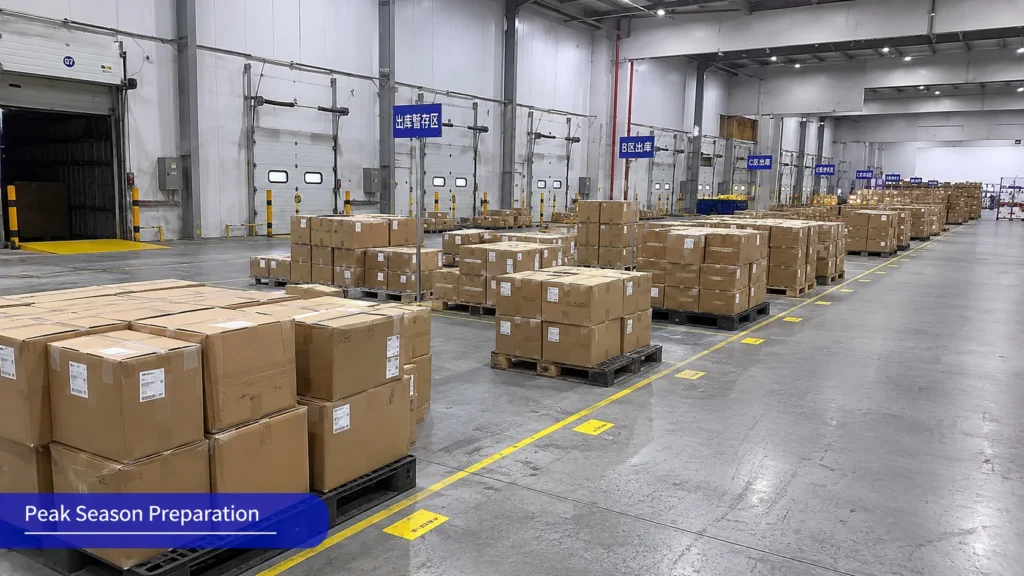
Peak season warehouse automation is not only about adding more robots before a sales event. It is about giving the warehouse enough visibility, orchestration, and flexible capacity to keep orders moving when volume rises faster than the manual process can absorb.
For ecommerce, retail, 3PL, apparel, and consumer goods warehouses, peak season can arrive through Black Friday, Cyber Monday, Singles' Day, 618, back-to-school demand, new product launches, or regional promotion campaigns. The exact event changes by market, but the operating problem is the same: order volume spikes, picking waves grow, docks become crowded, labor planning becomes unstable, and small delays compound into missed cutoffs.
Short answer: Peak season warehouse automation prevents congestion by connecting orders, inventory, robots, conveyors, picking stations, and shipping priorities through a warehouse execution system. WES coordinates work in real time, while ASRS, AGV/AMR fleets, scanners, and automated sorting increase the warehouse's physical handling capacity.
This article explains why peak season breaks manual logistics, how WES-based dispatching changes the operating model, where automation equipment creates the biggest capacity gains, and when temporary robot capacity or phased automation makes sense.
Why Peak Season Creates Warehouse Congestion
Peak season congestion usually starts before the dock is visibly crowded. The first failure is information delay.
In a normal week, a warehouse may survive with manual counting, spreadsheet planning, supervisor judgment, and fixed labor allocation. During peak season, those methods become too slow. Orders arrive in bursts. SKU velocity changes by hour. Promotional items move faster than historical averages. Returns, replenishment, and outbound shipping compete for the same aisles, workers, equipment, and dock doors.
The visible symptoms are familiar:
- Orders wait too long before being released to picking.
- Pickers walk more because waves are poorly grouped.
- Fast-moving SKUs create aisle congestion.
- Replenishment falls behind picking demand.
- Packing stations run out of balanced work.
- Shipping lanes receive work too late for carrier cutoff.
- Supervisors spend the day manually expediting exceptions.
- Temporary workers add capacity but also increase training and error risk.
Many teams describe this as a labor shortage. In reality, it is often an orchestration shortage. The warehouse has work, people, equipment, and inventory, but the work is not sequenced correctly.
The Role of WES in Peak Season Warehouse Automation
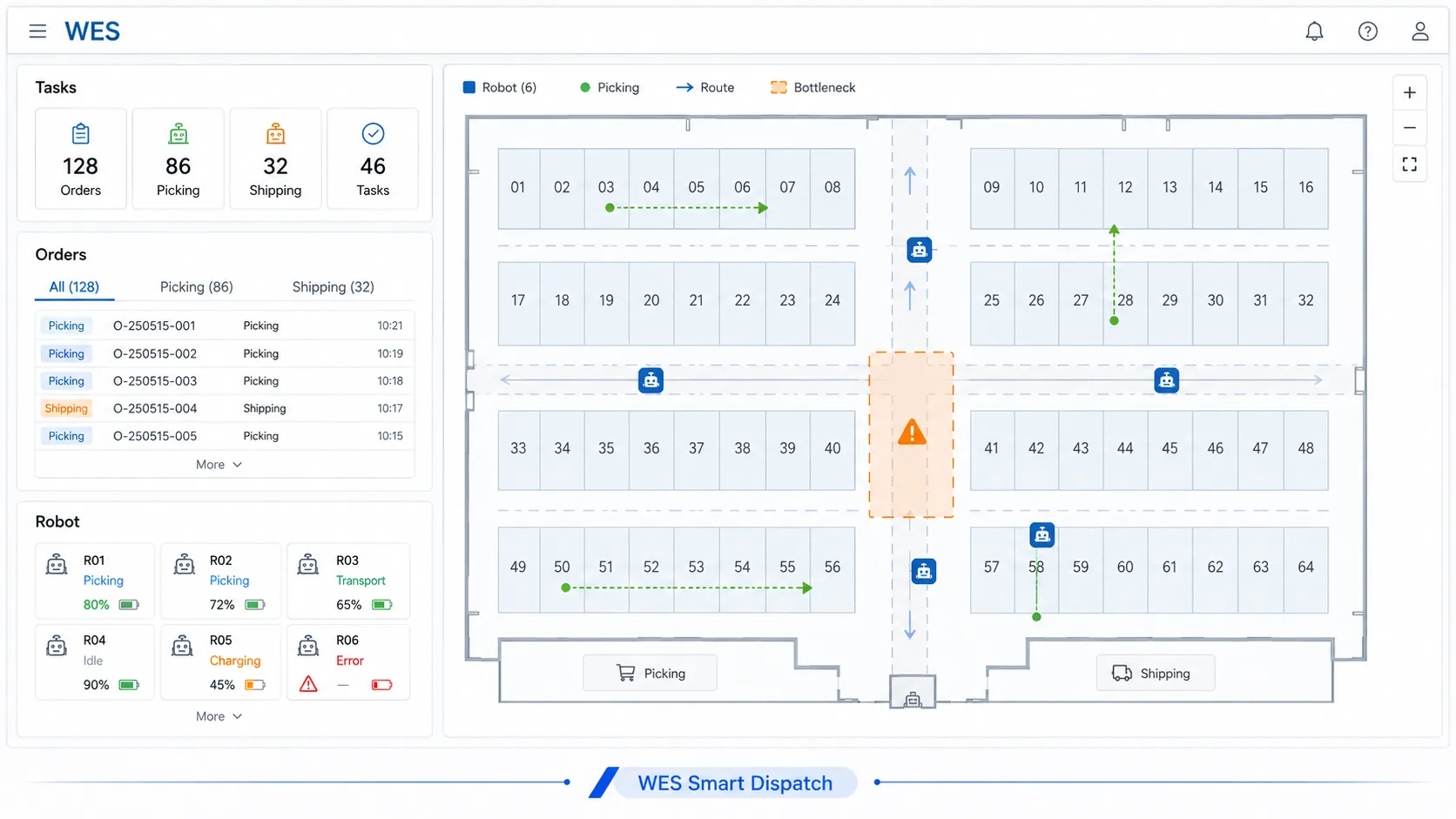
A warehouse execution system, or WES, sits between planning systems and physical automation. It does not replace the WMS. Instead, it turns order priorities, inventory status, and equipment availability into executable work.
During peak season, WES is valuable because the operation needs dynamic decisions, not static plans.
A mature WES can:
- Aggregate orders by priority, carrier cutoff, zone, SKU profile, and service level.
- Release work based on real-time station capacity.
- Balance picking, replenishment, packing, and outbound flow.
- Dispatch robots, shuttles, conveyors, and manual tasks from one execution layer.
- Detect bottlenecks before they become visible backlogs.
- Reassign work when a zone, station, or dock becomes overloaded.
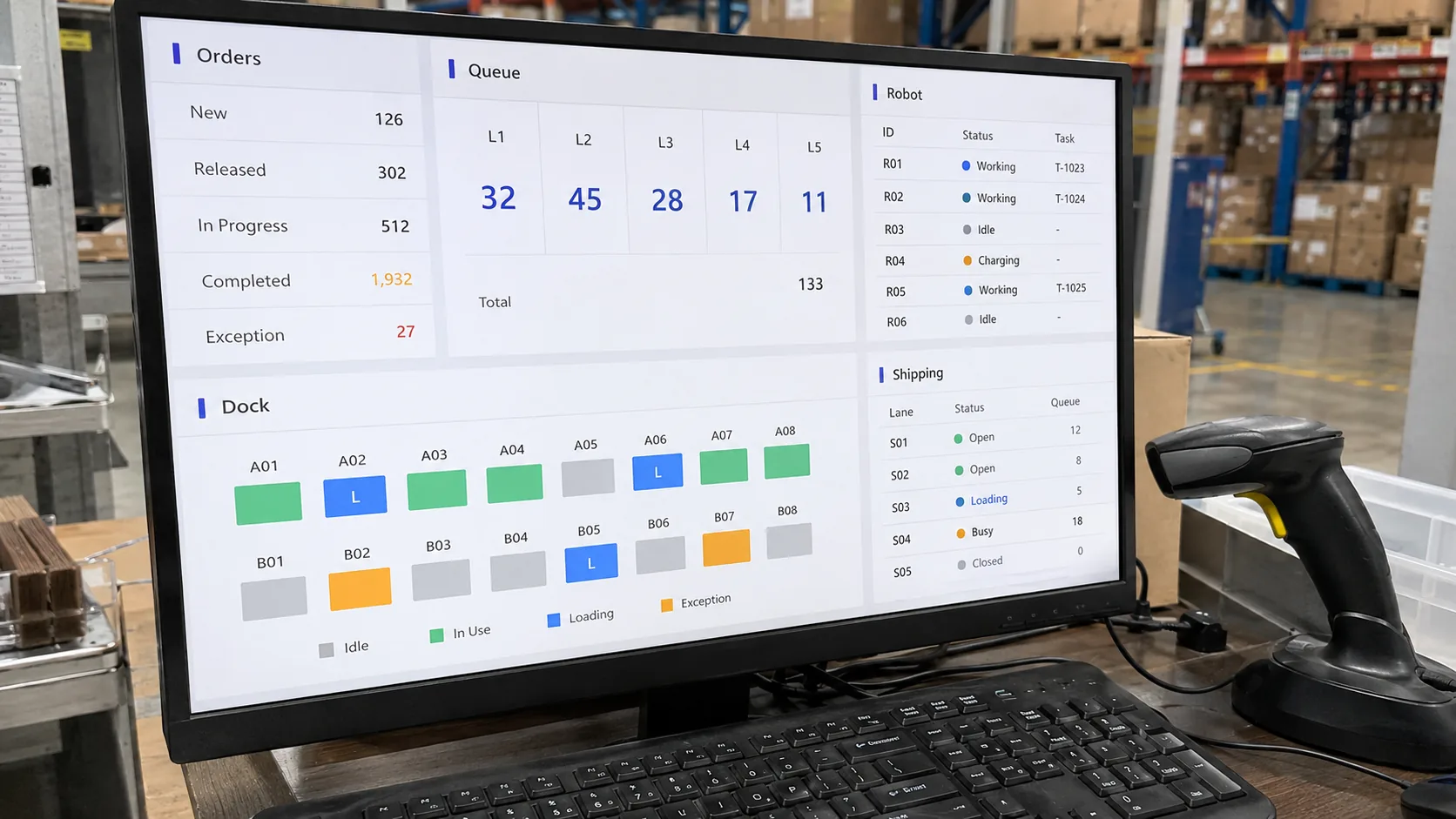
- Give supervisors live visibility into throughput, queue depth, and exception load.
Without WES, automation equipment may operate quickly inside each zone but still fail at system level. A shuttle system can retrieve totes quickly, but if packing is overloaded, the warehouse simply moves the bottleneck downstream. AMRs can move carts efficiently, but if tasks are released in the wrong order, travel becomes chaotic. Conveyors can move cartons fast, but if sortation is not aligned with carrier cutoff, speed does not translate into better service.
For more background on software layers, read our guide to WES vs WMS vs WCS.
How WES Prevents Backlogs Before They Become Delays
The most important peak-season function of WES is not emergency response. It is backlog prevention.
In a manual planning model, supervisors often react after work has already piled up. By the time the packing area is full or a picking zone is blocked, recovery requires overtime, expediting, or manual intervention.
WES changes this by monitoring the flow of work continuously:
| Peak-season risk | Manual response | WES-enabled response |
|---|---|---|
| Fast SKU surge | Supervisor notices after pick queue grows | WES increases replenishment priority and releases grouped work |
| Packing bottleneck | Orders wait at packing queue | WES slows upstream release and redirects work to available stations |
| Dock cutoff pressure | Team manually expedites late orders | WES prioritizes carrier-specific work before cutoff |
| Robot fleet imbalance | Robots queue in one zone | WES redistributes tasks by zone, battery, and station load |
| Inventory exception | Picker reports issue manually | WES routes exception task and preserves the remaining order flow |
| Labor shortage | Add temporary labor | WES allocates limited workers to the highest-value tasks |
This is why peak-season automation should start with process orchestration, not only hardware purchase. If the execution layer is weak, additional equipment may increase local speed but not end-to-end throughput.
Where Automation Equipment Creates the Most Peak-Season Capacity
WES coordinates work, but the physical warehouse still needs enough handling capacity. The best peak-season automation projects combine orchestration software with equipment that removes repetitive, high-volume labor.
Common equipment layers include:
- ASRS for dense storage and fast retrieval.
- Shuttle systems for high-throughput tote or carton handling.
- Bin robots or goods-to-person systems for SKU-intensive ecommerce.
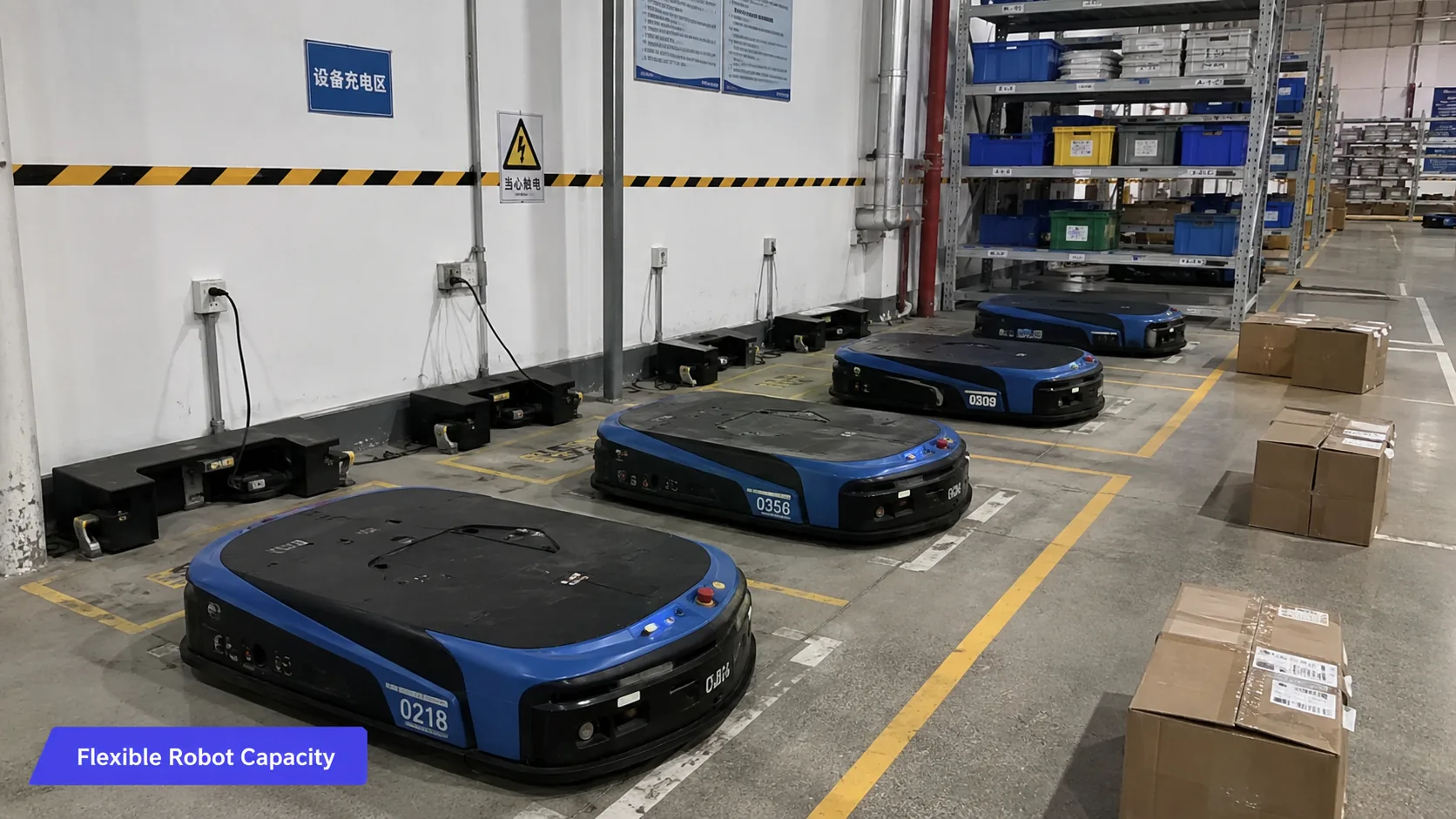
- AGV or AMR fleets for transport between storage, picking, packing, and staging zones.
- Automated scanning for fast identification and reduced manual keying.
- Conveyor and sortation systems for outbound flow.
- Pick-to-light or put-to-light stations for faster, more accurate station work.
The equipment selection depends on the bottleneck.
If the warehouse is running out of storage space, ASRS warehouse design matters more than adding labor. If pickers are walking too far, goods-to-person picking may produce the fastest productivity gain. If the issue is mixed transport between multiple zones, AMR or AGV deployment may help. If order release and station balancing are the constraint, WES may create value before a large hardware expansion.
The mistake is treating all peak-season problems as the same problem. A good automation plan starts by mapping the failure point:
| Bottleneck | Better automation lever |
|---|---|
| Storage density | ASRS, shuttle ASRS, bin robot storage |
| Long walking distance | Goods-to-person, AMR-assisted picking |
| Picking error rate | Scan verification, guided picking, WES exception handling |
| Replenishment lag | Dynamic replenishment rules, ASRS buffer, WES prioritization |
| Dock congestion | Sortation, staging logic, carrier cutoff prioritization |
| Labor volatility | Automated transport, robotic picking support, temporary robot capacity |
Temporary Robot Capacity Can Reduce Peak-Season Risk
Not every warehouse should buy permanent capacity for a temporary spike.
Some businesses operate with a stable base volume and a short promotional peak. Buying enough equipment for the highest week of the year may leave idle assets during normal months. That is why temporary robot rental or short-term automation capacity can be useful when the warehouse layout and systems are prepared for it.
Temporary robot capacity can help when:
- Peak volume is predictable and short.
- The workflow can absorb more mobile robots without redesign.
- Operators already know the process.
- Charging, traffic rules, and station layout are ready.
- WES can dispatch temporary capacity without manual workarounds.
It is less useful when the warehouse has no execution discipline, poor inventory accuracy, weak process data, or a layout that cannot support added movement. Renting robots does not fix a broken process. It only works when the system is ready to convert extra capacity into real throughput.
For buyers comparing automation models, our ASRS vs AMR guide explains where fixed automation and mobile robots fit.
Peak-Season Planning Should Start Months Before the Event
The biggest peak-season failures are usually not caused by the event itself. They are caused by decisions that were not made early enough.
A practical preparation timeline looks like this:
| Timing | What to prepare |
|---|---|
| 3-6 months before peak | Analyze order history, SKU velocity, labor limits, and facility bottlenecks |
| 2-3 months before peak | Validate WMS/WES rules, carrier cutoff logic, and equipment capacity |
| 1-2 months before peak | Test exception flows, temporary capacity, station staffing, and outbound staging |
| 2-4 weeks before peak | Run stress tests and simulate peak-hour order release |
| During peak | Monitor WES dashboards, queue depth, station utilization, robot availability, and cutoff risk |
| After peak | Review throughput, exceptions, delayed orders, labor hours, and automation ROI |
Waiting until the warehouse is already congested limits the available options. Emergency labor is expensive. Manual expediting distracts supervisors. Late equipment deployment creates training risk. Software rules changed during peak season can create unintended consequences.
The better approach is to build a peak-season operating model before demand arrives.
What to Measure During Peak Season
Peak-season warehouse automation should be measured by end-to-end flow, not only machine speed.
Useful metrics include:
- Orders released per hour.
- Lines picked per station hour.
- ASRS retrieval queue depth.
- Robot utilization and idle time.
- Replenishment delay.
- Packing station backlog.
- Carrier cutoff risk.
- Exception rate by zone.
- Mispick or rescan rate.
- Overtime hours.
- Same-day shipping completion rate.
- Queue depth before and after each automation zone.
Machine-level throughput can be misleading. A robot may be busy all day while the overall warehouse still misses shipping targets. A WES dashboard should show whether automation capacity is creating business value: fewer backlogs, better service levels, lower labor stress, and more stable outbound execution.
When Peak-Season Automation Makes Financial Sense
Peak-season automation is justified when the cost of congestion is larger than the cost of prevention.
Congestion cost can include:
- Overtime and temporary labor.
- Missed carrier cutoffs.
- Late shipments.
- Customer service tickets.
- Order cancellation.
- Return processing errors.
- Warehouse safety incidents.
- Lost marketplace ranking or account performance.
- Higher management workload.
The business case should compare automation cost against the fully loaded cost of peak-season failure. For broader financial modeling, see our warehouse automation ROI guide and ASRS total cost of ownership guide.
In many projects, the first automation phase does not need to automate the entire warehouse. It may be enough to automate the highest-volume storage zone, introduce WES dispatching, or add mobile transport between picking and packing. The goal is to remove the constraint that breaks the peak-season flow.
Practical Buyer Checklist
Before investing in peak season warehouse automation, ask these questions:
1. Which process fails first when order volume spikes? 2. Is the primary constraint storage, picking, replenishment, transport, packing, or outbound staging? 3. Does the WMS have accurate inventory and order priority data? 4. Can a WES release work based on real-time capacity? 5. Which zones need fixed automation, and which zones need flexible mobile transport? 6. Can temporary robot capacity be added without redesigning the layout? 7. What happens if a robot fleet, conveyor, station, or ASRS aisle goes down? 8. Which metrics will supervisors monitor during the event? 9. What carrier cutoff logic must be protected? 10. What manual fallback process exists if one zone becomes overloaded?
The answer should not be "buy more equipment." It should be a specific operating plan that connects software, equipment, labor, and service-level goals.
Frequently Asked Questions
What is peak season warehouse automation?
Peak season warehouse automation is the use of WES software, ASRS, robots, conveyors, scanners, and automated workstations to maintain throughput during high-volume demand periods such as Black Friday, Singles' Day, 618, or major retail promotions.
Why do warehouses become congested during peak season?
Warehouses become congested when order release, inventory movement, picking, replenishment, packing, and outbound staging are not balanced. The root problem is often poor orchestration rather than a simple lack of labor.
How does WES help during peak season?
WES helps by dynamically releasing work, prioritizing urgent orders, balancing station workload, dispatching robots or automation tasks, and giving supervisors real-time visibility into bottlenecks before they cause delays.
Should I buy robots or rent robots for peak season?
Buying robots makes sense when higher volume is permanent. Renting or temporary robot capacity makes sense when the peak is predictable, short, and the warehouse already has the layout, charging, traffic rules, and WES integration needed to use the extra capacity effectively.
Is ASRS useful for peak season ecommerce fulfillment?
Yes. ASRS can reduce walking, increase storage density, improve inventory control, and feed goods-to-person picking stations more consistently. It is especially useful when SKU count is high and storage or picking speed becomes the peak-season constraint.
How early should a warehouse prepare for peak season automation?
Most warehouses should start planning at least three to six months before a major demand event. The team needs time to analyze bottlenecks, configure WES rules, test equipment, train operators, and simulate peak-hour order release.
Bottom Line
Peak season warehouse automation is not a last-minute rescue plan. It is a way to build a warehouse that can absorb demand spikes without losing control of order flow.
The strongest projects combine WES-based orchestration, the right automation equipment, clear exception handling, and flexible capacity planning. When orders surge, the warehouse should not depend on supervisor heroics. It should have a system that sees the backlog forming, controls the release of work, and keeps people, robots, inventory, and outbound shipping moving in the same rhythm.
If your warehouse is preparing for a major sales event, contact GoASRS. We can help identify the real bottleneck, evaluate whether ASRS, AMR, WES, or temporary robot capacity fits your operation, and design a peak-season automation plan that protects service levels.
Source Note
This article was inspired by HengYan Technology's Chinese-language article on 618 logistics peak-season preparation and has been rewritten as original English guidance for international warehouse automation buyers.
Planning a Warehouse Automation Project?
Our team has delivered 50+ ASRS systems across retail, manufacturing, and logistics. Tell us about your project and we will get back to you within 24 hours.
Thank you!
We received your message and will get back to you within 24 hours.