
Carl Zeiss — Precision Logistics Automation
About Carl Zeiss
Carl Zeiss is a global leader in optics and optoelectronics, with operations spanning semiconductor manufacturing equipment, industrial quality inspection, medical technology, and consumer optical products. Their manufacturing facilities handle a wide range of high-value, precision materials that demand exacting standards in storage, handling, and distribution. As production complexity grew and product lines diversified, the existing manual logistics processes became a bottleneck — unable to meet the precision, speed, and traceability requirements of modern optical manufacturing.
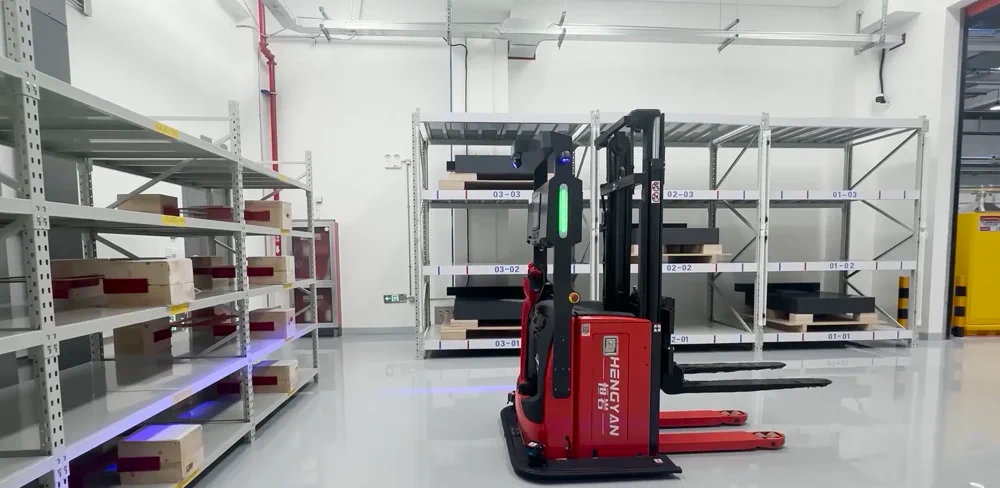
Carl Zeiss precision logistics automation powered by HengYan
Challenges
- Traditional stacking storage for marble and precision materials resulted in poor FIFO (first-in-first-out) capability and material degradation risk
- Low space utilization — existing warehouse layout could not accommodate growing SKU diversity
- Manual multi-point distribution was slow and error-prone, creating production line supply delays
- No automated delivery solution for low-volume, high-variety material requests — a challenge also faced by Konica Minolta in their precision manufacturing operations
- Information silos between production lines and warehouse systems prevented real-time visibility
- Heavy reliance on manual labor with high training costs and inconsistent handling quality
- High-precision material docking requirements that manual processes could not reliably meet
Solution
- Linde L20 Unmanned Forklifts: Automated pallet-level material handling and storage operations, replacing manual forklift drivers with precision-guided autonomous vehicles for heavy-load transport
- SLAM-Guided AGVs with Smart Cabinets: Point-to-multipoint intelligent distribution system using SLAM navigation technology, paired with intelligent cabinets for secure, traceable material delivery across multiple production lines
- Custom Buffer Lines with Vision Detection: Purpose-built buffer lines and rack systems equipped with vision sensors that automatically trigger material handling tasks — enabling fool-proof interaction and eliminating manual dispatch
- WES Integration: Full integration between warehouse management and production line systems, breaking down information silos and enabling real-time material tracking from storage to production
- Full Traceability System: End-to-end material tracking with digital records at every touchpoint, ensuring complete audit trails for quality-critical optical and semiconductor components
Results
- High-Precision Unmanned Operations: Automated material handling achieved the exacting docking accuracy required for optical and semiconductor components, eliminating human error in critical processes
- Efficient Storage & Turnover: Optimized warehouse layout and automated retrieval dramatically improved space utilization and material turnover rates
- Intelligent Multi-Point Distribution: SLAM-guided AGVs with smart cabinets enabled efficient one-to-many material delivery, reducing distribution time and labor requirements
- Production-Warehouse Data Integration: Real-time data flow between warehouse and production systems eliminated information silos, enabling proactive material replenishment
- Cost Reduction & Safety Improvement: Reduced manual labor dependency, lowered training costs, and improved workplace safety by removing workers from heavy material handling tasks
In the semiconductor and electronics sector, SICC achieved similar production-warehouse integration gains, while Sony deployed 49 robots to automate their camera lens material warehouse. Explore more warehouse automation insights on our blog.
Optical instruments are among the most demanding products to move. Carl Zeiss’s AGV deployment was designed around that single constraint.
The Handling Tolerance for Precision Optics
A lens assembly for a semiconductor lithography system or a medical imaging device is ground to tolerances measured in fractions of a wavelength of light. A shock event during transport that would be imperceptible to a human — a bump equivalent to dropping a tote from a height of two centimeters — can shift optical alignment enough to require complete recalibration. Recalibration costs hours of skilled technician time on equipment worth more than most cars.
Carl Zeiss’s previous material handling relied on trained operators pushing specialized carts along designated paths. The system worked, but it scaled poorly. Each operator handled one cart at a time, paths crossed in corridors creating congestion, and the human element introduced variability — a cart pushed too fast over a floor joint, a sudden stop to avoid a colleague, a momentary lapse during a long shift.
The AGV system replaces that variability with programmed consistency. Every movement follows a speed profile calculated for the specific payload’s sensitivity. Acceleration, deceleration, and cornering forces stay within limits that the optical engineering team validated through vibration testing. The WES assigns transport profiles by product classification — a finished lens assembly moves under stricter constraints than a housing component that has not yet received its optical elements.
Why AGV Instead of Conveyor or Tote Robots
The technology selection for Carl Zeiss was driven by three factors that ruled out alternatives.
First, payload weight and size. Optical subassemblies range from compact lens modules to large-frame systems that exceed standard tote robot capacity. AGVs handle the full range without multiple transport systems.
Second, floor flexibility. Carl Zeiss’s layout changes as product lines evolve. Conveyors are fixed infrastructure — rerouting means weeks of mechanical work. AGVs follow software-defined paths that update in hours. The hardware platform uses natural-feature navigation with no floor-embedded guides or tape.
Third, vibration isolation. Conveyors transmit vibration through motors, belt joints, and transfer points. AGVs carry payloads on pneumatic suspension that isolates cargo from wheel-to-floor vibration. For optical products, this isolation is a hard requirement that disqualifies fixed conveyor transport.
Measuring Success Beyond Efficiency Metrics
Most automation case studies lead with throughput gains and labor reduction. Carl Zeiss measures success differently. The primary KPI is handling-induced quality incidents — products that require recalibration, rework, or scrapping due to transport damage.
In our experience, this metric is harder to track than throughput because damage often manifests downstream. A lens assembly bumped during transport may pass visual inspection but fail alignment verification days later. The AGV system’s movement logs provide forensic data that connects downstream quality events to specific transport cycles, enabling root-cause analysis that was impossible with manual handling.
The efficiency gains exist — fewer transport operators, faster cycle times, reduced corridor congestion — but they are secondary to the quality improvement that justified the investment.
The SICC case shows a comparable precision-handling deployment for semiconductor wafers. The Sony case demonstrates high-value electronics handling at larger robot fleet scale. Our solutions page covers how we structure projects where product protection drives the automation design.
Frequently Asked Questions
How does the AGV system handle the transition between cleanroom and standard manufacturing zones?
AGVs pass through transition zones where wheel cleaning stations remove particles before entering controlled areas. The WES tracks each AGV’s zone history and enforces cleaning protocols — a vehicle that has been in a standard zone cannot enter a cleanroom zone without completing the decontamination sequence. The ASRS overview page covers how automated systems integrate with controlled-environment requirements.
What is the typical ROI timeline for AGV deployment in precision manufacturing?
For high-value products like optical instruments, payback periods are shorter than in general manufacturing because the quality-incident reduction contributes significantly to ROI alongside labor savings. Carl Zeiss’s deployment reached payback faster than the initial projection primarily due to the reduction in recalibration events. The cost analysis page models both efficiency and quality components of the ROI calculation.
Can AGVs operate alongside human workers in shared corridors without safety barriers?
Yes — the AGVs use multi-layer safety systems including LiDAR scanning, proximity sensors, and emergency stop mechanisms. When a person enters the AGV’s path, the vehicle slows or stops based on distance and closing speed. Carl Zeiss’s facility runs AGVs and pedestrian traffic in shared corridors during all shifts without physical barriers. Safety incident count since deployment: zero. Contact us for a facility walkthrough to assess corridor sharing feasibility in your layout.