
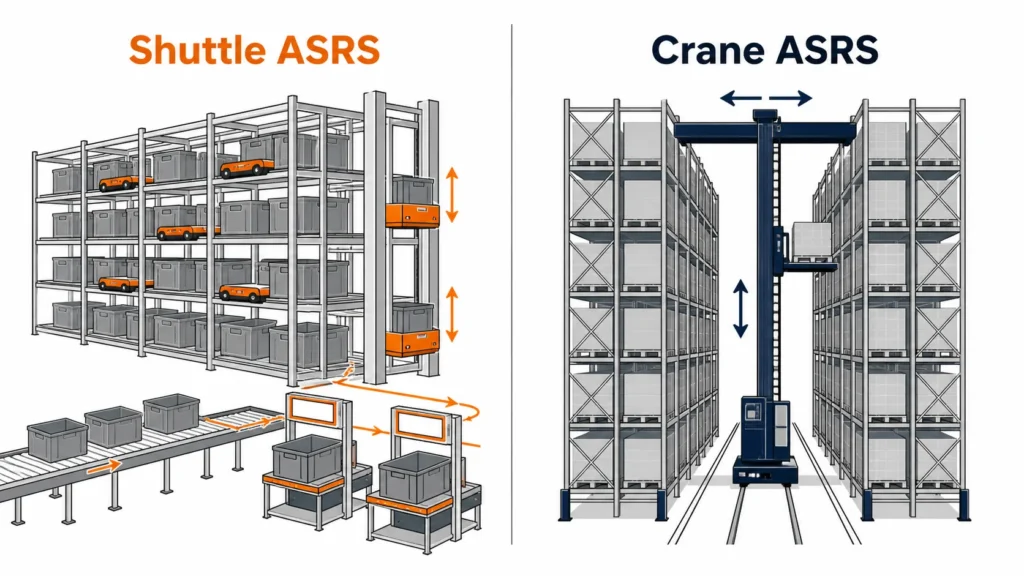
Choosing between a shuttle ASRS and a crane-based ASRS is usually not a question of which technology is "better." It is a question of what your warehouse needs to do every hour, every shift, and every peak season.
Short answer: Shuttle ASRS is usually the better fit when your operation needs high throughput, fast order response, and flexible scaling by adding more shuttles. Crane-based ASRS is usually the better fit when your operation needs very high vertical storage density, stable pallet or tote movement, and predictable throughput in a high-bay warehouse.
Both systems can be excellent. Both can also be expensive mistakes when they are matched to the wrong operating profile. A shuttle system can be overbuilt for a warehouse that mostly needs dense pallet reserve storage. A stacker crane ASRS can become a bottleneck in an e-commerce facility where thousands of small orders hit the system within a two-hour wave.
This guide compares shuttle ASRS vs crane ASRS from the buyer's side: throughput, density, SKU profile, cost, maintenance, software requirements, and practical selection rules.
What Is a Shuttle ASRS?
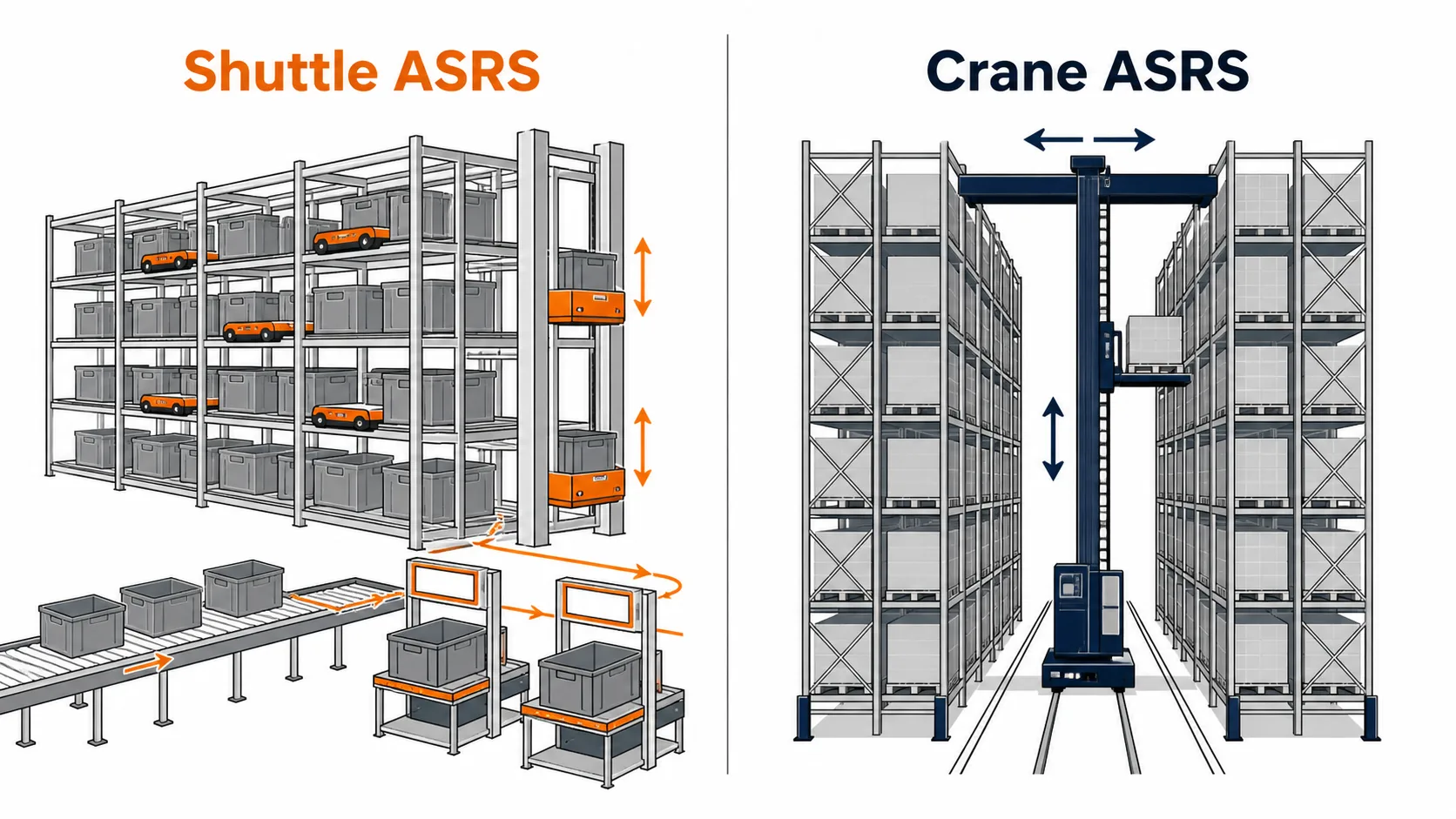
A shuttle ASRS uses autonomous carriers that run on rails inside the storage rack. In a tote or carton system, each shuttle usually moves containers along a storage level and hands them to a lift for vertical movement. In a pallet shuttle system, the shuttle moves pallets inside deep storage lanes while lifts, conveyors, or transfer vehicles connect levels and zones.
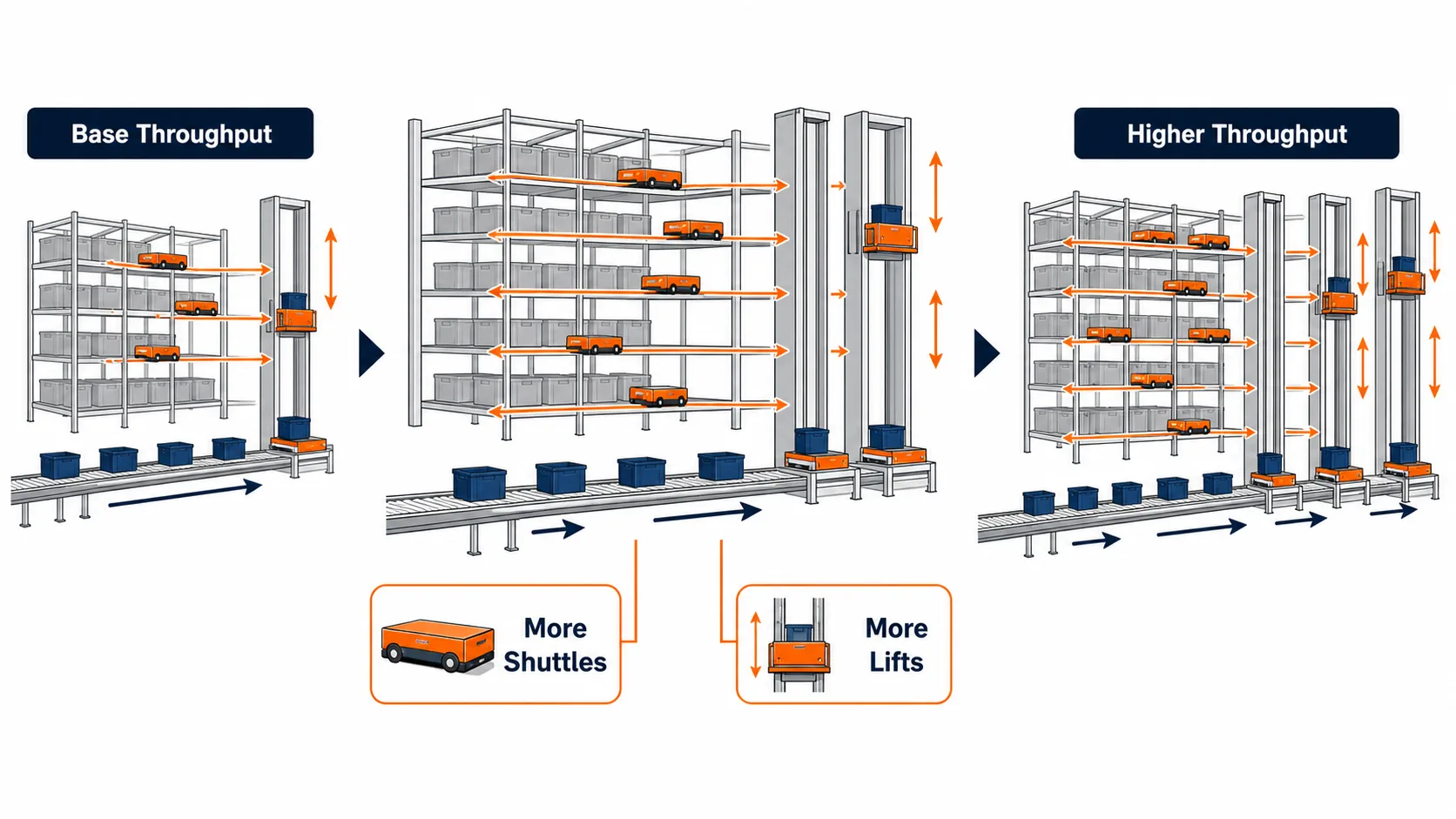
The core idea is parallel movement. Instead of one machine serving an entire aisle, a shuttle-based ASRS can run many shuttles at once. More shuttles means more simultaneous retrievals, faster response time, and a more flexible way to scale throughput.
A typical shuttle ASRS system includes:
- Storage rack structure with rails or channels for shuttle travel
- Shuttle vehicles for horizontal movement inside each level or lane
- Vertical lifts that move totes, cartons, or pallets between levels
- Conveyors or AMRs that connect the ASRS to picking, packing, or production
- WES software that assigns tasks, balances lifts, manages traffic, and prevents queue buildup
For tote and carton handling, shuttle systems can reach 200-1,000+ movements per hour per aisle depending on shuttle count, lift count, rack depth, and station design. That is why shuttle ASRS is common in e-commerce, apparel, pharmaceuticals, electronics, spare parts, and omnichannel fulfillment.
For pallet handling, shuttle systems are often used in high-volume lanes. A pallet shuttle ASRS can push 50-120+ pallets per hour per aisle when the storage profile supports deep-lane movement and the upstream/downstream flow is designed correctly.
The important point: shuttle ASRS throughput is not only a hardware number. It depends heavily on orchestration. If too many shuttles compete for the same lift, or if picking stations cannot absorb the flow, the system will not reach its modeled capacity. This is why shuttle projects need a strong Warehouse Execution System from day one.
What Is a Crane-Based ASRS?
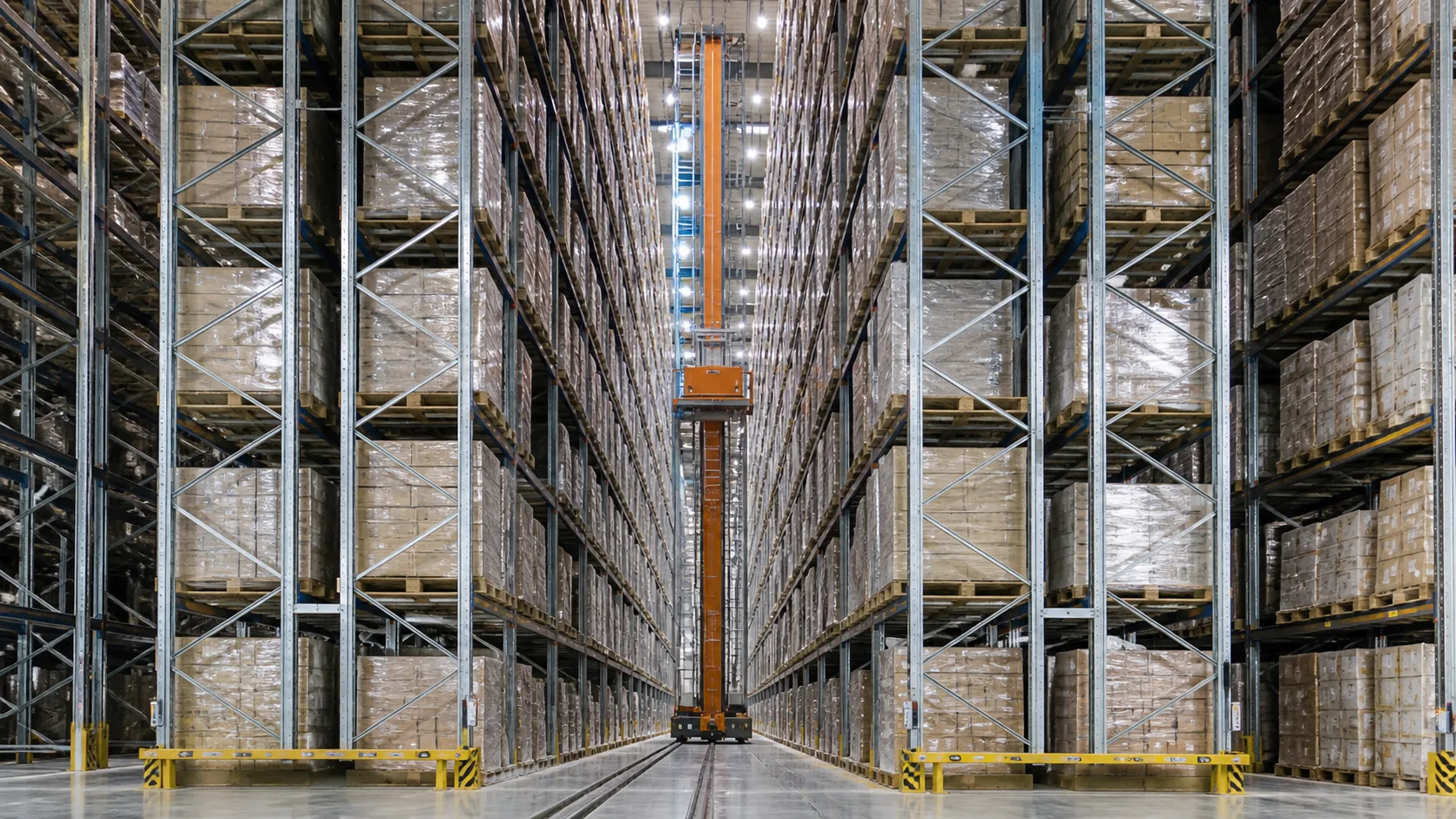
A crane-based ASRS, also called a stacker crane ASRS or ASRS crane system, uses one crane per aisle to store and retrieve loads from racking on both sides of the aisle. The crane travels horizontally along the aisle and vertically along the mast, then uses forks, a load handling device, or a satellite carrier to place or retrieve the pallet, tote, or container.
Crane-based systems are the classic form of automated storage and retrieval. They are common in high-bay pallet warehouses, manufacturing buffer storage, cold storage, finished goods storage, and operations where storage density matters more than extreme order response speed.
A typical crane ASRS includes:
- High-bay racking often 15-45 meters tall
- Stacker crane running on floor and top guide rails
- Load handling device for pallets, totes, trays, or cartons
- Input/output conveyors for handoff to production, picking, or shipping
- WCS and WES layers for machine control and task sequencing
For pallet systems, stacker cranes commonly handle 20-40 pallet movements per hour per aisle. For mini-load tote systems, the number can be higher, but it still follows the same basic limit: one crane serves one aisle, so the crane's travel path becomes the governing factor.
That limitation is not always a problem. If your warehouse needs to store 40,000 pallets in a compact footprint and retrieve them at a steady pace, a crane-based system may be the cleanest answer. It uses building height extremely well, creates predictable movement, and can run for many years with stable maintenance routines.
Shuttle ASRS vs Crane ASRS: Side-by-Side Comparison
| Factor | Shuttle ASRS | Crane-Based ASRS |
|---|---|---|
| Best fit | High-throughput order fulfillment, frequent small order changes, fast response | High-density storage, predictable pallet or tote flow, high-bay buildings |
| Movement model | Many shuttles work in parallel | One crane works per aisle |
| Typical tote/carton throughput | 200-1,000+ movements/hour/aisle | Lower to moderate, based on crane travel cycle |
| Typical pallet throughput | 50-120+ pallets/hour/aisle in suitable designs | 20-40 pallets/hour/aisle |
| Storage density | High, especially in deep-lane formats | Very high vertically, especially 30-45m high-bay |
| Scaling method | Add shuttles, lifts, stations, or aisles | Add aisles or cranes |
| SKU profile | Many SKUs with uneven demand, or fewer SKUs with high lane velocity | Many SKUs with steady storage/retrieval demand |
| Peak handling | Strong when software can rebalance work dynamically | Predictable but less elastic |
| Maintenance pattern | More vehicles, more distributed maintenance | Fewer moving machines, higher dependence on each crane |
| Software dependency | Very high | Medium to high |
| CAPEX profile | Higher when many shuttles and lifts are required | Higher in building/racking/crane infrastructure |
| Retrofit difficulty | Medium to high | High, especially for true high-bay crane systems |
The simple reading is this: shuttle ASRS buys speed and elasticity; crane ASRS buys vertical density and mechanical simplicity. The right choice depends on where your warehouse is constrained.
If the constraint is order response time, shuttle is usually the stronger candidate. If the constraint is storage capacity per square meter, crane-based ASRS deserves serious consideration.
Throughput: Where Shuttle ASRS Usually Wins
Throughput is the first reason many buyers compare shuttle ASRS vs crane ASRS. A shuttle system can put many vehicles into the same storage area, so it can serve many storage and retrieval requests at the same time. A crane-based ASRS is more sequential. The crane must travel, lift, deposit or retrieve, and return to the next task.
For example, imagine an e-commerce warehouse that releases 6,000 order lines between 8:00 p.m. and 11:00 p.m. The system does not just need average daily throughput. It needs burst capacity. It needs to feed picking stations quickly, absorb late order changes, and keep downstream packing from waiting.
That is a shuttle profile.
Now imagine a manufacturer that moves finished pallets from production into storage and retrieves them steadily for outbound shipping. The hourly flow is predictable. SKU demand is stable. The facility has 32 meters of clear height. The business case depends on storing more pallets without leasing a second building.
That is a crane profile.
The biggest mistake is using daily volume as the only throughput input. Daily averages hide the real design problem. What matters is peak-hour demand, station takt time, order cutoff windows, and the number of concurrent tasks the automation must handle.
When we model shuttle systems, we look at:
- Peak order lines per hour
- Required container presentations per station
- Shuttle count per level or zone
- Lift utilization and lift queue depth
- Empty tote/carton return flow
- Downstream packing and sortation capacity
When we model crane systems, we look at:
- Single-cycle and dual-cycle time
- Aisle length and rack height
- Input/output station placement
- Pallet or tote weight
- Single-deep, double-deep, or satellite handling
- Required moves per aisle per hour
In many high-throughput applications, shuttle ASRS wins because adding shuttles adds parallel work. But parallel work only helps when the rest of the system is ready. A shuttle system with too few lifts or undersized picking stations will still bottleneck.
Storage Density: Where Crane ASRS Often Wins
Crane-based ASRS systems are strong when the main goal is dense storage in a tall building. A high-bay stacker crane system can use 30-45 meters of vertical space with narrow aisles. Conventional forklift racking cannot get close to that cube utilization.
This is why crane ASRS is common in:
- Cold storage
- Beverage and food manufacturing
- Chemical and industrial goods storage
- Finished goods buffers
- Large pallet reserve warehouses
- Manufacturing facilities where floor space is tied to production value
A crane system can also be a strong fit for pallet ASRS when SKU count is high and each SKU does not need extremely high hourly access. Single-deep or double-deep crane storage gives cleaner selectivity than very deep shuttle lanes.
Shuttle systems can also be dense, especially for totes, cartons, and deep-lane pallet storage. But many shuttle designs trade some vertical density for faster access. They need lifts, transfer points, service areas, and sometimes more horizontal movement space.
The practical question is not "which system is denser?" The practical question is: "Which system gives enough throughput at the storage density my site requires?"
For a cold storage site, a crane-based high-bay may produce the strongest ROI because every extra cubic meter of freezer space is expensive. For an apparel fulfillment center, a shuttle system may create more value because the operation loses money when order waves miss carrier cutoff.
SKU Profile: The Hidden Decision Driver
SKU profile is where many early designs go wrong.
A shuttle ASRS works well when demand is uneven and the system must react quickly. Fast-moving SKUs can be stored near lifts or high-priority zones. Slow movers can sit deeper in the structure. The WES can adjust task priority as demand shifts during the day.
This is common in apparel, cosmetics, consumer electronics, spare parts, and omnichannel distribution. The SKU count may be high, but the actual demand curve changes by season, promotion, channel, and cutoff time.
A crane-based ASRS works well when storage and retrieval patterns are more predictable. It can handle large SKU counts, especially when the goal is accurate, dense, automated storage rather than rapid wave-by-wave response. For pallets, crane ASRS is often the safer choice when the SKU mix is broad and each pallet position needs direct access.
Deep-lane shuttle storage is different. It is excellent when you have fewer SKUs with multiple pallets per SKU. It becomes less attractive when you store one or two pallets per SKU across thousands of SKUs, because deep lanes create access rules that can slow retrieval unless the slotting logic is very carefully designed.
Before choosing shuttle ASRS vs crane ASRS, build a SKU movement profile:
- How many active SKUs move each day?
- What percentage of volume comes from the top 5%, 10%, and 20% of SKUs?
- How often do SKU velocities change?
- How many order lines need split-case picking?
- How many pallets are stored per SKU on average?
- How often do you need FIFO, FEFO, lot tracking, or batch control?
This profile often decides the system before any vendor presentation does.
Cost and TCO: Where the Tradeoff Is Real
Both shuttle ASRS and crane ASRS require serious capital. The right comparison is not just initial price. It is total cost of ownership across 10-15 years: equipment, racking, building work, controls, software, maintenance, energy, spare parts, and operational risk.
In general:
- Shuttle ASRS cost rises with shuttle count, lift count, station count, and WES complexity.
- Crane ASRS cost rises with building height, aisle count, crane specifications, racking tolerance, and civil works.
For shuttle systems, the appeal is incremental scaling. You can start with fewer shuttles and add more as volume grows, if the rack, lifts, controls, and software were designed for that expansion. This can protect cash flow when future volume is likely but not certain.
For crane systems, the major capacity decisions are more fixed. If you need more throughput later, you may need another aisle, another crane, or a larger structural change. That does not make crane ASRS worse. It means the design assumptions need to be more stable.
From GoASRS project planning, software and integration typically account for a meaningful share of project budget. It is common for WES/WCS integration, simulation, testing, and go-live support to represent 8-15% of total automation cost. Cutting that scope is one of the easiest ways to create an expensive underperforming system.
If you are building the financial model, connect this article with our full ASRS system cost guide and warehouse automation ROI guide. The headline equipment quote is not the business case. The business case is throughput, labor savings, space savings, accuracy, energy, uptime, and how quickly the system reaches stable operation after go-live.
Scalability: Add Shuttles or Add Aisles?
Scalability sounds simple until you ask what needs to scale.
If storage capacity needs to scale, a crane-based ASRS may be cleaner. Add a high-bay aisle in the master plan, and you add a large block of positions with predictable crane capacity.
If throughput needs to scale, shuttle ASRS may be cleaner. Add more shuttles, add lift capacity, expand stations, and tune the WES logic. The expansion can be more gradual, but only if the original layout planned for it.
The mistake is buying a shuttle system for "future flexibility" without reserving physical and software capacity for that future. If lift shafts are saturated on day one, adding shuttles later will not fix throughput. If the WES cannot rebalance tasks across zones, adding vehicles may create more congestion.
For crane ASRS, the mistake is assuming stable throughput forever. If your business shifts from wholesale pallet shipping to direct-to-consumer order fulfillment, a crane system designed for pallet reserve storage may struggle to feed piece-picking fast enough.
Good integrator work starts before vendor selection. At GoASRS, we usually test several scenarios:
- Base year volume
- Peak season volume
- Three-year growth case
- Equipment fault case
- Labor shortage case
- Channel mix change case
That modeling is more useful than a generic shuttle vs crane debate.
Maintenance and Uptime
Maintenance risk looks different in each system.
A crane-based ASRS has fewer major moving machines, but each crane is critical. If one aisle has one crane and that crane is down, that aisle is down unless the design has redundancy or cross-aisle recovery options. The upside is that crane maintenance is well understood. Parts, inspection routines, rail alignment, mast checks, and drive maintenance can be planned on a stable schedule.
A shuttle ASRS has more moving vehicles. A single shuttle failure may not stop the whole system because other shuttles can continue working. That distributed design can improve operational resilience. But the maintenance program must handle more batteries, wheels, sensors, controllers, chargers, and vehicle swaps.
The deciding question is not which system "has less maintenance." It is which maintenance pattern your team can support.
Ask these questions during selection:
- What happens when one crane fails?
- What happens when one shuttle fails inside a storage level?
- Can maintenance remove a failed vehicle without stopping the full system?
- What spare parts must be held on site?
- How long is mean time to repair for the most common faults?
- Does the WES reroute tasks automatically during equipment downtime?
- Are technicians available locally, or only through the equipment vendor?
For mission-critical operations, software behavior during faults matters as much as mechanical reliability. A WES should detect equipment status, reassign work, protect priority orders, and keep unaffected zones productive.
Software: Shuttle Systems Need Stronger Orchestration
Both systems need control software. Shuttle systems usually need more dynamic orchestration.
A crane ASRS has a relatively simple task model: assign a storage or retrieval job to the crane in an aisle, sequence tasks for travel efficiency, and coordinate input/output conveyors. That can still be complex, especially in large facilities, but the movement logic is more contained.
A shuttle ASRS has more shared resources:
- Multiple shuttles competing for lifts
- Lifts serving multiple levels
- Containers moving through buffer positions
- Picking stations requiring steady feed
- Empty containers returning into the system
- Charging or battery swap cycles
- Traffic rules between storage zones
Without strong WES logic, a shuttle system can look busy while producing poor output. Vehicles move, lifts queue, stations wait, and the operation blames the hardware.
This is where GoASRS's integrator role matters. We do not treat hardware selection and software design as separate decisions. The WES must match the physical layout, the WCS interfaces, the order profile, and the downstream process. The goal is not to make a shuttle or crane move. The goal is to make the full warehouse hit its SLA.
The MHI overview of automated storage describes ASRS as computer-controlled storage and retrieval equipment. In current warehouse projects, that "computer-controlled" layer is where many outcomes are won or lost.
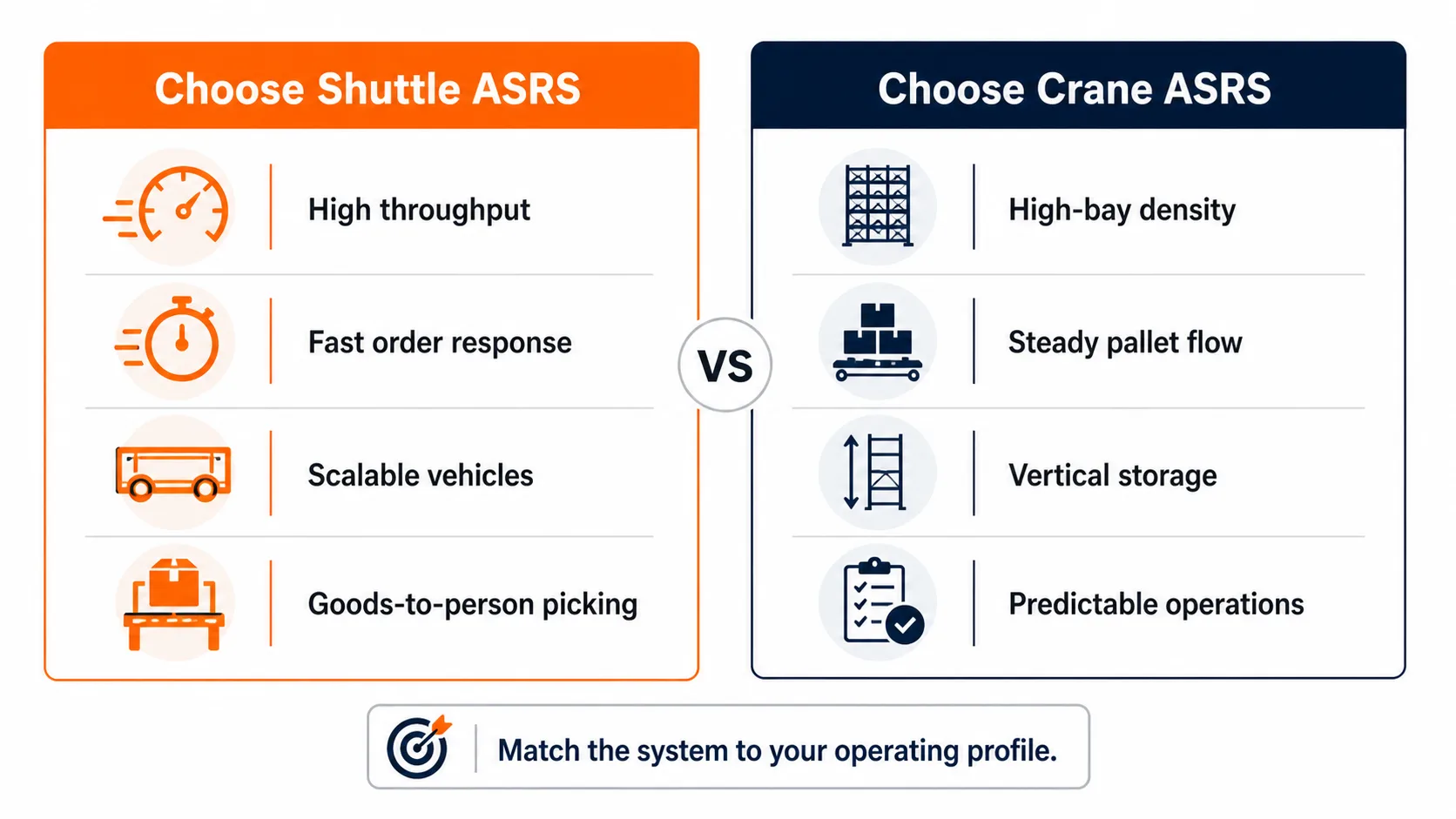
Decision Framework: Which System Fits Your Warehouse?
Use this as a first-pass selection guide.
Choose Shuttle ASRS If:
- You need high order-line throughput
- You run e-commerce, omnichannel, apparel, spare parts, or high-mix fulfillment
- Peak-hour demand is much higher than daily average demand
- You need to scale throughput gradually by adding vehicles or stations
- Your operation has frequent priority changes
- You need fast goods-to-person presentation
- You are comfortable investing in strong WES orchestration
Shuttle ASRS is often the right answer for goods-to-person picking and mini-load ASRS when the goal is fast tote or carton presentation to workstations.
Choose Crane-Based ASRS If:
- You need maximum vertical storage density
- Your warehouse has or can build 15-45m clear height
- Your throughput profile is steady and predictable
- You store pallets, heavy unit loads, or stable tote flows
- Your SKU profile needs high selectivity rather than deep high-velocity lanes
- You want fewer major moving machines
- Your ROI depends heavily on floor space savings
Crane-based ASRS is often the right answer for pallet reserve storage, cold storage, production buffers, and high-bay finished goods warehouses.
Consider a Hybrid System If:
- You need dense pallet reserve plus fast case or tote picking
- Production, storage, picking, and shipping have different automation needs
- One system cannot meet both density and throughput requirements
- You plan to automate in phases
- You need to integrate cranes, shuttles, conveyors, AMRs, and manual stations
Many real warehouses are hybrid. A crane-based pallet ASRS stores reserve inventory. A shuttle ASRS feeds high-speed picking. AMRs move work between zones. Conveyors handle sortation. The hard part is not buying the machines. The hard part is making them behave like one operation.
That is why we position GoASRS as a logistics integrator, not just an equipment supplier. We design the solution architecture, select the right storage technology, integrate the WES/WCS layers, and test the full system before go-live.
Example Scenarios
Scenario 1: Apparel E-Commerce Fulfillment
The warehouse has 80,000 SKUs, volatile demand, many small orders, and strict carrier cutoffs. Peak hour is 4x average hour. Most work is tote-based goods-to-person picking.
Likely fit: Shuttle ASRS.
Why: The operation needs fast container presentation and dynamic task priority. The system must react when order waves change. Crane-based storage could be dense, but it would likely struggle to feed enough concurrent picking work unless many aisles were added.
Scenario 2: Frozen Food Pallet Storage
The warehouse stores 22,000 pallets at -25°C. SKU count is moderate. Pallet movement is predictable. The site has expensive energy and limited land.
Likely fit: Crane-based pallet ASRS.
Why: The business case is density, energy reduction, and reduced human work in freezer zones. High-bay crane storage can use vertical space efficiently and run steady pallet movement with lower aisle count.
Scenario 3: Beverage Distribution With High Lane Velocity
The warehouse has fewer SKUs, many pallets per SKU, and high outbound pallet flow. The same SKUs move repeatedly every shift.
Likely fit: Pallet shuttle ASRS or hybrid shuttle/crane design.
Why: Deep-lane shuttle storage can work well when each SKU has enough pallet volume to justify lane depth. If the building is very tall and flow is steadier, a crane-plus-satellite design may also work.
Scenario 4: Electronics Manufacturing Buffer
The factory needs accurate storage between production and shipping. SKU count is high, lot control matters, and movement is steady. Space near production is expensive.
Likely fit: Crane-based ASRS or mini-load crane system, depending on load unit.
Why: Selectivity, traceability, and footprint matter more than burst order fulfillment. If downstream kitting or line-side delivery becomes more dynamic, a shuttle zone can be added later.
What We See in Real Projects
In GoASRS projects, the right choice often becomes clear only after we map the full material flow, not just the storage area.
For retail distribution projects like Decathlon's ASRS deployment, the storage system has to support store replenishment, online orders, seasonal demand changes, and fast SKU rotation. In that kind of environment, the design discussion usually moves beyond "one crane or many shuttles" and into workstation feed rate, replenishment timing, tote sequencing, and downstream sortation.
For manufacturing and electronics projects like Sony Semiconductor's ASRS case, traceability, stable material buffers, and accurate inventory control can matter more than extreme retrieval speed. A crane-based or mini-load design may be a better fit when each movement must support production reliability and quality control.
The lesson is practical: shuttle ASRS vs crane ASRS is not a product category decision. It is an operating model decision. The same warehouse can need a crane-based reserve system, a shuttle-based picking buffer, AMRs for transport, and conveyors for sortation. The value comes from matching each process to the right automation layer and then connecting those layers with software.
Common Mistakes When Comparing Shuttle ASRS vs Crane ASRS
Mistake 1: Comparing vendor brochure throughput. Published throughput numbers usually assume clean task mixes, ideal station behavior, and no downstream congestion. Real designs need simulation with your order profile.
Mistake 2: Ignoring lifts in shuttle systems. Shuttles may be fast, but lifts are often the choke point. If lift utilization is too high, more shuttles will not solve the problem.
Mistake 3: Treating cranes as old technology. Stacker crane ASRS is mature, but mature does not mean outdated. For high-bay density and steady movement, it remains one of the strongest designs.
Mistake 4: Using one system for every process. Storage, picking, buffering, replenishment, and shipping may need different automation. A hybrid design can outperform a single-technology design.
Mistake 5: Underfunding integration. A shuttle or crane system is only as good as the software and process design around it. Weak WES/WCS integration creates slow handoffs, manual overrides, and poor visibility.
Final Recommendation
If you are still early in the project, do not start by asking vendors whether shuttle ASRS or crane ASRS is better. Start by building a data model of your operation:
- Peak-hour order lines
- Required storage positions
- SKU velocity curve
- Pallet, tote, or carton profile
- Building height and footprint limits
- Labor cost and availability
- Growth plan for the next three to five years
- Downstream picking, packing, sorting, and shipping constraints
Then test system options against those numbers.
As a rule of thumb, shuttle ASRS is stronger when throughput and responsiveness drive the ROI. Crane-based ASRS is stronger when vertical density, stable flow, and high-bay storage drive the ROI. Hybrid systems are common when a facility needs both.
If you want a neutral design review, GoASRS can compare shuttle ASRS, crane ASRS, AMR-based storage, and hybrid layouts against your actual SKU and order data. Start with our ASRS solution team and bring your peak-hour data. That is the fastest way to move from technology debate to a working design.
FAQ: Shuttle ASRS vs Crane ASRS
Is shuttle ASRS better than crane ASRS?
Shuttle ASRS is better for high-throughput, fast-response fulfillment. Crane ASRS is better for high-bay density and predictable storage/retrieval flow. The better choice depends on throughput, SKU profile, building height, and growth plan.
Which system has higher throughput?
Shuttle ASRS usually has higher throughput because many shuttles can work in parallel. Tote and carton shuttle systems can reach 200-1,000+ movements per hour per aisle in suitable designs. Pallet shuttle systems can reach 50-120+ pallets per hour per aisle. Crane-based pallet ASRS commonly handles 20-40 pallets per hour per aisle.
Which system has better storage density?
Crane-based ASRS often has better vertical density, especially in 30-45m high-bay warehouses. Shuttle ASRS can also be very dense, especially for totes or deep-lane pallet storage, but it may need more lifts, transfer areas, and service space.
Is shuttle ASRS more expensive than crane ASRS?
It depends on shuttle count, lift count, station design, rack structure, and integration scope. Shuttle ASRS often has higher vehicle and software complexity. Crane ASRS often has higher building, racking, and crane infrastructure cost. The right comparison is total cost of ownership, not equipment price alone.
Can shuttle ASRS and crane ASRS work together?
Yes. Hybrid designs are common. A crane-based pallet ASRS can store reserve inventory while a shuttle ASRS feeds fast goods-to-person picking. A WES coordinates the two systems so replenishment, picking, and outbound flow stay synchronized.
Which system is better for cold storage?
Crane-based pallet ASRS is often strong in cold storage because it uses vertical space very efficiently and reduces human work in freezer areas. Shuttle systems can also work in cold storage when throughput or deep-lane pallet flow is the main requirement.
Do I need a WES for shuttle or crane ASRS?
For a single crane aisle with simple flow, WCS-level control may be enough. For multi-aisle, multi-zone, shuttle-based, or hybrid automation, a WES is strongly recommended. It coordinates orders, equipment, stations, and exceptions across the full warehouse.
Planning a Warehouse Automation Project?
Our team has delivered 50+ ASRS systems across retail, manufacturing, and logistics. Tell us about your project and we will get back to you within 24 hours.
Thank you!
We received your message and will get back to you within 24 hours.