
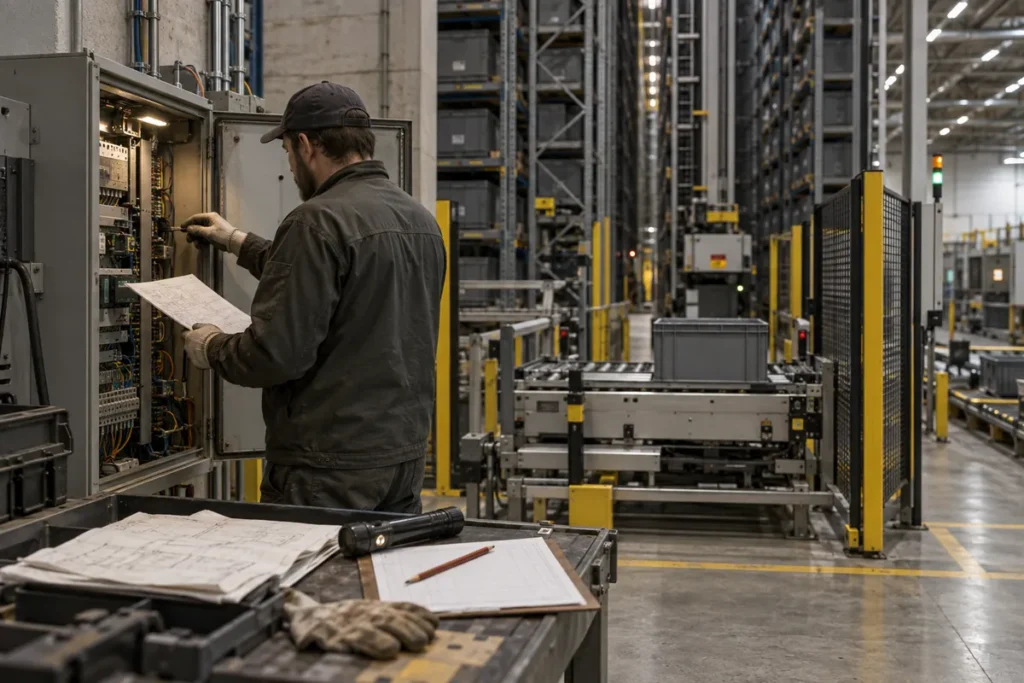
When a warehouse has too much slow-moving stock in the wrong locations, too little usable cube, a sharp outbound peak, and too many manual touches, automation can look like the clean answer. The contradiction appears after go-live: the operation now depends on more connected layers, yet a small fault in one layer can interrupt a larger promise to customers. A robot may be ready even as an order interface is not. A storage location may be available even as inventory status is stale. A conveyor may be running even as the release logic is holding work back. ASRS system maintenance is the discipline of keeping those relationships understandable, serviceable, and accountable after the launch project ends.
This guide is for operations leaders, engineering teams, IT owners, and procurement managers buying or reviewing an automated storage and retrieval system. It explains what to ask for in an ASRS system lifecycle service, how to separate a genuine service scope from a vague after-sales label, and how to judge whether a maintenance problem calls for repair, controlled change, or a larger redesign.
Short answer: what should happen after go-live?
An effective post-launch service contract should state its contract scope in writing. In this article, contract scope means the signed responsibilities and exclusions; RFQ questions are the items bidders answer before award; and the operating checklist is the post-go-live record used to execute and verify those responsibilities. The contract scope should answer six questions:
- Which layer is affected when a task fails?
- Who owns the first response and who owns the fix?
- What evidence is collected before a system is changed?
- How will software, interfaces, equipment, and operating rules be tested together?
- What does recovery mean: a workaround, partial operation, or full restoration?
- What evidence tells the buyer that repair is no longer the best answer?
The questions matter because an automated storage and retrieval system is not one machine. A warehouse automation system can include storage equipment, transfer equipment, controls, fleet or robot dispatch, inventory logic, order interfaces, workstations, networks, and operating procedures. The exact architecture differs by project. For that reason, the contract scope should describe the actual system boundary, rather than rely on a generic promise to “support the automation.”
The company profile available for this article presents HengYan as a warehouse robotics and systems integrator, with a combined software, hardware, and integration role rather than a device-manufacturing position. It lists WMS, WCS, and RCS software among its own capabilities. That positioning makes system-level questions especially relevant: a buyer should ask how responsibility is coordinated across the layers and equipment in the delivered design, not only how an individual robot is repaired.
What ASRS system maintenance really covers
The phrase “maintenance” often starts a conversation about motors, sensors, wheels, belts, lifts, or shuttle components. Those items matter, but they are only one part of continuity. A service review should map at least the following relationship:
Business demand → order and inventory data → execution rules → control commands → equipment movement → confirmation data.
If the chain breaks, the visible symptom may be misleading. A picking station that appears idle may be waiting for a valid inventory state. A robot that appears unavailable may be waiting for a blocked route or an unconfirmed handoff. A storage location that appears empty may be physically occupied but incorrectly represented in software. These examples are reasoning for a service design, not claims about a particular installation. They show why a maintenance scope that only lists spare parts leaves an operational gap.
The company profile describes a layered software structure in which WMS handles warehouse management, WCS coordinates warehouse equipment, RCS handles robot dispatch, and an equipment layer connects hardware. It states that the software can connect with customer ERP and MES systems. A buyer can use that structure as a starting point for a responsibility map, asking the supplier to confirm which components are actually present in the proposed solution.
A practical service boundary
Put every support item into one of seven ownership areas:
- Mechanical and electrical equipment: storage structures, conveyors, lifts, sensors, drives, charging points, and robot-side components that exist in the approved design.
- Control and dispatch: PLC logic, equipment controls, fleet or robot coordination, route rules, task states, and recovery procedures.
- Warehouse execution and inventory: release rules, location status, allocation logic, picking workflows, and exception handling.
- Business interfaces: ERP, MES, WMS, carrier, order, or master-data exchanges that feed or receive warehouse work.
- Site infrastructure: network, power, safety circuits, server or virtual-machine environment, access control, and environmental conditions.
- Operating practice: user permissions, manual recovery steps, training records, shift handovers, and escalation contacts.
- Change and lifecycle governance: version control, test evidence, spare-part risk, approved modifications, capacity review, and retirement planning.
The seven areas are a procurement framework. They are not a claim that every service provider includes every item. The buyer should mark each area as included, excluded, shared, or subject to a separate quotation. That simple classification prevents a common handoff problem: the equipment supplier owns a component, the software provider owns a task state, the site IT team owns the network, and nobody owns the moment when those conditions interact.
The four phases of an ASRS system lifecycle service
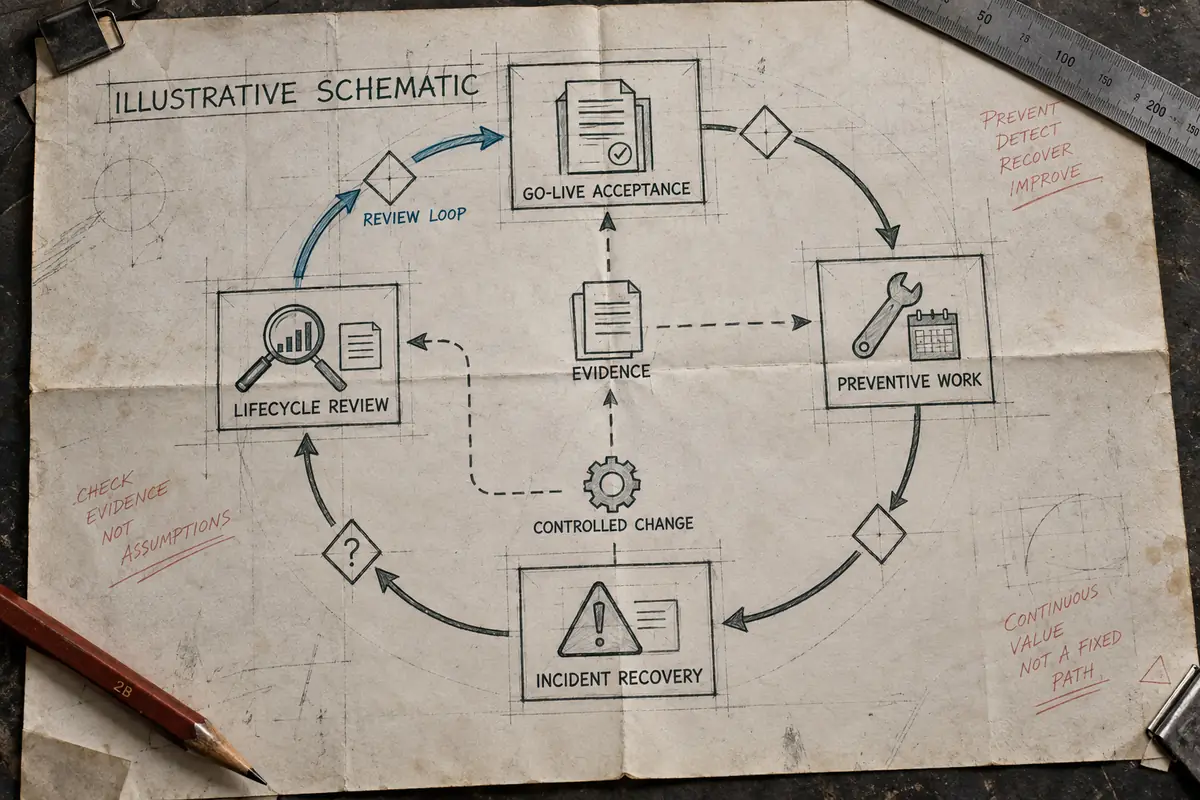
An ASRS system lifecycle service should begin before the first post-launch fault. A useful structure has four phases, each with a different output.
Phase 1: go-live readiness and acceptance
The first maintenance asset is not a spare motor. It is a reliable record of what was accepted. The handover package should identify the installed equipment, software versions, interface points, operating modes, safety interlocks, approved settings, backup arrangements, and known limitations. It should make clear which performance observations belong to the complete project, which belong to a subsystem, and which belong to one device.
Acceptance records need a fault vocabulary. “System down” is too broad for useful support. A better record separates a blocked location, unavailable robot, failed handoff, order-interface rejection, inventory mismatch, workstation stoppage, and site-wide loss of operation. The purpose is not bureaucracy. It is to help the next support person begin with the right evidence.
The available company profile describes a broad integration approach that combines robots and supporting equipment into complete solutions, including workstations, sorting conveyors, lifts, case sealing, labeling, pallet stacking, and temporary storage equipment. For a project with that kind of mixed equipment boundary, the handover should show the connection and ownership of each item rather than treat the entire installation as one undifferentiated asset.
Phase 2: stable operation and preventive work
Preventive work in ASRS system maintenance should be tied to actual equipment, duty, environment, and risk. A contract can include inspection tasks, cleaning requirements, alignment checks, sensor checks, lubrication where applicable, firmware or software review, backup verification, and operator checks. The exact frequency must come from the equipment manuals, the approved design, operating conditions, and the contract scope. There is no safe basis in the available evidence for assigning one universal maintenance interval to every ASRS system installation.
The buyer should request a record for every planned activity. The operating checklist should show the asset, date, person or organization responsible, observation, measured condition where relevant, action taken, parts used, open risk, and the acceptance condition for returning the asset to service. A completed tick box is weak evidence if it does not show what was examined or what changed.
The same principle applies to software. A version review should identify what changed, why it changed, which interfaces could be affected, what test data was used, and how the previous state can be restored. “No software changes” can be a valid operational decision, but it should still be recorded when a review was due.
Phase 3: incidents, diagnosis, and controlled recovery
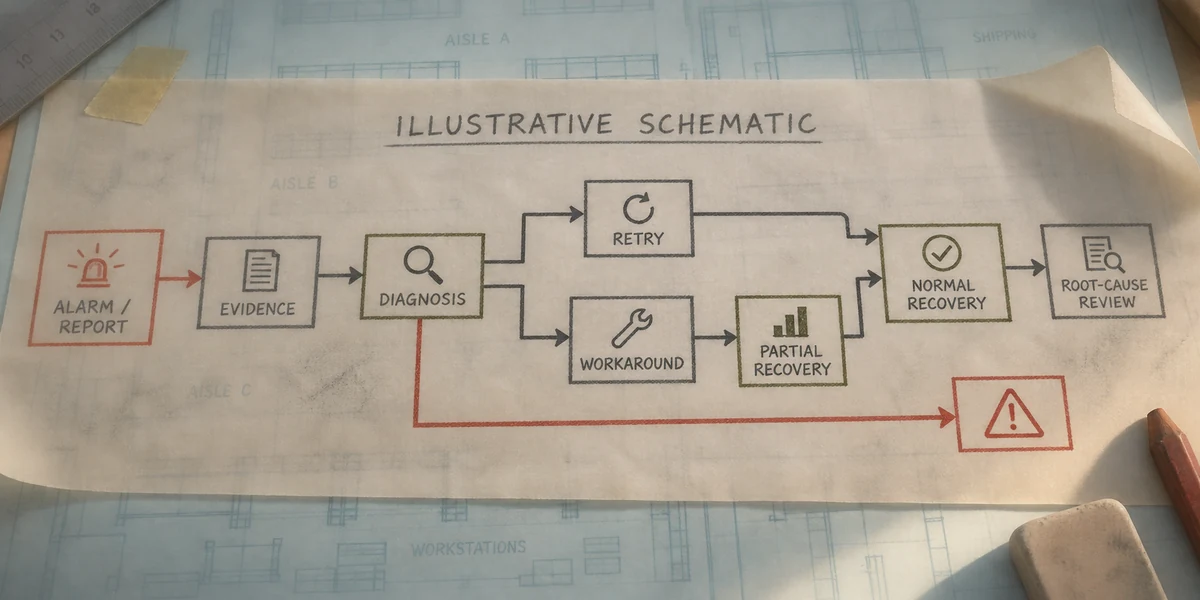
Incident service should distinguish the clock that starts when a problem is reported from the clock that starts when the service team can access useful evidence. It should record at least:
- report received;
- first human response;
- remote diagnosis started;
- temporary workaround available;
The recovery record should then continue with:
- partial operation restored;
- normal operation restored;
- root cause reviewed and accepted.
These are different events. A short response time does not prove a short recovery time. A temporary workaround does not prove that the cause has been removed. A replacement part may return one device to service even as an interface or configuration problem remains. The contract should define which events are measured, which operating condition applies, and which party records the time. Those definitions are central to comparing ASRS system maintenance proposals.
For each incident, the escalation path should state what information is needed: alarm history, task identifiers, inventory transactions, software logs, network events, photos, operating mode, recent changes, and the last known good state. Remote access rules and data handling should be agreed before a crisis, including who can approve access and who can change production data.
Phase 4: improvement, expansion, and retirement
Lifecycle service becomes valuable when it turns repeated observations into decisions. A rising number of blocked tasks may point to a rule or interface issue. Repeated component replacement may point to operating conditions, alignment, loading, or a design constraint. A growing gap between planned and actual peak work may call for capacity analysis rather than another repair visit.
The decision record should compare at least three paths: repair the current condition, modify part of the system, or replace a larger component. It should state the assumptions, downtime window, test requirement, data migration risk, spare-part risk, and expected operational effect. A fixed replacement age is not justified by the evidence available for this article. The better trigger is a documented change in business demand, technical risk, supportability, or safety conditions.
How to divide responsibility in a multi-vendor system
The buyer may purchase one integrated project despite several organizations remaining responsible for different technologies. The service model has to bridge that commercial reality. The strongest test is not whether one supplier says “we support the system.” The test is whether the buyer can identify the first owner for each failure class, the evidence that owner needs, and the point at which another party joins the investigation.
Ask for a fault ownership matrix
The matrix should use real examples from the site. Useful rows include:
| Failure or condition | First owner | Evidence required | Handoff trigger | Recovery acceptance |
|---|---|---|---|---|
| Robot or vehicle unavailable | Equipment or controls owner | Alarm history, asset ID, operating mode | Fault persists after approved reset | Asset returns to a defined operating state |
| Storage or transfer handoff blocked | Controls and equipment owners | Task ID, sensor state, last confirmed position | Mechanical and logic causes cannot be separated | Handoff completes without an unsafe manual step |
| Order or inventory transaction rejected | Execution software or interface owner | Message ID, payload, timestamp, transaction state | Data boundary or mapping is implicated | Transaction is reconciled and traceable |
| Site-wide communication loss | Site IT and automation owner | Network event, affected nodes, power state | Infrastructure boundary is confirmed | Approved degraded mode or normal service returns |
| Repeated performance shortfall | Integration and operations owners | Work profile, queue history, constraints, changes | Repair does not address the operating pattern | Cause, action, and follow-up measure are accepted |
This table is a model for procurement, not a service commitment. The names and acceptance tests need to match the project. Ask who can make a temporary operating decision. A warehouse may prefer a controlled degraded mode that protects priority orders over a rushed restart that creates inventory uncertainty. That decision should be agreed with operations, engineering, IT, and safety stakeholders before a high-pressure event.
The company profile lists several software layers and a range of equipment types, including robots, conveyors, lifts, workstations, and packaging-related equipment. This is why a service review should test the responsibility matrix against the delivered bill of systems. A generic helpdesk diagram is not enough if the live operation contains more interfaces than the contract describes.
One accountable integration owner, with named technical owners
In a multi-vendor environment, “one accountable integration owner” is a useful contract design principle. It does not mean that one organization performs every repair. It means the buyer knows who coordinates the incident, preserves the timeline, gathers the evidence, and confirms that the complete flow has recovered. Each technical supplier can retain responsibility for its equipment or software as the integration owner prevents the buyer from repeating the same fault description to several parties.
This is a recommendation for a service model, not a verified claim about a current GoASRS contract. Before awarding work, ask for the escalation chart, named roles, service hours, remote-access process, subcontractor boundaries, language coverage, and the approval authority for production changes. Ask the supplier to show how a fault that crosses two layers is handled. A promise of coordination is less useful than a worked example with inputs, decisions, and outputs.
What to measure in warehouse automation after-sales support
Service metrics should describe the operational event, not only the support desk event. A buyer comparing warehouse automation after-sales support should ask for definitions before asking for target numbers. The following measures are useful when their start points, end points, exclusions, and reporting period are stated:
- response time after a complete incident report is received;
- time to begin remote diagnosis;
- time to provide a safe workaround;
- time to restore partial operation;
The same report should track:
- time to restore the agreed normal state;
- time to issue a root-cause report;
- repeat-incident rate for the same cause;
- open corrective actions past their due date.
The list has eight items because they describe different management questions, not because a longer list is automatically better. A procurement document can group them into a smaller scorecard if each metric remains clear. The buyer should separate severity classes. A single unavailable robot, a blocked aisle, a failed order interface, and a complete system interruption do not carry the same operational consequence.
Do not compare a headline such as “same-day resolution” without asking what resolution means. It may mean a technician replied, a reset was attempted, a workaround was provided, or the original fault was permanently fixed. These are not interchangeable outcomes. Use one incident record with fields for affected process, start and end timestamps, cause category, action, owner, evidence link, and closure acceptance; roll those records into the monthly report.
Archived company articles use different response, arrival, repair, and spare-parts figures, including numbers recorded in separate sections of those articles. Treat them as historical claims only, not as evidence for a current service promise. The practical lesson is simple: ask for the current agreement and the measurement method rather than selecting the most attractive number.
Preventive maintenance, condition review, and spare parts
Preventive maintenance is not the same as replacing parts on a calendar. The right work depends on the equipment, load, operating pattern, environment, safety requirements, and failure history. A buyer should ask for the reasoning behind every planned action:
- What failure mode does the action address?
- What observation or measurement shows that the action was completed?
- What condition changes the action from monitoring to replacement?
- What production window is needed?
- What record proves the asset was returned to service?
The answers should be specific to the approved equipment. The company profile identifies multiple equipment categories and solution combinations, from bin robots and four-way shuttles to automated guided vehicles, workstations, conveyors, lifts, and packing equipment. A single inspection checklist for all those categories would be too broad to manage risk well.
Spare-parts planning deserves the same level of definition. The contract scope should identify critical parts, lead-time assumptions, storage responsibility, substitution rules, obsolescence review, and approval for non-standard replacement. It should distinguish a part that stops one asset from a part that can stop a complete flow. It should state whether the price includes consumables, emergency shipping, local storage, test equipment, and the labor needed to install and validate a replacement.
No current, auditable source in this task confirms a GoASRS spare-parts network, inventory level, coverage radius, or standard replenishment term. Those items should be requested in the RFQ rather than inferred from older marketing copy.
Software, interfaces, and data recovery belong in the service scope
An equipment-only contract can leave a warehouse exposed if a software change, master-data error, interface failure, or database problem stops the flow. For that reason, the contract scope should define how software and data are treated after handover.
Ask these questions:
- Which WMS, WCS, RCS, and equipment-layer versions are supported?
- Which party maintains the ERP or MES mapping?
- Who approves a change to task rules, location data, or message formats?
- Where is a change tested before it reaches production?
It should also answer:
- What is the rollback method if a release fails?
- How are inventory, task, and event records backed up?
- Who verifies that a recovery restored consistent business state, not only a running application?
- Which security, network, and access-control duties belong to the warehouse IT team?
The company profile’s description of WMS, WCS, RCS, equipment integration, and ERP/MES connectivity supports treating software boundaries as part of the delivered system. It does not, by itself, prove a particular backup frequency, disaster-recovery target, cybersecurity service, software support period, or remote-monitoring feature. Those details require a current service document or fact record.
Change control should cover more than major releases. A new SKU family, revised carton dimensions, altered order priority, new workstation, changed operating shift, or modified network rule can change the behavior of an automated flow. The change request should describe the business reason, affected interfaces, test cases, rollback point, release window, approvers, and post-release observation. The goal is traceability: if a new symptom appears later, the service team can see what changed before the symptom began.
When repair is no longer the right lifecycle decision
An ASRS system lifecycle service should include a review path for changes in the business, not only a repair path for failures. A repair may be appropriate when the fault is isolated, the part remains supportable, the operating profile is unchanged, and the restored condition can be tested. A modification may be more sensible when the same constraint recurs, the process has changed, or one layer is forcing workarounds in another. Replacement may deserve review when supportability, safety, compatibility, or capacity risk has become material.
Use evidence from the operation rather than a generic age rule. Review these signals together:
- inventory mix and storage-location profile;
- outbound peak shape and order release pattern;
- task queues, blocked states, and manual interventions;
- repeat faults and the time spent on recovery;
Review those signals alongside:
- discontinued or difficult-to-source components;
- interface and software change constraints;
- new safety, quality, or traceability requirements.
The company profile lists solution examples in apparel, electronics, semiconductor, retail, office supplies, fastener manufacturing, and precision manufacturing. That range illustrates why lifecycle decisions need site-specific evidence. A storage and picking design for mixed apparel flows may face different change pressures from a production-side material movement system. The source supports the existence of those solution categories, not a universal maintenance or replacement rule.
For each upgrade candidate, compare the current baseline with the proposed state. Include downtime, training, data migration, interface regression testing, temporary manual operation, spare-part exposure, acceptance criteria, and the owner of post-change support. A larger automation project is not automatically the right answer. Nor is repeated repair automatically the cheaper answer. The decision should be made from the operating risk and the cost of each path, with assumptions visible to the buyer.
How to compare lifecycle RFQ responses
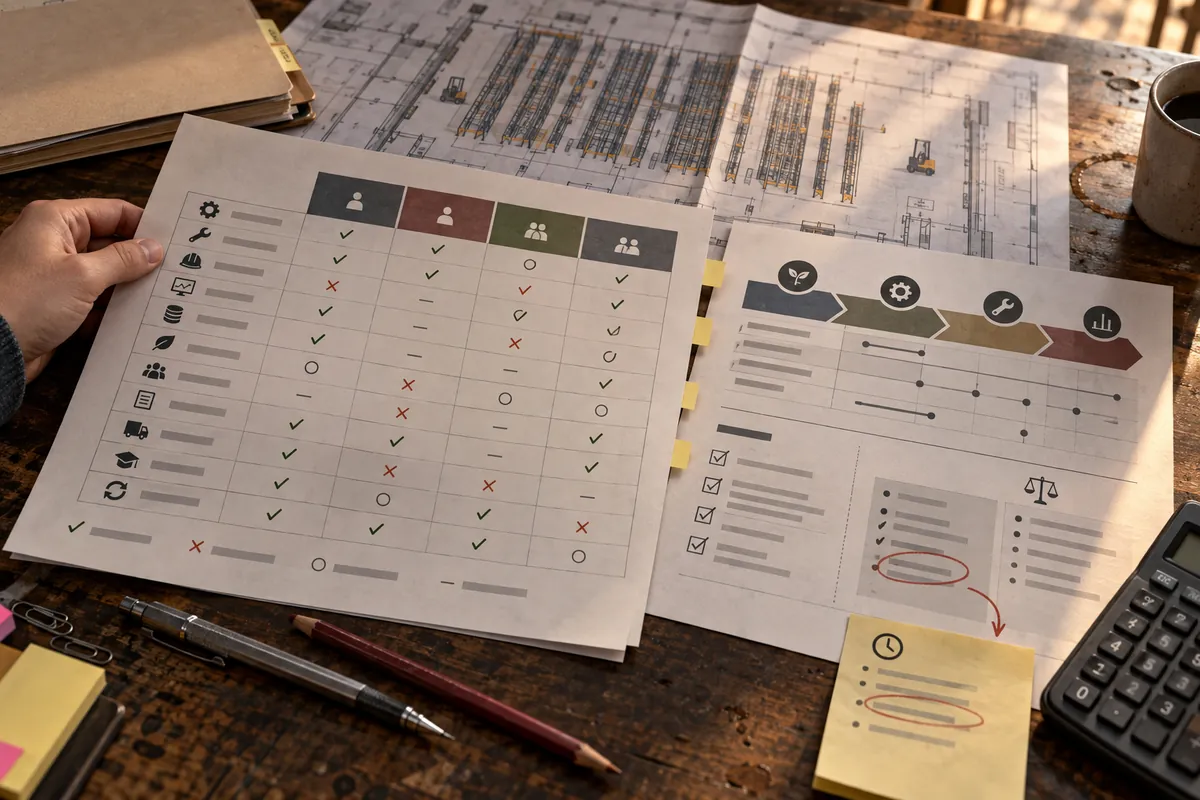
RFQ responses become difficult to compare when one supplier prices a helpdesk, another prices site visits, and a third includes software changes inside a broad integration fee. Put the responses into a common scope before comparing totals. Useful RFQ questions ask each bidder to state:
- supported assets and software layers;
- service hours and escalation method;
- remote diagnosis and site-access assumptions;
- preventive work, records, and reporting;
- spare-parts ownership and replacement conditions;
- change, upgrade, backup, and recovery responsibilities;
- exclusions, subcontractors, renewal terms, and exit support.
Keep the service boundary aligned with the project boundary. The company profile presents solutions that combine different robot types and supporting equipment for different warehouse tasks. A proposal that names only “the robot” may omit the conveyor, lift, workstation, interface, or inventory process that determines whether an order can actually move.
Cost should be discussed as a set of drivers, not as an unsupported market average. Relevant inputs include the number and type of assets, software and interface boundaries, site geography, coverage hours, response definitions, planned visits, remote access, spare parts, emergency logistics, training, reporting, change requests, upgrade work, and exit requirements. The available evidence contains no public, condition-matched price list for ASRS system maintenance or lifecycle service. A buyer should use an RFQ with a fixed scenario and a shared metric dictionary before drawing a cost comparison.
The existing site guide on ASRS system cost can provide a related cost-planning path. The guide on ASRS total cost of ownership is relevant when the evaluation needs to include operating and lifecycle exposure. These links are reading paths, not evidence for a service price.
A buyer’s go-live-to-lifecycle checklist
Before signing a service contract, ask the service team to walk through one normal month, one serious incident, one software change, and one expansion scenario. Record the answer in the following operating checklist:
System boundary and incident ownership
- Is the delivered bill of systems attached to the service scope?
- Does every major asset have an identifier, owner, status, and maintenance record?
- Can the service team explain the path from an order event to a physical confirmation?
- Does the fault matrix define first response, escalation, evidence, and acceptance?
Recovery and planned work
- Are response, diagnosis, workaround, partial recovery, full recovery, and root-cause times separate?
- Are remote access, data handling, safety controls, and production-change approvals clear?
- Does preventive work produce usable records rather than only completed check boxes?
- Are critical spare parts, substitutions, obsolescence, and logistics addressed?
Software and lifecycle decisions
- Does software support cover versions, interface changes, testing, rollback, and recovery evidence?
- Are repeat incidents reviewed for redesign or rule changes?
- Are expansion and retirement triggers connected to warehouse demand and technical risk?
- Are exclusions and handoffs written in language an operations manager can use during an incident?
The checklist is deliberately operational. It does not ask a buyer to select a robot by headline specification before defining the service boundary. For a broader comparison of system choices, readers can review types of ASRS systems and the ASRS system selection framework. For the software relationship behind a connected installation, see WES, WMS, and WCS software layers. For the initial process explanation, how an ASRS system works gives a separate starting point. Buyers planning the interface boundary can read ASRS system integration before finalizing the RFQ.
FAQ about ASRS system maintenance
Is ASRS system maintenance only equipment repair?
No. Equipment repair is one workstream. A useful service scope addresses controls, dispatch, inventory and execution logic, business interfaces, site infrastructure, operating practice, change control, records, and escalation. The precise boundary depends on the installed system and the commercial agreement.
What should an ASRS system maintenance SLA measure?
It should define the event and the clock before it defines a target. Separate first response, diagnosis, workaround, partial restoration, normal restoration, and root-cause reporting. State severity, exclusions, access conditions, business hours, and who records each timestamp. A single resolution number is not enough to explain operational recovery.
Should software and ERP or MES interfaces be included?
They should be addressed explicitly. If software and interface ownership is omitted, a warehouse can have functioning equipment but no reliable task or inventory flow. The contract should state version ownership, change approval, test evidence, rollback, backup, recovery, and the boundary between automation and site IT.
How should a buyer compare two after-sales RFQ responses?
Give both suppliers the same asset list, failure scenarios, service hours, metric definitions, access assumptions, spare-parts assumptions, and change examples. Compare what each RFQ response includes, excludes, measures, and requires from the warehouse. Request separate prices for base support, planned maintenance, emergency work, parts, software changes, and upgrades where the scope differs.
When should a warehouse consider an upgrade instead of another repair?
Review the decision when repeat failures, supportability risk, business demand, inventory mix, peak workload, interface constraints, safety requirements, or component availability have changed. Compare repair, partial modification, and larger replacement with the same assumptions for downtime, testing, training, data, and post-change support. Do not use a fixed age rule without a project-specific baseline.
The practical meaning of lifecycle service
The post-go-live question is not “who will come when a robot stops?” It is “who can explain the complete operating state, preserve the evidence, coordinate the right technical owners, and confirm that the business flow is safe to resume?” That question changes the purchase from a vague maintenance promise into a defined operating relationship.
For an integrator-led project, the service conversation should connect the solution design, software layers, equipment boundary, operating data, and future change plan. The company profile describes HengYan as combining software, hardware, and systems integration, with WMS, WCS, RCS, equipment connections, and ERP/MES connections listed in its capabilities. That background supports asking system-level lifecycle questions. It does not replace a current contract scope, SLA, maintenance manual, or project-specific acceptance record.
If a warehouse is preparing an automation RFQ, start with the delivered system boundary, the failure scenarios that matter most, and the operating evidence available today. Then ask prospective partners to price and document the same lifecycle scope.
Research adoption list
Adopted
- The company profile’s description of HengYan as a warehouse robotics and systems integrator, together with its software layers, is used only in limited company-background statements.
- The WMS, WCS, RCS, equipment-layer, and ERP/MES connection description is used to frame software and interface ownership questions.
- The equipment and solution categories are used to explain why a service scope must match the delivered bill of systems.
- The company profile’s industry and project-solution categories are used as context for site-specific lifecycle decisions.
- Archived company articles record response, arrival, repair, and spare-parts figures in separate sections, with the figures differing across the articles.
- This draft treats those figures as historical material, not as current GoASRS commitments, and uses them only to show why a current service metric needs a defined event, clock, and reporting scope.
Not adopted as evidence
- Historical response, arrival, repair, resolution, spare-parts, and coverage figures were not used as current GoASRS commitments because the available articles use inconsistent figures and no current agreement was available.
- Historical customer stories were not presented as maintenance or lifecycle case studies because the research set does not provide a service period, baseline, incident record, or outcome that can be audited for this topic.
- No fixed preventive-maintenance interval, remote-monitoring feature, predictive-maintenance claim, backup target, cybersecurity scope, software support term, price, delivery term, certification, or service-level promise was added without a current company source.
To verify later
- Current maintenance agreement, service catalogue, SLA, service territory, escalation chart, spare-parts policy, software support policy, and incident statistics.
- Project-specific acceptance pack, asset register, approved software versions, interface map, backup and recovery test record, and change-control procedure.
- A current, attributable after-sales case with system boundary, service duration, failure baseline, response definitions, and measured result.
Planning a Warehouse Automation Project?
Our team has delivered 50+ ASRS systems across retail, manufacturing, and logistics. Tell us about your project and we will get back to you within 24 hours.
Thank you!
We received your message and will get back to you within 24 hours.