
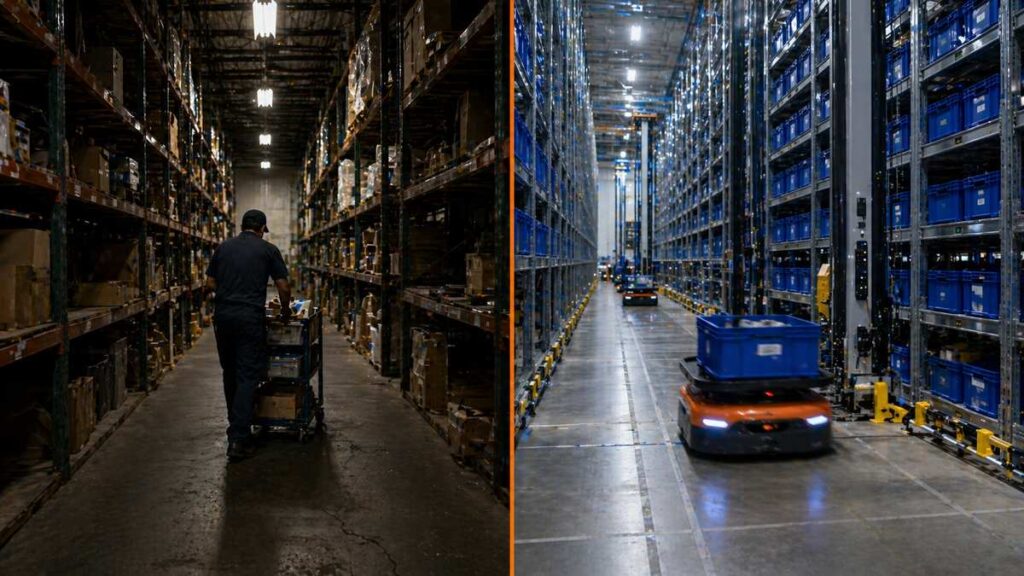
Manual warehousing is losing ground. Not slowly, not gradually — rapidly. The global warehouse automation market crossed $23 billion in 2025 and is on track to hit $41 billion by 2027. Companies that once viewed automation as a luxury are now treating it as a survival strategy.
We've spent years helping manufacturers, e-commerce brands, and 3PL operators transition from manual operations to automated storage and retrieval systems. The pattern is consistent: teams that switch to ASRS cut labor costs by 60%+, reclaim 40–60% of wasted floor space, and push picking accuracy past 99.9%. The teams that wait keep bleeding money on overtime, mis-picks, and warehouse expansions they shouldn't need.
This article breaks down ASRS vs traditional warehousing across every metric that matters — with real numbers from deployed projects, a cost analysis framework, and a decision guide to help you figure out if automation is the right move for your operation right now.
What Traditional Warehousing Actually Costs You
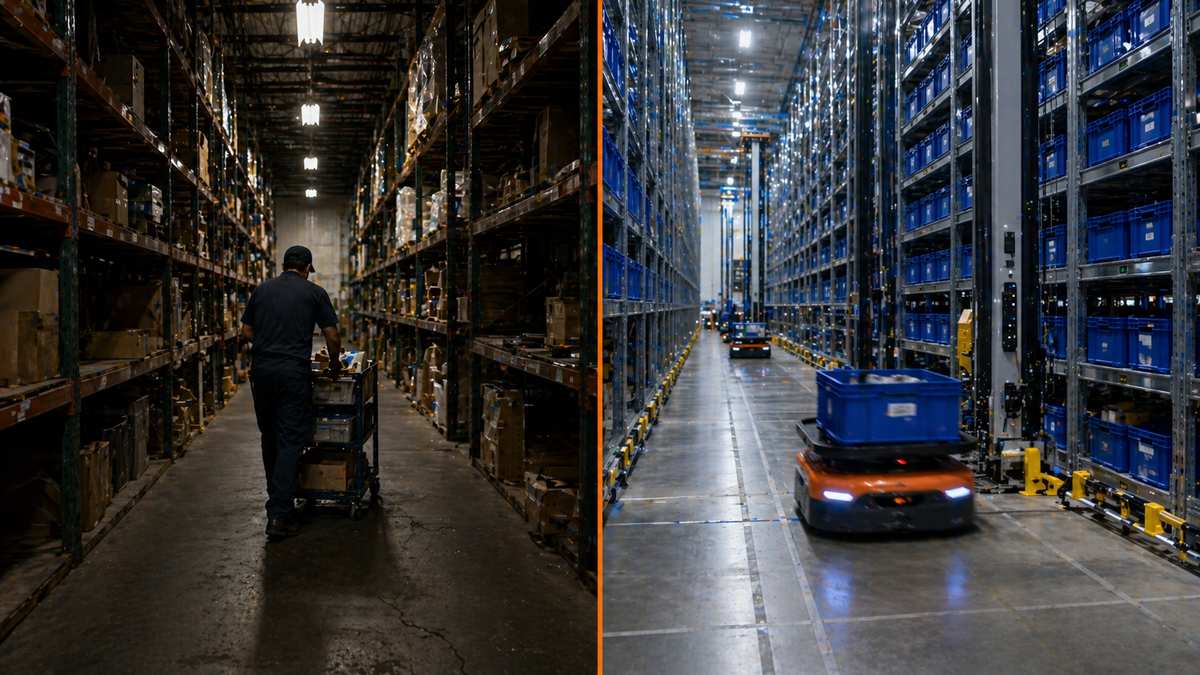
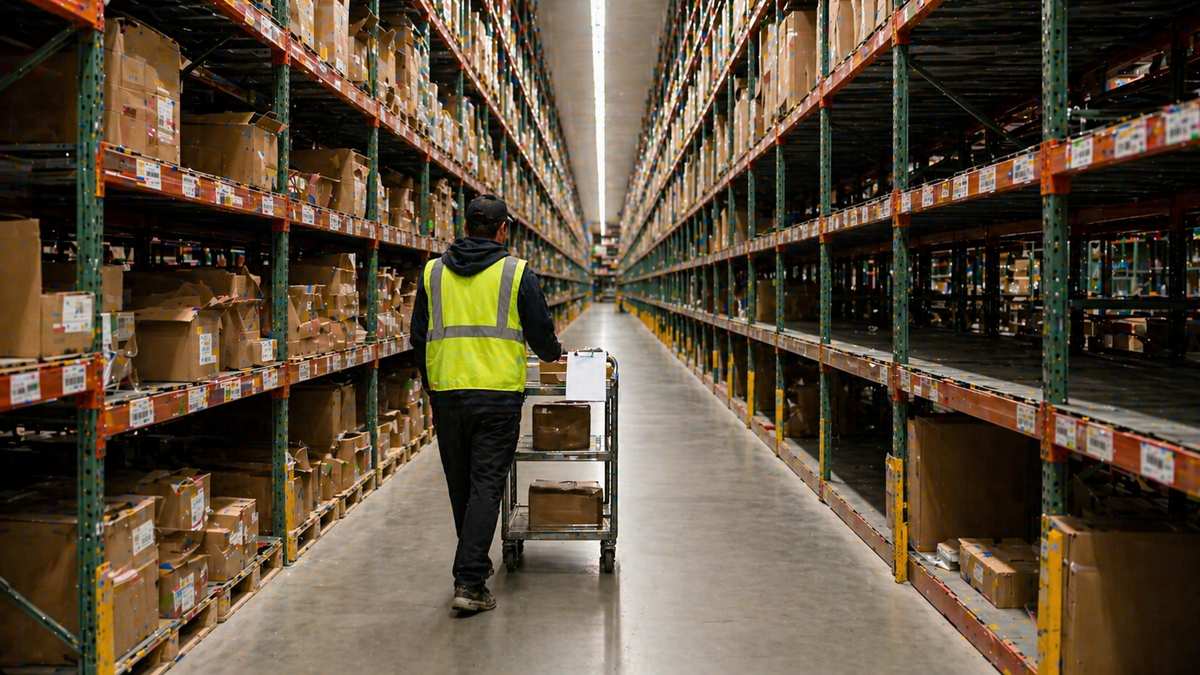
Traditional warehousing — workers walking aisles, pulling items from shelves, loading carts, and hauling goods to packing stations — still runs the majority of warehouses worldwide. It works. But "works" and "works well at scale" are two different things.
Here's where manual operations bleed money and time.
Labor is the biggest expense, and it keeps climbing. Picking alone eats roughly 55% of total warehouse operating costs, according to Georgia Institute of Technology research. US warehouse turnover rates sit around 36% annually. Every time a picker quits, you're spending $3,000–$5,000 on recruiting and training a replacement who won't hit full productivity for weeks.
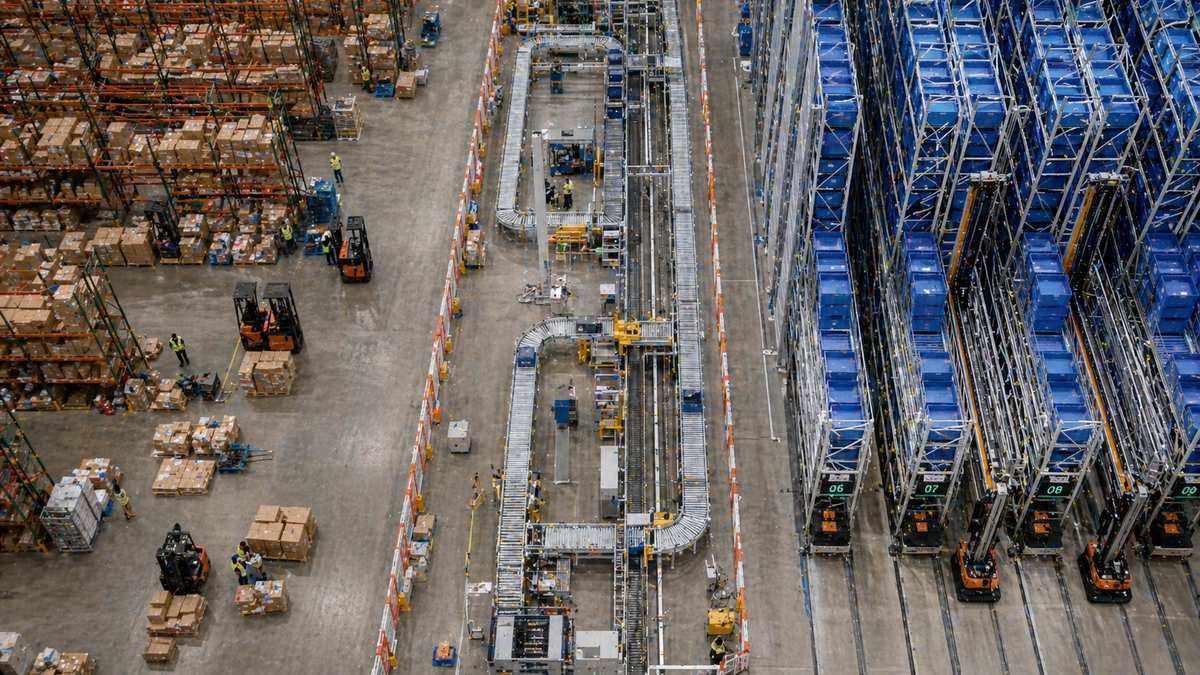
You're paying rent on air. Conventional racking with forklift aisles uses only 25–30% of a building's cubic volume. The rest is dead space — aisles wide enough for forklifts to turn, vertical gaps between shelves that can't be reached safely, and buffer zones mandated by fire codes. In markets where industrial rent runs $8–$15 per square foot, that wasted space adds up fast.
Errors compound. Manual picking typically hits 97–99% accuracy. Sounds decent until you do the math: a facility processing 10,000 order lines per day at 99% accuracy generates 100 mis-picks daily. Each one triggers a return, a reship, a customer service interaction, and a hit to your brand reputation. At an average cost of $15–$25 per return, that's $1,500–$2,500 per day in error-related losses.
Scaling means spending more on the same problems. Need to handle 30% more volume? Hire 30% more people. Run a third shift. Lease a second building. Every scaling lever in a manual warehouse is linear — more output requires proportionally more input. There's no efficiency curve.
Safety is a constant liability. OSHA data consistently ranks warehousing among the most injury-prone industries. Forklift collisions, repetitive strain injuries, falls from ladders — these aren't edge cases. They're statistical certainties at scale. Each recordable incident costs an average of $42,000 in direct and indirect expenses.
How ASRS Changes the Equation
If you're not familiar with the technology, here's a primer on what ASRS is and how it works. The short version: automated storage and retrieval systems use robotics, software, and dense racking to store and retrieve goods without human intervention in the storage zone.
The impact isn't incremental. It's structural.
Labor drops 60–80%. A goods-to-person robotic system eliminates aisle walking entirely. Robots bring inventory to stationary pick stations where a single operator processes 2–4x more orders per hour than a manual picker. One of our clients, Li-Ning (the sportswear brand), saw a 630% improvement in warehouse efficiency after deploying an integrated ASRS solution — the kind of gain that's impossible to achieve by just hiring more people.
Storage density jumps 40–85%. ASRS eliminates wide forklift aisles and stacks inventory vertically in tightly packed structures. When we deployed a system for ERAL (a fashion retailer), they achieved 3x storage density in the same building footprint. That's the equivalent of tripling your warehouse capacity without signing a new lease.
Accuracy hits 99.9%+. Software-controlled picking with barcode or RFID verification removes the human error variable from the retrieval process. The system knows exactly where every SKU sits, and automated handling eliminates misreads, miscounts, and misplacements. For Shengyun Circuit Board, this translated to a 30% boost in storage efficiency and 40% improvement in picking accuracy — measurable gains that showed up in their P&L within the first quarter.
Scaling becomes modular. Adding capacity to an ASRS often means deploying more robots or extending the racking grid. No recruiting cycles, no training programs, no second-shift premiums. Many systems can scale throughput by 20–50% with minimal capital expenditure and zero additional headcount.
Safety improves by design. Fewer people in the storage zone means fewer injuries. ASRS systems also perform well in environments that are uncomfortable or dangerous for humans — cold storage at -25°C, cleanrooms, and facilities handling heavy or hazardous materials.
The Full Comparison: ASRS vs Traditional Warehousing Across 10 Dimensions
Here's the head-to-head breakdown across every operational metric that drives warehouse economics:
| Dimension | Traditional Warehousing | ASRS Automated Warehouse |
|---|---|---|
| Storage density | 25–30% cubic utilization | 60–85% cubic utilization |
| Picking accuracy | 97–99% | 99.9%+ |
| Picking throughput | 60–80 lines/hour/worker | 150–300+ lines/hour/station |
| Labor requirement | High (55% of OpEx) | 60–80% reduction |
| Operating hours | Limited by shift availability | 24/7 capable |
| Scalability | Linear (more people + space) | Modular (more robots + racking) |
| Workplace safety | High injury rate (OSHA data) | Significantly reduced exposure |
| Energy consumption | Standard HVAC + lighting for full facility | Optimized (LED, sleep modes, regenerative braking) |
| Inventory visibility | Periodic cycle counts, lag time | Real-time, SKU-level tracking |
| Typical ROI period | N/A | 2–4 years |
The gap is wide on every dimension except one: upfront investment. Traditional warehousing has a lower barrier to entry. But that advantage evaporates quickly once you factor in the compounding costs of labor, space, errors, and inefficiency over a 5–10 year horizon.
Real Project Data: What the Numbers Look Like in Practice
Generic benchmarks are useful. Real project data is better. Here are three deployments that illustrate the ASRS vs traditional warehousing gap with actual measured outcomes.
Li-Ning (Sportswear, China) — 630% efficiency gain
Li-Ning's distribution center was struggling with seasonal demand spikes and high labor costs across multiple shifts. After deploying an integrated ASRS with goods-to-person picking stations, warehouse efficiency improved by 630%. The system handles peak volumes that previously required temporary labor surges, and it does so with a fraction of the permanent headcount.
Shengyun Circuit Board (Electronics Manufacturing) — 30% storage + 40% accuracy improvement
Shengyun's manual warehouse couldn't keep pace with the precision requirements of circuit board component handling. Small parts, high SKU counts, and zero tolerance for picking errors made automation a necessity. The ASRS deployment delivered a 30% improvement in storage efficiency and a 40% improvement in picking accuracy — both measured against the manual baseline within the same facility.
ERAL (Fashion Retail) — 3x storage density
ERAL faced a common retail problem: growing SKU counts in a fixed-size warehouse. Expanding to a second facility would have doubled their logistics overhead. The ASRS solution tripled storage density within the existing building, eliminating the need for expansion and cutting per-unit storage costs by more than half.
These aren't cherry-picked outliers. They represent the typical range of outcomes we see across manufacturing, e-commerce, and retail deployments.
Cost Analysis: Short-Term Investment vs Long-Term Returns
The cost question is the first one every operations leader asks, and it deserves a thorough answer. For a full ASRS cost breakdown with 2026 pricing by system type, read our dedicated guide. Here's the strategic summary.
Short-term costs (Year 0–1):
ASRS requires significant upfront capital. A mid-scale robotic goods-to-person system typically runs $1.5M–$5M depending on throughput requirements, storage positions, and integration complexity. Add 15–30% for WMS/ERP integration, site preparation, and commissioning. This is real money, and it's the primary reason many companies delay the decision.
Long-term economics (Year 2–5+):
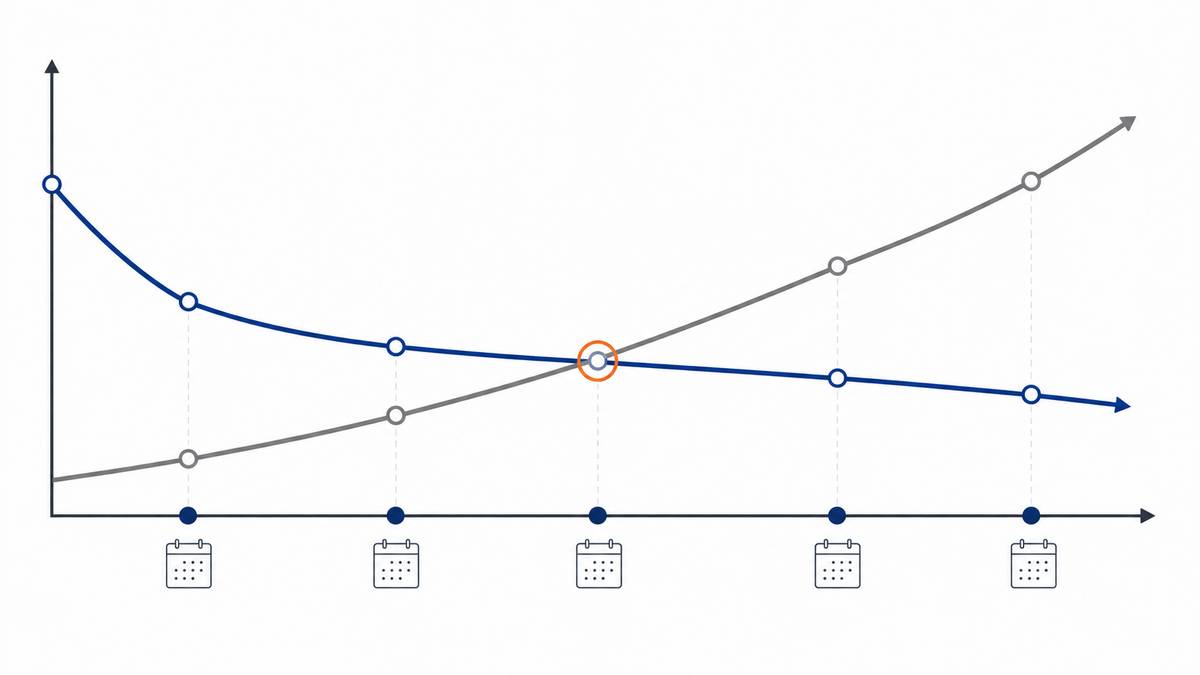
The math shifts dramatically once the system is operational. Consider a warehouse running 40 manual pickers at an average fully loaded cost of $45,000/year. That's $1.8M annually in picking labor alone. An ASRS that reduces headcount to 10 operators saves $1.35M per year in labor. Add space savings (smaller facility or deferred expansion), error reduction ($500K–$1M/year for high-volume operations), and throughput gains, and most systems reach full ROI in 2–3 years.
The compounding effect:
After payback, the cost advantage accelerates. Labor costs rise 3–5% annually. Warehouse rents increase. ASRS operating costs stay relatively flat — maintenance, energy, and software licensing don't scale with inflation the way human labor does. By year 5, the cumulative savings over a manual operation typically exceed 2–3x the original investment.
What most ROI calculators miss:
Opportunity cost. A manual warehouse that can't scale fast enough loses orders during peak season. A warehouse with 2% error rates loses customers to competitors with better fulfillment accuracy. These revenue impacts don't show up in a standard cost comparison, but they're often the biggest factor in the long-term business case.
When Should You Automate? A Decision Framework
Automation isn't the right move for every warehouse at every stage. We've worked with operations that genuinely weren't ready — and we told them so. Here's the framework we use internally to assess whether a facility is a strong candidate for ASRS.
Evaluate these five factors:
- Warehouse footprint and ceiling height. ASRS delivers the most value in facilities with 8m+ ceilings where vertical storage can be maximized. If you're in a low-ceiling building with a short lease, the ROI math gets harder.
- SKU count and profile. Operations with 1,000+ active SKUs benefit most from automated storage and retrieval. High SKU diversity means more walking time in manual operations — exactly the inefficiency ASRS eliminates. Check all ASRS types compared to match your SKU profile to the right technology.
- Daily order volume. Facilities processing 2,000+ order lines per day typically see the strongest payback. Below that threshold, simpler solutions like pick-to-light or zone picking may deliver sufficient improvement at lower cost.
- Labor cost trajectory. If your warehouse labor costs have increased 10%+ over the past three years and you're in a tight labor market, the automation case strengthens significantly. Factor in overtime premiums, temp agency fees, and turnover costs — not just base wages.
- Growth projections. If you expect 20%+ volume growth over the next 3–5 years, building that capacity into an ASRS now is almost always cheaper than scaling a manual operation incrementally.
Strong automation candidate: Scores high on 3+ factors. Start with a formal assessment. Moderate candidate: Scores high on 2 factors. Consider a phased approach (see next section). Not yet ready: Scores high on 0–1 factors. Optimize manual processes first, revisit in 12–18 months.
The Hybrid Approach: You Don't Have to Automate Everything at Once
One of the biggest misconceptions about ASRS vs traditional warehousing is that it's an all-or-nothing decision. It's not. Many of the most successful deployments we've managed started as hybrid implementations.
Phase 1: Automate the highest-impact zone. Identify the area of your warehouse where labor costs, error rates, or space constraints are most acute. For most operations, that's the fast-moving SKU zone — the 20% of products that account for 80% of picks. Deploy a mini load ASRS for tote handling or a robotic goods-to-person system in that zone while keeping slower-moving inventory in conventional racking.
Phase 2: Expand based on measured results. Once Phase 1 is operational and you have real performance data, use those numbers to build the business case for expanding automation to additional zones. This approach reduces risk, spreads capital expenditure, and lets your team build operational expertise with the technology before scaling.
Phase 3: Full integration. Connect all automated zones through a unified warehouse execution system that orchestrates robots, conveyors, and manual stations as a single workflow. This is where the compounding efficiency gains kick in — the WES optimizes task allocation across the entire facility in real time.
This phased model works particularly well for companies retrofitting existing warehouses rather than building greenfield facilities. You can explore ASRS hardware options that are designed for modular deployment and industry-specific automation solutions that match your operational profile.
Frequently Asked Questions
How long does it take to install an ASRS?
Typical deployment timelines range from 3–6 months for a single-zone robotic system to 12–18 months for a large-scale, multi-technology installation. The longest phase is usually integration with existing WMS/ERP systems, not the physical hardware installation. We recommend starting the software integration workstream 2–3 months before hardware arrives on site.
Can ASRS work in my existing warehouse, or do I need a new building?
Most ASRS technologies can be retrofitted into existing facilities. The key constraints are ceiling height (8m+ is ideal for vertical storage), floor flatness (robotic systems require tighter tolerances than forklifts), and electrical capacity. A site assessment will identify any modifications needed — and in our experience, retrofit costs are typically 5–15% of total project budget.
What happens if the system goes down?
Modern ASRS platforms are built with redundancy. If a single robot fails, the system reroutes tasks to other units with minimal throughput impact. Full system outages are rare (99.5%+ uptime is standard) and typically resolved within hours. Most operators maintain a small manual backup capability for critical orders during maintenance windows.
Is ASRS only for large enterprises?
Not anymore. Five years ago, the minimum viable ASRS investment was $2M+, which priced out small and mid-sized operations. Today, modular robotic systems start at $500K–$800K for compact deployments handling 500–2,000 order lines per day. The technology has scaled down without sacrificing the core benefits of accuracy and density.
How do I calculate ROI for my specific operation?
Start with three numbers: your annual warehouse labor cost, your current error rate (and the cost per error), and your cost per square foot of warehouse space. An ASRS that reduces labor by 60%, errors by 95%, and space requirements by 40% will generate savings you can model against the system cost. For a detailed walkthrough, see our complete ASRS pricing guide linked above. Or request a free ROI analysis from our engineering team — we'll run the numbers for your specific operation.
The Bottom Line
The ASRS vs traditional warehousing comparison isn't close on the metrics that drive warehouse profitability. Automated systems outperform manual operations on storage density, picking speed, accuracy, labor efficiency, scalability, and safety. The only metric where traditional warehousing wins is upfront cost — and that advantage disappears within 2–4 years for most operations.
The question isn't whether warehouse automation is the future of logistics. That's already settled. The question is whether your operation is ready to make the transition now, or whether you'll spend the next few years watching competitors pull ahead while you keep throwing labor at problems that technology solves better.
If you're processing 2,000+ order lines per day, running out of space, or watching labor costs climb faster than revenue, the business case is already there. Talk to our engineering team and let us show you what the numbers look like for your specific operation.
Planning a Warehouse Automation Project?
Our team has delivered 50+ ASRS systems across retail, manufacturing, and logistics. Tell us about your project and we will get back to you within 24 hours.
Thank you!
We received your message and will get back to you within 24 hours.