
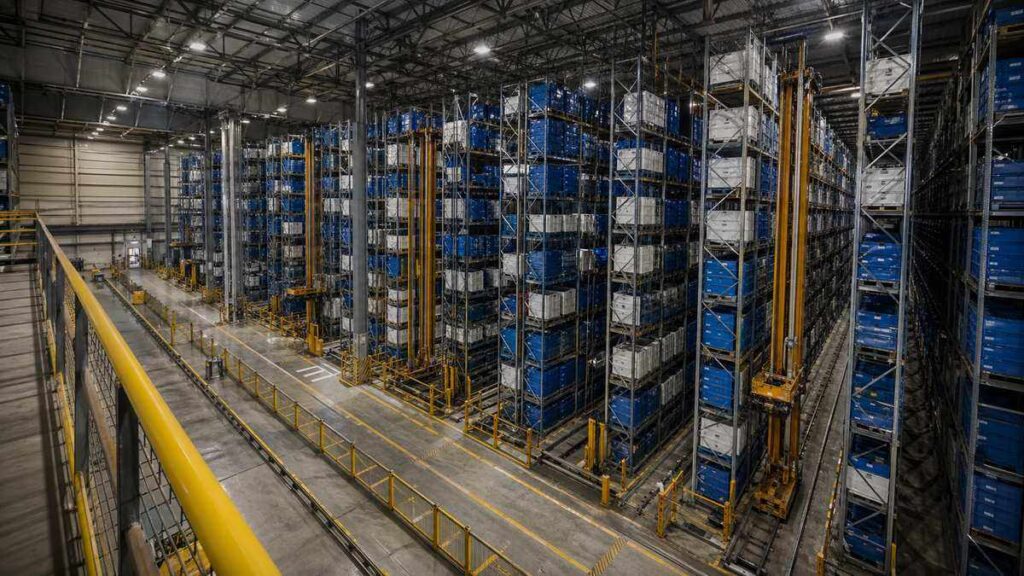
If you manage a warehouse or oversee supply chain operations, you have almost certainly encountered the term ASRS in trade publications, vendor pitches, or conversations with peers who recently automated their facilities. The technology is not new — it dates back to the 1960s — but the pace of adoption has accelerated dramatically in the past five years. Global ASRS market size crossed $9 billion in 2024 and is projected to reach $15 billion by 2030, according to the Material Handling Institute (MHI).
So what exactly is an ASRS, how does it work, and is it the right investment for your operation? This guide answers all of that — drawing from our experience deploying 500+ systems across 30 countries.
What is an Automated Storage and Retrieval System (ASRS)?
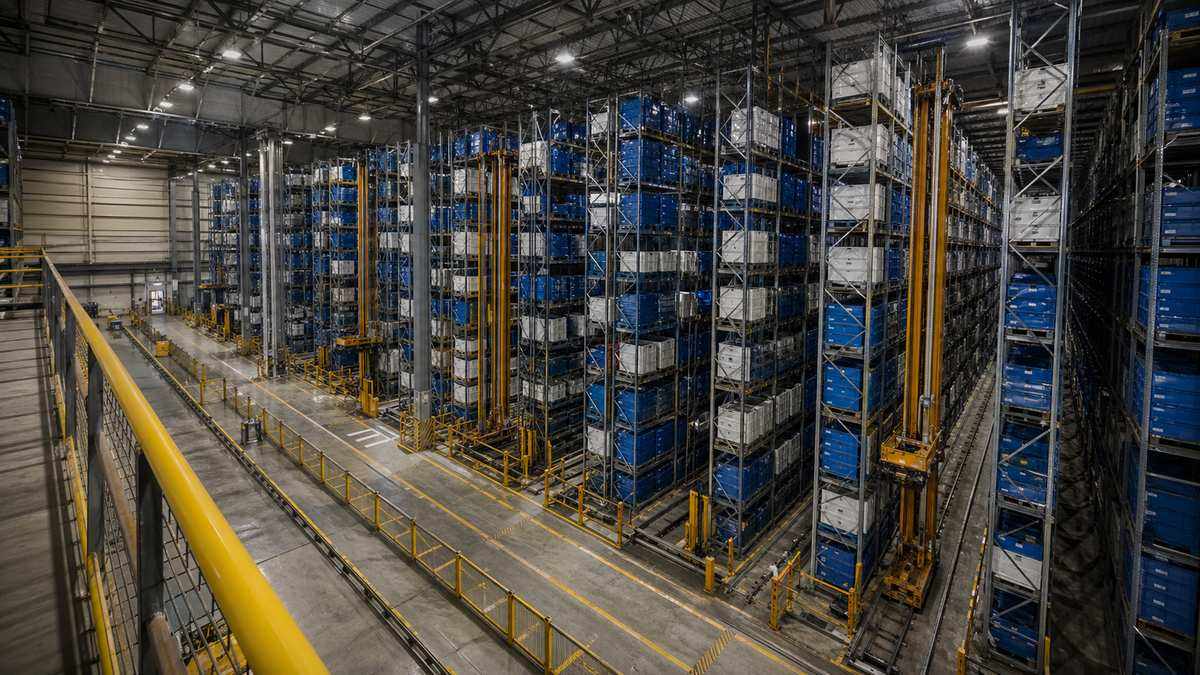
An ASRS (Automated Storage and Retrieval System) is a combination of hardware, software, and controls that automatically places goods into storage locations and retrieves them on demand — without requiring a human to physically walk to the shelf, pick the item, and carry it back. The system replaces manual labor with robotics, conveyors, cranes, or shuttles, all coordinated by intelligent software that decides where to store each item and how to sequence retrievals for maximum efficiency.
The ASRS meaning is straightforward: it is any system that automates the storage and retrieval of inventory within a warehouse, distribution center, or manufacturing facility.
Short answer: An automated storage and retrieval system (ASRS) is a computer-controlled warehouse system that stores inventory in fixed locations and retrieves it automatically when orders, replenishment tasks, or production requests require it. It combines high-density storage, automated handling equipment, and control software so warehouses can move goods with less walking, fewer forklift touches, and more predictable inventory accuracy.
ASRS vs. Automated Storage and Retrieval System: Is There a Difference?
There is no technical difference between ASRS and an automated storage and retrieval system. ASRS is simply the acronym. You may also see the term written as AS/RS, especially in older engineering documents and vendor specifications. In buyer conversations, all three terms usually refer to the same category of warehouse automation: a system that stores loads, tracks inventory locations, and retrieves goods through automated equipment instead of manual travel.
A Brief History
The concept originated in the early 1960s when Demag (now part of Konecranes) installed the first automated high-bay warehouse in Germany. Those early systems were simple by today's standards — fixed cranes on rails, basic PLC controls, and limited software intelligence. Through the 1970s and 1980s, unit load AS/RS spread across automotive manufacturing and beverage distribution in Europe and Japan, driven by high land costs and labor expenses.
The real transformation came in three waves. First, mini load systems in the 1990s brought automation to smaller items and e-commerce fulfillment. Second, shuttle-based architectures in the 2000s broke through the throughput ceiling of single-crane systems. Third — and this is where we are now — robotic goods-to-person systems starting around 2012 made ASRS accessible to mid-size operations that previously could not justify the capital expenditure of fixed infrastructure.
Today, an ASRS warehouse can range from a 500-position vertical lift module in a maintenance shop to a 200,000-position multi-zone automated distribution center processing 50,000 order lines per hour.
Core Components
Every automated storage and retrieval system consists of three layers:
- Storage structure — racking, shelving, or bin systems designed to hold inventory in a dense, organized layout. Configurations range from single-deep selective racking to multi-deep shuttle-served structures reaching 40+ meters in height.
- Automated machinery — the physical movers. This includes stacker cranes, shuttle vehicles, robotic mobile units, vertical lift trays, or carousel mechanisms. Each type optimizes for different load sizes, speeds, and throughput profiles.
- Control software — the warehouse execution system (WES) that orchestrates everything. It manages inventory locations, optimizes storage slotting, sequences retrieval tasks, coordinates traffic, and integrates with your WMS and ERP. The software layer is where most of the performance gains come from — a well-tuned algorithm can improve throughput by 20-30% on identical hardware.
Types of ASRS Systems
Not all automated storage and retrieval systems solve the same problem. The right type depends on your load profile, throughput targets, available space, and budget. Here is a breakdown of the five main categories — for a deeper comparison with side-by-side specs, see our detailed comparison of all ASRS types.
Unit Load ASRS
Unit load systems handle full pallets using automated stacker cranes that travel on fixed rails within narrow aisles. Typical installations reach 30 to 45 meters in height and store 5,000 to 60,000+ pallet positions. The cranes perform simultaneous horizontal and vertical travel, achieving 20-40 dual cycles per hour per aisle.
These systems dominate in manufacturing raw material storage, beverage distribution, cold chain operations, and any environment where full-pallet in/out is the primary workflow. The core advantage is storage density — by eliminating the 3.5-meter aisles that forklifts require and replacing them with 1.5-meter crane aisles, you store 40-60% more pallets in the same building footprint.
The trade-off is flexibility. Unit load ASRS is fixed infrastructure — rails bolted to the floor, racking anchored to the slab. Reconfiguring after installation is expensive. If your product mix changes significantly year over year, this rigidity becomes a constraint.
Mini Load ASRS
Mini load systems are the unit load concept scaled down for totes, trays, cartons, and cases weighing up to 50 kg per unit. Automated cranes or robotic extractors operate within enclosed racking structures, storing 15,000 to 100,000+ container positions and delivering them to ergonomic picking stations at the aisle ends.
These systems excel in e-commerce fulfillment with high SKU counts, pharmaceutical distribution requiring lot tracking and FIFO compliance, electronics warehousing, and spare parts operations. Throughput ranges from 30-60 tote movements per hour for single-shuttle cranes up to 200+ double cycles per hour for dual-shuttle configurations. Read our mini load ASRS guide for a deep technical breakdown including cost data and ROI timelines.
Shuttle-Based ASRS
Shuttle systems replace the single crane per aisle with multiple autonomous vehicles that travel horizontally within racking levels, combined with dedicated lifts for vertical movement. This architecture breaks through the throughput ceiling of crane-based systems: instead of one bottleneck per aisle, you deploy dozens of shuttles across multiple levels.
A well-configured shuttle system handles 200-1,000+ container movements per hour per aisle — 5 to 10 times the throughput of a traditional mini load crane. The scaling model is linear: add more shuttles to increase speed, add more levels to increase capacity. This makes shuttle ASRS the go-to choice for high-velocity e-commerce fulfillment, grocery micro-fulfillment, and any operation where throughput requirements exceed what crane-based systems can deliver.
Robotic Goods-to-Person (G2P)
This is the fastest-growing segment of the ASRS market. Robotic G2P systems use fleets of autonomous mobile robots — bin-carrying bots, tote-lifting units, or rack-moving AGVs — to bring inventory directly to stationary human pickers at ergonomic workstations. Workers stay in one place while robots handle all the travel.
The result: picking rates of 300-600 lines per hour per station (compared to 80-120 for manual cart picking), near-zero walking time, and a deployment model that scales incrementally. You can start with 20 robots and add more as volume grows — no structural changes to the building required. Our industry-specific solutions page shows how we configure G2P systems for different verticals.
Vertical Lift Modules (VLM) and Carousel Systems
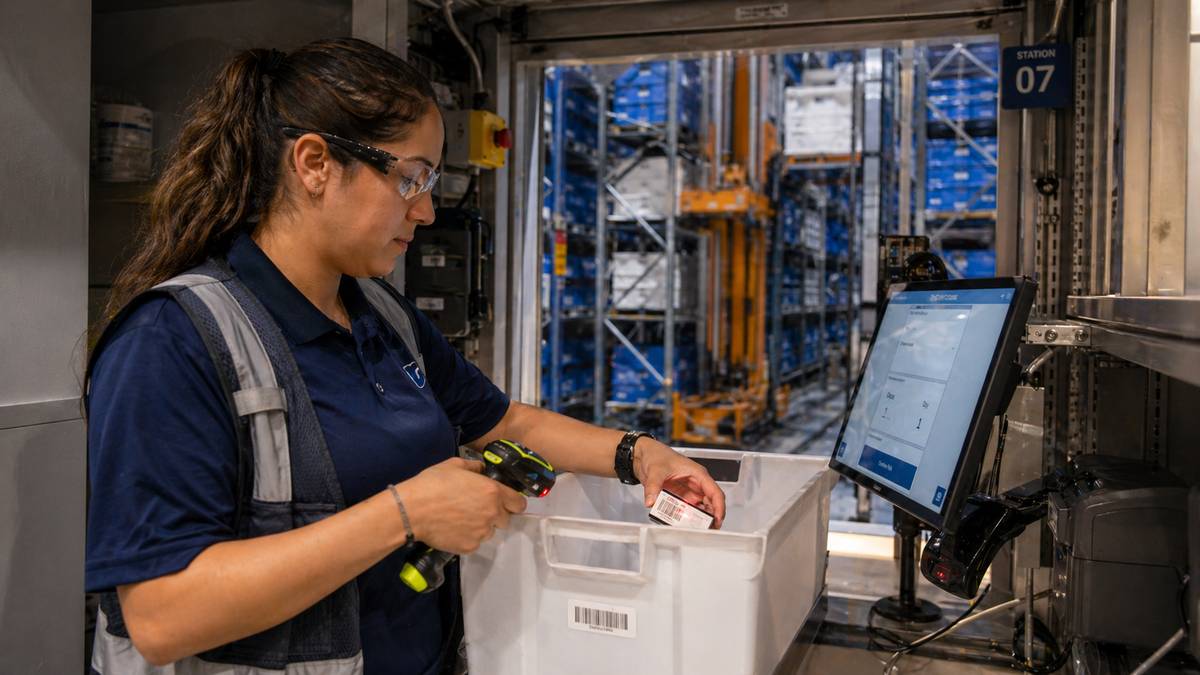
VLMs store items in enclosed columns of trays that are automatically delivered to an access window at ergonomic height. Carousels rotate shelving units (horizontal or vertical) to bring items to a fixed pick point. Both are compact ASRS solutions designed for small-parts storage in space-constrained environments.
VLMs typically stand 3 to 14 meters tall and recover 60-85% of floor space compared to static shelving. They are common in maintenance facilities, retail backrooms, hospital pharmacies, and manufacturing tool cribs. Throughput is modest — 40-100 lines per hour per unit — but the space savings and accuracy improvements (99.9%+) justify the investment for the right application.

How ASRS Works: The Complete Workflow
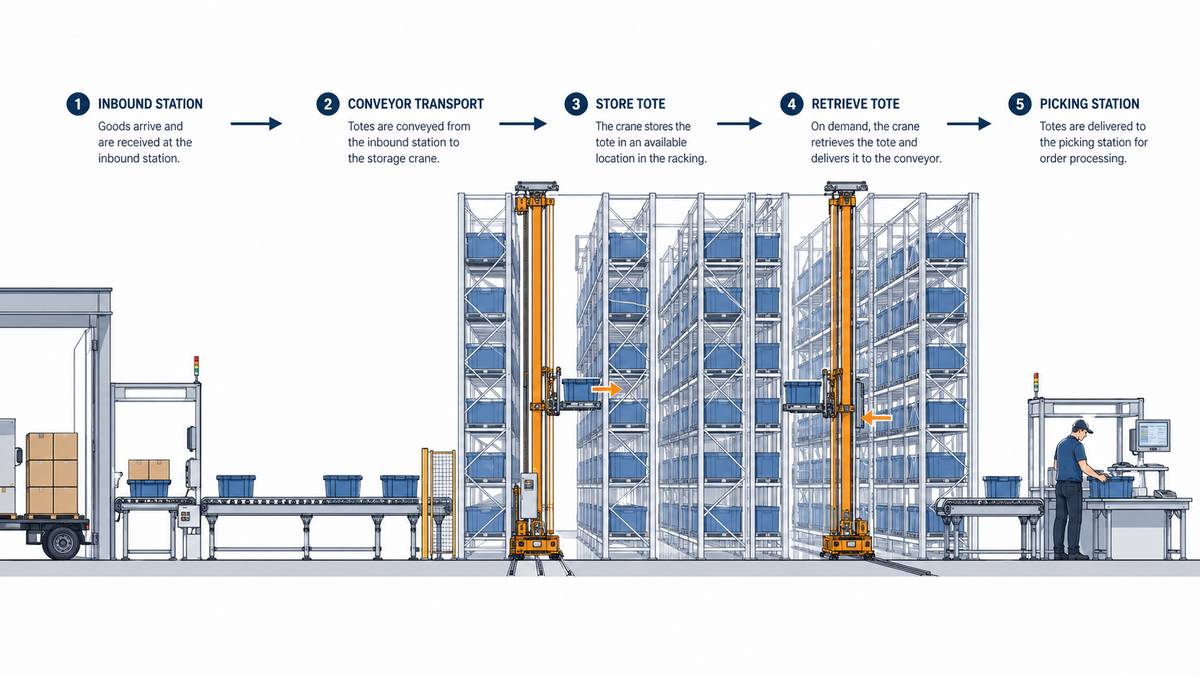
Understanding how an ASRS warehouse operates from end to end helps you evaluate whether the technology fits your process. Here is the standard workflow, broken into four phases.
Phase 1: Inbound and Storage
Goods arrive at the receiving dock and are checked in — either as full pallets (unit load) or broken down into totes and cartons (mini load / robotic). The WES assigns each item an optimal storage location based on velocity data, physical dimensions, weight, and product affinity rules. Fast-moving SKUs get placed near the I/O points to minimize retrieval time. Slow movers go to higher or deeper positions.
The automated machinery — crane, shuttle, or robot — picks up the load from the inbound conveyor or staging area and transports it to the assigned position. The system confirms the putaway and updates inventory records in real time.
Phase 2: Storage Optimization
This is a background process that runs continuously. The WES monitors order patterns and reshuffles inventory to keep the highest-velocity items in the most accessible positions. If a SKU that was slow-moving last month suddenly spikes in demand (seasonal shift, promotion, new customer), the system automatically migrates it to a faster-access location during off-peak hours.
Good storage optimization reduces average retrieval time by 15-25% compared to static slotting. This is one of the reasons why the software layer matters as much as the hardware — and why we invest heavily in our warehouse execution system.
Phase 3: Order Retrieval
When an order drops, the WES decomposes it into individual retrieval tasks, sequences them for efficiency (batching multiple orders that share common SKUs), and dispatches commands to the automated machinery. The system calculates the optimal retrieval sequence to minimize empty travel and maximize dual-command cycles (storing one item and retrieving another in a single trip).
Retrieved items travel via conveyor, robot, or shuttle to the designated picking or packing station. In a goods-to-person setup, the operator sees a screen displaying exactly which items to pick from the arriving container, how many, and where to place them.
Phase 4: Picking and Outbound
At the pick station, operators work with light-directed or screen-directed systems that guide each pick. Accuracy rates exceed 99.9% because the system controls which container appears and validates each action. After picking, containers return to storage automatically, and completed orders route to packing, labeling, and shipping.
The entire cycle — from order release to items ready for shipment — typically takes 3-8 minutes in a well-designed system, compared to 20-45 minutes in a manual warehouse handling the same order complexity.
Core Benefits of ASRS: Data-Backed Advantages
Why are companies investing in ASRS at an accelerating pace? The numbers from real deployments tell the story.
Space Savings: 40-60% Footprint Reduction
ASRS systems reclaim space in two ways. First, they eliminate wide forklift aisles (3.5m) and replace them with narrow crane or robot aisles (1.2-1.5m). Second, they exploit vertical height — most manual warehouses use only 6-8 meters of a 12-meter building, while ASRS fills the full cube. In markets where industrial real estate runs $8-$15 per square foot annually, the space savings alone can justify the investment within 3 years.
Throughput: 2-5x Improvement Over Manual Operations
Automated systems operate at consistent speeds 24/7 without fatigue, breaks, or shift changes. Specific benchmarks from our deployments:
- Unit load crane: 20-40 pallets/hour/aisle vs. 8-12 for a forklift operator
- Mini load: 200+ totes/hour/aisle vs. 40-60 for manual picking
- Robotic G2P: 300-600 picks/hour/station vs. 80-120 for cart-based manual picking
Decathlon's 1000+ robot deployment processes peak volumes that would require 3x the workforce to handle manually — and does it with higher accuracy.
Accuracy: 99.9%+ Pick Rates
Manual picking typically achieves 97-99% accuracy. At scale, even a 1% error rate means thousands of mis-picks per month, each costing $10-$50 in returns processing, reshipping, and customer service time. ASRS systems routinely hit 99.9%+ accuracy because the software controls which container appears at the pick station and validates each action electronically.
Labor Reduction: 60-80% for Storage and Retrieval Tasks
With warehouse labor shortages affecting operations globally and wages rising 5-8% annually in most markets, reducing headcount dependency is not just about cost — it is about operational resilience. Li-Ning's 630% efficiency gain came primarily from eliminating manual storage and retrieval labor, allowing the company to redeploy workers to value-added activities like quality inspection and returns processing.
Safety: 60-80% Reduction in Warehouse Injuries
Fewer workers navigating aisles with heavy equipment means fewer accidents. ASRS eliminates the three most common warehouse injury categories: forklift collisions, repetitive lifting strain, and slips/falls in high-traffic aisles. For cold storage operations, it also eliminates prolonged human exposure to freezer temperatures — a significant occupational health concern.
Energy Efficiency
Modern ASRS systems use regenerative drives that capture braking energy from cranes and shuttles, LED-only lighting in automated zones (no human presence means no full-spectrum lighting needed), and optimized movement algorithms that reduce total travel distance. Net energy consumption per pallet movement is typically 30-50% lower than forklift-based operations when you factor in HVAC savings from reduced building footprint.
Industries That Benefit Most from ASRS
While ASRS technology applies across any sector that stores and moves goods, certain industries see particularly strong ROI due to their operational characteristics.
E-commerce and retail — High SKU counts, fast order turnaround, and extreme seasonal demand spikes make automation essential for competitive fulfillment speeds. Companies operating 10,000+ SKUs with same-day or next-day shipping commitments are the sweet spot.
Third-party logistics (3PL) — 3PL operators serve multiple clients with varying product profiles and SLAs. Flexible robotic G2P systems allow them to handle diverse inventory without dedicated zones for each client. The scalability of adding robots during peak seasons and removing them during slow periods matches the 3PL business model perfectly.
Pharmaceutical and healthcare — Strict accuracy requirements (serialization, lot tracking, expiry management), regulatory compliance (GDP, FDA 21 CFR Part 11), and high product values demand traceable, reliable systems. A single mis-pick in pharma can trigger a recall.
Food and beverage / cold chain — Human productivity drops 40-50% in freezer environments (-25C), and labor turnover in cold storage exceeds 100% annually at many facilities. ASRS operates at full speed regardless of temperature, making the ROI case compelling even at smaller scales.
Automotive and manufacturing — Just-in-time delivery to production lines requires precision sequencing that manual processes cannot reliably maintain at high volumes. ASRS feeds assembly lines with the right parts in the right order, eliminating line stoppages caused by picking errors.
We have deployed systems across all of these verticals — see our industry-specific solutions for configuration details and case studies.
How to Choose the Right ASRS: A Decision Framework
Selecting an ASRS is not a one-size-fits-all decision. Here is the practical framework we use with clients during initial consultations. For detailed cost data to support your business case, see our complete ASRS pricing breakdown.
Step 1: Baseline Your Current Operations
Start with data. Measure your current throughput rates (lines per hour, orders per day), error rates (mis-picks per thousand), labor costs (fully loaded, including turnover and training), and space utilization (cubic utilization, not just floor). These numbers become your ROI baseline.
Step 2: Define Requirements and Constraints
Map your SKU profile (dimensions, weights, quantities), order characteristics (lines per order, daily volume, peak-to-average ratio), growth projections (3-year and 5-year), and hard constraints (ceiling height, floor load capacity, temperature zones, seismic requirements).
Step 3: Match Technology to Requirements
Use this simplified decision matrix:
- Full pallets, moderate throughput (<40 moves/hr/aisle) — Unit load ASRS
- Totes/cartons, moderate throughput (<200 moves/hr/aisle) — Mini load ASRS
- Totes/cartons, high throughput (>200 moves/hr/aisle) — Shuttle-based ASRS
- High SKU count, flexible scaling, goods-to-person workflow — Robotic G2P
- Small parts, limited floor space, <100 lines/hr — VLM or carousel
Step 4: Evaluate Scalability
Your warehouse needs will change. Choose a system that scales without requiring a full redesign. Robotic G2P systems offer the most flexibility (add robots incrementally), followed by shuttle systems (add vehicles and levels). Crane-based systems are the least flexible post-installation.
Step 5: Assess Total Cost of Ownership
Look beyond the hardware price tag. Factor in installation, site preparation, software licensing, annual maintenance (typically 3-5% of system value), energy consumption, and the expected 15-20 year lifespan of the equipment. Most ASRS solutions deliver full ROI within 2-4 years. Our ASRS vs traditional warehousing comparison breaks down the long-term economics.
Step 6: Choose an Integration Partner
The technology is only as good as the team deploying it. Look for a provider with proven experience in your industry, strong after-sales support, a hardware product lineup that covers your needs, and — critically — software expertise to integrate the ASRS with your existing systems. The most common source of project delays and cost overruns is poor integration planning.
Frequently Asked Questions
What does ASRS stand for? ASRS stands for Automated Storage and Retrieval System. It refers to any computer-controlled system that automatically places and retrieves loads from defined storage locations. The term is sometimes written as AS/RS (with a slash) — both forms are correct and refer to the same technology.
What is an automated storage and retrieval system in simple terms? An automated storage and retrieval system is a warehouse automation setup that puts items away and brings them back automatically. Instead of a worker driving a forklift or walking to a shelf, a crane, shuttle, robot, or lift moves the load while software tracks the inventory location and directs the task.
Is ASRS the same as an automated storage and retrieval system? Yes. ASRS, AS/RS, and automated storage and retrieval system refer to the same technology category. The acronym is more common in warehouse engineering and vendor discussions, while the full phrase is more common in educational searches and early buyer research.
What is an ASRS warehouse? An ASRS warehouse is a facility that uses automated storage and retrieval equipment as part of its core inventory flow. It may still include manual receiving, packing, quality checks, or exception handling, but the storage and retrieval steps are controlled by software and executed by automated equipment.
How much does an ASRS system cost? Costs range from $500,000 for a small robotic G2P installation to $25 million+ for a large multi-zone automated distribution center. The primary cost drivers are system type, storage capacity, throughput requirements, and integration complexity. See our complete ASRS pricing breakdown for detailed numbers by system type.
How long does it take to install an ASRS? Typical timelines range from 6-9 months for a robotic G2P system (minimal structural work) to 12-18 months for a large unit load or shuttle installation (requires racking construction, crane installation, and extensive commissioning). Site preparation and software integration often take longer than the physical hardware installation.
Can ASRS work in existing warehouses or only new buildings? Both. Robotic G2P systems and VLMs can be deployed in almost any existing warehouse with minimal structural modifications. Crane-based and shuttle systems require adequate ceiling height (minimum 10-12 meters for meaningful ROI) and floor flatness specifications. Many clients retrofit one zone of an existing facility as a first phase before committing to full automation.
What is the difference between ASRS and AMR (Autonomous Mobile Robots)? AMRs are a subset of ASRS technology. Traditional ASRS (cranes, shuttles) operates on fixed paths within dedicated racking structures. AMR-based ASRS (robotic goods-to-person) uses free-roaming robots that move dynamically through the facility. The distinction is blurring as modern systems combine both approaches — fixed high-density storage served by flexible robotic retrieval.
Ready to Explore ASRS for Your Operation?
Whether you are evaluating automation for the first time or looking to upgrade an existing system, the right starting point is always the same: understand your current operation, define what you need the system to do, and match that to the technology that fits.
At GoASRS, backed by HengYan's 20+ years of warehouse automation engineering, we design and deploy end-to-end ASRS solutions across all five system types. Our team can help you assess your current setup, model the ROI, and design a system that handles both today's volume and tomorrow's growth.
Get a free consultation — our engineers will review your operation and recommend the right automation approach for your specific requirements and budget.
Planning a Warehouse Automation Project?
Our team has delivered 50+ ASRS systems across retail, manufacturing, and logistics. Tell us about your project and we will get back to you within 24 hours.
Thank you!
We received your message and will get back to you within 24 hours.