
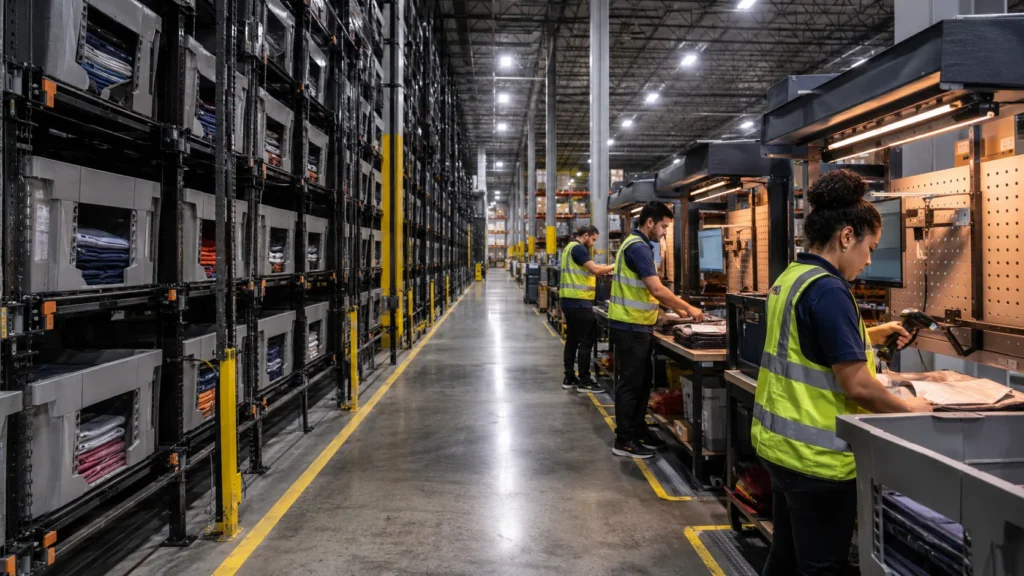
ASRS for apparel warehouse operations sits at the intersection of three problems that almost no other industry has at the same time: SKU explosion, brutal seasonality, and return rates that routinely cross 30%. A consumer electronics fulfillment center stores a few thousand SKUs and handles maybe 5% returns. An apparel distribution center stores tens of thousands of size-color-material combinations, sees demand triple in 6 weeks of peak season, and processes more returns than some warehouses process outbound orders.
This article walks through how automated storage and retrieval system technology actually solves these problems on real apparel and fashion floors. We pull data from deployments at Li-Ning and Decathlon, both of whom we worked with directly, and we cover the parts that vendor brochures usually skip.
What Makes Apparel Different From Every Other Vertical
Three structural traits make apparel warehousing harder than its peers.
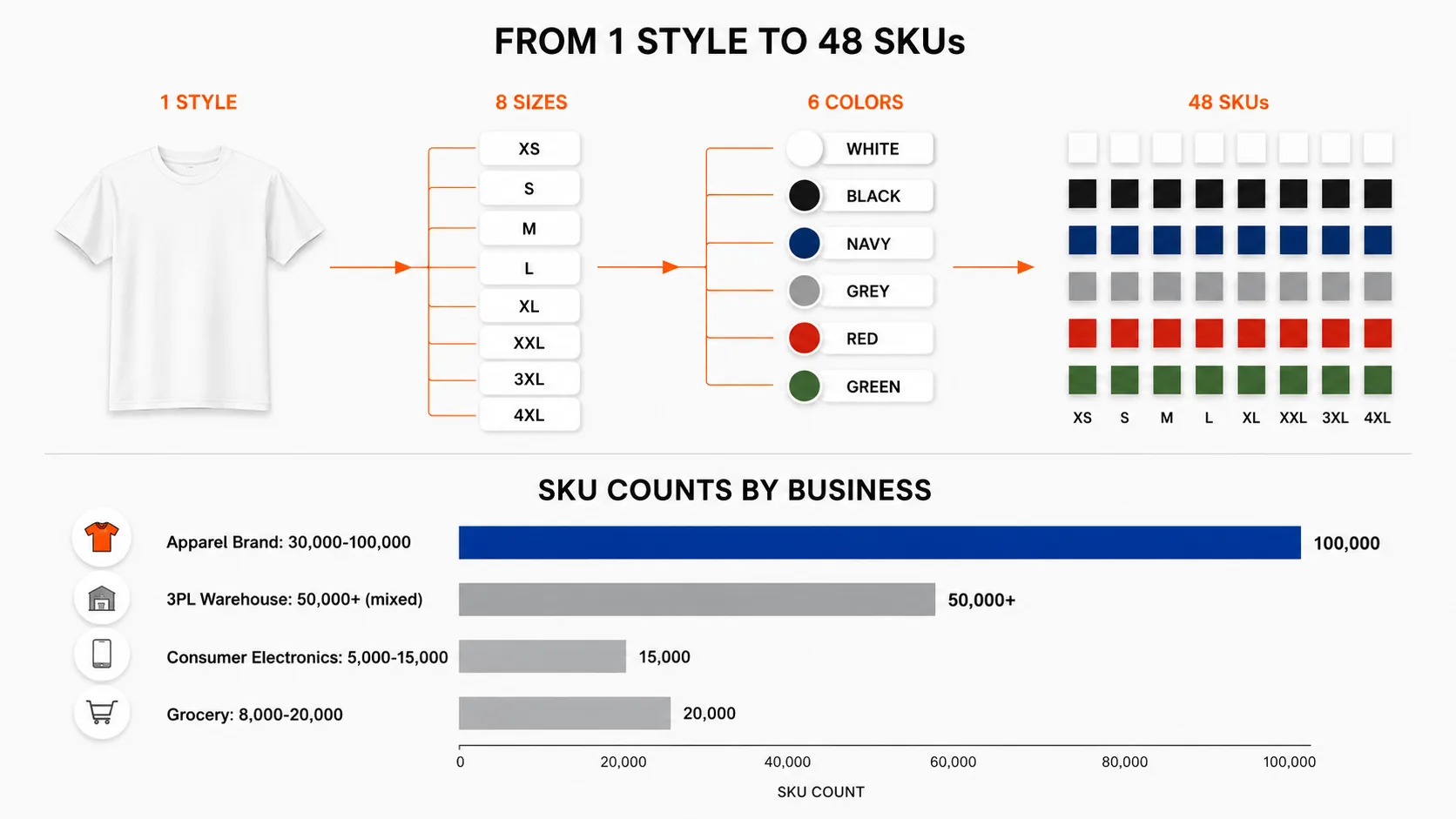
SKU explosion. A single garment style with 8 sizes and 6 colors becomes 48 distinct SKUs. Add fabric variants, regional sizing differences, and limited collaborations, and one style line can carry 80+ SKUs. A mid-size apparel brand routinely manages 30,000-100,000 active SKUs across its catalog, with another 10,000+ historical SKUs that still need to support returns and warranty claims.
Demand volatility. Apparel has more concentrated peaks than almost any other industry. Back-to-school, Black Friday, Christmas, Chinese New Year, and seasonal collections each drive 3x to 8x baseline order volume for 4-8 weeks at a time. The warehouse has to handle the peak without sitting on idle capacity the other 9 months of the year.
Return rates. Online apparel sales return at 25-40% depending on category — significantly higher than electronics, books, or household goods. Returns are not a fringe workflow. For some brands, return processing volume exceeds outbound shipping volume in absolute units handled.
The exact return rate varies by brand, country, and channel mix, so the number should not be treated as a universal benchmark. But the direction is clear: ecommerce returns are structurally higher than store returns, and apparel sits near the difficult end of the spectrum because size, fit, color expectation, and bracketing behavior all create avoidable reverse flow. NRF and Happy Returns projected total U.S. retail returns at $890 billion in 2024, with online returns representing a much higher operational burden than store-only flows. A logistics design for apparel that ignores returns is therefore not a conservative design; it is an incomplete design.
These three traits compound. High SKU count plus high return rate means every returned item is a small needle in a very large haystack. High seasonality plus high SKU count means you cannot pre-position inventory close to demand — you have to retrieve quickly from anywhere in the building.
Storage Strategies for Apparel
Different apparel categories need different storage approaches. The mistake we see most often is treating apparel as one workload.
Folded Garments — Tote-Based ASRS
T-shirts, jeans, polos, knitwear, accessories — anything that ships folded. The right answer is almost always a mini-load or shuttle ASRS holding totes of 5-30 garments each.
Why totes work for folded apparel:
- Density: 4-6x more SKUs per square meter compared to bin shelving
- Speed: 800-1,200 totes per hour per aisle
- Mixing: Multiple SKUs per tote when garment size allows, increasing flexibility
We deployed exactly this configuration at Li-Ning's Nanning regional distribution center where folded apparel makes up the bulk of order volume. The system holds 24,000+ totes serving both wholesale replenishment and direct-to-consumer order flows from the same inventory pool.
Hanging Garments — Different Beast Entirely
Suits, dresses, jackets, formal wear, premium denim — anything that ships on a hanger or gets damaged when folded. Standard tote ASRS will not work here. Two options exist.
A hanging garment ASRS uses overhead rail systems with motorized pouches or trolleys. Density is lower than tote systems (typically 200-400 garments per square meter compared to 1,500+ for folded), but the alternative is hanging rail with manual picking, which gets unmanageable past 8,000 SKUs.
A hybrid approach stores hanging garments in flat totes within the same shuttle ASRS, then unfolds and re-hangs at the packing station. This works if hanging is a finishing step rather than a storage requirement. We've seen this approach used for premium denim where the SKU count is too high for dedicated hanging infrastructure.
High-Value Items — Lockable Storage
Limited collaborations, sneakers, leather goods, accessories above $200 retail. These need pick verification and tamper-evident storage. Most apparel ASRS deployments include a sub-zone with lockable totes and dual-operator pick confirmation. Volume here is usually under 5% of total but theft prevention is non-negotiable.
Picking Strategies for Apparel Operations
Storage technology is half the answer. The picking workflow on top of it determines whether you can hit fashion ecommerce's same-day or next-day SLA.
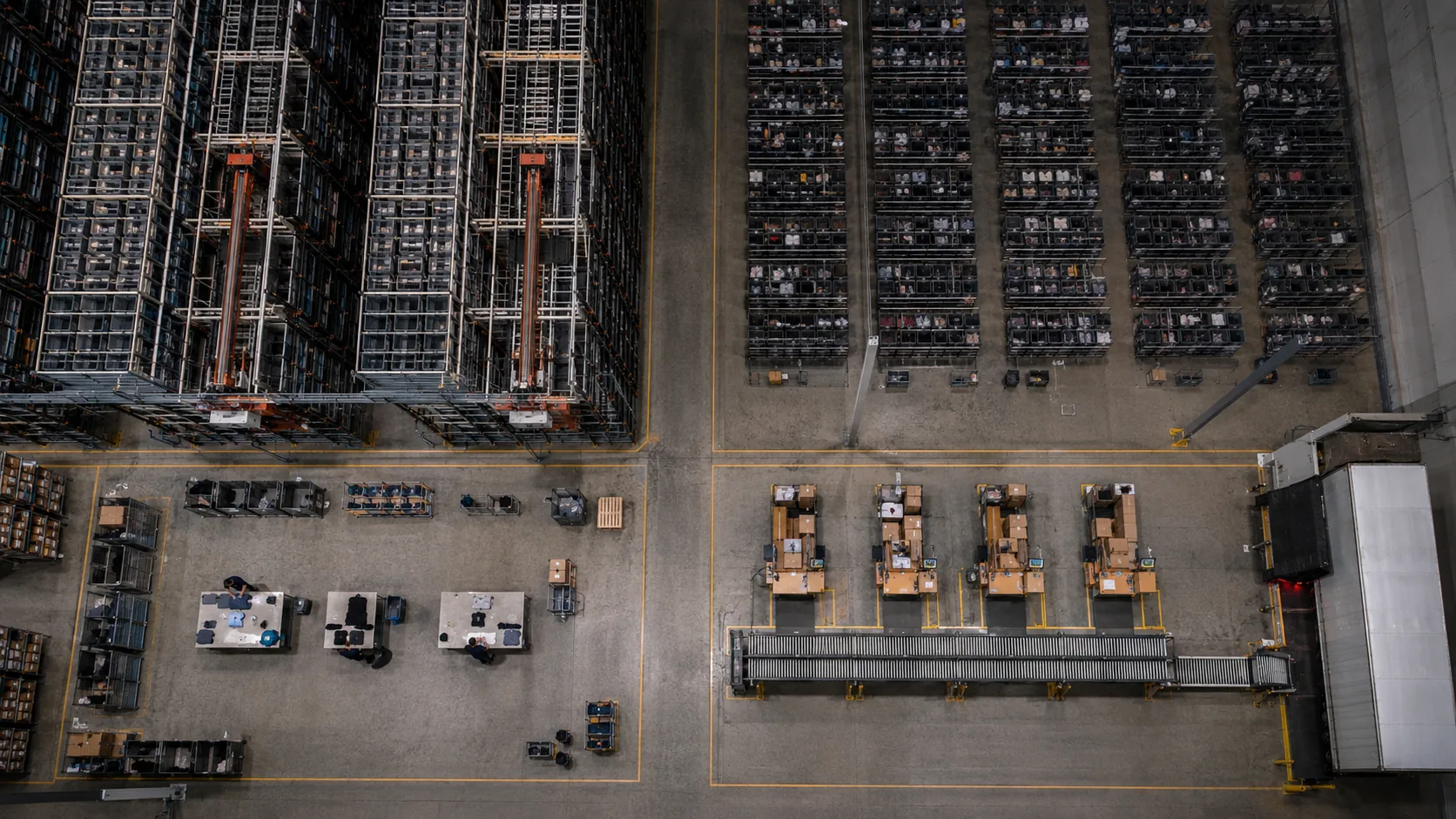
The default for apparel is goods-to-person picking. A shuttle ASRS delivers totes to a stationary operator, who picks one or more units per tote and places them into order cartons. This eliminates walking time, which in a manual apparel warehouse can consume 60-70% of operator hours.
Batch picking works for high-volume SKUs. Operators pick multiple orders simultaneously from the same tote presentation, with put-to-light or put-to-screen systems routing items to the correct order. We see this in fast fashion where 200-300 order lines per hour per operator is typical.
Wave picking suits scheduled wholesale replenishment, where retail stores order in fixed patterns and the warehouse can pre-build picking waves overnight for next-day truck departure. This pattern is common with brands that maintain physical retail networks alongside ecommerce.
Handling Returns — The Hidden Workload
A 30% return rate on a million-order-per-year ecommerce operation means 300,000 returned units flow back through the warehouse annually. That is a serious throughput requirement that often gets bolted on as an afterthought.
The right architecture treats returns as a parallel inbound workflow with its own ASRS interaction pattern.
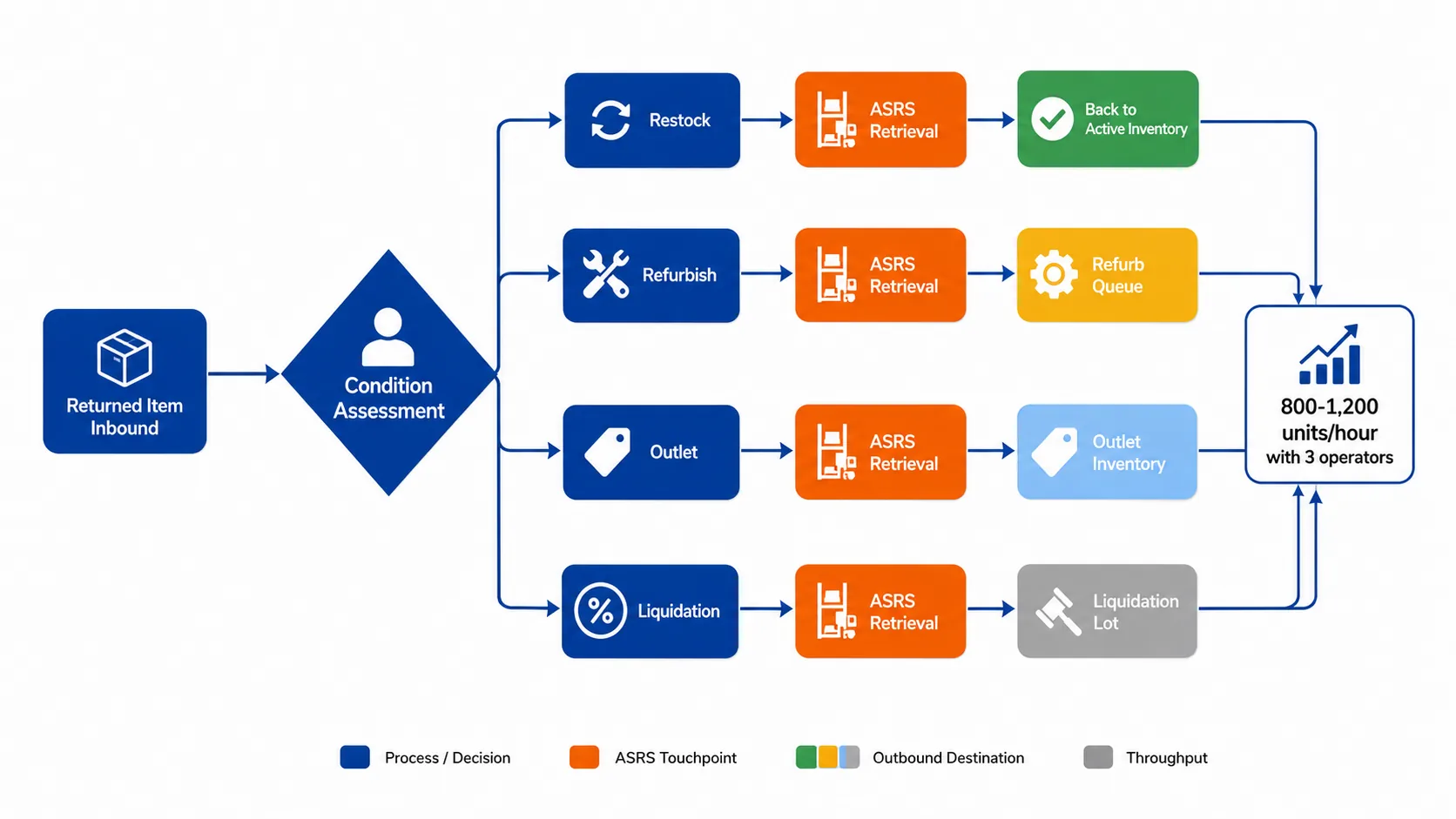
Step 1: Operator receives returned item, scans return label, inspects condition.
Step 2: System decides destination — restock to original SKU location, route to refurbishment for minor defects, route to outlet inventory for damaged-but-sellable, route to liquidation for unsellable.
Step 3: For restocks, ASRS retrieves an existing tote of that SKU, operator adds the returned unit, system stores tote back.
The bottleneck in most apparel return operations is decision-making, not movement. Trained operators making restock-or-route calls drive the throughput, with ASRS retrieval and putaway running underneath. We have seen well-designed apparel return zones process 800-1,200 units per hour with 3 operators and one shuttle aisle dedicated to the workflow.
For broader context on how ecommerce-driven volume changes warehouse design, our ASRS for E-Commerce Fulfillment guide covers parallel concerns around order profile and packing station design.
Case Study: Li-Ning Apparel Distribution
Li-Ning's Nanning regional center handles wholesale replenishment to franchise stores plus direct ecommerce fulfillment from the same building. The pre-automation operation managed roughly 14,000 active SKUs and shipped 1.8 million units annually with peaks at 4x baseline during Singles' Day and Chinese New Year.
The constraint was not floor space. The constraint was peak labor — Li-Ning could not hire and train enough seasonal workers fast enough to hit Singles' Day SLAs without using inventory pre-positioning that froze working capital.
Our deployment combined a shuttle ASRS holding 24,000 totes with 8 goods-to-person picking stations. Three results worth flagging:
- Picking throughput tripled per labor hour, allowing the same headcount to handle 3x peak volume.
- Order cycle time from receipt to ship-ready dropped from 4.2 hours to 1.1 hours.
- Cross-docking between ecommerce returns and wholesale replenishment improved inventory turnover, freeing roughly 18% of working capital previously tied up in safety stock.
Full case study details at the Li-Ning ASRS implementation page.
Case Study: Decathlon Multi-Category Distribution
Decathlon's distribution model is harder than pure apparel because it mixes soft goods with bicycles, fitness equipment, and small camping gear. The apparel portion alone — sportswear and footwear — runs to 11,000+ SKUs with the same seasonal pressure as fashion apparel.
The Decathlon deployment uses pallet ASRS for bulk reserve storage and shuttle ASRS for tote-level picking, with hardware separation between fast-moving SKUs (top 800 SKUs in dense shuttle storage) and long-tail SKUs (slower retrieval but higher storage density).
The interesting design choice: the system was sized for 1.5x current peak, not 3x current peak. Decathlon's reasoning was that future demand growth would be absorbed by adding stations and software optimization rather than building idle capacity. Five years on, this has held — the system has not bottlenecked despite the ecommerce share of orders growing from 22% to 47% over the period.
ROI Considerations Specific to Apparel
The standard ROI inputs for ASRS — labor savings, density, accuracy — all apply to apparel. Three additional inputs matter more here than in other verticals.
Peak handling capacity. A manual apparel operation has to staff for peak or lose holiday revenue. ASRS lets you staff for average and absorb peak through throughput rather than headcount. The financial value of this is often 2-3x the labor savings on baseline volume.
Returns processing speed. Faster returns processing means faster inventory availability for re-sale. In apparel, where seasonality means yesterday's returned item still has 80% of its original sell-through value but next month's returned item has 30%, the speed of putback directly affects revenue recovery.
Markdown reduction. Tight inventory visibility from ASRS-tracked stock reduces over-buying for peak. Apparel companies routinely take 20-40% markdowns on excess seasonal stock. Even a 5 percentage point reduction in markdown rate is worth more than typical labor savings on the same volume. For a brand with $80M annual apparel revenue, that reduction is worth roughly $3-4M in recovered gross margin per year, dwarfing the headcount savings most ROI models lead with.
This is where apparel automation differs from a simple labor-saving project. A faster pick face matters, but the bigger financial lever is often inventory quality: knowing where sellable inventory sits, returning it to active stock quickly, and avoiding the late-season markdown spiral caused by poor visibility. BCG has written extensively about how markdown decisions depend on inventory, sell-through, and gross-profit tradeoffs; McKinsey's State of Fashion 2025 also frames inventory excellence as a continuing pressure point for fashion brands. ASRS does not solve merchandising strategy by itself, but it gives the operations team cleaner inventory location data and faster physical response when the commercial team changes the plan.
For a detailed walkthrough of ROI calculation methodology, see our warehouse automation ROI guide.
Common Mistakes Apparel Companies Make
After deploying apparel ASRS across multiple clients, four patterns of error keep showing up.
Sizing for current SKU count, not 3-year projection. Apparel SKU counts grow 12-18% per year for healthy brands. A system sized for today's catalog hits capacity in year 2 and forces expensive retrofits.
Underestimating returns volume. Companies forecast outbound throughput carefully but treat returns as 5-10% of outbound when actual figures are 25-40%. Returns workflow has to be sized at the design stage, not bolted on after go-live.
Ignoring inbound complexity. Apparel inbound is unusual — single SKU pallets from manufacturers, but mixed-SKU containers from consolidators, plus return-to-vendor flows. The receiving workflow needs as much design attention as picking.
Treating fast and slow SKUs identically. The top 500 SKUs generate 60% of daily picks. Storing them in the same density tier as the long tail wastes both fast-mover throughput and long-tail storage density.
Choosing the Right System for Apparel
The decision framework for apparel borrows from the general ASRS selection criteria but with three apparel-specific weights.
Step 1: Map your SKU velocity curve. If your top 200 SKUs do less than 30% of daily picks, you have an unusually flat curve — favor flexible AMR fleets over dense ASRS. If they do more than 60%, classic ASRS density wins.
Step 2: Forecast return volume in 3 years. Apparel returns scale with ecommerce share. If your ecommerce mix is climbing, returns volume will scale faster than outbound.
Step 3: Estimate peak-to-baseline ratio. Above 3x peak, automation pays back in single seasons. Below 2x, the math gets longer.
Step 4: Decide hanging vs folded mix. If hanging is above 20% of SKU count, dedicated hanging infrastructure justifies its capital cost. Below 20%, hybrid approaches are cheaper.
Step 5: Validate against actual order profile, not vendor reference profile. Apparel order profiles vary widely by brand. Run the design through your real data before commitment.
For deeper technology comparison between system types relevant to apparel, see our breakdown of shuttle ASRS versus crane-based ASRS.
Industry Context and External Benchmarks
The apparel logistics market is shifting in ways that favor automation. Public market data points in the same direction, even when sources define the market differently. Adobe's 2024 ecommerce spending report reported that U.S. consumers spent $52.5 billion online for apparel in the first four months of 2024, up 2.6% year over year, while NRF's 2024 returns report shows how costly reverse logistics has become for retailers. For warehouse design, the conclusion is practical: more online apparel volume means more SKU fragmentation, more return touches, and more pressure on inventory accuracy.
The strategic pressure is also visible in consulting research. McKinsey's State of Fashion 2025 highlights inventory excellence as a continuing challenge for fashion executives, and BCG's markdown analytics research explains why pricing and markdown decisions depend heavily on inventory position and sell-through signals. Those reports are not ASRS vendor material, which is why they are useful context: they show that the warehouse problem is tied to broader commercial performance, not just pick speed.
For apparel operations teams, this means automation should be evaluated against three business outcomes at the same time: peak-season service level, return-to-stock speed, and markdown exposure. If ASRS only reduces walking, the business case may be narrow. If it also improves inventory availability during the selling window and helps returned items become sellable again faster, the business case becomes much stronger.
Frequently Asked Questions
Can a single ASRS handle both folded and hanging garments? In limited cases yes, through hybrid systems where hanging garments live in flat totes and get re-hung at packing. For brands with hanging-heavy assortments above 30% of SKU count, dedicated hanging infrastructure outperforms hybrid approaches on both speed and garment quality preservation.
How does ASRS handle items returned damaged or used? The system tracks return condition at receiving, then routes items to different putaway zones — restock, refurb, outlet, or liquidation. The ASRS only stores items that get restocked; the other categories flow to dedicated outbound paths.
Is ASRS worth it for apparel brands under $30M revenue? Usually no, for now. Below roughly $30M revenue, the throughput does not justify fixed automation capital. Apparel brands in the $30-100M range benefit most from hybrid setups — partial automation on the fastest movers, manual operation on the long tail.
How long does an apparel ASRS deployment take? Greenfield builds run 12-18 months from contract to first shipped order. Retrofits into existing apparel warehouses run 18-24 months because operations have to keep running during install. Peak season cutoffs constrain when retrofit go-live can happen safely.
What about same-day delivery — can ASRS support it? Yes, but the constraint is rarely the ASRS itself. Same-day requires order cutoffs aligned with carrier pickup windows, micro-fulfillment positioning, and last-mile logistics. ASRS speeds the warehouse portion to 30-90 minutes from order receipt to ship-ready, which is fast enough that other parts of the chain become the bottleneck.
Bottom Line
Apparel and fashion are not edge cases for ASRS — they are exactly the workload type where automation pays back fastest, because the underlying problems (SKU explosion, seasonality, returns) are structural and only get worse as ecommerce share grows. The brands that have already automated are not slowing down; they are extending into hanging garments, returns workflows, and micro-fulfillment.
For brands sitting on the fence, the deciding question is rarely "can we afford it" — it is "can we afford not to" once peak season demand outgrows the ability to hire and train seasonal workers fast enough.
If you want to talk through your specific catalog, return profile, and peak forecasts, contact our team — we have scoped enough apparel deployments to tell you within a 30-minute call whether the math works for your operation.
Planning a Warehouse Automation Project?
Our team has delivered 50+ ASRS systems across retail, manufacturing, and logistics. Tell us about your project and we will get back to you within 24 hours.
Thank you!
We received your message and will get back to you within 24 hours.