If you run a warehouse that handles thousands of small parts, totes, or cartons every day, you already know the pain: pickers walking miles, inventory errors stacking up, and floor space that never seems to be enough. A mini load ASRS system is built to solve exactly these problems — and in our experience, it does so faster than most operations expect.
This guide breaks down what a mini load ASRS is, how it works, what it costs, and how to decide if it fits your operation. We have deployed these systems across electronics, fashion, pharma, and 3PL warehouses, so the advice here comes from real projects, not spec sheets.
What Is a Mini Load ASRS and When Does It Make Sense?
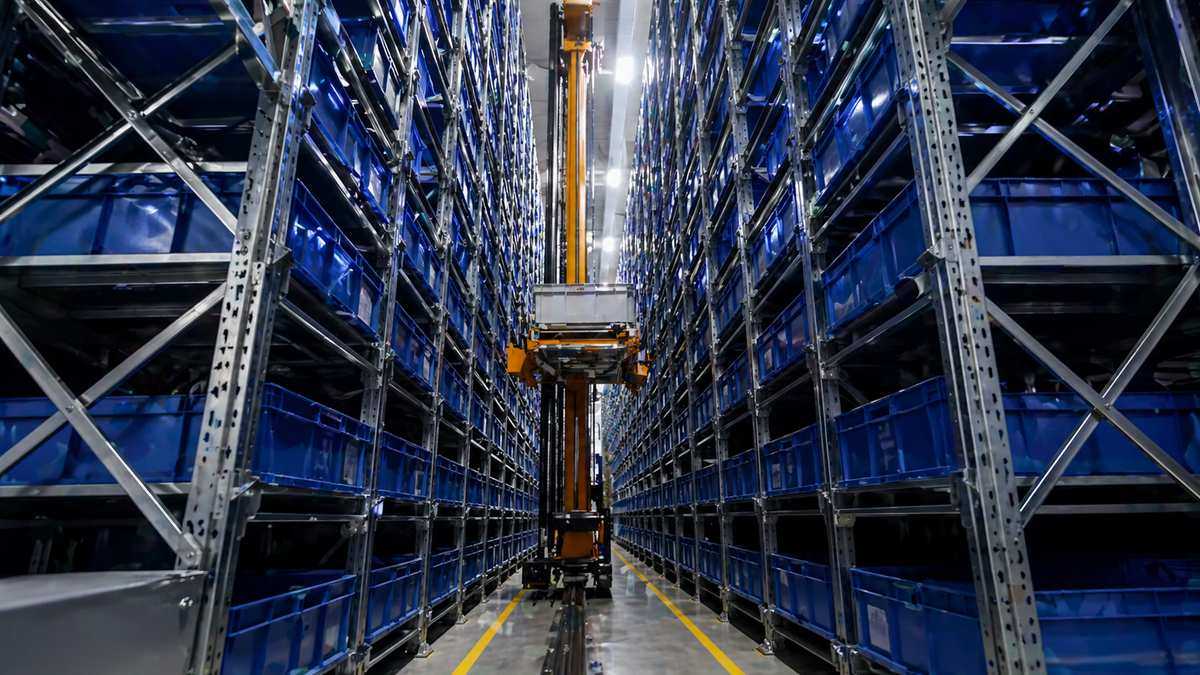
A mini load ASRS (Automated Storage and Retrieval System) is a crane-based system designed to store and retrieve small to medium loads — typically totes, bins, cartons, or trays weighing up to 50 kg (110 lbs) per unit. Unlike unit-load AS/RS that handles full pallets, a mini load ASRS system targets the SKU-level: individual parts, components, or picked orders stored in standardized containers.
If you are new to the broader category, our overview of what ASRS means covers the fundamentals.
A mini load automated storage system makes sense when your operation meets several of these conditions:
- High SKU count with small to medium items — thousands of unique parts that do not justify full-pallet storage
- Order profiles that demand piece-level or case-level picking — e-commerce, spare parts, pharma, electronics
- Limited floor space — you need vertical density, not more square footage
- Labor pressure — rising wages, high turnover, or difficulty hiring reliable warehouse staff
- Accuracy requirements above 99.5% — regulated industries, serialized inventory, or high-value goods
- Throughput between 100 and 500+ order lines per hour — too fast for manual picking, but not requiring goods-to-person robotics at scale
When we deployed a mini load ASRS for a consumer electronics distributor, the trigger was simple: they had 12,000 active SKUs in a 30,000 sq ft facility and pickers were averaging 8 miles of walking per shift. The system cut that to zero walking for 85% of picks.
How a Mini Load ASRS Works
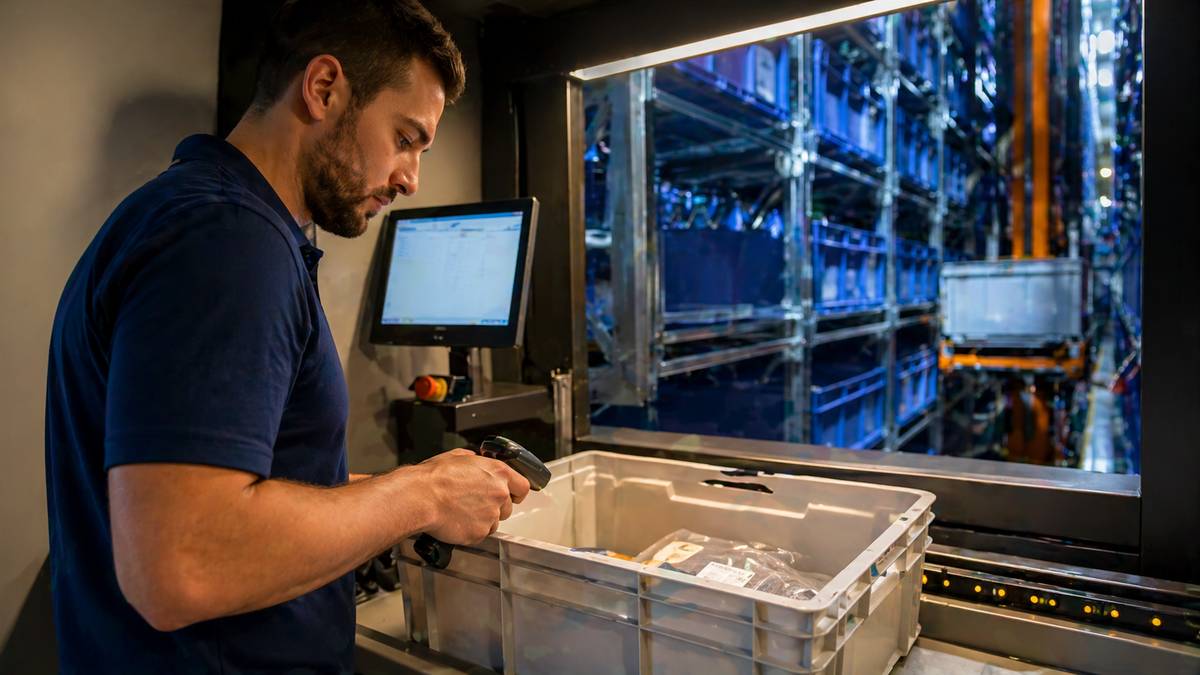
The operating principle is straightforward. A mini load crane runs on rails inside a narrow aisle between two rows of racking. The crane carries an extractor — a telescopic fork, gripper, or shuttle plate — that reaches into the racking to pull out a tote or carton and deliver it to a conveyor at the end of the aisle. From there, the container travels to a picking station where an operator picks the required items, and the system returns the container to storage.
Here is the step-by-step flow:
- Order release — The warehouse execution system receives an order and identifies which totes contain the needed SKUs.
- Retrieval command — The WES sends a retrieval task to the mini load crane assigned to the relevant aisle.
- Crane travel — The crane moves simultaneously in the horizontal and vertical axes (dual-axis travel) to reach the target storage position.
- Extraction — The extractor pulls the tote from the rack onto the crane's platform.
- Transport to pick station — The crane deposits the tote onto a conveyor system that routes it to the correct picking workstation.
- Picking — The operator picks items guided by a put-to-light or pick-by-light display, confirms the pick, and the tote is returned to storage or routed to the next station.
- Putaway — The same process runs in reverse for inbound goods or replenishment.
Modern mini load cranes reach speeds of 5 m/s horizontally and 2 m/s vertically, with acceleration profiles tuned to avoid damaging fragile goods. Dual-shuttle cranes — carrying two totes at once — can handle 200+ double cycles per hour per aisle, which means one crane can serve 400+ tote movements per hour.
The intelligence sits in the WES layer. Good software optimizes storage slotting (putting fast-movers near the I/O point), batches orders to minimize crane travel, and sequences retrievals so that the pick station always has work queued. This is where integration expertise matters — and why we focus heavily on our WES platform as the brain of every system we build.
Mini Load ASRS vs Other System Types
Choosing the right ASRS type is one of the most consequential decisions in a warehouse automation project. Here is how a mini load ASRS stacks up against the alternatives. For a deeper breakdown, see our comparison of all ASRS types.
| Feature | Mini Load ASRS | Shuttle ASRS | Cube-Based (Bin Robot) | Unit-Load AS/RS |
|---|---|---|---|---|
| Load type | Totes, cartons (up to 50 kg) | Totes, cartons (up to 50 kg) | Bins (up to 35 kg) | Pallets (up to 1,500 kg) |
| Throughput per aisle | 200-400 totes/hr | 400-1,000+ totes/hr | Scales with robot count | 40-60 pallets/hr |
| Max racking height | 12-20 m | 12-25 m | 5-8 m (grid-based) | 30-45 m |
| Scalability | Add aisles | Add shuttles per level | Add robots | Add aisles/cranes |
| Capital cost | Medium | Medium-High | Medium | High |
| Best for | Medium throughput, high density | High throughput, flexible scaling | Dense storage, moderate throughput | Full-pallet, bulk storage |
| Maintenance complexity | Low-Medium (single crane per aisle) | Medium-High (many shuttles) | Low (robots are replaceable) | Low-Medium |
The key trade-off: mini load cranes give you excellent vertical density and reliable throughput at a moderate price point. Shuttle systems beat them on raw speed but cost more and have more moving parts. Cube-based bin robots (like the systems we deployed for Haiou Housing's cross-floor tote automation) offer extreme density but cap out on height.
In our experience, mini load ASRS hits the sweet spot for operations processing 100-500 order lines per hour with 5,000-50,000 SKUs. Below that range, simpler solutions work. Above it, shuttle or hybrid systems start to make more economic sense.
Industries That Benefit Most from Mini Load ASRS
Mini load automated storage is not industry-specific, but certain verticals see outsized returns. We have built systems across all of these and can point to measurable results in each.
Electronics and spare parts — High SKU counts (often 20,000+), small item sizes, and strict accuracy requirements make this a textbook fit. Serialized inventory tracking and ESD-safe tote handling are standard requirements.
Pharmaceutical and healthcare — Regulatory compliance (FDA, GMP) demands traceability and climate-controlled storage. Mini load ASRS systems with temperature-controlled zones and lot-tracking integration are common in this space.
Fashion and apparel — Seasonal demand swings, high return rates, and massive SKU proliferation (size/color/style combinations) create exactly the kind of complexity that bin storage automation handles well. See how ERAL achieved 3x storage density with their fashion warehouse automation project.
E-commerce and 3PL — Order profiles are small (1-3 items per order), velocity is high, and SLA windows are tight. Mini load systems paired with goods-to-person picking stations can process 300+ order lines per hour per station.
Automotive aftermarket — Tens of thousands of part numbers, irregular demand patterns, and the need to ship same-day. A mini load ASRS system keeps slow-movers accessible without consuming prime floor space.
For a broader look at how we approach different verticals, check our industry-specific solutions page.
Cost and ROI: What to Expect
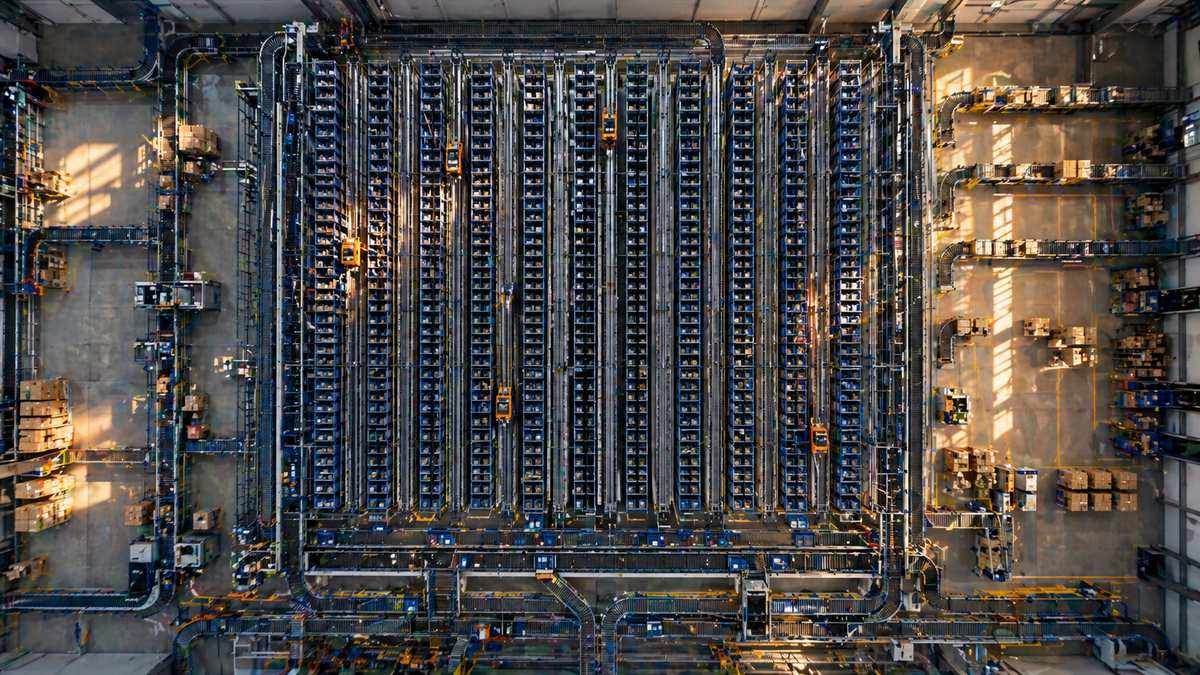
Let's talk numbers. A mini load ASRS system typically falls in the $1.5 million to $8 million range for a complete installation, depending on scale, throughput requirements, and integration complexity. Per storage position, expect $100 to $350, which includes racking, cranes, conveyors, pick stations, and software.
Here is how the cost breaks down in a typical mid-size project:
| Component | % of Total Cost | Notes |
|---|---|---|
| Mini load cranes | 30-40% | Single or dual-shuttle, speed-dependent |
| Racking system | 15-20% | Height, load capacity, seismic requirements |
| Conveyor network | 15-20% | Length, routing complexity, sortation |
| WES/WMS software | 10-15% | Integration depth, custom logic |
| Pick stations | 5-10% | Ergonomic design, put-to-light, displays |
| Installation and commissioning | 10-15% | Site prep, electrical, fire suppression |
ROI timeline: Most operations we have worked with see payback in 2.5 to 4 years, driven by three factors:
- Labor reduction — Typically 40-60% fewer FTEs in the picking operation. At $45,000-$55,000 fully loaded cost per warehouse worker per year, this adds up fast.
- Space savings — Mini load racking stores 3-5x more SKUs per square foot than conventional shelving. If you are leasing warehouse space at $8-$15/sq ft/year, the density gain has real dollar value.
- Accuracy improvement — Going from 99.2% to 99.9% pick accuracy eliminates costly returns, re-ships, and customer credits. For operations shipping 10,000+ lines per day, this alone can save $200,000-$500,000 annually.
For a more detailed cost analysis across all system types, see our detailed ASRS pricing breakdown.
How to Choose the Right Mini Load ASRS
Selecting a mini load ASRS system is not just about picking a crane. It is a system-level decision that touches racking, software, conveyors, building infrastructure, and operational workflow. Here are the factors we walk through with every client:
1. Throughput requirements — Map your current and projected order profiles. How many order lines per hour at peak? What is the ratio of picks to putaways? A single-shuttle crane handles 200 totes/hr; a dual-shuttle crane handles 350-400. If you need more, you add aisles or consider shuttle-based alternatives.
2. SKU profile and container sizing — Standardize on tote or carton dimensions early. Most mini load systems support 600x400mm or 400x300mm Euro-standard totes. Mixed container sizes are possible but add complexity and cost.
3. Building constraints — Ceiling height determines racking height. Floor flatness affects crane rail installation. Column spacing dictates aisle layout. We have seen projects where a 1-meter difference in clear height changed the business case entirely.
4. Software integration depth — The mini load crane is hardware. The value comes from how well the WES integrates with your ERP, WMS, and order management systems. Ask hard questions about API architecture, real-time inventory visibility, and failover handling.
5. Maintenance and support model — Crane-based systems have fewer moving parts than shuttle systems, but they are single points of failure per aisle. Redundancy planning, spare parts strategy, and remote diagnostics capability matter.
6. Scalability path — Can you add aisles later without shutting down the existing system? Is the software licensed per crane or per site? What happens when throughput requirements double in three years?
Browse our full ASRS hardware lineup to see the crane and racking options we integrate.
Real-World Case Studies
Theory is useful, but results are what matter. Here are projects where mini load and bin storage automation delivered measurable outcomes.
Li-Ning: 630% Efficiency Improvement
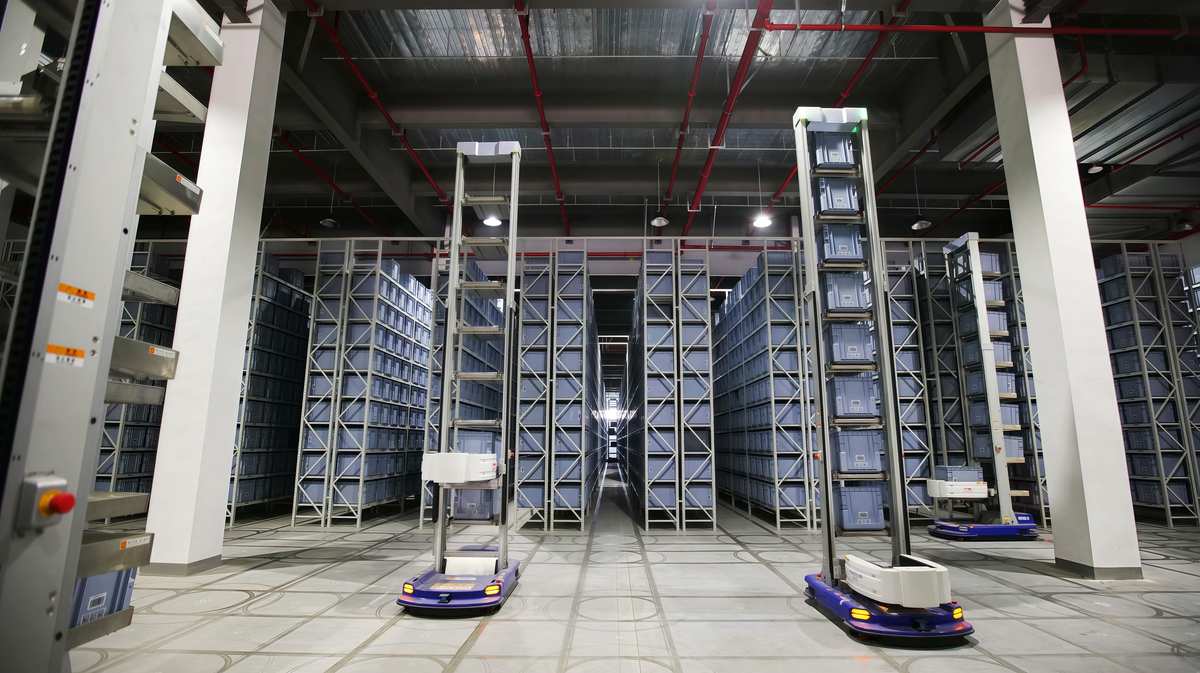
Li-Ning, one of China's largest sportswear brands, needed to handle explosive e-commerce growth without expanding their warehouse footprint. We integrated a high-density bin storage automation system that combined mini load principles with goods-to-person picking stations.
The result: 630% improvement in picking efficiency, with the same team processing over 6x the daily order volume. The system paid for itself in under two years. Read the full story in our Li-Ning case study.
Sony: 49-Robot Deployment
Sony's distribution center required precision handling for high-value electronics with strict ESD and serialization requirements. The deployment included 49 autonomous robots working within a dense racking structure, integrated with Sony's existing WMS through our WES platform.
Throughput targets were exceeded by 15% in the first quarter of operation, and inventory accuracy hit 99.97%. See the details in our Sony case study.
ERAL: 3x Storage Density and 300% Order Processing Speed
ERAL, a fashion brand dealing with massive SKU proliferation across seasonal collections, was running out of space and struggling with pick accuracy. The automated bin storage system we deployed tripled their storage density in the same footprint and increased order processing speed by 300%.
The project also cut mispick rates by 90%, which directly reduced return-related costs. Full breakdown in our ERAL case study.
Haiou Housing: Cross-Floor Bin Robots
Haiou Housing presented a unique challenge: multi-floor operations with inventory that needed to move between levels. We deployed bin-carrying robots that operate across floors using integrated lift systems, creating a seamless flow between storage zones on different levels.
This project pushed the boundaries of what bin storage automation can do in constrained, multi-story facilities.
Getting Started with Mini Load ASRS
If you are evaluating bin storage automation for your operation, here is the practical path forward:
- Audit your current state — Document your SKU count, order profiles, peak throughput, current labor cost, and building dimensions. This data drives every downstream decision.
- Define your requirements — Not just today's numbers, but where you need to be in 3-5 years. Overbuilding by 20-30% is cheaper than retrofitting later.
- Evaluate system types — Mini load ASRS is one option among several. A good integrator (that is what we do) will tell you honestly if a different approach fits better.
- Request proposals from integrators, not just equipment vendors — The crane is 30-40% of the cost. The other 60-70% is racking, conveyors, software, and integration. You want a partner who owns the whole solution.
- Plan for commissioning and ramp-up — Budget 3-6 months from installation complete to full production speed. Training, software tuning, and slotting optimization take time.
As the Material Handling Institute (MHI) notes in their annual industry report, automated storage systems continue to rank among the top investment priorities for warehouse operators — and mini load systems represent the fastest-growing segment within that category.
We have been through this process hundreds of times across industries and geographies. If you want to talk specifics — throughput modeling, budgetary estimates, or site feasibility — request a mini load ASRS consultation and we will set up a technical call with our engineering team.