
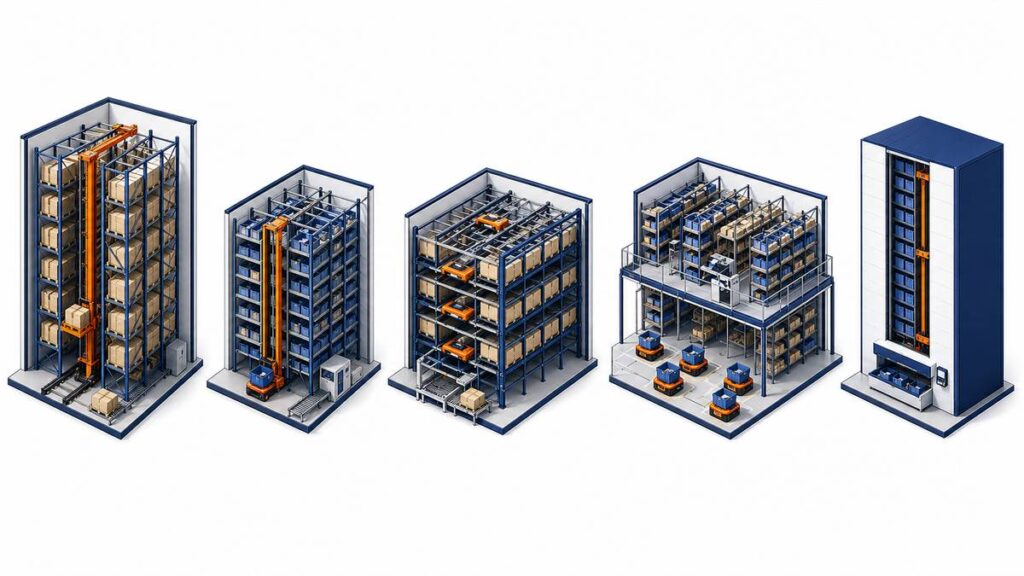
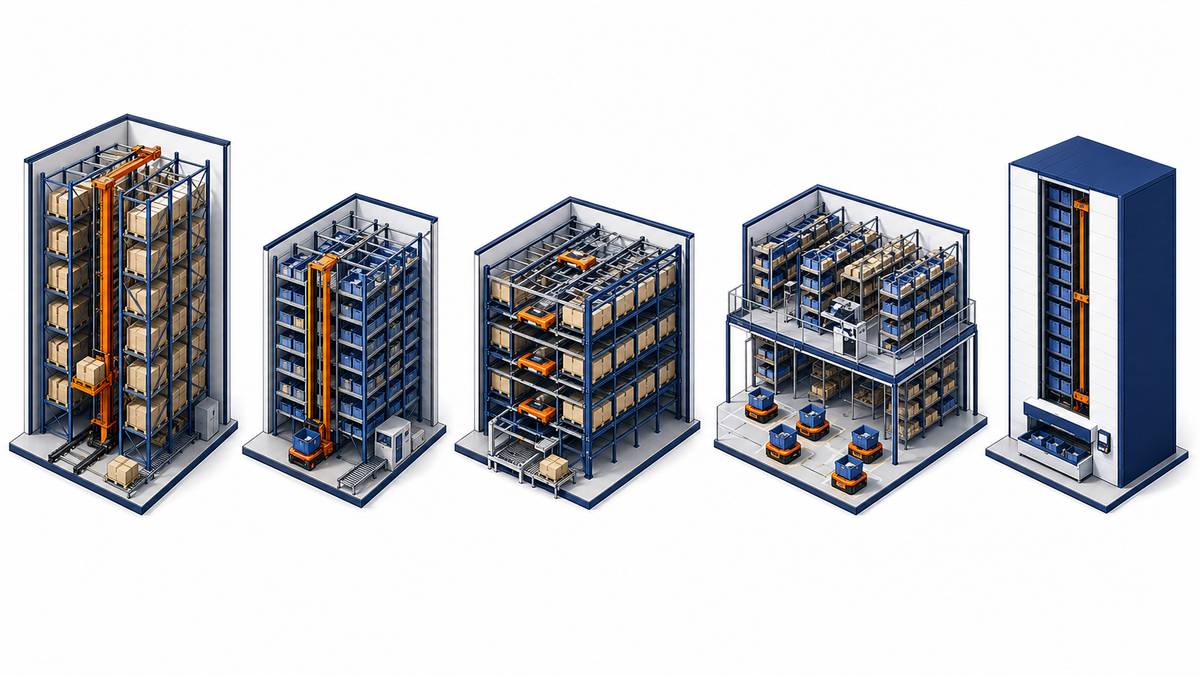
There are five main types of ASRS systems used in modern warehouses: unit load, mini load, shuttle-based, robotic goods-to-person, and vertical lift modules. Each one solves a different problem — and picking the wrong type is one of the most expensive mistakes a warehouse operator can make.
We've deployed all five across manufacturing plants, e-commerce fulfillment centers, 3PL operations, and retail distribution hubs. The pattern we see over and over is this: companies fixate on a single technology (usually whatever they saw at the last trade show) without mapping it to their actual SKU profile, throughput targets, and growth trajectory. That's how you end up with a $4 million system that bottlenecks at 60% of your peak-season volume.
This guide breaks down each type of automated storage and retrieval system, compares them head-to-head, and gives you a practical framework for choosing the right one. If you're still getting up to speed on the basics, our guide on what ASRS means and how it works is a good starting point.
1. Unit Load ASRS
Unit load ASRS is the workhorse of heavy-duty automated storage. These systems use automated stacker cranes — tall, rail-guided machines — that travel along narrow aisles to store and retrieve full pallets from high-rise racking. Typical installations reach 30 to 40 meters in height, and some purpose-built facilities push past 45 meters.
The core advantage is raw storage density. By eliminating the wide aisles that forklifts need, a unit load ASRS can store 40–60% more pallets in the same building footprint. The cranes operate 24/7 at consistent speeds, handling 20–40 pallet movements per hour per aisle depending on the system configuration and racking depth.
Where unit load ASRS fits best:
- Bulk storage for manufacturing raw materials and finished goods
- Cold chain and frozen storage (where minimizing human exposure to extreme temperatures is a safety priority)
- Beverage distribution with high pallet volumes and predictable SKU profiles
- Any operation storing full pallets with moderate throughput requirements
Limitations to know about: Unit load systems are fixed infrastructure. The cranes run on rails, the racking is bolted to the floor, and reconfiguring the layout after installation is expensive and disruptive. If your product mix or storage needs change significantly year over year, this rigidity becomes a real constraint. Throughput per aisle is also capped by crane speed — if you need 100+ pallet moves per hour from a single aisle, you'll need to look at shuttle-based alternatives.
Cost range: $2M–$10M for a typical installation, with per-position costs of $150–$500. See our full ASRS pricing breakdown for detailed numbers by system size.
2. Mini Load ASRS
Mini load ASRS handles smaller inventory — totes, trays, cartons, and individual cases — using automated cranes or robotic extractors within enclosed racking structures. Think of it as the unit load concept scaled down for items that don't need a full pallet position.
These systems typically store 15,000 to 100,000+ tote positions in a compact footprint, with cranes serving each aisle at speeds of 30–60 tote movements per hour. The totes are delivered to ergonomic picking stations where operators fulfill orders without walking the warehouse floor.
Where mini load ASRS fits best:
- E-commerce fulfillment with high SKU counts (10,000+ active SKUs)
- Pharmaceutical distribution requiring lot tracking and FIFO compliance
- Electronics and spare parts warehousing with small, high-value items
- Any operation where order profiles involve picking many different small items per order
Real-world performance: In our experience working with 3C electronics clients, mini load systems consistently deliver 99.9%+ inventory accuracy and reduce picking labor by 50–70%. Sony's 49-robot installation started as a mini load concept before evolving into a hybrid robotic deployment — a common progression we see as clients outgrow their initial throughput targets.
Limitations to know about: Like unit load systems, traditional mini load ASRS uses fixed cranes on rails. Throughput scales by adding aisles (each with its own crane), which means capacity planning needs to happen upfront. The systems also require consistent tote sizes — if your inventory includes items that don't fit standard containers, you'll need a secondary handling process.
3. Shuttle-Based ASRS
Shuttle-based ASRS replaces the single crane per aisle with multiple autonomous shuttle vehicles that travel horizontally within racking levels. Vertical movement is handled by dedicated lifts at the end of each aisle. This architecture fundamentally changes the throughput equation: instead of one crane bottleneck per aisle, you can deploy dozens of shuttles across multiple levels.
A well-configured shuttle system handles 200–1,000+ tote or carton movements per hour per aisle — 5 to 10 times the throughput of a traditional mini load crane. And the scaling model is straightforward: add more shuttles to increase speed, add more racking levels to increase capacity.
Where shuttle-based ASRS fits best:
- High-throughput distribution centers processing 10,000+ order lines per day
- Omnichannel fulfillment requiring both e-commerce and store replenishment from the same inventory
- 3PL operations where client volumes fluctuate and the system needs to scale up or down
- Any operation where throughput growth is expected but hard to predict precisely
The scalability advantage: This is the single biggest reason companies choose shuttle systems over crane-based alternatives. When we work with clients whose volumes are growing 20–30% year over year, shuttle ASRS lets them start with a base configuration and add capacity incrementally. You're not locked into a fixed throughput ceiling the day the system goes live.
Limitations to know about: The upfront cost per storage position is higher than crane-based systems, and the mechanical complexity increases maintenance requirements. Shuttle systems also need robust warehouse execution system software to coordinate vehicle traffic, manage charging cycles, and optimize task sequencing across hundreds of moving parts.
Cost range: $2M–$15M depending on scale and throughput requirements. The per-position cost runs $120–$400, but the total cost of ownership often favors shuttles over cranes for operations above 5,000 order lines per day.
4. Robotic Goods-to-Person ASRS
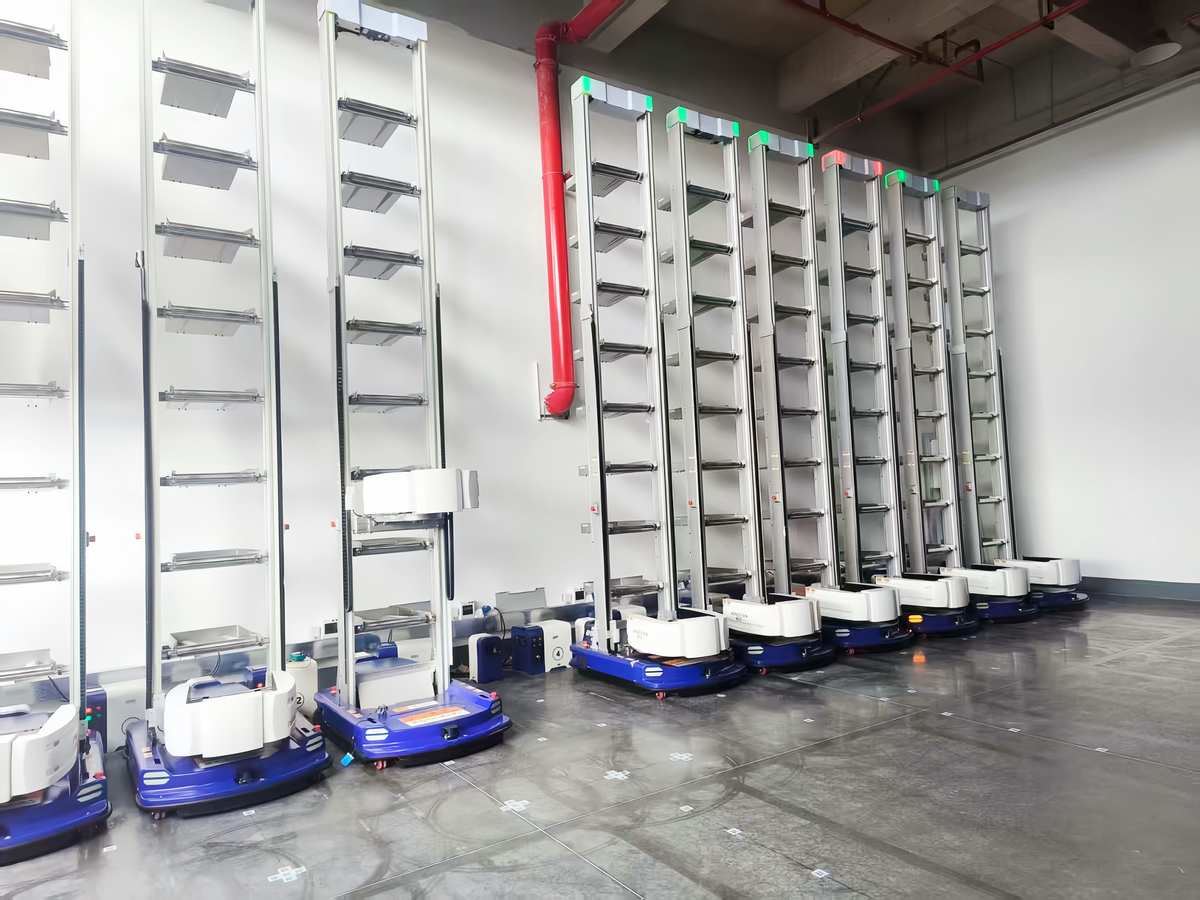
This is the category that's reshaping warehouse automation fastest. Robotic goods-to-person (G2P) systems use fleets of autonomous mobile robots — bin robots, shelf-carrying robots, or composite AGVs — to bring inventory directly to stationary human operators at picking workstations. The workers stay put; the robots do all the traveling.
The concept is simple, but the execution varies widely. Some systems use robots that slide underneath portable shelving units and carry them to the pick station (the Amazon Kiva model). Others use bin robots that climb racking structures, extract individual totes, and deliver them via conveyor. More advanced setups combine multiple robot types with robotic arms for fully automated pick-and-place.
Where robotic G2P fits best:
- E-commerce and retail distribution with high pick rates (500+ lines per hour per station)
- Operations with frequent SKU changes or seasonal inventory rotation
- Facilities where floor space is available but ceiling height is limited
- Companies that want to start small and scale robot fleets incrementally
Real deployment data from our projects:
- Li-Ning (sportswear): Bin robot deployment across multiple warehouse zones achieved a 630% efficiency improvement over manual operations. The system handles peak-season volumes for one of China's largest athletic brands. Read the full Li-Ning case study.
- Decathlon (sporting goods): 1,000+ robots deployed across 25+ projects globally, using a mix of ASRS types including robotic G2P as the primary picking technology. See Decathlon's multi-zone deployment.
- YKK (fasteners/zippers): Goods-to-person robots combined with robotic arms for 24/7 unmanned operation — no human operators on the warehouse floor during overnight shifts.
Limitations to know about: Robot fleets require flat, clean floors and reliable Wi-Fi or 5G connectivity. The robots themselves are consumable assets with 5–8 year lifespans, so replacement cycles need to factor into your TCO calculation. And while the per-robot cost has dropped significantly (now $25,000–$60,000 per unit depending on capability), a large-scale deployment of 200+ robots still represents a major capital commitment.
5. Vertical Lift Modules (VLM) and Carousel Systems
Vertical lift modules store items in enclosed columns of trays that are automatically delivered to an access window at an ergonomic working height. The operator requests an item, the VLM retrieves the correct tray, and presents it for picking — all within a footprint of roughly 10–20 square meters of floor space.
Carousel systems work on a similar principle but use rotating shelves (horizontal or vertical) instead of trays on a lift. Both technologies are designed for small-parts storage in space-constrained environments.
Where VLMs and carousels fit best:
- Maintenance, repair, and operations (MRO) parts storage
- Retail backrooms and store-level inventory management
- Tool cribs and manufacturing line-side storage
- Medical device and pharmaceutical storage requiring controlled access
- Any location where floor space is extremely limited but ceiling height is available
Performance characteristics: A single VLM unit typically stores 5,000–50,000 small parts in a 10–15 square meter footprint, replacing 50–75% of the shelving that would otherwise be needed. Pick rates are modest — 40–100 lines per hour per unit — but the space savings and accuracy improvements (99.9%+) make them compelling for the right application.
Limitations to know about: VLMs are point solutions, not warehouse-scale systems. They work well for specific zones within a larger operation but can't handle the throughput or volume requirements of a full distribution center. They're also single-point-of-failure systems — if the lift mechanism goes down, everything stored inside is inaccessible until it's repaired.
Cost range: $50,000–$200,000 per unit, making them the most accessible entry point into ASRS technology.
ASRS System Types: Head-to-Head Comparison
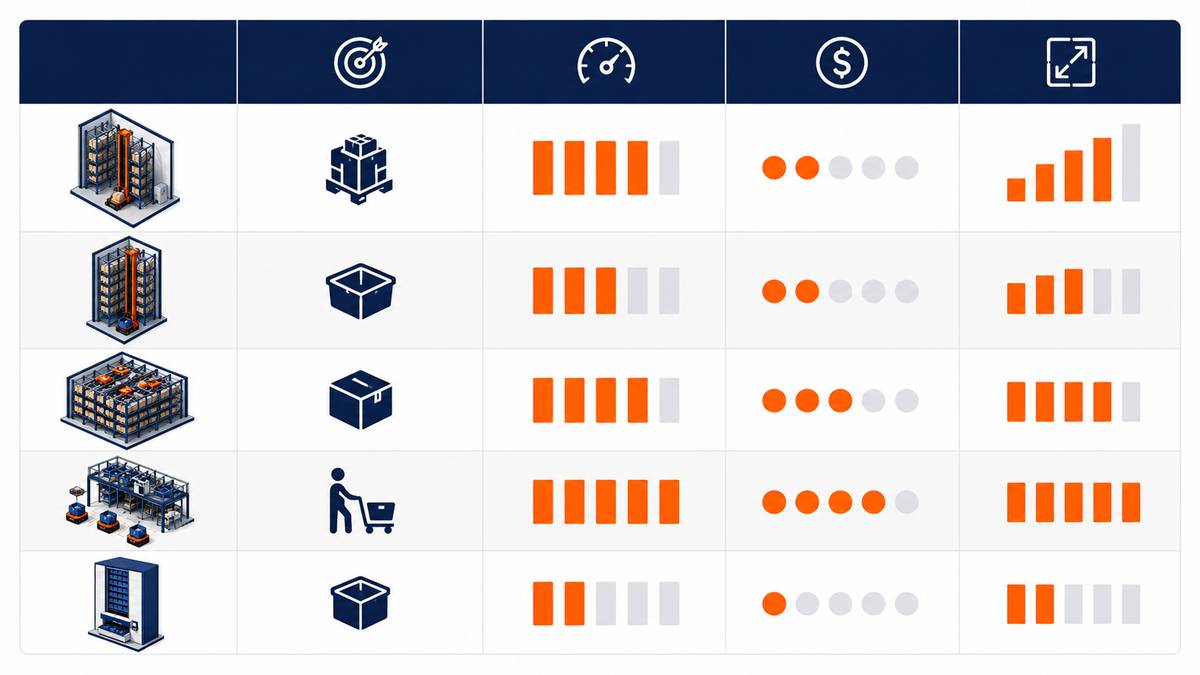
Here's how the five types of ASRS systems stack up across the metrics that matter most for selection decisions:
| Feature | Unit Load | Mini Load | Shuttle | Robotic G2P | VLM/Carousel |
|---|---|---|---|---|---|
| Typical load | Full pallets | Totes/cartons | Totes/cartons | Bins/shelves | Small parts |
| Storage capacity | 5,000–50,000+ pallets | 15,000–100,000+ totes | 20,000–200,000+ totes | 10,000–100,000+ bins | 5,000–50,000 parts |
| Throughput | 20–40 pallets/hr/aisle | 30–60 totes/hr/aisle | 200–1,000+ totes/hr/aisle | 500+ lines/hr/station | 40–100 lines/hr/unit |
| Accuracy | 99.9%+ | 99.9%+ | 99.9%+ | 99.5–99.9% | 99.9%+ |
| Scalability | Low (fixed cranes) | Low (fixed cranes) | High (add shuttles) | High (add robots) | Low (add units) |
| Flexibility | Low | Low | Medium | High | Medium |
| Typical cost | $2M–$10M | $1.5M–$8M | $2M–$15M | $500K–$12M | $50K–$200K/unit |
| Space savings | 40–60% | 50–70% | 50–70% | 30–50% | 50–75% (local) |
| Best ceiling height | 20–45m | 10–25m | 10–20m | 3–10m | 3–14m |
| Implementation time | 12–18 months | 10–16 months | 10–16 months | 3–8 months | 2–6 weeks |
How to Choose the Right ASRS Type: A Decision Framework
Choosing between types of automated storage and retrieval systems isn't about finding the "best" technology — it's about matching the right technology to your specific operation. Here's the framework we use with clients during the planning phase.
Step 1: Define your unit of handling
What are you storing and moving? Full pallets point toward unit load. Totes and cartons point toward mini load or shuttle. Mixed small items point toward robotic G2P or VLMs. This single question eliminates 2–3 options immediately.
Step 2: Quantify your throughput requirements
Map your current order volume AND your projected volume 3–5 years out. If you need fewer than 5,000 order lines per day, a mini load or small robotic fleet handles it. Above 10,000 lines per day, you're looking at shuttle systems or large-scale robotic G2P. Above 50,000 lines per day, you almost certainly need a hybrid approach.
Step 3: Assess your building constraints
Ceiling height is the most underrated factor in ASRS selection. A 30-meter-tall purpose-built facility opens up unit load and deep shuttle configurations that are impossible in a standard 10-meter warehouse. Floor load capacity, column spacing, and available footprint all constrain your options further.
Step 4: Evaluate your growth trajectory
If your volumes are stable and predictable, fixed-infrastructure systems (unit load, mini load) offer lower lifetime costs. If you're growing fast or operating in a volatile market, the incremental scalability of shuttle and robotic systems protects your investment. When we deployed a system for Shengyun Circuit, the forklift AGV solution delivered a 30% efficiency gain and 40% labor reduction — but the real value was the ability to scale the fleet as production volumes increased without ripping out infrastructure.
Step 5: Calculate total cost of ownership, not just purchase price
A robotic G2P system with a $2M purchase price and 7-year robot replacement cycle has a very different TCO than a $3M shuttle system with a 20-year structural lifespan. Factor in maintenance, energy consumption, software licensing, and the cost of future expansion. Our full ASRS pricing breakdown covers these hidden costs in detail.
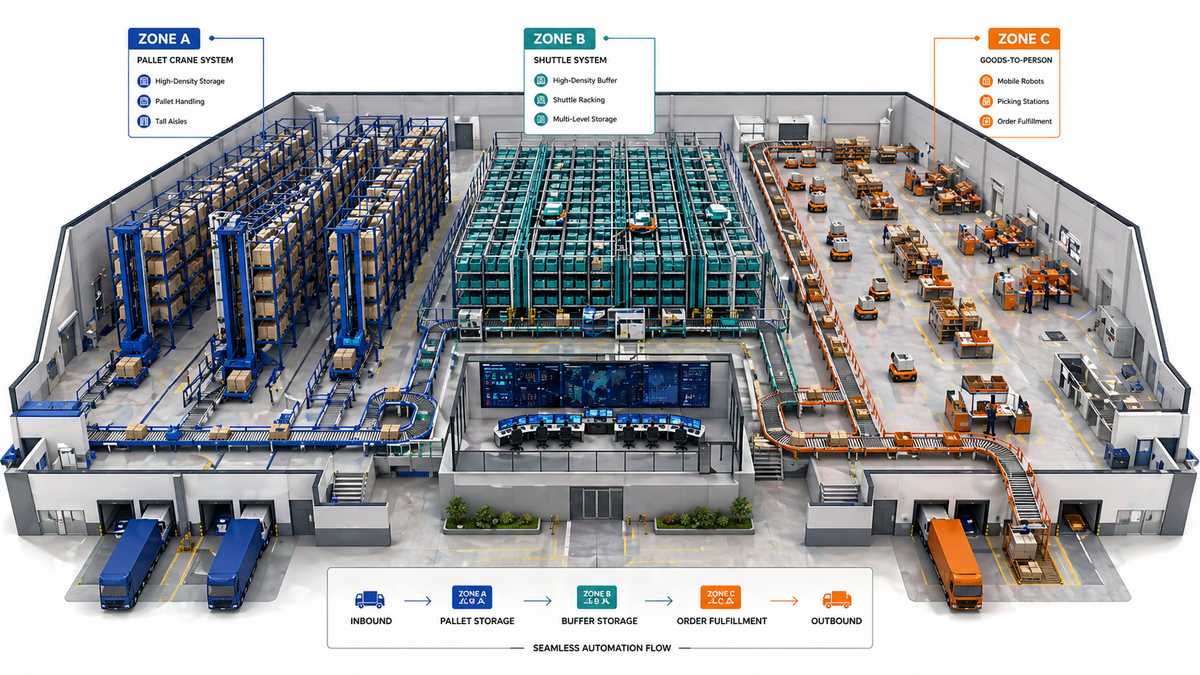
The Hybrid Approach: Why Most Large Operations Mix ASRS Types
Here's something most ASRS vendors won't tell you: the majority of large-scale warehouse automation projects don't use a single system type. They combine two or three types of ASRS systems into an integrated operation where each technology handles the zone it's best suited for.
This is where working with a logistics integrator — rather than a single-technology manufacturer — makes a measurable difference.
A robot manufacturer will recommend robots. A crane manufacturer will recommend cranes. An integrator evaluates your entire operation and designs a system that uses the right technology in each zone, connected by conveyors, lifts, and a unified warehouse execution system that orchestrates everything.
Real-world hybrid deployments from our project portfolio:
Decathlon — Multi-type, multi-zone automation: Across 25+ projects and 1,000+ robots, Decathlon's warehouses combine robotic G2P for fast-moving e-commerce SKUs with shuttle systems for store replenishment and unit load ASRS for bulk reserve storage. No single technology could handle all three workflows efficiently. See the full Decathlon deployment.
Haiou Housing — Cross-floor bin robots with conveyors and lifts: This project required bin robots operating across multiple building floors, connected by conveyor lines and vertical lifts. The integration challenge wasn't any single technology — it was making them work together seamlessly across elevation changes and building zones.
YKK — Goods-to-person plus robotic arms for unmanned operation: YKK's deployment combines G2P robots that deliver bins to workstations with robotic arms that handle the actual pick-and-place. The result is a fully unmanned operation running 24/7 — something neither technology could achieve alone.
Why integration matters more than any single technology choice:
When we look at the projects that deliver the strongest ROI, the common thread isn't which ASRS type they chose — it's how well the different components work together. The warehouse execution system software that coordinates robot fleets, shuttle traffic, conveyor routing, and workstation queuing is often the difference between a system that hits its throughput targets and one that doesn't.
Browse our full range of industry-specific automation solutions to see how different ASRS types combine for specific verticals, or explore our hardware product lineup for the specific equipment options available.
Making the Right Choice for Your Operation
Selecting between types of ASRS systems is a decision that locks in your warehouse performance for the next 10–20 years. The technology landscape has matured to the point where there's a proven solution for virtually every warehouse profile — the challenge is matching the right one to your specific operation.
Here's what we recommend as a starting point:
- Document your current state — SKU count, order profiles, throughput by hour, building dimensions, and growth projections.
- Eliminate the obvious mismatches — Use the decision framework above to narrow your options to 2–3 ASRS system types.
- Request integrated proposals — Talk to integrators who can design hybrid solutions, not just single-technology vendors who'll push their own product.
- Visit reference sites — Nothing replaces seeing a system run in a real warehouse. Ask for references in your industry.
We've helped companies across retail, manufacturing, electronics, and logistics find the right mix of ASRS types for their operations. If you're evaluating options and want a straight answer on what fits, reach out to discuss which ASRS type fits your operation. No pitch deck — just an honest assessment based on your numbers.
For more context on the broader technology landscape, the Material Handling Institute (MHI) maintains a solid overview of ASRS fundamentals and industry standards.
Planning a Warehouse Automation Project?
Our team has delivered 50+ ASRS systems across retail, manufacturing, and logistics. Tell us about your project and we will get back to you within 24 hours.
Thank you!
We received your message and will get back to you within 24 hours.