
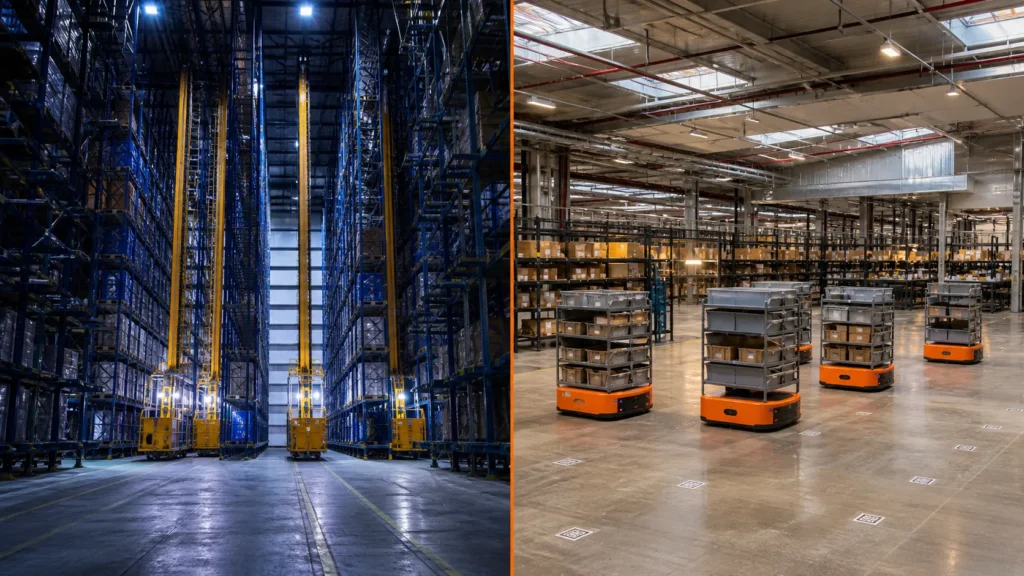
Most warehouse operators ask the same question once their throughput crosses a threshold: do we go with fixed automation, or do we go with mobile robots? The ASRS vs AMR decision shapes every downstream choice — building layout, software stack, headcount, capex versus opex, even how the loading dock is staged.
This article walks through both technologies, where each one earns its keep, and how we'd think about the choice if we were sitting on your side of the table. We've installed both kinds of system on real client floors, and the answer is rarely as clean as the vendor pitch decks suggest.
What ASRS Actually Means
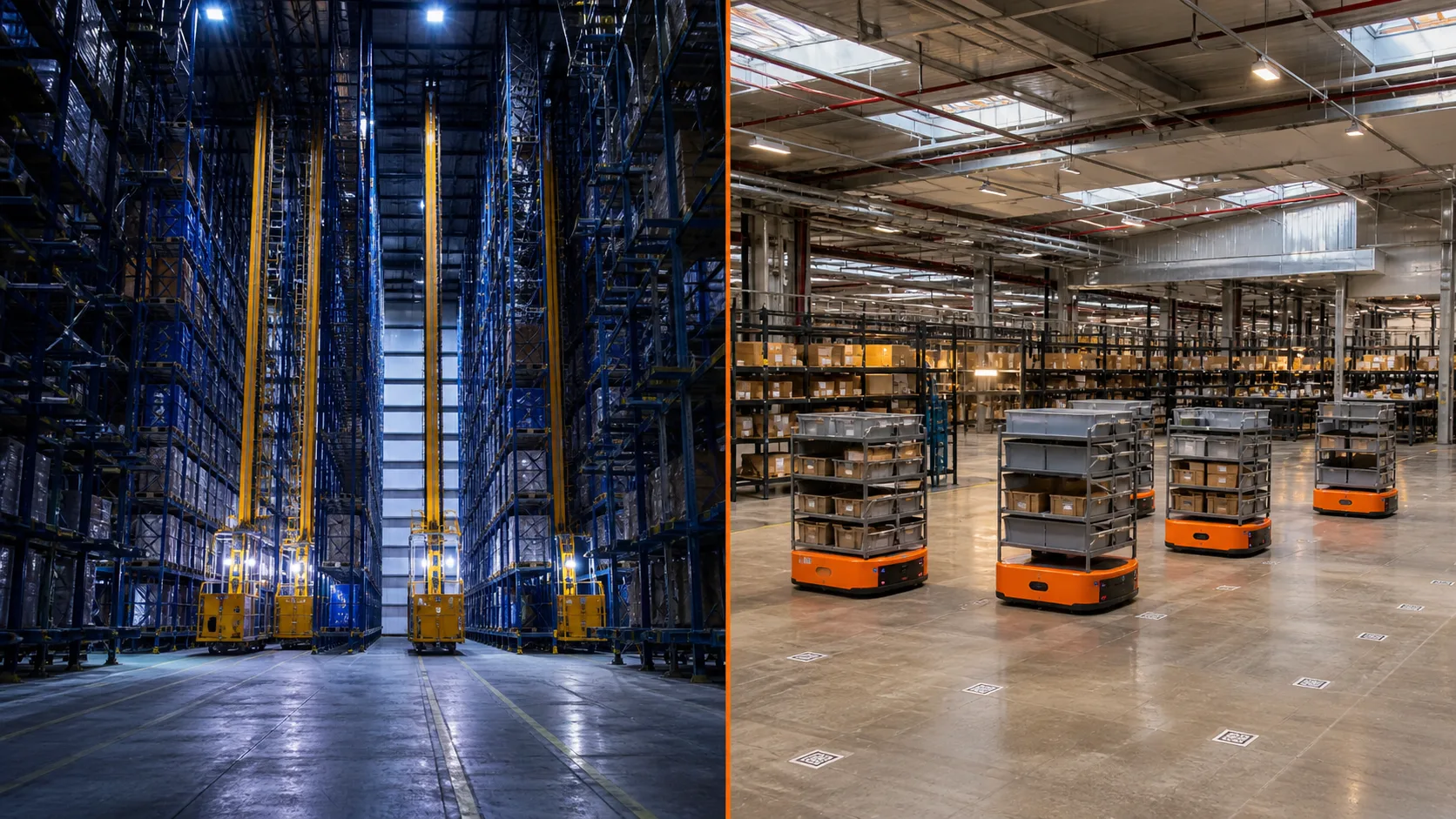
An automated storage and retrieval system is fixed infrastructure. Cranes, shuttles, miniloads, vertical lift modules, or grid-based bin systems travel along rails, racks, or a structured frame. The robot doesn't decide where to go; it executes a deterministic path inside a known geometry.
Read the full ASRS primer if you want the long version, but the short answer: ASRS is purpose-built infrastructure that trades flexibility for density, speed, and predictability. The category covers several distinct system types, each tuned for a specific load size and throughput profile.
What AMR Actually Means
Autonomous mobile robots roam open floor space. They map the building with LiDAR, plan paths in real time, and avoid people and other robots dynamically. Most fleets carry totes or shelves to stationary pick stations, though heavier units can move pallets.
The defining trait isn't the wheels. It's that an AMR doesn't need fixed infrastructure to operate — no rails, no anchored racks, no overhead structure. Drop a charging dock and a software server, and the fleet runs.
Head-to-Head: ASRS vs AMR
Density first. A crane-based ASRS routinely hits 80–90% volumetric utilization on tall pallet builds. A shuttle ASRS handling totes lands somewhere between 55–70%. AMR fleets working low-rise shelving usually sit in the 25–35% range — the same envelope as conventional racking, because the robot still needs aisle clearance to drive.
Throughput tells a different story. A pallet ASRS crane cycles around 25–35 dual-cycles per hour. A tote shuttle hits 800–1,200 totes/hour on a single aisle. An AMR fleet's throughput scales with fleet size — 30 robots in a 500 m² zone can deliver 1,500+ totes/hour to picking stations, but you're paying for more robots, more floor space, and more recharge overhead.
CapEx is where it gets interesting. A turnkey shuttle system for a 20,000-tote inventory typically lands between $4M and $8M, as we break down in the ASRS pricing guide. An equivalent AMR deployment might land at $1.5M–$3M for hardware plus another $400K–$800K for the software platform and integration. AMR wins on day one.
OpEx flips that. ASRS racks don't wear out the way batteries do. Robots in a goods-to-person AMR fleet need battery swaps or fast-charging cycles roughly every 4–6 hours of operation, and the batteries themselves degrade meaningfully within 3–5 years. We've seen fleets where total cost of ownership crosses ASRS at year 6 or 7.
Layout flexibility is AMR's clearest win. We had a client in Foshan reconfigure a picking zone twice in eighteen months as their SKU profile shifted from bulk B2B to small-parcel B2C. With AMRs and movable shelves, the second reconfiguration took a long weekend. A shuttle ASRS would have been a six-figure rework.
Where ASRS Earns Its Keep
Tall buildings. Once your ceiling is north of 12 meters, fixed automation is the only economic way to reach it. AMRs cannot meaningfully use vertical space — the robot is on the floor, and so is your inventory.
Stable SKU profiles. If your top 200 SKUs do 80% of your volume and that ratio doesn't move much, an ASRS optimized for those SKUs will outperform a general-purpose AMR fleet on cost per pick.
High-throughput pallet movement.Pallet ASRS cranes move 1,200–1,500 kg loads at 4 m/s horizontal and 1 m/s vertical, with no human in the loop. We deployed exactly this kind of system at a Decathlon distribution center where the throughput target ruled out anything except a crane on day one.
Cold chain. Sub-zero environments destroy AMR batteries and degrade LiDAR performance. ASRS racks and cranes designed for −25°C are mature; cold-rated AMRs exist but cost a serious premium and have shorter duty cycles.
Compliance-heavy industries. Pharma, semiconductor, and certain food categories require traceable, deterministic movement. A crane that travels the same path every cycle is easier to validate than a fleet whose path-planning is a black box.
Where AMR Earns Its Keep
Greenfield sites with uncertain volume. If you don't yet know what your SKU mix or throughput will look like in 18 months, AMRs let you start small and grow the fleet rather than buying fixed capacity you might not use.
Existing buildings with low ceilings. A 6-meter clearance kills most ASRS economics. AMRs work fine in standard industrial space.
Seasonal peaks. Renting additional AMRs for Q4 is a real option from several vendors. You can't rent half a shuttle aisle.
Mixed workflows. If the same building does receiving, putaway, picking, and replenishment with shifting priorities through the day, AMRs handle the variability gracefully. ASRS subsystems are usually optimized for one task each.
When You Want Both
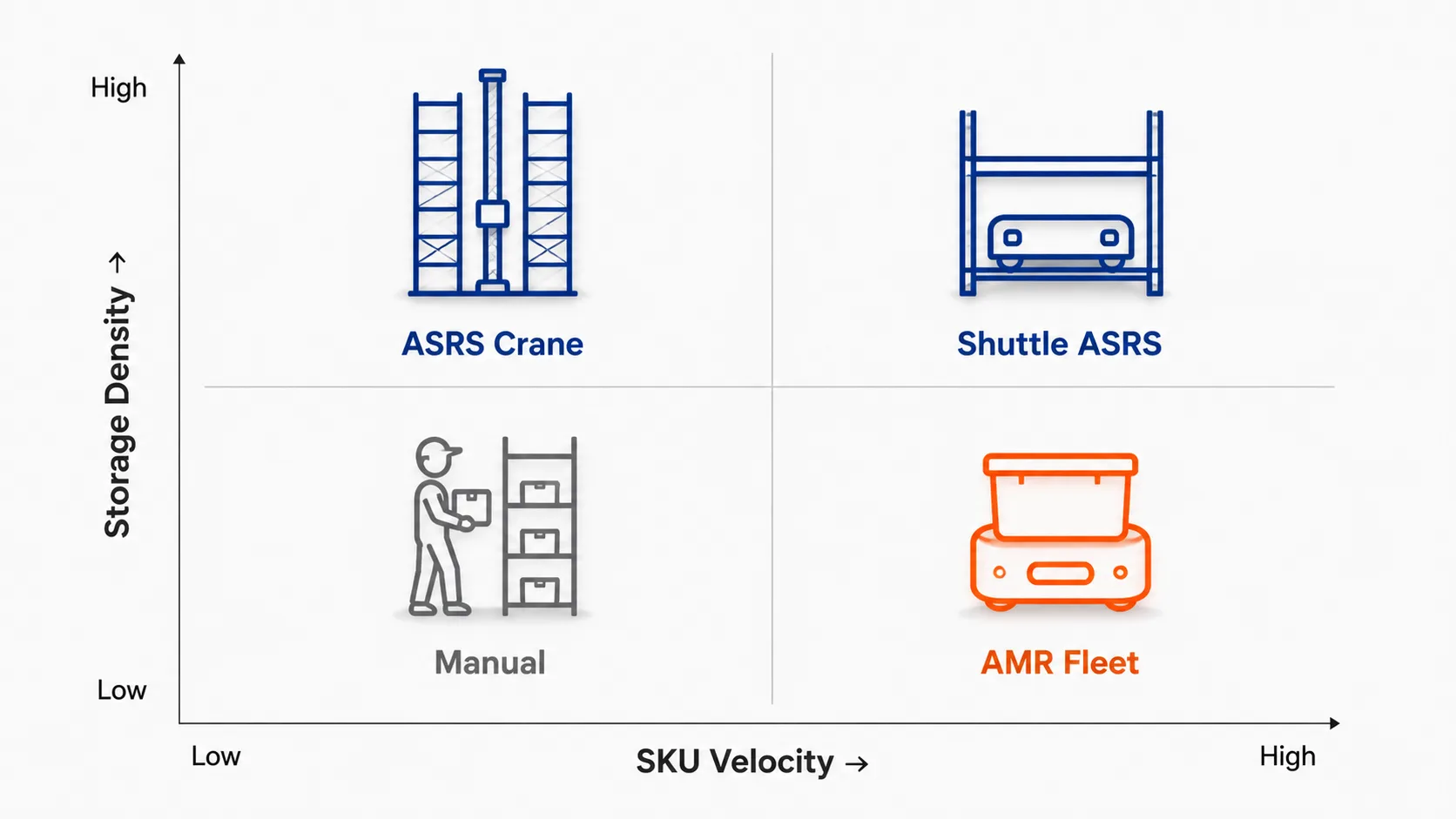
The honest answer in many real deployments is "both." Use ASRS for the dense, stable inventory tier — fast movers, bulk pallets, anything that benefits from vertical storage. Use AMRs for the long tail, returns processing, value-added services, and any zone where the layout might change.
A client in Shanghai runs exactly this hybrid. A miniload ASRS holds the top 3,000 SKUs that drive 75% of their order lines. An AMR fleet of 24 robots handles the remaining 12,000 SKUs in a low-rise zone. The orchestration layer — a WES coordinating with their WMS and WCS — decides which zone fulfills each order line based on inventory location and operator availability.
This is where most of the interesting engineering sits. The hardware decision is the easy part once you've sized the workload. The software integration is where projects succeed or fail.
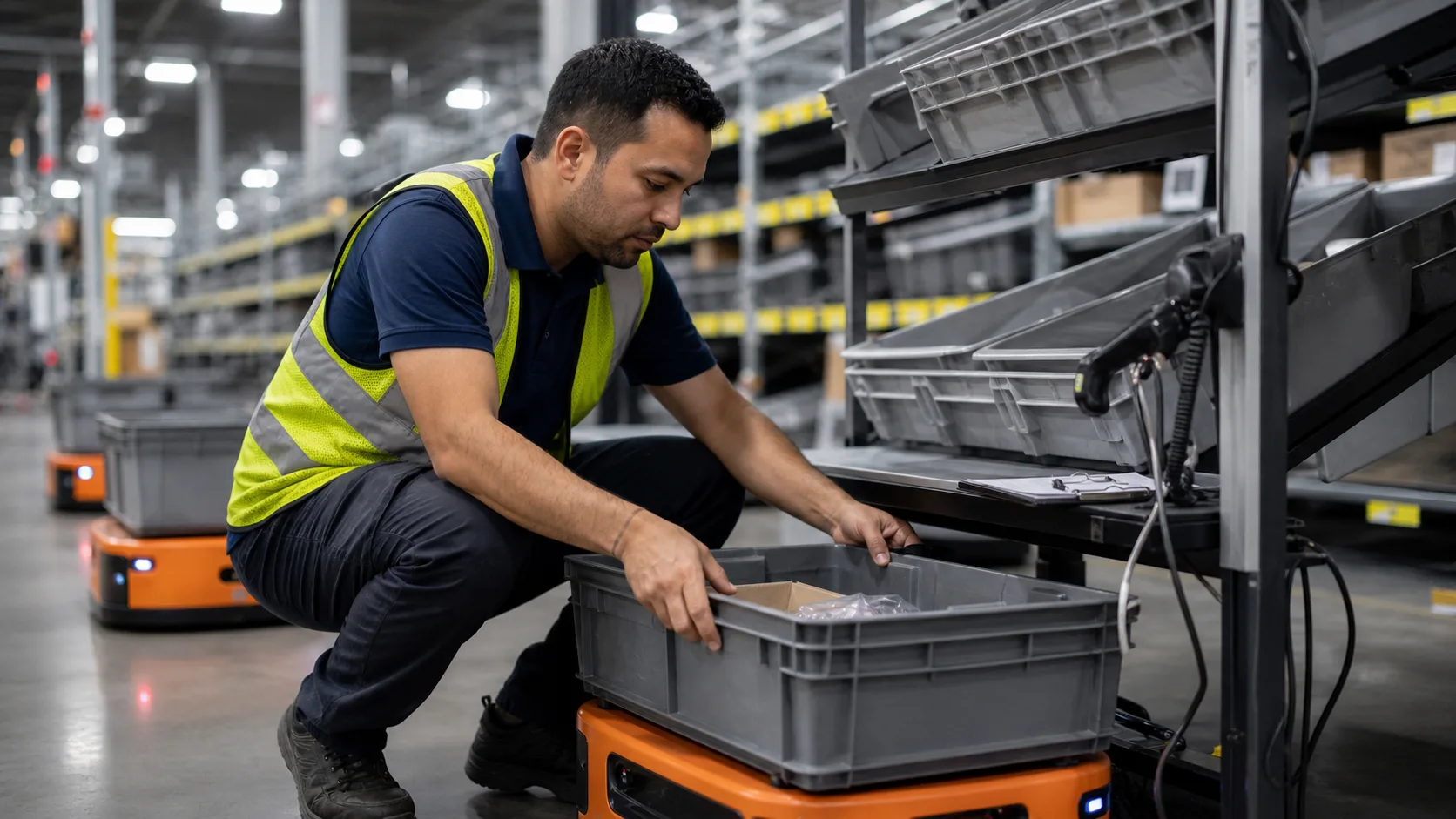
The picking station is where the two worlds meet. A goods-to-person workflow can be fed by either an ASRS aisle or an AMR fleet — what matters is the operator's experience at the station, the cycle time per pick line, and the buffer logic upstream.
Industry-by-Industry View
The right answer shifts noticeably across industries. A quick read on the verticals we work in most:
E-commerce fulfillment. Order profiles here are messy — single-line orders mixed with multi-line orders, long-tail SKUs, daily promotions that break velocity rankings. AMR fleets handle the variability well, especially for the tail. But the fast movers still benefit from a shuttle ASRS feeding the same picking stations. We covered the broader e-commerce angle in our ASRS for e-commerce fulfillment guide — the short version: hybrid wins almost every time.
Apparel and footwear. SKU counts run high (a single style might have 60 size/color variants) and seasonality is brutal. ASRS handles the dense storage of replenishment stock; AMRs work the picking floor where SKU velocity changes weekly. Li-Ning's Nanning regional center runs this exact split.
3PL operations. Multiple clients in one building, each with different volume profiles and SLAs, makes ASRS sizing genuinely hard. AMR fleets are easier to allocate per client and easier to expand when a new account lands. The trade-off is per-pick cost — you'll pay it.
Pharma and medical devices. Compliance-driven validation pushes most of these projects toward ASRS. The deterministic path of a crane is far easier to qualify under FDA or NMPA scrutiny than a path-planning AMR.
Heavy manufacturing. Pallets dominate, ceilings are tall, throughput is steady. This is the classic crane ASRS use case and we'd rarely recommend AMRs as a primary system here, though they often serve well as point-to-point movers between assembly cells.
How To Decide: A Practical Framework
Step 1 — Map your SKU velocity curve. Plot SKUs on the x-axis sorted by pick frequency, and cumulative pick volume on the y-axis. The shape of the curve tells you almost everything. A steep curve with 80% of picks in the first 200 SKUs argues for ASRS on those SKUs. A flat curve argues for AMRs.
Step 2 — Calculate your ceiling utilization. Multiply your floor area by your usable ceiling height. If that volume divided by your inventory cube is over 3:1, you're paying for air, and ASRS will recover that cost. Under 1.5:1 and AMRs make more sense.
Step 3 — Stress-test your forecast. If your three-year throughput projection has a confidence interval wider than ±30%, lean toward AMRs. The flexibility premium is worth it. Tighter than ±15%, and ASRS sizing becomes safe.
Step 4 — Run TCO over 7 years, not just CapEx. Include battery replacements, robot fleet refreshes, software licensing renewals, and the labor cost of operators on each side. We published a warehouse automation ROI walkthrough with the inputs we use on real engagements.
Step 5 — Ask what breaks if a robot stops. ASRS aisles are single points of failure — a stuck crane locks an entire aisle. AMR fleets degrade gracefully — losing 2 of 30 robots costs you 7% of throughput. Match the risk profile to your SLA.
Deployment Timeline: What To Expect
CapEx differences get all the attention, but timelines matter just as much for operations leaders trying to hit a go-live date.
A greenfield ASRS project — site civil work, racking install, crane commissioning, software integration, FAT and SAT — typically runs 12 to 18 months from contract to first shipped order. Brownfield retrofits inside an operating warehouse usually run 18 to 24 months because of the staging required to keep operations running during install.
An AMR deployment of equivalent throughput is faster. Hardware lead times run 8 to 14 weeks, integration with existing WMS takes 6 to 10 weeks, and we've seen pilots move into production in as little as 90 days. The trade-off is that AMR projects are often phased — the "production" go-live is really the start of fleet expansion, not the end of the project.
The implication for project planning: if your business case has a hard deadline (lease expiry, capacity wall, peak season), AMR will hit it more reliably. If you have a 24-month runway and stable requirements, ASRS will cost less per pick over the life of the system.
A Note On Vendor Comparisons
Most vendor decks compare best-case ASRS against best-case AMR using whichever metric flatters their product. Watch for these specific tells:
Throughput claims at peak burst rate, not sustained. Real operations need sustained numbers. Pick rates without a defined order profile mean nothing — a "1,000 picks/hour" claim is meaningless without average lines per order, average tote weight, and station configuration. ROI calculations that exclude integration and software are the third trap; hardware is usually 60–70% of total project cost, and the rest is integration, training, software licensing, and the first year of operational tuning.
When we scope projects, we ask vendors to commit to throughput numbers under the client's actual order profile, not their reference profile. The numbers always come down.
For broader industry data on warehouse automation adoption rates and ROI benchmarks, MHI's annual State of Industry research is the cleanest public source.
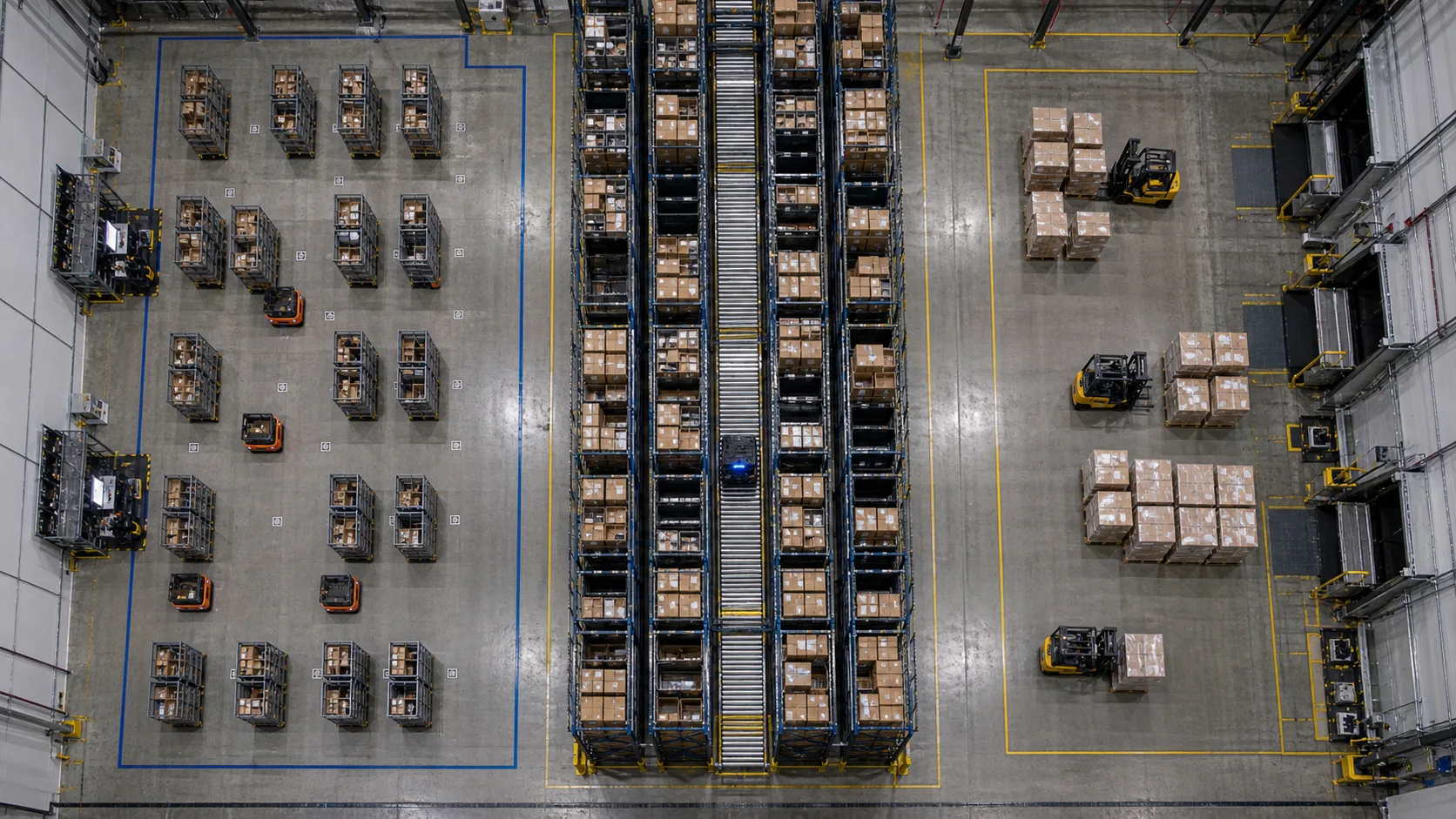
What We've Seen On Real Floors
A few patterns from the last three years worth flagging.
Footprint surprises. Clients consistently underestimate how much floor space an AMR fleet really needs once you account for charging zones, induction stations, exception-handling areas, and the buffer space the safety system requires around moving robots. Plan for 25–35% more floor area than the vendor's initial layout suggests.
Software underspend. Teams who buy AMRs to "save on software" usually end up paying for it later. The orchestration layer that lets AMRs work alongside conveyors, sortation, and existing WMS calls is often more complex than an ASRS WCS. Budget accordingly.
People impact. ASRS removes a labor category — the order picker. AMR fleets often keep the picker but change the job: less walking, more standing at a station, more clicks per hour. Some workers prefer it. Some really don't. Have an honest conversation with operations leadership before signing.
Maintenance reality. ASRS uptime tends to run 99%+ once tuned. AMR fleets we've audited typically run 96–98% — the gap shows up in P95 cycle times more than total throughput. Build that into capacity planning.
For a deeper view of the system types we deploy across both categories, the GoASRS Solutions catalog walks through the configurations we actually ship. If you're earlier in the process and still narrowing categories, the ASRS buyer's decision framework covers the upstream questions.
Frequently Asked Questions
Is AMR cheaper than ASRS? On day-one CapEx, almost always yes — typically 40–60% lower. Over a 7-year TCO including battery replacement and software licensing, the gap closes and often flips in ASRS's favor for stable, high-volume operations.
Can ASRS and AMR work in the same building? Yes, and this is increasingly the default for mid-to-large fulfillment centers. The orchestration layer is what makes it work — a single WES routes orders to the appropriate fulfillment zone based on SKU location and station availability.
How long does an AMR deployment take? Pilot to production runs 90 days at the fast end, 6 months at the typical end. Full-fleet rollouts to replace a legacy operation usually take 9–12 months including software integration and operator training.
Which one handles peak season better? AMR fleets, by a clear margin. You can rent additional robots, you can shift them between zones, and you can scale picking stations independently. ASRS throughput is fixed at design time — overrunning peak capacity means waiting in line.
Do I need to choose now if I'm not sure? No. Most clients we work with start with the highest-confidence tier of inventory — the dense, fast-moving, predictable part — and use ASRS there. The variable tier gets AMRs when the project budget supports a second phase. Phasing the decision is often the right move.
Bottom Line
The ASRS vs AMR question rarely has a single correct answer. The right system is the one that fits your SKU velocity curve, your building, your forecast confidence, and your team's appetite for software complexity.
If we had to compress the answer to one rule of thumb: stable, dense, vertical → ASRS. Variable, low-rise, evolving → AMR. Most real warehouses are both, and the project that wins is the one that matches each tier of inventory to the right machine.
If you want a second opinion on your specific case, our team has scoped projects across both technologies — send us your operation profile and we'll tell you what we'd recommend.
Planning a Warehouse Automation Project?
Our team has delivered 50+ ASRS systems across retail, manufacturing, and logistics. Tell us about your project and we will get back to you within 24 hours.
Thank you!
We received your message and will get back to you within 24 hours.