
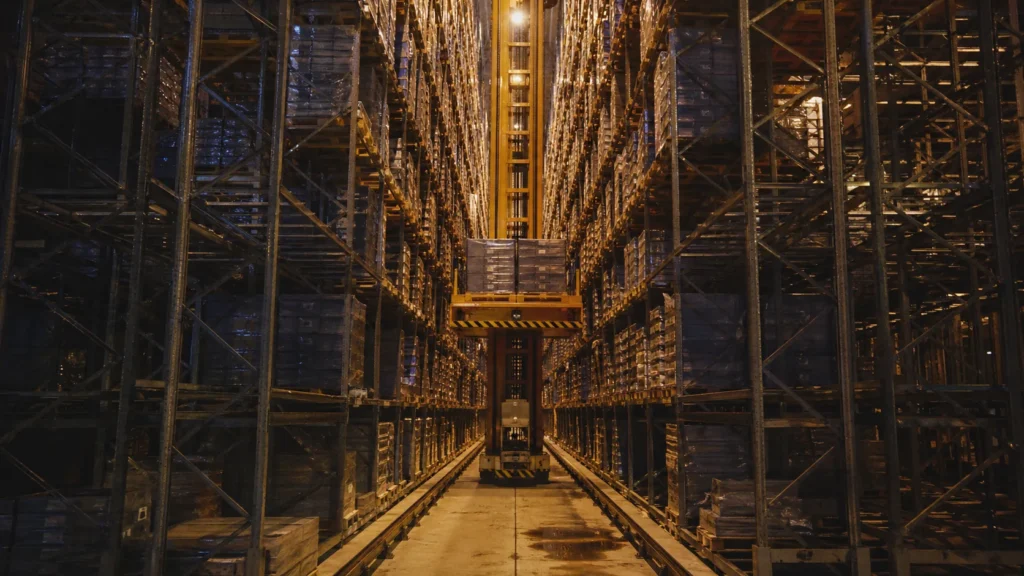
A pallet ASRS (Automated Storage and Retrieval System) moves full pallets in and out of high-density racking without forklifts or manual labor. The system uses cranes, shuttles, or AGVs running on fixed rails or guided paths to store and retrieve unit loads — typically pallets weighing 500 kg to 2,000 kg — at heights that human-operated equipment cannot safely reach.
For warehouses handling 200+ pallets per day with repetitive put-away and retrieval cycles, a pallet ASRS replaces the slowest, most expensive part of the operation: the forklift driver navigating narrow aisles, scanning locations, and manually placing loads at height.
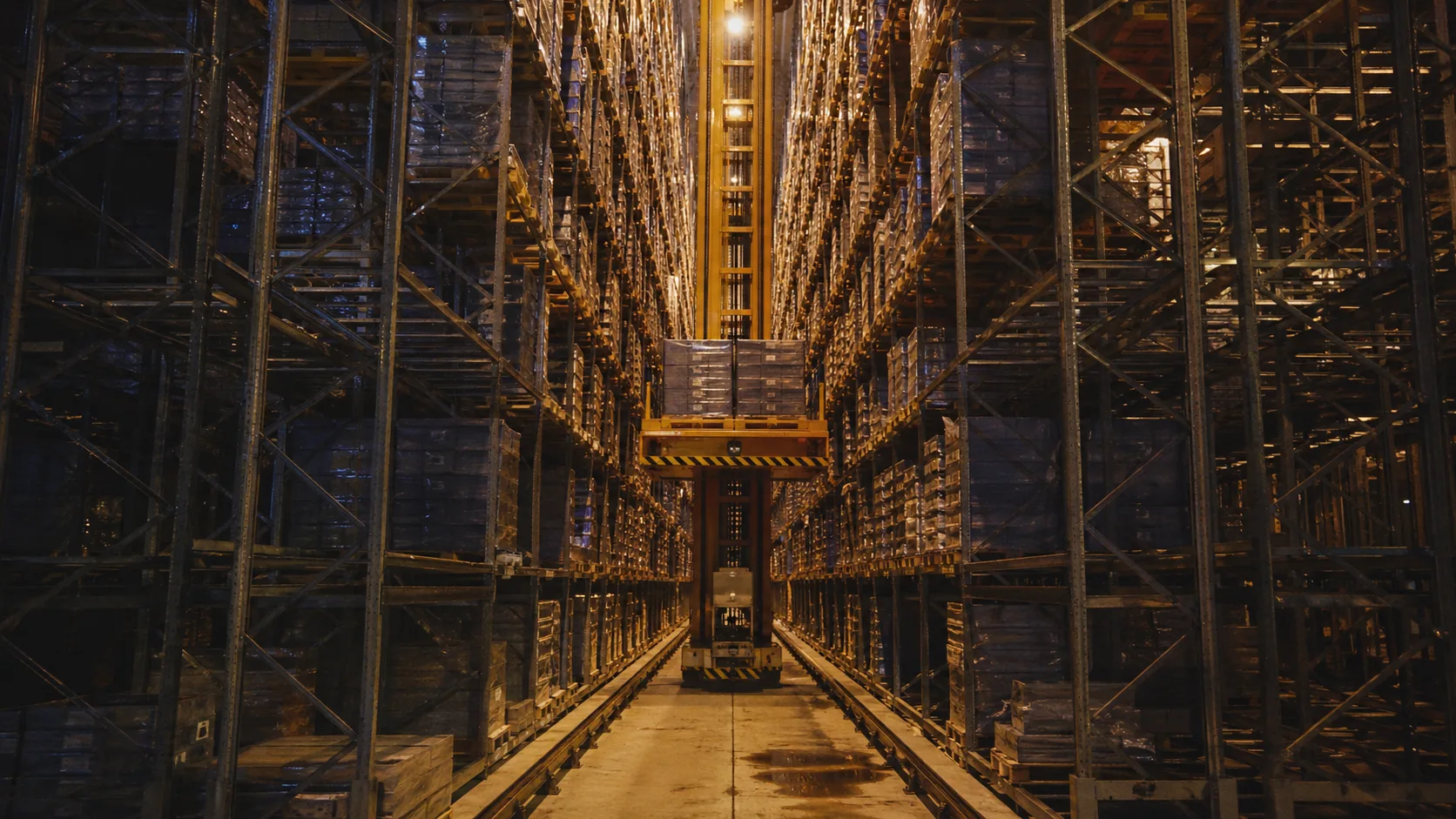
A stacker crane retrieves pallets from racking 30+ meters high — heights impossible for conventional forklifts.
How a Pallet ASRS Works
The operating principle is straightforward. A Warehouse Execution System (WES) receives inbound or outbound orders, calculates the optimal storage location, and dispatches a crane or shuttle to execute the move.
Inbound flow:
- Pallet arrives at the ASRS input station (conveyor or AGV handoff)
- System scans barcode/RFID, checks dimensions and weight
- WES assigns a storage location based on velocity, product type, and available slots
- Crane picks the pallet and travels to the assigned cell
- Pallet is deposited; inventory record updates in real time
Outbound flow:
- Order management system triggers a retrieval request
- WES identifies the pallet location and dispatches the crane
- Crane retrieves the pallet and delivers it to the output conveyor
- Pallet moves to the picking station, shipping dock, or next process
The entire cycle — from request to delivery at the output point — takes 60 to 180 seconds depending on aisle length, rack height, and crane speed. Compare that to 4-8 minutes for a forklift driver doing the same task manually.
Types of Pallet ASRS Systems
Not every pallet ASRS looks the same. The right configuration depends on your throughput requirements, ceiling height, SKU count, and budget.
Stacker Crane Systems (Unit Load ASRS)
The most common pallet ASRS type. A single crane operates in each aisle, running on floor-mounted rails with a top guide rail for stability. The crane's mast carries a telescoping fork or satellite that reaches into racking on both sides of the aisle.
Best for: High-bay warehouses (15-45 meters), moderate throughput (20-40 pallets/hour per aisle), large SKU counts requiring single-deep or double-deep storage.
Throughput: 15-25 dual cycles per hour (single crane per aisle)
Key specs:
- Height: up to 45 meters
- Load capacity: 500-2,500 kg per pallet
- Aisle width: 1.5-1.8 meters (vs. 3.5+ meters for forklifts)
- Travel speed: 2-4 m/s horizontal, 0.5-1.5 m/s vertical
Shuttle-Based Pallet ASRS
Instead of a single crane per aisle, shuttle systems use multiple autonomous carriers running on rails at each rack level. A lift transfers shuttles and pallets between levels.
Best for: High-throughput operations (50-100+ pallets/hour per aisle), deep-lane storage (5-20 pallets deep), fewer SKUs with high volume per SKU.
Throughput: 50-120+ pallets/hour per aisle (scales with shuttle count)
Key advantage: Adding more shuttles increases throughput without adding aisles. The system scales incrementally.
AGV/AMR-Based Pallet Handling
Automated Guided Vehicles or Autonomous Mobile Robots transport pallets between storage locations, staging areas, and dock doors. These systems work alongside existing racking or within purpose-built storage zones.
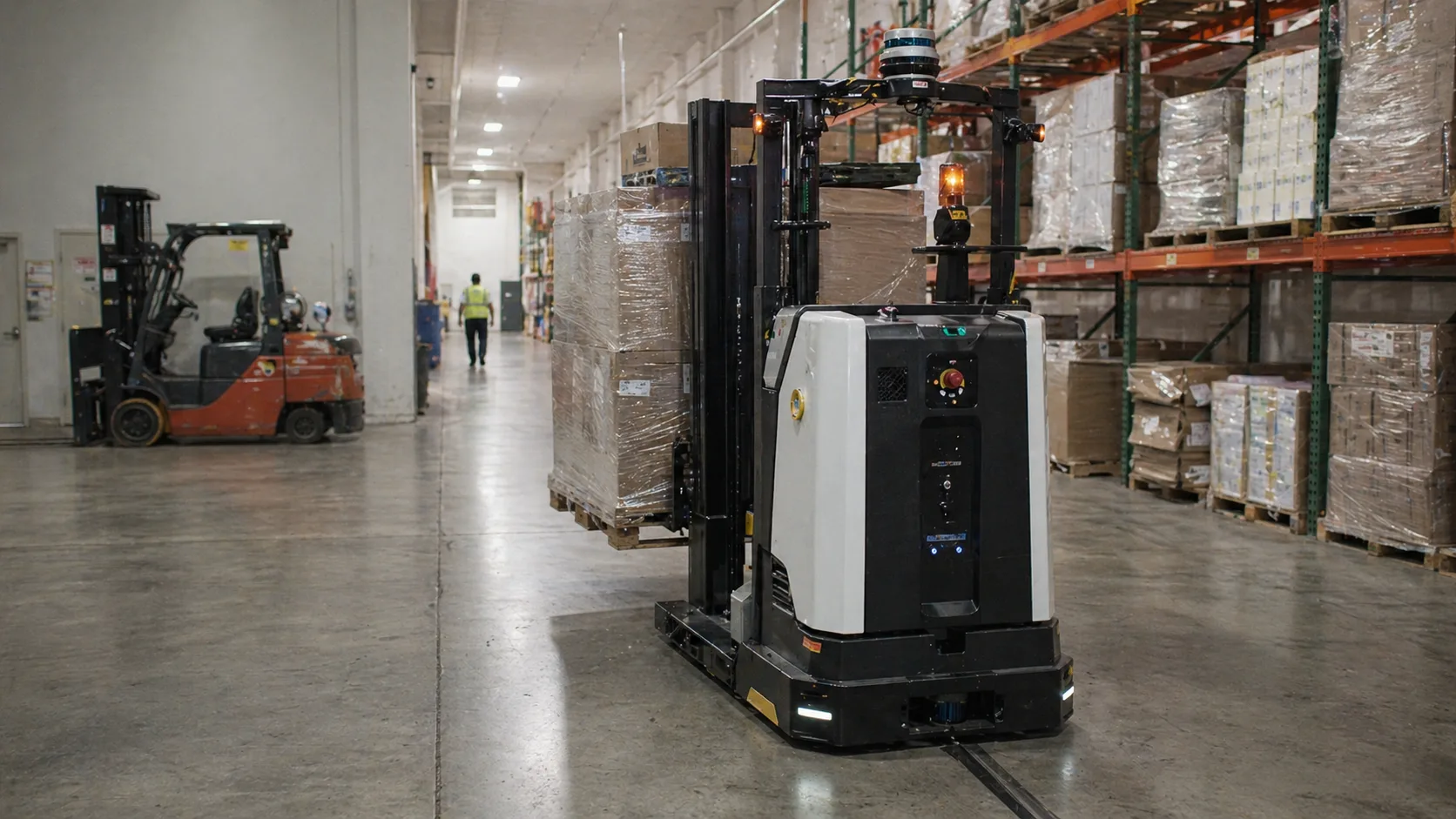
AGV-based pallet handling integrates with existing racking infrastructure — no fixed rails required.
Best for: Brownfield warehouses (retrofitting existing facilities), mixed operations where full automation isn't feasible, flexible layouts that change seasonally.
Throughput: 8-15 pallets/hour per vehicle (add vehicles to scale)
Key advantage: No fixed infrastructure. The system adapts to layout changes without civil works.
Comparison Table
| Feature | Stacker Crane | Shuttle System | AGV/AMR |
|---|---|---|---|
| Height | 15-45m | 10-25m | Ground level |
| Throughput/aisle | 20-40 pallets/hr | 50-120+ pallets/hr | 8-15/vehicle |
| Storage density | High (narrow aisle) | Very high (deep lane) | Moderate |
| Scalability | Add aisles | Add shuttles | Add vehicles |
| Retrofit friendly | No (new build) | Partial | Yes |
| Capital cost | $$$$ | $$$$$ | $$ |
| Best SKU profile | Many SKUs, low volume each | Few SKUs, high volume | Mixed |
Storage Density: Pallet ASRS vs. Conventional Warehousing
The density advantage is where pallet ASRS systems pay for themselves fastest. A conventional warehouse with reach trucks uses 40-50% of its cubic volume for actual storage. The rest is aisles, clearances, and wasted vertical space.
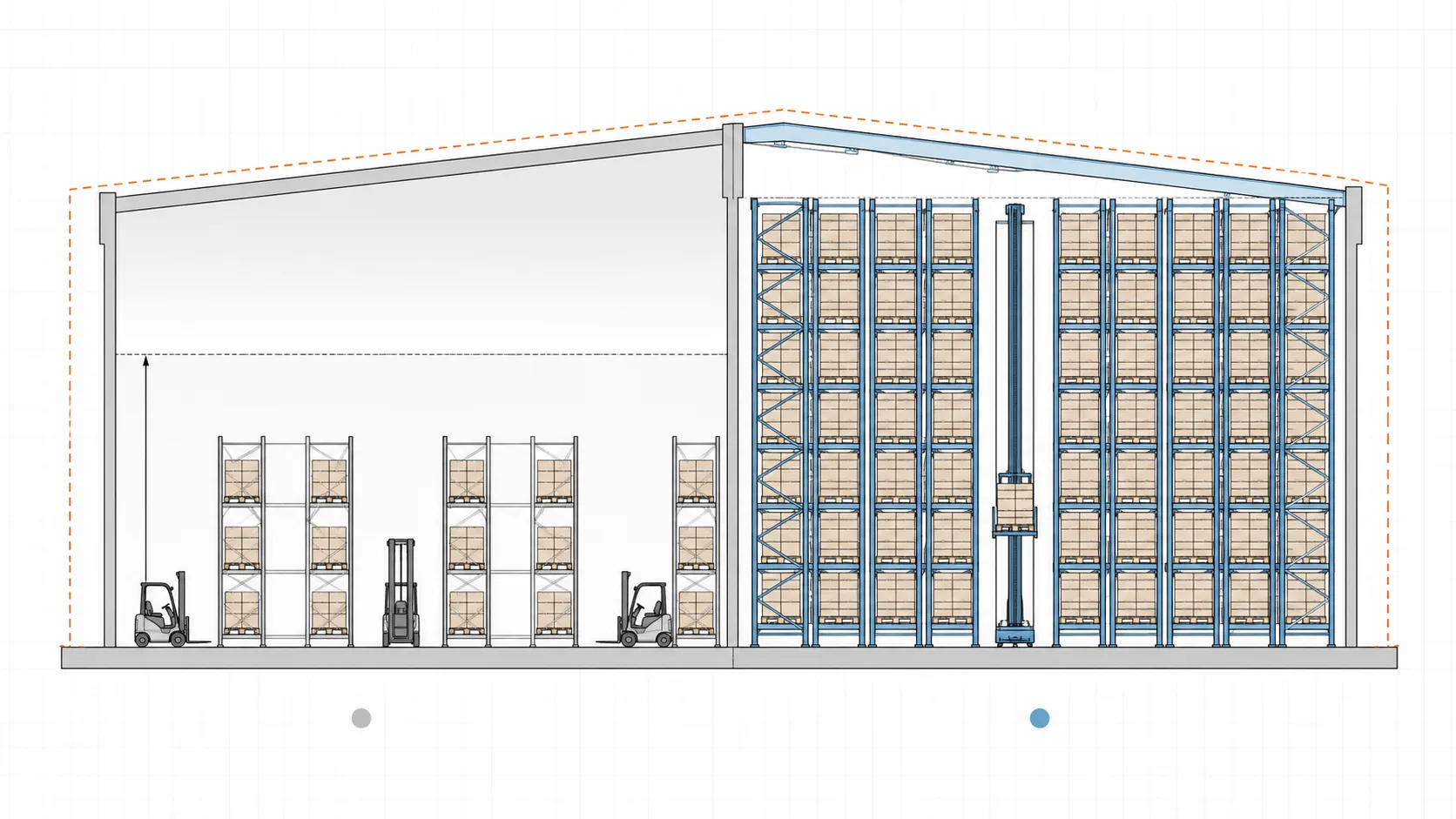
Pallet ASRS achieves 3-5x the storage density of conventional racking by eliminating wide aisles and using full building height.
A pallet ASRS flips those numbers:
- Aisle width: 1.5m vs. 3.5m (57% reduction)
- Usable height: 30-45m vs. 10-12m (3-4x increase)
- Cubic utilization: 80-85% vs. 30-40%
- Pallets per square meter: 4-8 vs. 1.5-2.5
For a 10,000 sqm footprint, that translates to storing 40,000-80,000 pallets in an ASRS versus 15,000-25,000 in conventional racking. When land costs $200-500/sqm in industrial zones near major cities, the density premium alone can justify the investment.
When we deployed a pallet ASRS for a consumer electronics manufacturer in their semiconductor facility, the client recovered 4,200 sqm of floor space that was previously consumed by wide-aisle racking and forklift staging areas. That freed-up space became a new production line — generating revenue instead of storage costs.
Cold Storage: Where Pallet ASRS Delivers the Highest ROI
Cold chain warehouses (-25°C to +4°C) represent the strongest business case for pallet ASRS. The economics are brutal in cold storage: every cubic meter of refrigerated space costs 3-5x more to build and operate than ambient storage. Labor costs spike because workers can only spend 20-40 minutes in freezer environments before mandatory warm-up breaks.
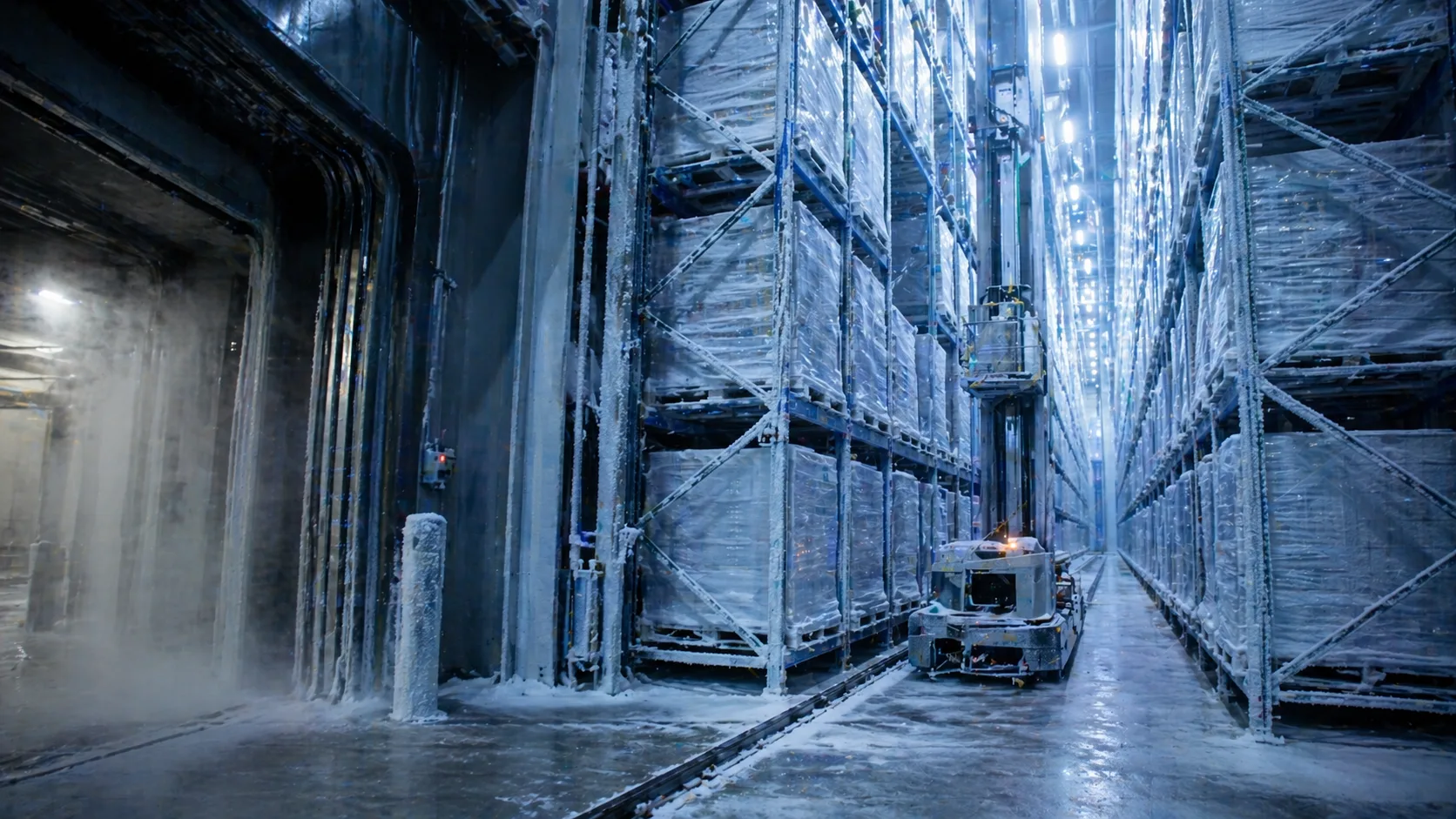
Automated cranes operate continuously in -25C environments where human workers face strict time limits.
A pallet ASRS in cold storage eliminates both problems simultaneously:
- No human exposure: Cranes and shuttles operate 24/7 at -25°C without breaks
- Minimal air infiltration: Narrow aisles and sealed access points reduce energy loss by 30-40%
- Reduced building volume: Higher density means less cubic space to refrigerate
- Energy savings: 25-35% reduction in refrigeration costs from smaller, tighter building envelope
One food and beverage client we worked with cut their cold storage energy bill by 31% after switching from manual forklift operations to a shuttle-based pallet ASRS. The labor savings were secondary — the energy reduction alone paid back the system in 3.2 years.
Cost Breakdown: What Does a Pallet ASRS Actually Cost?
Pricing varies dramatically based on system type, height, throughput, and integration complexity. Here are realistic ranges based on projects we've delivered:
Capital Expenditure (CAPEX)
| Component | % of Total | Typical Range |
|---|---|---|
| Racking structure | 20-30% | $800K – $3M |
| Cranes/shuttles | 30-40% | $1.2M – $5M |
| Conveyor systems | 10-15% | $400K – $1.5M |
| WES/WMS software | 8-12% | $300K – $800K |
| Installation & commissioning | 10-15% | $400K – $1.2M |
| Civil works (slab, building) | 10-20% | $500K – $2M |
Total system cost: $3M – $15M for a typical 5,000-20,000 pallet position system.
Cost per pallet position: $300-$800 (fully installed), compared to $50-$150 for conventional racking. The premium pays back through labor elimination, density gains, and error reduction.
Operating Expenditure (OPEX)
Annual operating costs for a pallet ASRS run 3-5% of the initial capital investment:
- Maintenance contracts: 1.5-2.5% of CAPEX annually
- Energy: $0.02-$0.05 per pallet move (crane systems are surprisingly efficient)
- Software licenses/updates: $50K-$150K/year
- Spare parts inventory: 0.5-1% of CAPEX
Compare this to manual operations where labor alone costs $150K-$300K per forklift driver annually (salary + benefits + training + workers' comp), and a typical warehouse needs 8-15 drivers to match the throughput of a single ASRS aisle.
ROI Timeline: When Does a Pallet ASRS Pay for Itself?
Based on 50+ projects we've integrated across retail, manufacturing, and logistics sectors:
Typical payback period: 3-5 years
ROI drivers ranked by impact:
- Labor reduction: 60-80% fewer warehouse staff (biggest single factor)
- Density gains: 50-70% smaller building footprint (or 3-5x more capacity in same space)
- Error reduction: 99.9%+ picking accuracy vs. 97-99% manual
- Throughput increase: 2-4x more pallets moved per hour
- Safety improvement: Near-zero forklift accidents (a hidden cost that adds up)
Break-even accelerators:
- 3-shift operations (ASRS runs 24/7 without overtime premiums)
- Cold storage (energy savings compound the labor savings)
- High land costs (density premium is worth more per sqm)
- Labor shortage markets (can't hire even if you wanted to)
How to Choose the Right Pallet ASRS Configuration
The selection process starts with four questions:
1. What's your throughput requirement?
- Under 30 pallets/hour → Stacker crane (single aisle may suffice)
- 30-80 pallets/hour → Multi-aisle crane or entry-level shuttle
- 80+ pallets/hour → Shuttle system with multiple carriers per level
2. How many SKUs do you store?
- High SKU count (1,000+) with low volume per SKU → Single/double-deep crane system
- Low SKU count (under 200) with high volume per SKU → Deep-lane shuttle (5-20 deep)
- Mixed profile → Hybrid system with crane aisles for slow movers and shuttle lanes for fast movers
3. Is this a new build or retrofit?
- New build → Optimize building dimensions around the ASRS (height, column spacing, slab load capacity)
- Retrofit → AGV/AMR systems or low-profile shuttle systems that fit existing ceiling heights
- Partial retrofit → Consider a hybrid approach combining automated and manual zones
4. What's your budget timeline?
- Full CAPEX available → Purpose-built crane or shuttle system
- Phased investment → Start with AGVs or a single shuttle aisle, expand as volume grows
- Lease/OPEX model → Some integrators offer robotics-as-a-service for shuttle and AGV systems
Integration Challenges (and How to Avoid Them)
The hardware is the easy part. Most pallet ASRS failures happen at the integration layer — where the physical system meets your existing WMS, ERP, and operational workflows.
Common failure points:
WMS/ERP integration gaps. Your existing WMS may not support real-time location management at the granularity an ASRS requires. A purpose-built WES layer sitting between the WMS and the ASRS equipment handles real-time dispatching, load balancing, and exception management without replacing your existing systems.
Conveyor interface bottlenecks. The ASRS crane can move 25 pallets/hour, but if your inbound conveyor only delivers 15 pallets/hour, the crane sits idle. Size the peripheral systems to match the ASRS capacity, not the other way around.
Pallet quality issues. Automated systems are less forgiving than forklift drivers. Broken boards, non-standard dimensions, or overhanging loads cause jams. Implement pallet inspection stations at every ASRS entry point.
Change management. Operators who spent 10 years driving forklifts don't become ASRS technicians overnight. Budget 3-6 months for training and parallel operations during the transition.
This is where working with an experienced logistics integrator matters. An integrator coordinates multiple equipment vendors, handles the software middleware, and manages the commissioning process — so you're not stuck mediating between your crane supplier, conveyor vendor, and WMS provider when something doesn't connect.
Pallet ASRS vs. Mini-Load ASRS: Which Do You Need?
A common point of confusion: pallet ASRS and mini-load ASRS solve different problems.
| Pallet ASRS | Mini-Load ASRS | |
|---|---|---|
| Unit handled | Full pallets (800-2,500 kg) | Totes/cartons (5-50 kg) |
| Use case | Bulk storage, full-pallet picks | Each-picking, order fulfillment |
| Typical height | 20-45m | 8-20m |
| Throughput | 15-40 pallets/hr per aisle | 100-300 totes/hr per aisle |
| Industry fit | Manufacturing, 3PL, food/bev | E-commerce, pharma, electronics |
Many operations need both. A manufacturer might use a pallet ASRS for raw material and finished goods storage, feeding a mini-load system that handles component picking for production lines. The WES software orchestrates both systems as a unified operation.
Industry Applications
Food & Beverage / Cold Chain Frozen food distributors, dairy processors, and beverage companies gain the most from pallet ASRS due to the cold storage premium. Typical configurations: shuttle systems with 8-15 deep lanes, operating at -25°C.
Automotive & Manufacturing Just-in-time production requires precise sequencing of parts pallets. Crane-based ASRS systems feed production lines in the exact order needed, eliminating staging areas and buffer stock. See how leading manufacturers use ASRS to support lean production.
Third-Party Logistics (3PL) 3PLs need flexibility to handle multiple clients with different pallet sizes, weights, and throughput requirements. Multi-deep shuttle systems with configurable lane depths handle this variability without dedicated infrastructure per client.
Retail Distribution High-volume retail DCs processing 10,000+ pallets daily use multi-aisle crane systems for reserve storage, feeding pick modules and cross-dock operations. Sporting goods retailers and fashion brands with seasonal peaks benefit from the consistent throughput regardless of labor availability.
FAQ: Pallet ASRS Systems
How long does it take to install a pallet ASRS? From contract signing to full operation: 12-18 months for a standard crane system, 8-14 months for shuttle systems in existing buildings. The civil works and racking installation run in parallel with equipment manufacturing.
Can a pallet ASRS handle mixed pallet sizes? Yes, but with constraints. Most systems accommodate 2-3 standard pallet footprints (800x1200mm Euro, 1000x1200mm, 1100x1100mm) with adjustable fork positions. Non-standard sizes require custom engineering.
What happens when the ASRS breaks down? Modern systems achieve 98-99.5% uptime. Redundancy strategies include: multiple cranes per aisle (one can cover while the other is serviced), manual override access for emergency retrieval, and predictive maintenance that flags components before failure.
Is a pallet ASRS worth it for small warehouses? Below 3,000 pallet positions, the economics rarely work for crane systems. Consider AGV-based solutions or vertical lift modules for smaller operations. The break-even point drops significantly if you're in cold storage or facing severe labor shortages.
What's the lifespan of a pallet ASRS? Mechanical components (cranes, rails, racking): 20-30 years with proper maintenance. Controls and software: expect upgrades every 7-10 years to maintain performance and compatibility. Total cost of ownership over 20 years is typically 40-60% lower than equivalent manual operations.
Can I integrate a pallet ASRS with my existing WMS? Yes. A WES (Warehouse Execution System) acts as middleware between your WMS and the ASRS equipment. The WES handles real-time dispatching and optimization while your WMS maintains inventory visibility and order management. Learn more about WES integration.
Planning a Warehouse Automation Project?
Our team has delivered 50+ ASRS systems across retail, manufacturing, and logistics. Tell us about your project and we will get back to you within 24 hours.
Thank you!
We received your message and will get back to you within 24 hours.