
ERAL — Ultra-Dense Intelligent Picking
About ERAL
ERAL (Ai Lai Yi) is a leading fashion down jacket brand in China, guided by the philosophy of “Asian women’s lifestyle aesthetics.” The company has achieved a fully integrated retail digitalization system covering R&D, production, and sales. Much like Li-Ning in the sportswear sector, their national distribution center in Lu’an, Anhui Province, needed a major upgrade.
Challenges
- Ground-level pile storage made it difficult to record, locate, and retrieve goods
- Over 2 meters of vertical space above storage was completely wasted
- Need to optimize warehouse utilization and inbound/outbound efficiency
- Growing omni-channel business (online + offline) demanded faster logistics response — a trend also driving transformation at Decathlon
- Manual inbound/outbound operations unable to keep up with peak season demand surges — as a down jacket brand, ERAL faces extreme seasonal spikes requiring rapid order fulfillment
Solution
We implemented an ultra-high-density intelligent picking system in a 2,800 m² warehouse with 9-meter ceiling clearance:
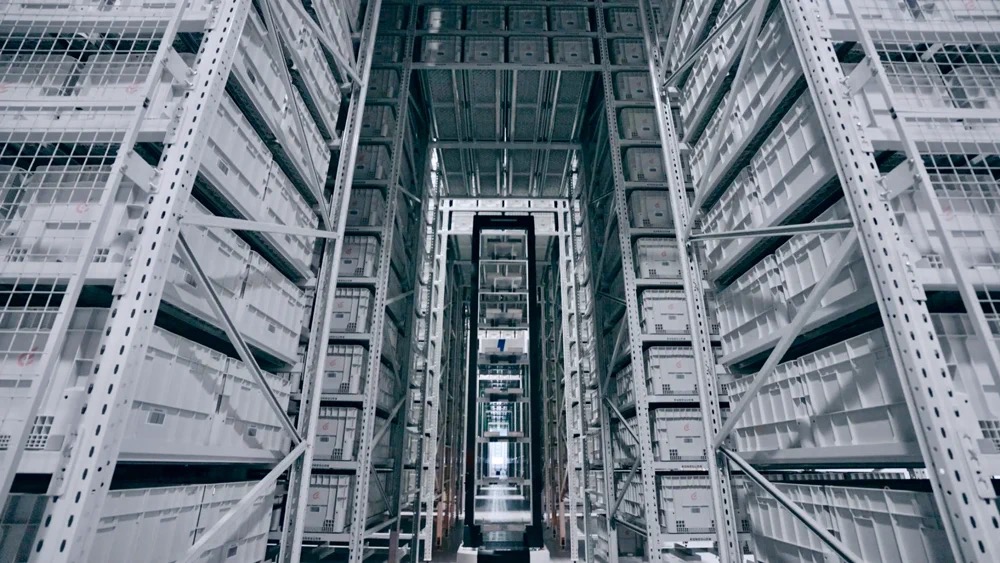
- 16-Layer Racking: 8.7-meter tall shelving with sky bridge racks above 5.4 meters in the aisles
- Near-Solid Storage: 29 standard bins per square meter — approaching maximum theoretical density
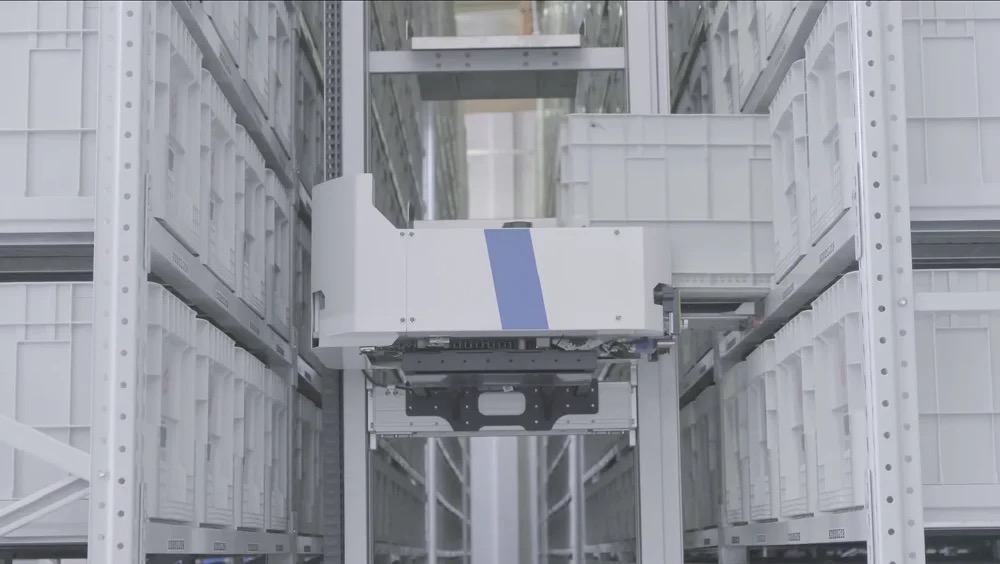
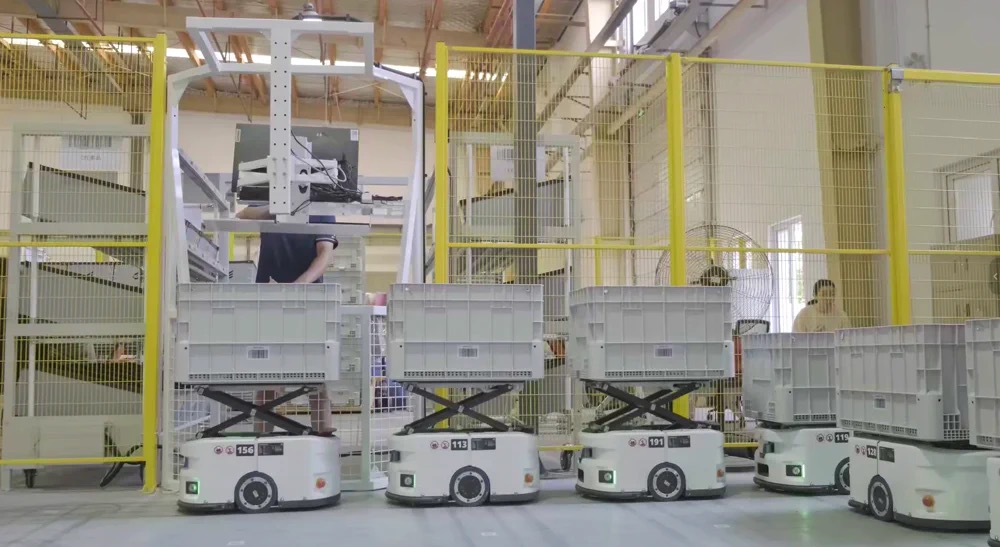
- ACR + AMR Relay: 36 A42T-L robots and 94 K50H hook-type bin robots work in relay, replacing manual fruit-picking-style operations
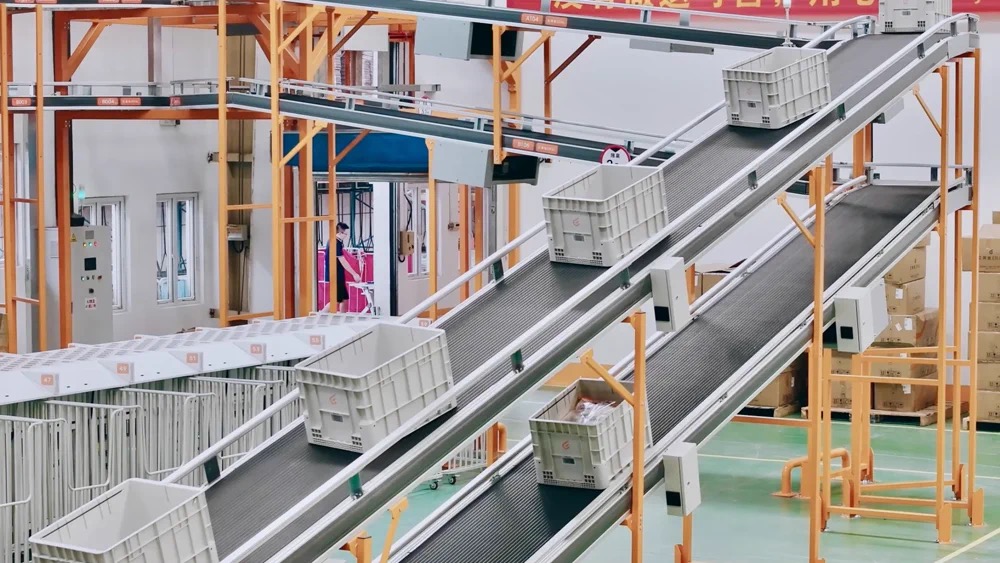
- Automated Inbound: Conveyor lines seamlessly connect with upstream production lines; high-speed AMR robots transport bins from conveyor exits
- Smart Outbound: Combined bin consolidation for both single-SKU and multi-SKU orders, with trolley and seeding wall options
- 9 Human-Robot Picking Stations: Ergonomic workstations for efficient order fulfillment
ACR Robot Demo
Software Platform
Our proprietary WES system features a microservices architecture with plug-and-play management. It integrates four-way shuttles, bin robots, latent jacking robots, and multi-layer shuttles under a unified task management platform. An AI algorithm platform optimizes inbound/outbound allocation logic and task balancing in real time.
Results
- 47,280 storage positions in approximately 2,800 m²
- Storage density of 16.88 bins/m², reaching 29 bins/m² with sky bridge racks
- Shipping capacity of 45,000 items per 10-hour shift
- Equipment: 36 A42T-L + 94 K50H + 9 human-robot picking stations
Business Impact
- Space Utilization Leap: Achieved 29 bins/m² — near-theoretical maximum density, transforming a 2,800 m² footprint into a high-capacity fulfillment center
- Picking Efficiency Revolution: From manual fruit-picking to fully automated ACR + AMR relay, dramatically reducing labor dependency and error rates
- Full-Process Automation: End-to-end automated management from inbound receiving to outbound shipping, eliminating manual bottlenecks
- Peak Season Ready: Omni-channel order fulfillment at 45,000 items per shift ensures ERAL can handle seasonal demand surges without temporary staffing
Fashion logistics runs on a calendar that punishes slow warehouses. ERAL’s automation project was built around that reality.
The Seasonal Spike Problem in Fashion Fulfillment
Fashion brands live and die by promotional windows. Singles’ Day, Black Friday, end-of-season clearance — each event can triple daily order volume for one to three weeks, then drop back to baseline overnight. The traditional response is temporary labor: hire 200 extra pickers two weeks before the peak, train them on a warehouse they have never seen, and hope error rates stay manageable.
When we designed ERAL’s system with 47,280 storage positions and 3x storage density over their previous manual layout, the seasonal math changed fundamentally. The automated system processes the same peak volume with the same robot fleet — no hiring surge, no training lag, no quality drop from unfamiliar staff working unfamiliar aisles.
The WES handles peak periods through dynamic task prioritization rather than additional resources. Orders flagged as time-sensitive (flash sales, same-day shipping commitments) move to the front of the retrieval queue. The system redistributes robot assignments across zones based on real-time demand patterns, pulling capacity from slower zones to support hot ones.
Managing 47,000+ Positions With High SKU Turnover
Fashion inventory is not static. A sportswear brand might carry 60% of its SKUs year-round. A fashion retailer like ERAL turns over a significant portion of its catalog every season. New arrivals flow in while last-season stock flows out to clearance channels — sometimes simultaneously.
That churn rate creates a storage optimization problem that manual warehouses handle poorly. Human pickers memorize locations; when half the locations change every quarter, that institutional knowledge evaporates. The automated system treats storage as a continuously optimized matrix. The hardware layer — tote robots operating across dense racking — assigns and reassigns positions based on velocity data, not fixed slotting charts.
In our experience, fashion warehouses benefit more from dynamic slotting than almost any other vertical. A SKU that sells 500 units in week one of a promotion and 5 units in week six should not occupy the same storage tier for the entire period. ERAL’s system re-slots inventory nightly based on trailing sales velocity, keeping fast movers in positions that minimize retrieval time.
Why 3x Storage Density Changes the Real Estate Equation
Floor space in urban distribution centers is expensive and scarce. ERAL’s previous manual warehouse required wide aisles for pickers and carts, single-deep racking for accessibility, and generous staging areas for sorting. The automated layout eliminated picker aisles entirely, moved to multi-deep tote storage, and reduced staging footprint because the goods-to-person picking stations process orders in sequence rather than batch-and-sort.
The 3x density gain meant ERAL could consolidate operations that previously required overflow space during peak seasons. No more renting temporary warehouse capacity in November — the permanent facility holds the full seasonal inventory with room to spare.
For fashion brands evaluating storage density improvements, the types of ASRS systems guide compares tote-based, shuttle, and carousel architectures. The cost analysis page models how density gains translate to real estate savings over a 5-10 year horizon. The Li-Ning case shows a comparable high-SKU deployment in sportswear with a different robot mix.
Frequently Asked Questions
How does the system handle returns during peak season without disrupting outbound flow?
Returns enter through a dedicated inbound station that operates independently from outbound picking. The WES inspects, re-grades, and re-slots returned items into available positions without interrupting active order fulfillment. During peak periods, return processing priority drops below outbound orders — returns queue but do not compete for robot capacity. Post-peak, the system catches up on the return backlog automatically.
Can the 47,280-position system scale further without a facility expansion?
The racking infrastructure supports adding vertical tiers if ceiling height permits. Robot fleet size is the more common scaling lever — adding robots to the existing grid increases throughput without modifying storage structure. ERAL’s current configuration runs below maximum robot density, leaving room for fleet expansion as order volume grows.
What accuracy rate does the system maintain during peak volume?
Picking accuracy stays above 99.9% regardless of volume because the error sources in manual picking — misreads, wrong locations, fatigue-related mistakes — do not exist in the automated workflow. The case studies page documents accuracy metrics across deployments. Reach out to our team for a walkthrough of how accuracy is measured and maintained.