
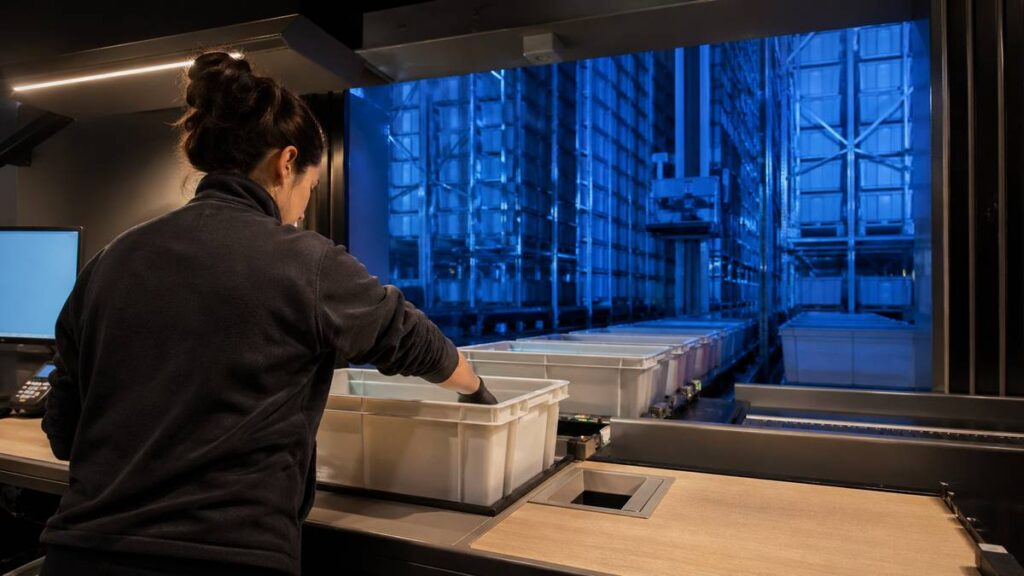
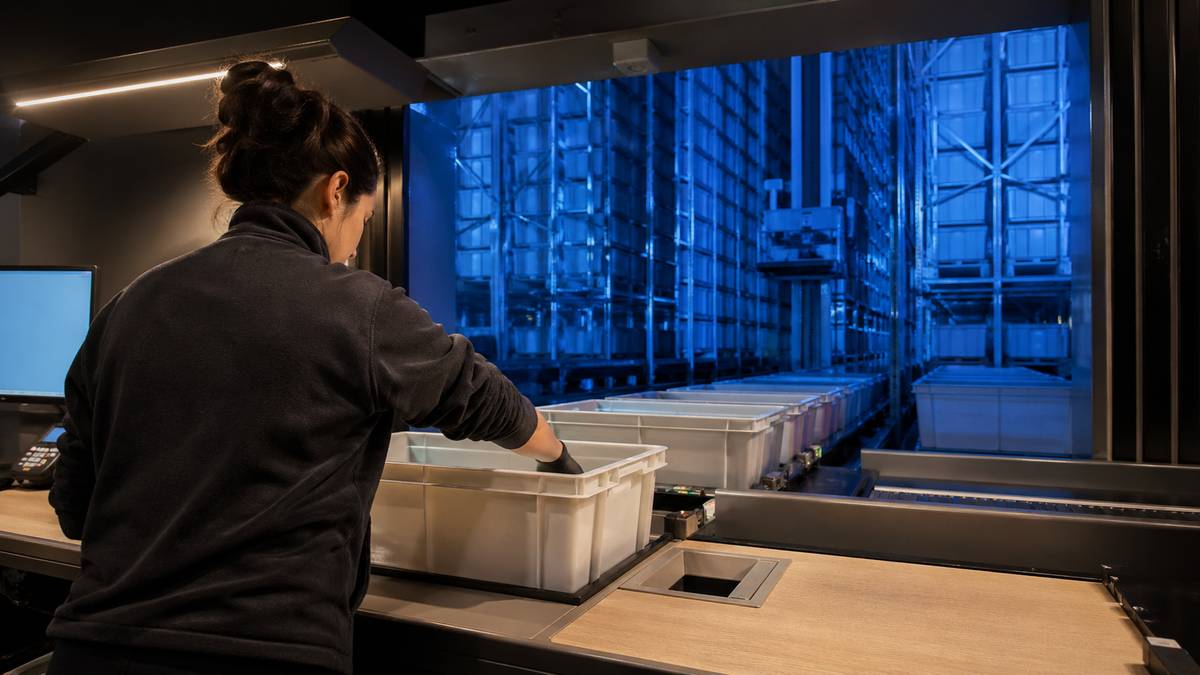
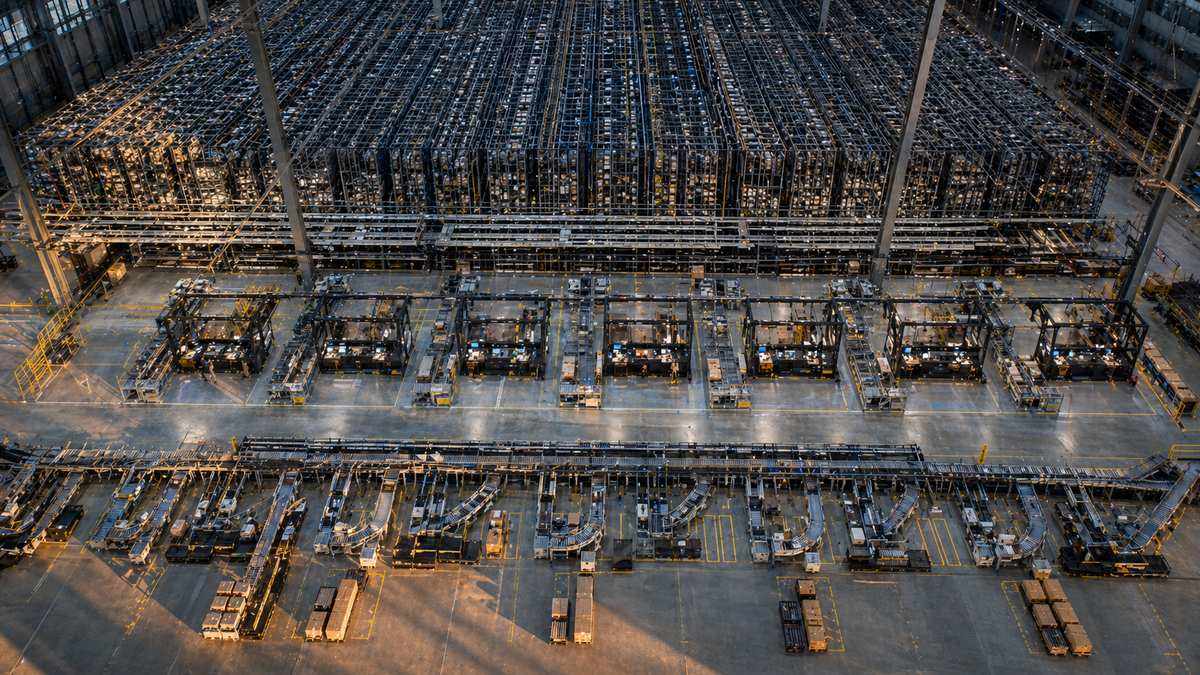
A goods to person system flips the oldest rule in warehousing: instead of workers walking to inventory, inventory travels to workers. Autonomous robots retrieve totes, bins, or shelving units from high-density storage and deliver them to stationary picking stations where operators fulfill orders without taking a single step into the aisles.
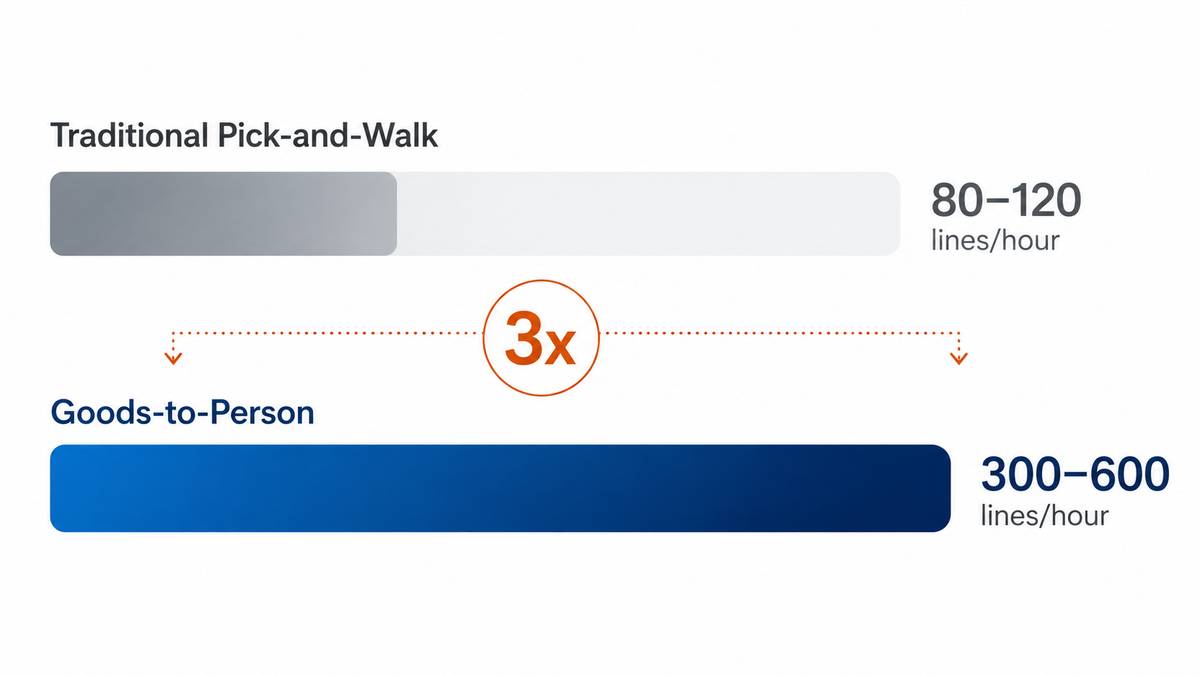
The result, across every goods to person system deployment we have been part of, is a 2x to 4x throughput improvement over traditional pick-and-walk operations. The median sits right around 3x. That number comes from reduced travel time (which accounts for 50-70% of a picker's shift in conventional warehouses), tighter pick accuracy, and the ability to run stations around the clock without scaling headcount linearly.
This guide covers how a goods to person system actually works at the mechanical and software level, where it outperforms traditional picking, what the core components are, and how to evaluate whether a G2P warehouse setup fits your operation. If you are still getting oriented on automated storage in general, start with our overview of what ASRS means and then come back here.
How Goods-to-Person Picking Works
The operating principle behind every goods to person system is the same: bring the SKU to the operator, not the operator to the SKU. The execution varies by robot type and racking architecture, but the workflow follows a consistent sequence.
Step 1: Order release and task assignment
The warehouse execution system receives incoming orders and breaks them into individual pick tasks. The WES identifies which storage locations hold the required SKUs, calculates the optimal retrieval sequence, and assigns tasks to specific robots based on proximity, battery level, and current workload.
Step 2: Robot retrieval
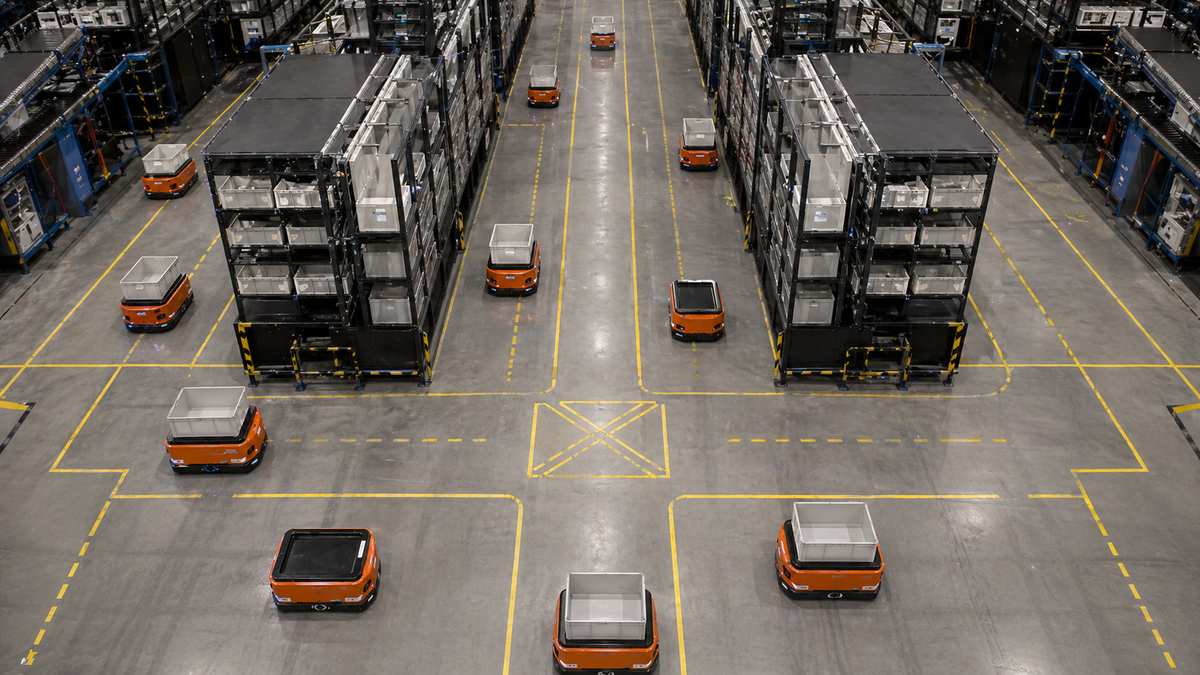
An autonomous mobile robot (AMR) travels to the designated storage location. Depending on the system design, the robot either lifts an entire portable shelving unit from underneath (shelf-to-person), extracts a single tote from a racking structure (tote-to-person), or picks up a bin from a grid-based storage system. The robot finds its path using a combination of QR codes embedded in the warehouse floor, LiDAR, and onboard cameras.
Step 3: Transport to picking station
The robot carries the inventory unit along an optimized path to the assigned picking station. Traffic management algorithms coordinate hundreds of robots simultaneously, preventing collisions and minimizing congestion at intersections. In a well-tuned system, robots queue at the station so the operator always has the next tote waiting — zero idle time between picks.
Step 4: Operator picks
At the robotic picking station, a display screen or put-to-light system tells the operator exactly which item to pick, the quantity needed, and which order bin to place it in. The operator picks the item, confirms the action (via scan, button press, or weight verification), and the system updates inventory in real time.
Step 5: Return to storage
Once the pick is complete, the robot carries the inventory unit back to storage. The WES may assign it to a different storage position than where it came from — fast-moving SKUs get repositioned closer to the picking stations over time, a process called dynamic slotting that continuously optimizes retrieval speed.
This entire cycle — from order release to item picked — takes 30 to 90 seconds depending on warehouse size and robot fleet density. A single picking station served by a goods to person system typically processes 300 to 600 order lines per hour. Compare that to the 80 to 120 lines per hour that a skilled manual picker achieves walking the aisles, and the 3x throughput claim becomes straightforward math.
Goods-to-Person vs Traditional Pick-and-Walk: A Direct Comparison
The performance gap between goods-to-person picking and conventional manual picking is not subtle. Here is how they compare across the metrics that drive warehouse operating costs.
| Metric | Traditional Pick-and-Walk | Goods-to-Person Picking |
|---|---|---|
| Pick rate | 80-120 lines/hr per picker | 300-600 lines/hr per station |
| Travel time (% of shift) | 50-70% | 0% (operator is stationary) |
| Pick accuracy | 97-99% | 99.5-99.9% |
| Labor per 10,000 lines/day | 12-16 pickers | 3-5 station operators |
| Training time for new hires | 2-4 weeks | 2-4 hours |
| Ergonomic injury risk | High (walking, bending, lifting) | Low (waist-height presentation) |
| Operating hours | Limited by shift staffing | 24/7 with minimal supervision |
| Space utilization | 40-50% of floor area is aisles | 80-85% is active storage |
| Scalability | Add headcount (linear cost) | Add robots (decreasing marginal cost) |
The training time difference deserves attention. In a traditional warehouse, new pickers need weeks to learn the layout, memorize fast-mover locations, and reach target pick rates. At a goods to person system station, the software tells the operator exactly what to do — the learning curve drops to hours. For operations dealing with seasonal labor surges or high turnover, that difference alone changes the staffing equation.
The space utilization gap is equally significant. Manual picking requires wide aisles for carts and foot traffic. A goods to person system packs inventory into dense racking that only robots access, reclaiming 30-40% of floor space that was previously dedicated to human movement paths. The Material Handling Institute (MHI) reports that goods-to-person technologies are among the fastest-adopted automation categories in North American warehouses, with adoption rates climbing year over year.
Core Components of a Goods to Person System
A goods to person system is not a single product — it is an integrated system built from four interdependent layers. Getting any one of them wrong degrades the performance of the entire deployment.
1. Autonomous Mobile Robots (AMRs)
The robots are the visible part of a goods to person system, but they are not the most important part. AMRs in a G2P warehouse come in several form factors:
- Shelf-carrying robots lift portable shelving units (typically 1.5 to 2 meters tall) and transport them to picking stations. Payload capacity ranges from 500 kg to 1,500 kg. These are the workhorses of large-scale e-commerce fulfillment.
- Tote-carrying robots extract individual totes or bins from racking and deliver them directly. Smaller and faster than shelf carriers, they work well in operations with high SKU counts where only a few items are needed from each storage unit.
- Composite robots combine horizontal travel with vertical climbing capability, moving up racking structures to access totes at height. These maximize storage density by using the full cube of the warehouse.
Robot fleet sizes range from 20 units for a small operation to 1,000+ for large-scale deployments. Our AMR hardware lineup covers the full range of form factors and payload classes.
2. High-Density Racking
The racking in a goods to person system is purpose-built for robotic access, not human access. That means narrower aisles (or no aisles at all in grid-based systems), tighter bin spacing, and structural designs optimized for the specific robot type being deployed.
Racking configurations include:
- Portable shelving units — lightweight, modular shelves that robots lift and carry. Storage density is moderate but flexibility is high; you can reconfigure the layout by simply moving shelves.
- Fixed racking with robotic extraction — traditional racking structures where robots reach in to pull totes. Higher density than portable shelving, but less flexible.
- Grid-based storage — a dense grid of bins stacked on top of each other, accessed by robots that travel on top of the grid and reach down to extract bins. This offers the highest storage density of any G2P approach.
3. Picking Stations
The picking station is where human productivity gets multiplied. A well-designed station presents inventory at an ergonomic height (waist to chest level), displays clear pick instructions, and minimizes the physical motions required per pick.
Station designs typically include:
- A tote presentation area where the robot-delivered container appears
- A put-to-light wall with 10 to 30 order bins, each with an indicator light showing where to place picked items
- A display screen showing item image, quantity, and location within the tote
- A confirmation mechanism (barcode scan, button, or weight sensor)
Peak-performing stations process 400 to 600 lines per hour with a single operator. When we deployed goods-to-person stations for Li-Ning's sportswear distribution, the combination of optimized station layout and intelligent order batching drove a 630% efficiency gain over their previous manual operation.
4. Warehouse Execution System (WES)
The WES is the brain. It coordinates every moving part: robot task assignment, traffic management, order batching, dynamic slotting, station workload balancing, and inventory tracking. Without strong software, a fleet of 500 robots becomes a traffic jam.
Key WES functions in a goods to person system:
- Order batching — grouping orders that share common SKUs so a single tote retrieval serves multiple orders
- Robot dispatching — assigning the right robot to the right task based on location, battery state, and queue depth
- Traffic optimization — routing hundreds of robots through shared pathways without deadlocks or congestion
- Dynamic slotting — continuously repositioning inventory so that high-velocity SKUs are stored closest to picking stations
- Station balancing — distributing work evenly across stations to prevent bottlenecks
Our warehouse execution system is the integration layer we build every G2P deployment around. It is the single component that has the most impact on whether a goods to person system hits its throughput targets or falls short.
When a Goods to Person System Makes Sense
Not every warehouse needs a goods to person system. The technology delivers its strongest ROI under specific operating conditions. Here is the profile of operations where we consistently see the business case close within 2 to 3 years.
High SKU count (5,000+ active SKUs). The more SKUs you manage, the more time manual pickers spend traveling between locations. A goods to person system eliminates that travel entirely, and the benefit scales with SKU complexity.
High order volume (5,000+ order lines per day). Below this threshold, simpler automation (pick-to-light, zone picking, or a small mini load ASRS) often delivers sufficient throughput at lower capital cost. Above it, the labor savings from G2P compound rapidly.
E-commerce and omnichannel fulfillment. The combination of small order sizes, high SKU variety, and same-day or next-day shipping deadlines is exactly what goods-to-person picking was designed for. Each-pick operations with 1 to 5 items per order see the biggest gains.
3PL operations with variable client volumes. Robot fleets scale up and down faster than fixed automation. You can add 50 robots to a goods to person system in a week; you cannot add a new crane aisle in a week. For third-party logistics providers managing multiple clients with fluctuating demand, that flexibility is worth paying for.
Labor-constrained markets. If you are in a region where warehouse labor is expensive, scarce, or both, a goods to person system converts a variable labor cost into a fixed capital investment with predictable operating expenses.
Operations requiring 24/7 throughput. Robots do not take breaks, call in sick, or slow down at 3 AM. When we work with clients who need true round-the-clock operation, G2P is almost always part of the answer. YKK's goods-to-person deployment combined with robotic arms runs 24/7 with zero human operators on the warehouse floor during overnight shifts.
Cost and ROI of Goods-to-Person Picking
The capital investment for a goods to person system varies widely based on scale, robot type, and racking configuration. Here are the ranges we see across our project portfolio.
Robot costs: $25,000 to $60,000 per unit depending on payload capacity and navigation technology. A mid-size deployment of 100 robots runs $3M to $5M for the robot fleet alone.
Racking and infrastructure: $500,000 to $3M depending on storage capacity and racking type. Grid-based systems cost more upfront but deliver higher density per square meter.
Picking stations: $30,000 to $80,000 per station, fully equipped with displays, put-to-light systems, and conveyor integration.
WES software and integration: $200,000 to $1M depending on complexity, number of integrations (ERP, WMS, shipping systems), and customization requirements.
Total system cost for a typical mid-scale goods to person system deployment (50-200 robots, 30,000-80,000 tote positions): $2M to $8M. For a detailed breakdown of how these numbers compare across all automation types, see our ASRS pricing breakdown.
ROI timeline: Most goods to person system deployments we have been involved with reach payback in 2 to 3 years. The primary savings come from labor reduction (60-70% fewer picking staff), accuracy improvement (fewer returns and re-ships), and space savings (deferring or eliminating facility expansion). Operations running two or three shifts see faster payback because the labor savings multiply with each shift eliminated.
Total cost of ownership consideration: Robots are consumable assets with 5 to 8 year operational lifespans. Budget for fleet replacement cycles and ongoing maintenance (typically 3-5% of robot fleet value per year). Battery replacement, wheel wear, and sensor calibration are the primary recurring costs.
Real-World Goods-to-Person Deployments
Theory is useful, but deployment data is what closes decisions. Here are four goods-to-person projects that illustrate the range of what G2P systems deliver in production.
Li-Ning: 630% Efficiency Improvement
Li-Ning, one of China's largest sportswear brands, deployed a bin-robot goods to person system across multiple warehouse zones to handle peak-season e-commerce fulfillment. The system replaced a manual pick-and-walk operation that was struggling to keep up with double-digit annual order growth.
Results: 630% improvement in picking efficiency, measured as order lines processed per labor hour. The system handles seasonal demand spikes (Singles' Day, Chinese New Year) without temporary staffing surges. Read the full Li-Ning case study.
YKK: 24/7 Unmanned Operation
YKK, the global fastener and zipper manufacturer, needed a system that could run overnight shifts without human operators. The solution combined goods to person system robots with robotic picking arms at the station level — robots bring totes to the station, and a robotic arm handles the physical pick-and-place.
Results: True 24/7 unmanned operation during overnight shifts, with human operators staffing stations only during daytime peak hours. The hybrid approach cut labor requirements by over 80% while maintaining 99.7% pick accuracy on small, high-variety fastener components. See YKK's deployment details.
Decathlon: 1,000+ Robots Across 25+ Projects
Decathlon, the French sporting goods retailer, has scaled goods to person system automation across its global distribution network with over 1,000 robots deployed across more than 25 projects. The deployments span multiple warehouse formats — from compact urban fulfillment centers to large regional distribution hubs.
Results: Standardized G2P picking across a global network, with each facility tuned to local volume and SKU profiles. The scale of the deployment demonstrates that goods-to-person systems are not pilot-stage technology — they are production infrastructure running at enterprise scale. Explore Decathlon's multi-site deployment.
Sony: 49-Robot Precision Deployment
Sony deployed a 49-robot goods to person system for electronics component distribution, handling high-value, fragile inventory that demands precise handling and near-perfect accuracy. The system started as a mini load concept and evolved into a robotic G2P deployment as throughput requirements grew — a progression we see frequently with clients who outgrow their initial automation scope.
Results: 99.9%+ inventory accuracy on high-value electronics components, with throughput scaled to match growing order volumes without adding warehouse staff.
How to Choose the Right Goods to Person System
Not all goods to person systems are built the same. The robot type, racking architecture, and software platform need to match your specific operation. Here is the evaluation framework we walk clients through.
Match the robot type to your inventory profile
- Shelf-carrying robots work best for operations with moderate SKU density per shelf and frequent access to a wide range of products. If your pickers typically need items from many different locations per order, shelf-to-person keeps things simple.
- Tote-carrying robots are the better choice when you have high SKU counts and need precise, single-tote retrieval. They are faster per cycle than shelf carriers and waste less time presenting irrelevant inventory to the operator.
- Grid-based bin robots maximize storage density and work well for operations with very high SKU counts (50,000+) in a constrained footprint. The trade-off is lower ceiling height utilization compared to racking-based systems.
Size the robot fleet for peak, not average
A common mistake is sizing the robot fleet for average daily volume. Your system needs to handle peak throughput — Black Friday, promotional events, seasonal surges — without degrading pick rates. We typically recommend sizing for 120-130% of projected peak volume to account for growth and operational variability.
Prioritize WES capability over robot specs
The robots are commoditizing. Prices are dropping, performance is converging across manufacturers, and the hardware differences between competing platforms are narrowing. The WES is where differentiation lives. A strong warehouse execution system with intelligent order batching, dynamic slotting, and real-time traffic optimization will outperform a fleet of premium robots running on mediocre software.
Plan for integration, not just installation
A goods to person system does not operate in isolation. It connects to your WMS, ERP, shipping systems, and potentially other automation subsystems (conveyor, sortation, packing). The integration layer is where most deployment delays and cost overruns originate. This is why we position ourselves as a logistics integrator, not a robot manufacturer — the value is in making all the pieces work together. Explore our industry-specific solutions to see how we approach integration across different verticals.
Start with a pilot zone
For operations new to goods to person system technology, we recommend starting with a single zone — 30 to 50 robots serving 2 to 4 picking stations — and expanding once the system is tuned and the team is comfortable. A pilot deployment takes 3 to 6 months from contract to go-live, compared to 8 to 14 months for a full-scale rollout. The pilot gives you real performance data from your own inventory and order profiles, which is worth more than any simulation.
For a broader view of how goods-to-person fits within the full landscape of automated storage, our guide to all ASRS types compared covers every major technology category side by side.
Start Your Goods-to-Person Evaluation
A goods to person system is not a small decision, but it is a straightforward one once you have the right data. The operations that benefit most share a common profile: high SKU counts, high order volumes, labor pressure, and a need for speed and accuracy that manual picking cannot sustain.
If that sounds like your warehouse, the next step is a site assessment. We analyze your current throughput, SKU profile, order patterns, and facility constraints to determine whether a goods to person system is the right fit — and if so, which configuration delivers the best ROI for your specific operation.
Get a G2P system consultation and we will walk through the numbers with you.
Planning a Warehouse Automation Project?
Our team has delivered 50+ ASRS systems across retail, manufacturing, and logistics. Tell us about your project and we will get back to you within 24 hours.
Thank you!
We received your message and will get back to you within 24 hours.