
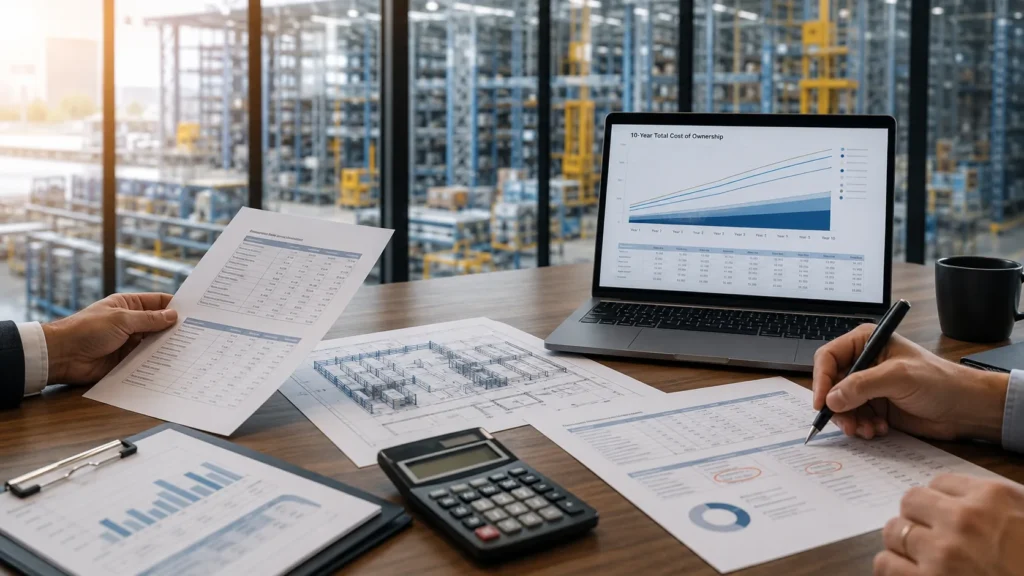
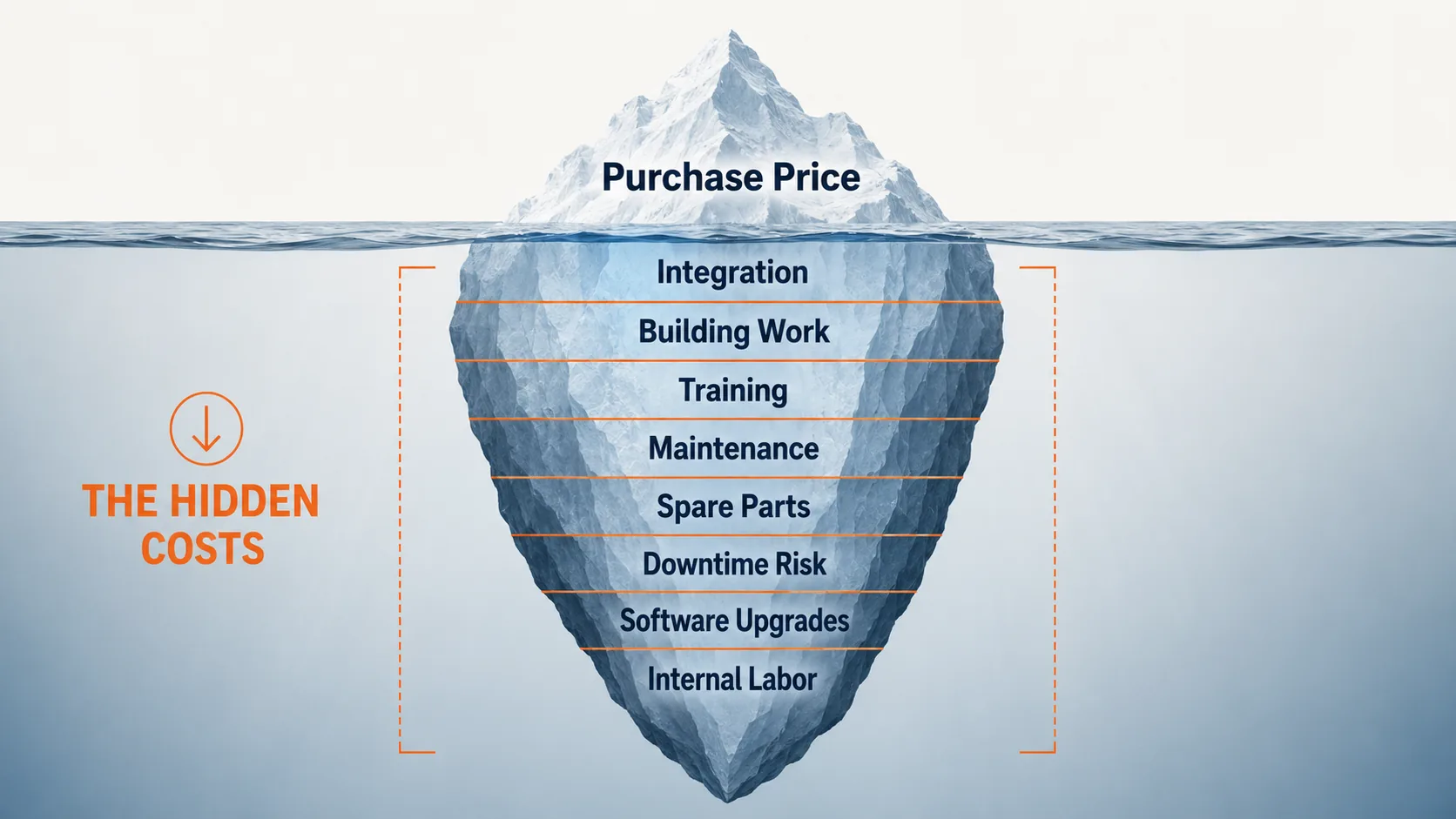
ASRS total cost of ownership is the real cost of owning, operating, maintaining, integrating, and upgrading an automated storage and retrieval system over its working life. The purchase price is only the opening number. A warehouse automation project can look affordable in a vendor quote and still become expensive if building work, software integration, spare parts, ramp-up losses, and downtime risk are not included in the model.
Most buyers ask, "How much does the ASRS cost?" That is the wrong first question. The better question is, "What will this system cost to own for 10 years, and what operating problem will it remove during that time?"
Short answer: ASRS total cost of ownership includes initial equipment, installation, building modifications, software, WMS/WES/WCS integration, commissioning, training, maintenance, spare parts, energy, support contracts, operational downtime, upgrade cycles, and internal project time. For serious buying decisions, model TCO over 5 to 10 years, then compare it with the fully loaded cost of the manual process it replaces.
This guide explains the cost layers vendors often compress into one line item, how to build a defensible TCO model, and which questions to ask before signing an automation contract.
What ASRS Total Cost of Ownership Actually Means
Total cost of ownership, or TCO, is a way to evaluate the full economic burden of a system across its life cycle. For ASRS, that means looking beyond the equipment invoice and including every cost required to make the system useful, reliable, integrated, and maintainable.
Deloitte's warehouse automation guidance frames automation cost in three broad layers: initial capital investment, ongoing operational costs such as maintenance and energy, and workforce training or redeployment. That is a useful starting point, but ASRS buyers need to go deeper because automated storage touches the building, software stack, operational process, and maintenance model at the same time.
At a minimum, an ASRS TCO model should include:
- Equipment and storage structure
- Controls, sensors, PLCs, and safety systems
- Installation and mechanical/electrical work
- Building modifications and utilities
- Software licensing and integration
- Testing, commissioning, and go-live support
- Operator and maintenance training
- Spare parts and maintenance contracts
- Internal project management time
- Energy and facility operating impact
- Downtime, ramp-up, and productivity risk
- Upgrades, retrofits, and expansion costs
- Decommissioning or relocation costs if the site changes
If your model only includes equipment plus installation, it is not a TCO model. It is a purchase estimate.
Why Purchase Price Is Misleading
Two ASRS proposals can have the same purchase price and very different ownership cost.
One proposal may include robust WES integration, spare parts, operator training, documentation, preventive maintenance, remote diagnostics, and realistic go-live support. Another may include the same storage capacity and throughput on paper but leave integration, floor work, network upgrades, system testing, and after-sales support as assumptions.
The cheaper proposal is not always cheaper. It may simply move cost into later phases where the buyer has less leverage.
The same pattern appears in most warehouse automation projects:
- The equipment price is visible.
- The integration effort is partially visible.
- Building and process changes are underestimated.
- Internal labor is rarely counted.
- Ramp-up losses are treated as "temporary."
- Maintenance and spare parts are negotiated late.
- Software ownership is unclear until testing begins.
That is why a serious ASRS buyer should compare vendors on 10-year operating economics, not just quote price.
For the narrower equipment-level pricing view, see our ASRS system cost guide. This article focuses on the wider ownership model.
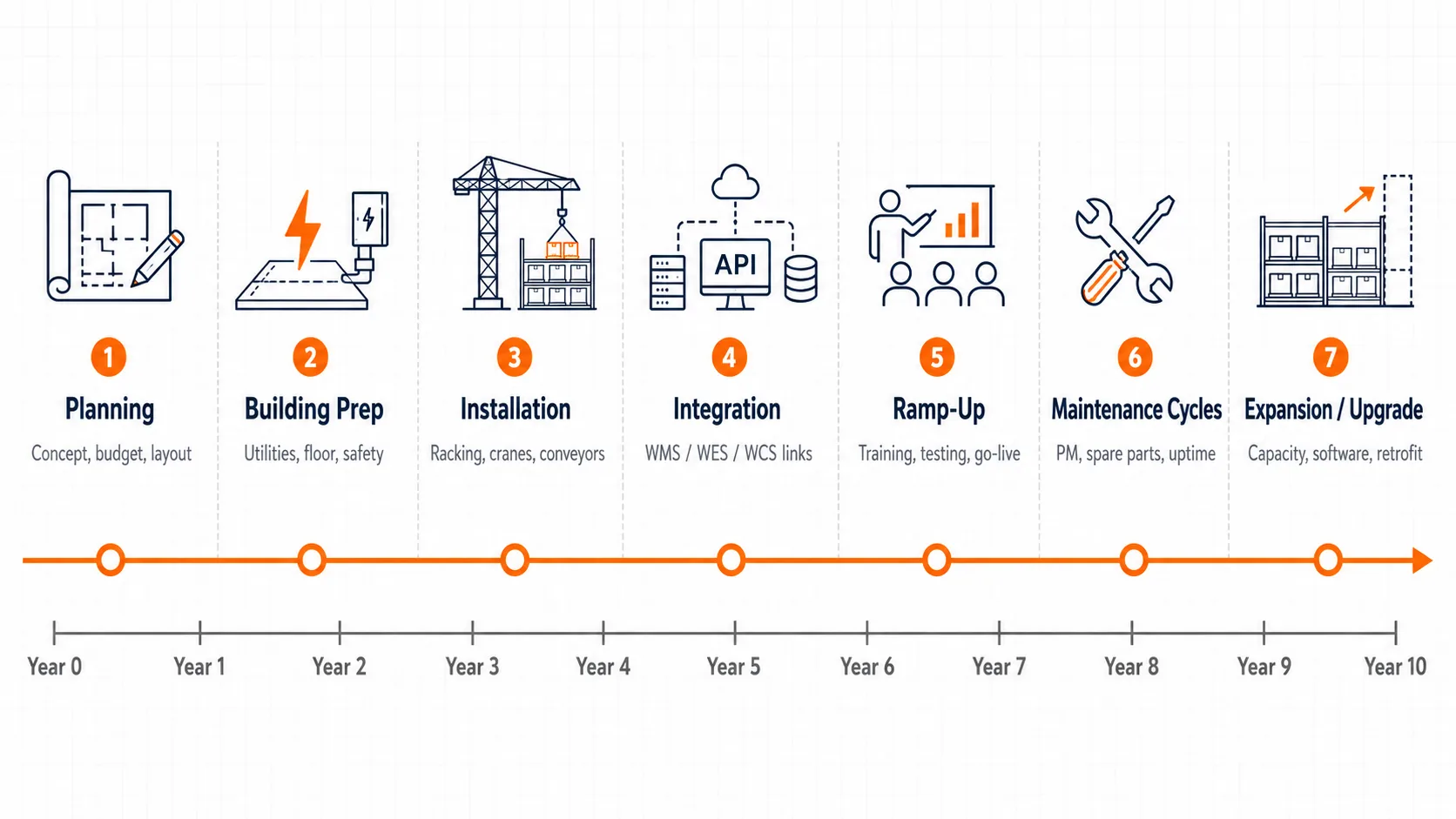
The ASRS TCO Formula
A practical ASRS TCO formula looks like this:
| Cost layer | What to include | Often missed? |
|---|---|---|
| Capital equipment | Cranes, shuttles, robots, racks, lifts, conveyors, workstations | No |
| Controls and safety | PLCs, sensors, guarding, light curtains, emergency systems | Sometimes |
| Building work | Floor, fire protection, mezzanine, power, network, HVAC, dock changes | Yes |
| Software | WMS/WES/WCS licenses, middleware, dashboards, APIs | Yes |
| Integration | ERP, WMS, WES, WCS, OMS, TMS, labelers, carrier systems | Yes |
| Commissioning | FAT, SAT, acceptance testing, go-live support, tuning | Sometimes |
| Training | Operators, supervisors, maintenance team, IT support | Yes |
| Maintenance | Preventive maintenance, inspections, support contracts | Yes |
| Spare parts | Critical spares, batteries, belts, motors, sensors, wear parts | Yes |
| Energy | Electricity, compressed air, heating/cooling impact | Sometimes |
| Internal labor | Project managers, IT, operations, engineering, super users | Usually |
| Ramp-up risk | Lower productivity during stabilization and learning period | Usually |
| Downtime risk | Lost throughput, manual fallback labor, expedited shipping | Usually |
| Upgrades | Software upgrades, controls refresh, added stations, capacity expansion | Yes |
The model should be calculated by year. A one-time total hides timing risk.
Use this structure:
text 10-year ASRS TCO = Initial capital cost + Implementation and integration cost + Building and utility modifications + Internal project labor + Annual maintenance and support + Annual software and hosting + Spare parts and consumables + Energy and facility operating impact + Ramp-up and downtime cost + Upgrade and expansion cost
- Residual value or avoided relocation value
Then compare that number with:
text 10-year manual process cost = Labor cost + overtime and temporary labor + recruiting and training + forklift lease and maintenance + warehouse space or expansion cost + error, damage, and return cost + safety incidents and insurance impact + missed service level or peak-season cost
The decision is not "automation cost versus no cost." Manual operations have a TCO too. They just hide it inside payroll, overtime, space, errors, and management effort.
Upfront Cost: What Goes Into the First Quote
The visible cost usually includes physical automation equipment and basic implementation.
For pallet ASRS, that may include high-bay racking, stacker cranes, pallet conveyors, input/output stations, pallet inspection, safety fencing, and controls.
For tote or carton ASRS, it may include shuttle aisles, lifts, totes, rack structure, goods-to-person stations, conveyor interfaces, and warehouse control software.
For a bin robot or robotic goods-to-person system, it may include robots, charging stations, storage racks, workstations, fleet management software, and implementation services.
The quote may also include:
- Design engineering
- Mechanical installation
- Electrical installation
- Controls programming
- Factory acceptance testing
- Site acceptance testing
- Initial operator training
- Standard documentation
These items matter, but they are not the whole project. The purchase quote is only the first layer of ownership.
For system selection context, read ASRS warehouse systems, layouts, and automation examples and how to choose an ASRS system.
Building Modifications: The Cost Buyers Underestimate
ASRS is not just a machine that sits inside a building. It often changes how the building works.
Potential building costs include:
- Floor flatness correction
- Floor load verification
- Rack anchoring and seismic requirements
- Fire protection review
- Sprinkler modification
- Electrical service upgrades
- Network cabling and industrial Wi-Fi
- Conveyor openings and wall penetrations
- Dock flow changes
- Mezzanine or platform work
- Temperature, humidity, or condensation control
- Emergency egress and access planning
Cold storage projects require special attention. A freezer ASRS may reduce labor exposure, but the system must handle low-temperature components, door strategy, frost control, maintenance access, and energy implications. That can materially affect TCO.
Building work is also where timelines slip. A crane, shuttle, or robot fleet may arrive on schedule, but if the floor, power, network, fire protection, or access zones are not ready, the project burns time before the system can produce value.
Software and Integration Cost
Software is where many ASRS TCO models are too optimistic.
An ASRS may need to connect with:
- ERP
- WMS
- WES
- WCS
- OMS
- TMS
- MES
- Carrier systems
- Print-and-apply systems
- Labeling software
- Dimensioning and weighing systems
- Client portals in 3PL operations
- Business intelligence tools
The 2025 MHI Annual Industry Report coverage emphasized unified data and fully integrated supply chain systems as priorities for modern operations. That is directly relevant to ASRS TCO. A storage system that moves inventory well but fails to synchronize cleanly with WMS, ERP, and execution software will create manual workarounds.
Interact Analysis has also described a warehouse automation market shift where value increasingly moves toward design, orchestration, and the ability to connect different systems. In other words, software and integration are not side work. They are central to the ownership cost.
Questions to ask before accepting a software estimate:
- Which system owns inventory location?
- Which system releases tasks?
- Which system prioritizes urgent orders?
- Which system handles exceptions?
- Which system records failed scans and manual overrides?
- Who maintains the interface after go-live?
- What happens when the WMS or ERP is upgraded?
- Are support hours included or billed separately?
- Is the WES license perpetual, subscription, or usage-based?
If those answers are unclear, the software cost is not fully defined.
For background on the software layers, see WES vs WMS vs WCS.
Maintenance and Spare Parts
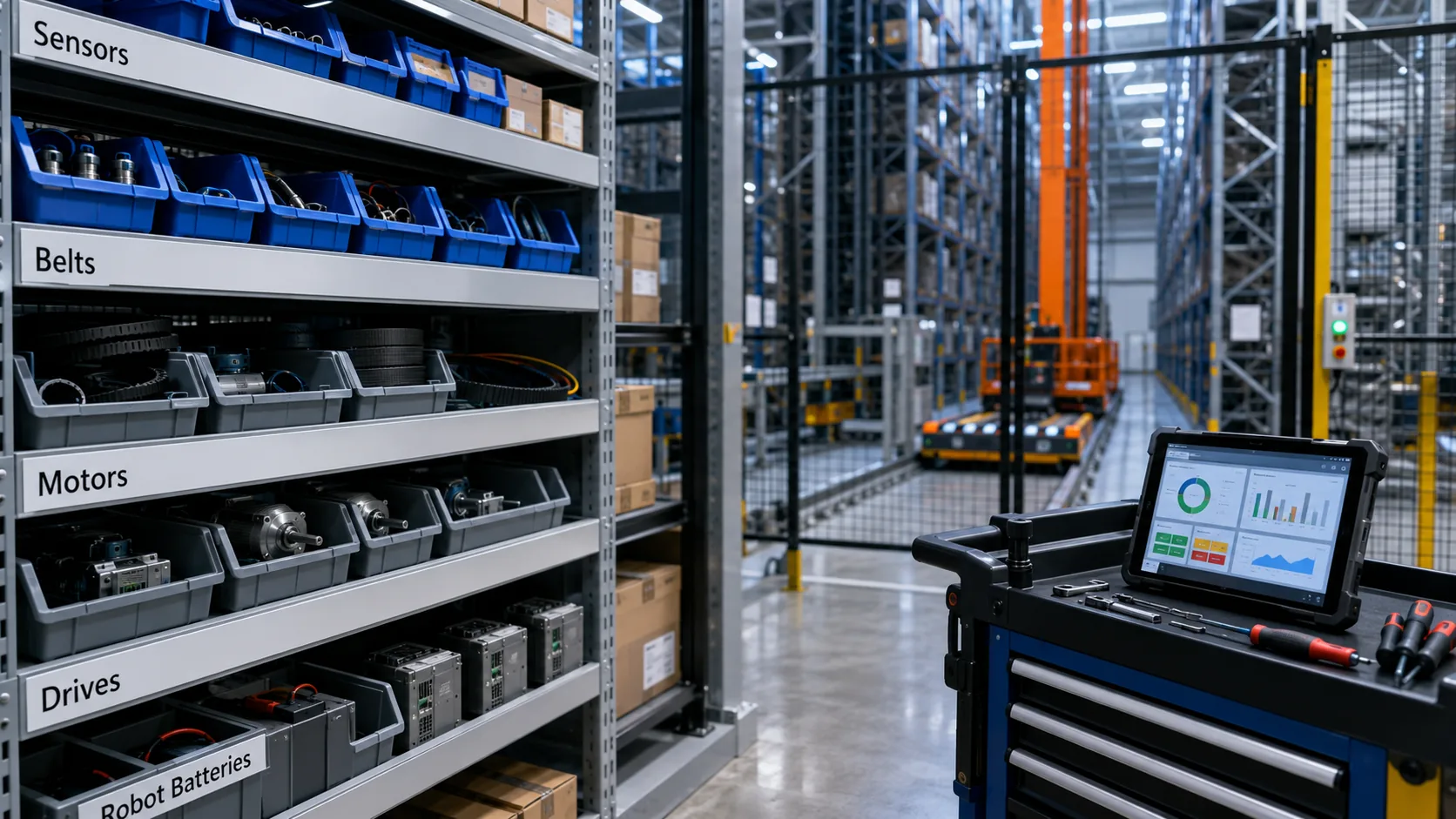
Maintenance is not a footnote. It is part of the business case.
Typical ASRS maintenance categories include:
- Preventive inspections
- Emergency support
- Remote diagnostics
- Mechanical wear parts
- Motors and drives
- Sensors and scanners
- Belts, rollers, chains, and wheels
- Batteries for robot fleets
- Crane or shuttle components
- PLC and controls support
- Software patches and updates
- Safety system inspection
The ownership question is not just "What is the annual maintenance fee?" It is:
- What is included?
- What is excluded?
- What response time is guaranteed?
- Which spare parts must be kept on site?
- What parts have long lead times?
- Who can service the system?
- Are technicians local, regional, or remote?
- What downtime is expected during preventive maintenance?
A low maintenance quote can be a warning sign if it excludes emergency visits, remote diagnostics, spare parts, software support, or technician travel.
The best practice is to create a critical spare parts list before go-live. A small sensor, motor, or communication component can stop a high-throughput zone if the system has no redundancy and the part is not available.
Internal Labor Is a Real Cost
Many ASRS business cases count vendor cost but ignore internal cost.
Internal effort usually comes from:
- Operations managers
- Warehouse supervisors
- IT team
- ERP or WMS owners
- Maintenance team
- Finance team
- Procurement
- Safety or compliance staff
- Super users from receiving, picking, packing, and shipping
These people attend design workshops, validate layouts, clean data, test process flows, prepare SOPs, support go-live, train teams, and manage exceptions. Their time is not free. If the project requires hundreds of internal hours, the TCO model should include them.
Ignoring internal labor also creates a management risk. If key people are overloaded, decisions slow down, testing is shallow, and go-live becomes unstable.
Ramp-Up Cost and Productivity Dip
Most ASRS projects do not reach target productivity on day one.
During ramp-up, the team is still learning:
- New screen prompts
- New exception rules
- New maintenance routines
- New replenishment timing
- New inventory discipline
- New escalation paths
- New picking and packing balance
The system may be mechanically ready, but the operating process still needs tuning.
Ramp-up cost can include:
- Extra supervision
- Temporary manual labor
- Lower station productivity
- Rework from process mistakes
- Delayed order cutoffs
- Vendor support extensions
- Extra IT support
- Additional training shifts
This does not mean ASRS is risky by default. It means the first 30 to 90 days should be part of the TCO plan, not treated as an exception.
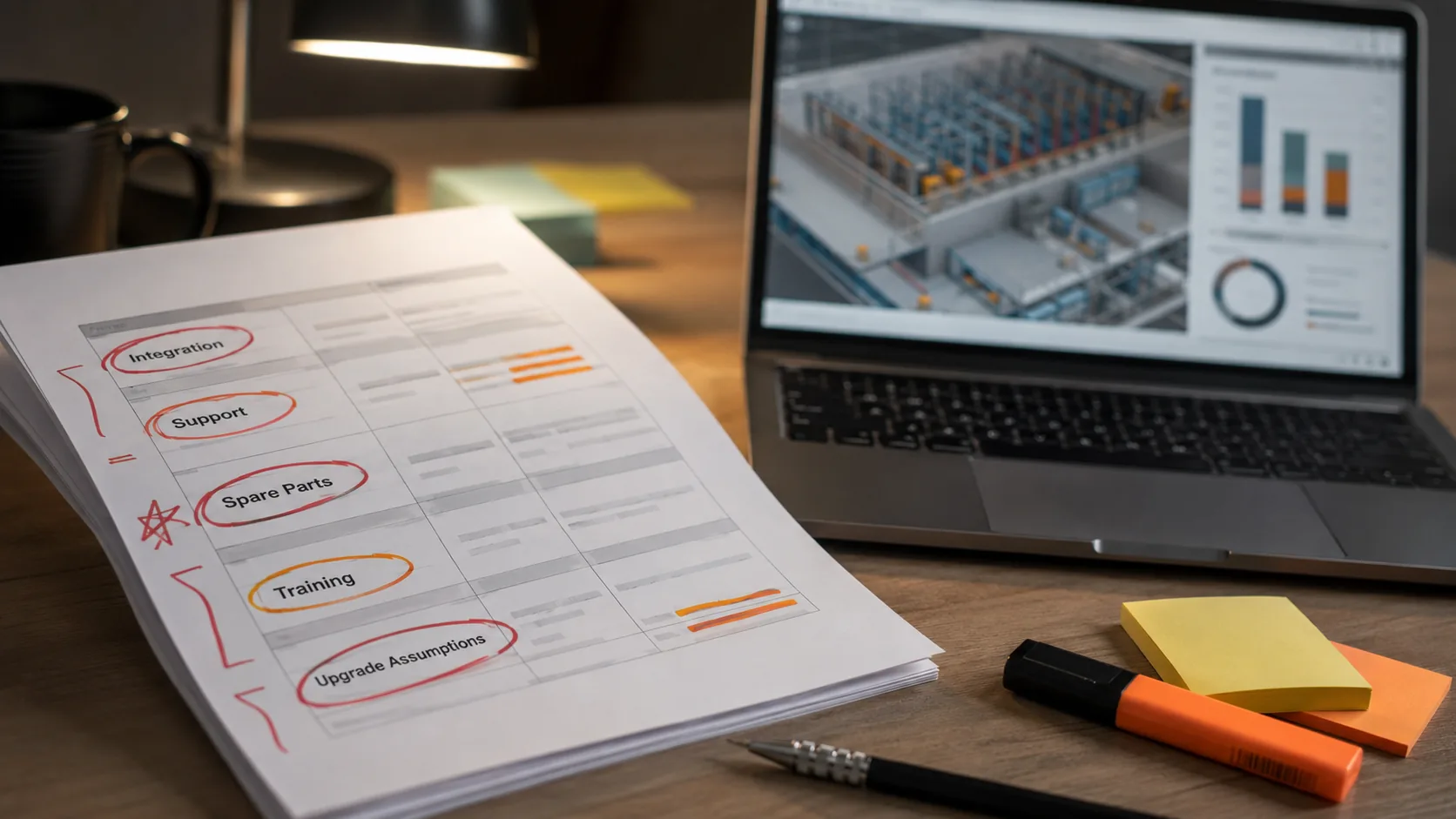
Downtime Risk and Redundancy
Downtime cost is hard to model, so many buyers skip it. That is a mistake.
A manual warehouse can slow down when a forklift fails. An automated warehouse can lose an entire flow if a critical conveyor, lift, crane, server, or interface fails without redundancy.
Downtime cost may include:
- Missed carrier cutoff
- Manual fallback labor
- Overtime recovery shifts
- Expedited shipping
- Production line stoppage
- SLA penalties in 3PL operations
- Customer service work
- Damaged service reputation
The right model does not assume disaster. It asks a practical question: if this system is down for two hours, eight hours, or one day, what happens?
Ask vendors:
- Which components are single points of failure?
- What is the designed fallback process?
- Can part of the system keep running?
- What is the expected mean time to repair?
- What support hours are included?
- What remote diagnostics are available?
- What spares must be kept on site?
- What does a recovery plan look like?
Downtime planning is not pessimism. It is basic operational design.
Upgrade, Expansion, and Obsolescence Cost
An ASRS is usually expected to run for many years. During that time, the warehouse will change.
Common changes include:
- More SKUs
- Different tote or pallet sizes
- Higher order volume
- New client requirements
- New WMS or ERP version
- Different carrier process
- New labeling rules
- Added goods-to-person stations
- Additional aisles or robots
- Controls or server upgrades
The system should be evaluated for expansion before purchase.
Important questions:
- Can storage capacity be expanded?
- Can throughput be expanded independently from storage?
- Can more workstations be added?
- Can the software handle more zones?
- Can the system support new SKU profiles?
- Is the technology vendor likely to support this platform in 10 years?
- What happens if the facility relocates?
The cheapest system may be expensive if it becomes a dead end after three years.
How to Compare Vendor Proposals
Do not compare ASRS vendors line by line only on equipment cost. Normalize the proposals first.
Use this checklist:
| Comparison area | Question to ask |
|---|---|
| Scope | Are all physical and software components included? |
| Throughput | Is the throughput measured at machine level or complete process level? |
| Building work | Who owns floor, fire, electrical, network, and utility assumptions? |
| Integration | Which systems are included, and how many interfaces are priced? |
| Testing | Are FAT, SAT, stress testing, and exception testing included? |
| Go-live | How many days of on-site support are included? |
| Training | Is training one-time, role-based, and documented? |
| Maintenance | What is covered, what is excluded, and what is the SLA? |
| Spare parts | What must be stocked locally, and what are lead times? |
| Upgrade path | What does expansion or software upgrade cost? |
| Performance | What acceptance criteria define success? |
If one vendor includes these items and another excludes them, the lower quote is not a lower TCO. It is a less complete proposal.
Example: Why a Higher Quote Can Be Cheaper
Imagine two ASRS proposals for a tote-based ecommerce warehouse.
Vendor A quotes $3.8 million. Vendor B quotes $4.4 million.
At first glance, Vendor A looks cheaper. But Vendor B includes:
- WES integration
- Four WMS interfaces
- Stress testing
- Operator and maintenance training
- Critical spare parts
- 60 days of go-live support
- Preventive maintenance in year one
- Remote diagnostics
- Two added workstation expansion options
Vendor A excludes several of these items or lists them as assumptions.
If Vendor A later requires $400,000 of integration change orders, $180,000 in support extensions, $120,000 in spare parts, and loses two weeks of productivity during ramp-up, Vendor A becomes more expensive. More importantly, it creates more operational risk.
The point is not that higher quotes are always better. The point is that TCO comparison must normalize scope, risk, and support.
ASRS TCO by System Type
Different ASRS types have different cost profiles.
| System type | TCO risk profile | Watch closely |
|---|---|---|
| Pallet ASRS | Building, fire protection, crane maintenance, controls | Floor, rack, pallet quality, emergency access |
| Shuttle ASRS | Software, lifts, throughput balance, spare parts | Lift redundancy, tote quality, station design |
| Mini-load ASRS | Integration, crane uptime, tote/carton standards | Load unit consistency, maintenance access |
| Bin robot system | Battery life, fleet maintenance, rack accuracy | Charging strategy, robot availability, expansion cost |
| VLM | Lower system complexity, but limited scaling | Throughput ceiling, ergonomics, part size fit |
| Hybrid ASRS + AMR | Orchestration and interface complexity | WES ownership, exception flow, fleet coordination |
This is why system selection and TCO modeling should happen together. The technically best system may not be the financially best system if it creates integration, maintenance, or expansion problems the operation cannot support.
For related system comparisons, read mini load ASRS vs shuttle or crane options, shuttle ASRS vs crane-based ASRS, and ASRS vs AMR.
Benefits That Offset TCO
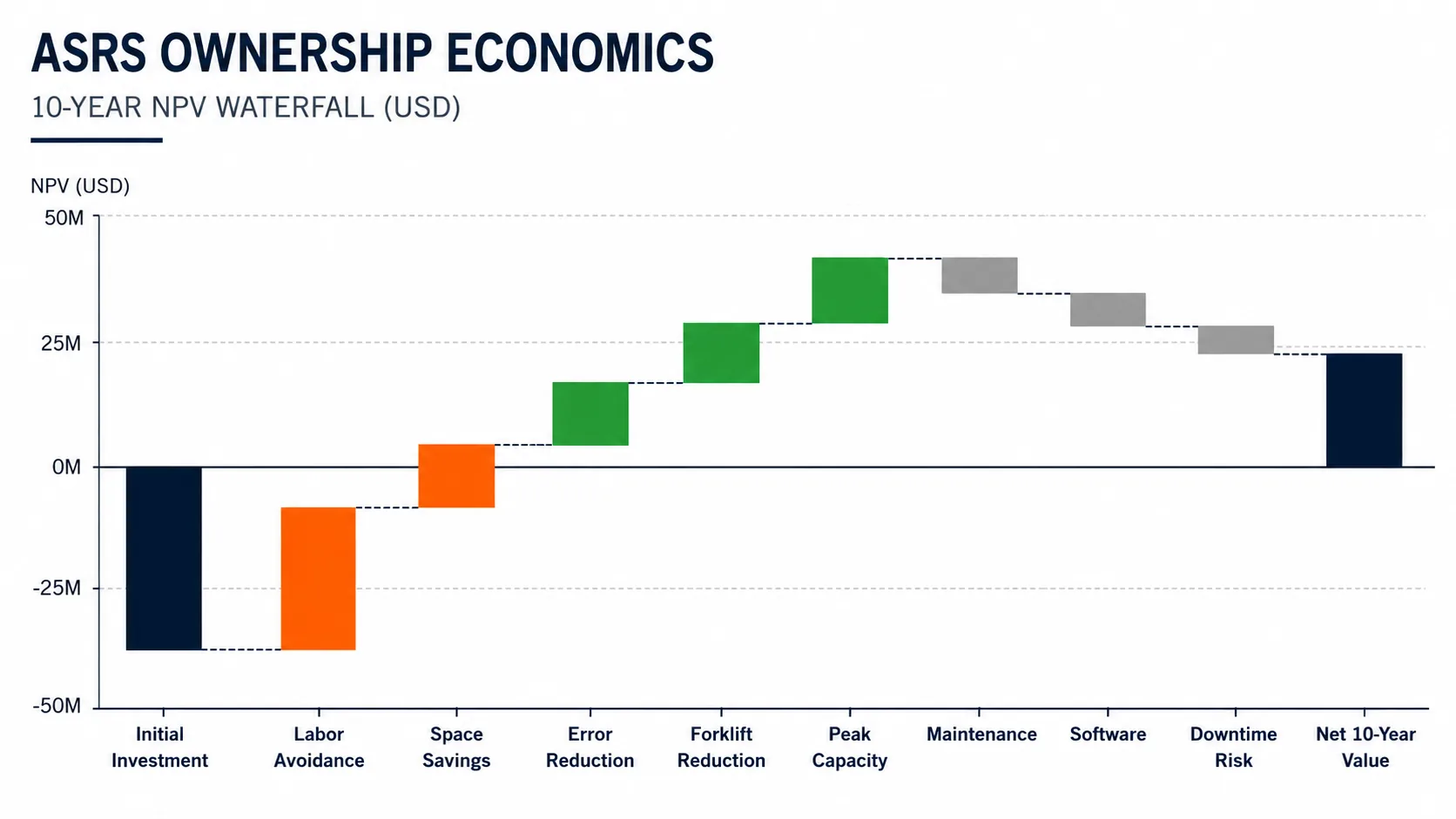
TCO is only half the decision. A high TCO can still be justified if the system removes a bigger business constraint.
Common benefits include:
- Reduced labor dependency
- Less overtime and temporary labor
- Higher storage density
- Avoided warehouse expansion
- Fewer forklifts and less traffic
- Better inventory accuracy
- Lower mispick and damage rates
- Faster order cycle time
- More predictable peak season capacity
- Better cold storage working conditions
- Stronger traceability and process control
The strongest business cases combine several benefits. A project justified only by labor reduction is more vulnerable to assumptions. A project that also avoids building expansion, reduces errors, improves service levels, and supports growth is much more defensible.
Use our warehouse automation ROI guide to connect TCO with return analysis.
Questions to Ask Before Signing
Before approving an ASRS project, ask these questions:
1. What is included in the 10-year ownership model? 2. What is excluded from the vendor quote? 3. What building assumptions are required? 4. Who owns WMS, WES, WCS, and ERP integration? 5. What happens if a critical component fails? 6. Which spare parts must be stocked on site? 7. What annual maintenance contract is recommended? 8. What support response time is guaranteed? 9. How long is the expected ramp-up period? 10. What acceptance tests define a successful go-live? 11. What system capacity can be expanded later? 12. What costs are likely if order volume doubles? 13. What happens when the WMS or ERP is upgraded? 14. What internal team time is required? 15. What manual fallback process is available?
If a vendor cannot answer these clearly, the TCO risk is not yet understood.
Frequently Asked Questions
What is ASRS total cost of ownership?
ASRS total cost of ownership is the full cost of owning and operating an automated storage and retrieval system over its life cycle. It includes equipment, building modifications, installation, software, integration, maintenance, spare parts, training, internal labor, downtime risk, and future upgrades.
How is ASRS TCO different from ASRS price?
ASRS price usually refers to the initial purchase or project quote. ASRS TCO includes the purchase price plus the costs required to operate, maintain, support, integrate, and upgrade the system over time. A lower purchase price can still produce a higher TCO.
What is the biggest hidden ASRS cost?
The most common hidden costs are software integration, building modifications, internal project labor, ramp-up productivity loss, and after-sales support. The biggest risk depends on the system type and the maturity of the buyer's WMS, process data, and maintenance team.
How many years should an ASRS TCO model cover?
Most buyers should model ASRS TCO over at least 5 years, and preferably 10 years for larger fixed automation projects. Shorter models can miss maintenance cycles, software upgrades, spare parts consumption, and expansion needs.
Should maintenance be included in ASRS ROI?
Yes. Maintenance, spare parts, and support contracts should be included as annual operating costs. ROI should compare net benefits after these costs, not gross labor savings alone.
Can ASRS reduce total cost even if the upfront investment is high?
Yes, if the system removes a large operating constraint such as labor dependency, space shortage, error cost, forklift congestion, cold storage labor exposure, or peak season capacity limits. The business case is strongest when several benefits offset the ownership cost.
What should I send a vendor before asking for ASRS TCO?
Send SKU data, order history, inbound and outbound volumes, load unit dimensions, building drawings, ceiling height, floor data if available, WMS/ERP details, peak-hour demand, labor cost assumptions, current error rates, and future growth expectations.
Bottom Line
ASRS total cost of ownership is not about making automation look expensive. It is about making the decision honest.
A serious TCO model protects the buyer from incomplete quotes, underestimated integration, building surprises, weak maintenance planning, and unrealistic ramp-up assumptions. It also helps justify automation when the system solves a real operating constraint.
The right question is not "Which ASRS quote is lowest?" The right question is "Which system gives us the lowest risk-adjusted cost to hit the service level, storage density, accuracy, and growth target we actually need?"
If you are comparing ASRS proposals, contact the GoASRS team. We can help you normalize vendor scope, identify hidden cost assumptions, and build a TCO model that reflects how your warehouse actually operates.
External References
- Deloitte: Five in 5, Warehouse Automation
- Supply Chain Xchange: 2025 MHI Annual Industry Report coverage
- Interact Analysis: The Warehouse Automation Industry Structure is Changing
Planning a Warehouse Automation Project?
Our team has delivered 50+ ASRS systems across retail, manufacturing, and logistics. Tell us about your project and we will get back to you within 24 hours.
Thank you!
We received your message and will get back to you within 24 hours.