
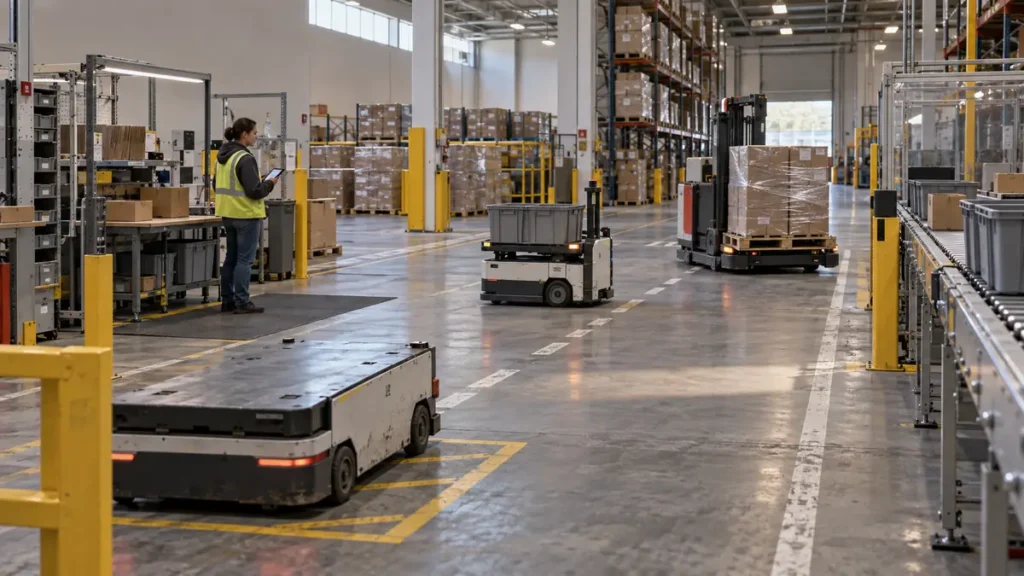
When inventory is split across fast movers, reserve stock, returns, and mixed-size loads, a buyer can test whether robot availability is enough to meet the shipping cut-off. A design may need to test whether storage capacity and pick-station demand stay aligned. A large-fleet scenario can test whether an urgent order moves promptly or waits in a queue. The buyer can also test whether blocked aisles, exceptions, and task priority require human decisions. As an engineering inference, more mobile equipment can create more possible work while adding shared traffic, stations, charging points, and data constraints.
A warehouse robot control system is the software and control boundary that turns warehouse work into coordinated robot actions. It does not mean one application must own every decision. For example, a design may place inventory and order truth in a WMS, execution coordination in a WES, device control in a WCS, robot movement in a fleet manager or robot control system, and safety functions in dedicated control hardware. The useful question is not which label sounds most complete. It is who owns each decision, what state that decision uses, and what happens when the state changes.
Short answer: how should a warehouse robot control system be evaluated at scale?
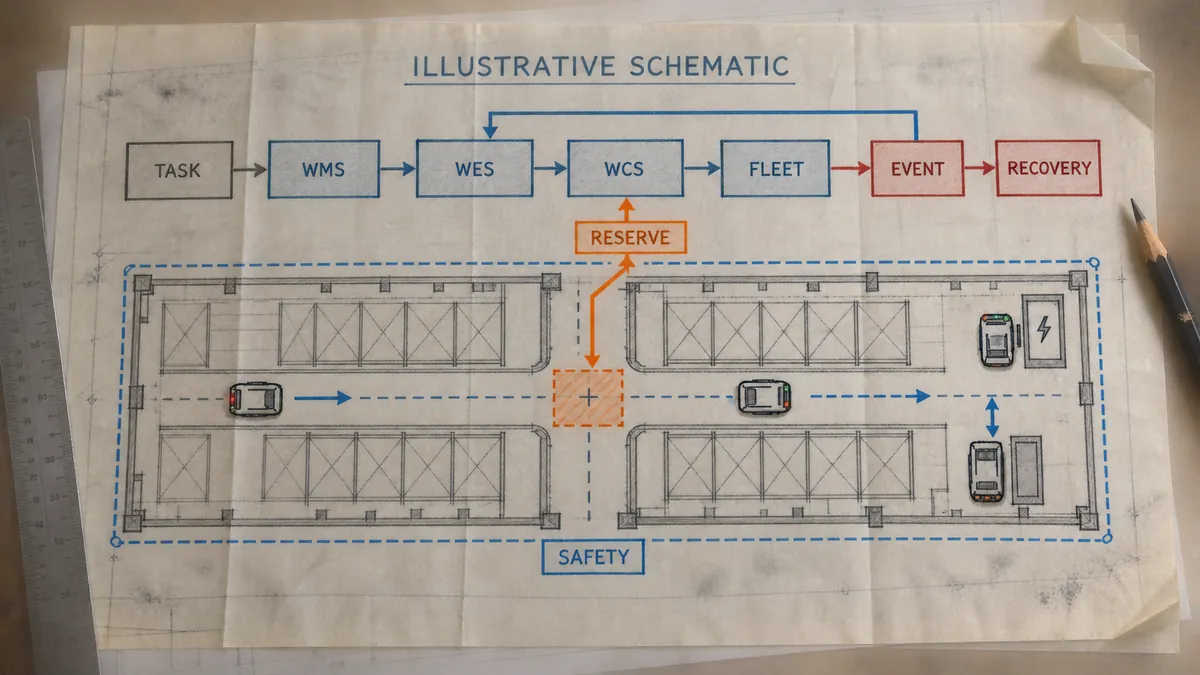
A closed-loop model is useful for analyzing a scalable warehouse robot control system. In that model, it receives work, breaks work into executable tasks, assigns tasks against current constraints, grants access to shared traffic or work resources, receives execution events, and recalculates when conditions change. Collision prevention is one part of that model. The buyer can test how the selected control logic handles a full station, a blocked aisle, a low battery, an offline robot, a late order, a missing tote, or a communication gap.
“Without collisions” should therefore be read as a design and validation target, not as an unconditional promise. A traffic scheduler can be evaluated for its handling of foreseeable conflicts through movement permissions and resource use. It cannot replace emergency stops, protective sensors, safe speed functions, guarding, or the site’s functional-safety design. Those boundaries require separate engineering evidence.
At a glance
- The control problem starts with order and inventory context, not with robot motion.
- Task assignment must consider destination, priority, load state, station capacity, traffic, and equipment availability.
- Traffic control works best when aisles, intersections, lifts, stations, and charging points are treated as explicit resources.
- A robot scheduling software demo is incomplete if it shows only a clear route and a successful pick.
- The buying decision should focus on ownership, observability, recovery, testing, and integration responsibility.
What a warehouse robot control system actually controls
The word “control” hides several layers. The following is one possible responsibility pattern, not an industry standard or a fixed GoASRS product architecture. The exact boundary changes from project to project:
| Layer | Possible decision owner | Information it needs | Typical handoff |
|---|---|---|---|
| WMS | Inventory, order, and warehouse transaction truth | Orders, stock, locations, business rules | Releases demand or work context |
| WES | Cross-process execution sequence and work balancing | Priorities, queues, stations, equipment state | Creates and reprioritizes executable work |
| WCS | Device-area coordination and equipment sequencing | Sensors, PLC states, conveyor or storage status | Sends device-level commands |
| Fleet or robot control | Robot assignment, movement state, and local route execution | Map, pose, battery, load, blocked areas | Reports accepted, active, paused, or failed tasks |
| Safety control | Protective stop and safe operating conditions | Safety devices, zones, interlocks, emergency inputs | Removes motion permission when required |
This division is a practical architecture, not a universal naming standard. A warehouse robot control system can sit across these layers rather than replacing them. A buyer may ask how WMS, WES, and WCS divide inventory, execution, and equipment decisions, and where robot fleet management sits in that map.
The company material reviewed for this article describes HengYan as a warehouse robotics and systems integrator rather than a robot manufacturer. It lists WMS for inventory, orders, and strategy, WCS for equipment coordination, and RCS for robot path planning and task allocation, with links to the equipment layer and customer ERP or MES. That is the company’s documented software division, not a claim that every warehouse should copy the same product naming.
For a buyer, the important test is decision ownership. Ask who owns inventory truth, who releases work, who chooses an execution sequence, who grants access to a narrow aisle, who stops motion, who marks a task as recoverable, and who can change the plan after a device failure. If two applications can both make the same decision, the project needs a tie-break rule before commissioning.
The control loop from order release to robot movement
1. Convert demand into work
An order is not automatically a robot task. It may require a storage retrieval, a tote delivery, a pallet transfer, a scan, a presentation at a station, a return movement, or a human confirmation. The control layer needs to know what outcome is required and what sequence of actions can produce it.
Consider a split-case order. The business instruction may be “ship these lines.” Execution work could include locating inventory, reserving a container, retrieving it, presenting it to the correct station, waiting for a scan, returning the container, and closing the inventory event. Treating the order as one indivisible robot command creates a recovery risk to test when only one stage fails.
2. Select the right robot and destination
Task assignment in a warehouse robot control system is more than choosing the nearest idle vehicle. A useful assignment decision can include load compatibility, current location, route access, battery condition, station eligibility, software mode, and the cost of taking a robot away from another queue. The exact scoring model is project-specific and should be demonstrated with the buyer’s workload rather than described as a universal algorithm.
The phrase multi-robot fleet management often suggests a dashboard that shows locations. For a buyer’s assessment, the state list to verify should include what each robot has accepted, what it is carrying, which route segment it has reserved, what it is waiting for, and whether its last event is fresh enough to trust. A map full of moving icons is not evidence that task ownership is correct.
When several equipment types share one operation, assignment may happen at more than one level. The execution layer may choose a process path, the device controller may choose a particular machine, and the robot controller may select a vehicle and route. The interfaces must state which layer can reject a task and how that rejection returns to the scheduler. The buyer should test whether an assigned task can become unavailable to every eligible device.
3. Reserve shared resources before movement
For this article’s engineering analysis, treat resource contention as a hypothesis to test alongside geometry. An intersection, lift, narrow aisle, charging position, transfer point, staging lane, or work station can become a shared resource. A robot should not enter a resource merely because its immediate path is clear. The system should check whether the resource is available, whether the robot is eligible to use it, and whether the downstream handoff can accept the load.
A useful reservation sequence looks like this:
- The scheduler identifies the next movement and its required zones.
- The traffic layer checks occupancy, reservations, direction rules, and priority.
- The robot receives permission for the next safe movement segment.
- Position and device state are reported back during execution.
- The reservation is released only after the agreed exit or handoff event.
This is a reasoning model for a project workshop, not a statement about a particular vendor’s implementation. A project may use zones, locks, time windows, graph search, or another method. The buyer should ask to see the method in a test case where two robots request the same constrained area and a third task has a higher operational priority.
The reservation itself must have an expiry and recovery rule. If a robot loses communication after reserving an intersection, the system needs a defined response. It may hold the resource until a verified state is obtained, mark the robot unavailable, call a safe recovery routine, or require an operator. The correct response depends on the equipment and safety design. What matters in procurement is that the response is explicit, observable, and tested.
How collision prevention differs from functional safety
Traffic coordination in a warehouse robot control system and safety control work together, but they are not the same thing. Traffic coordination answers questions such as: which robot may enter this aisle, which route should be delayed, and how should a queue be reordered? Safety control answers questions such as: what happens when a protective device is triggered, a person enters a guarded area, an emergency stop is pressed, or a safety signal becomes invalid?
The distinction matters because a scheduler can be logically consistent and still be unsuitable as a safety function. A software view of a robot’s position is not automatically a safety-rated position signal. A planned route is not a substitute for a protective field. A “no conflict” result in a simulation is not proof that the physical installation meets its safety requirements.
The specification should separate at least four boundaries: normal task scheduling, traffic permission, machine control, and protective safety. Each boundary needs an owner, a data contract, a failure response, and a commissioning test. Certification claims should be tied to named equipment, versions, scope, and the applicable project documentation. No current source reviewed for this article supports a GoASRS certification claim for collision-free robot operation, so none is made here.
What happens when the normal plan breaks?
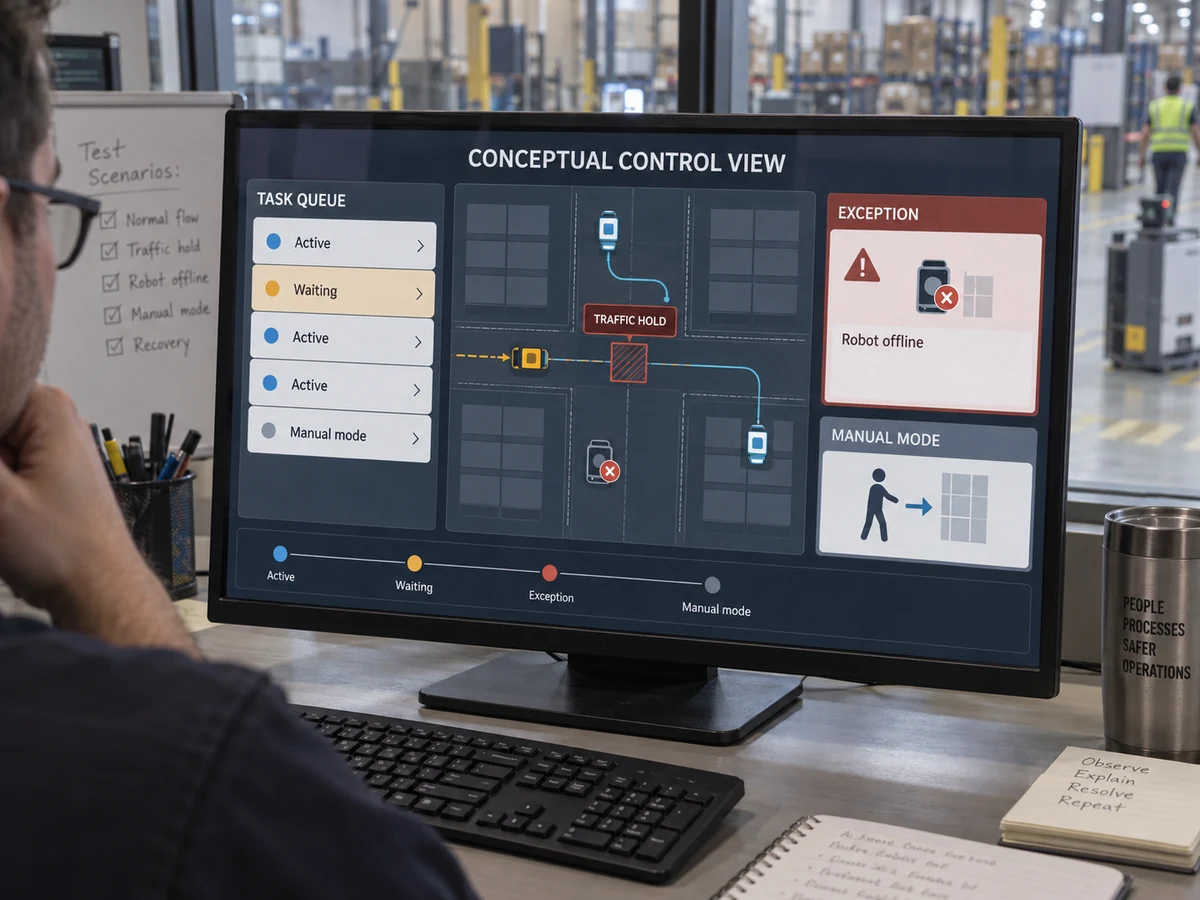
Exception testing is important to a buyer’s assessment of a warehouse robot control system, alongside clear-path testing. The scheduler should be tested for distinguishing a temporary wait from a failed task. That distinction affects inventory state, operator workload, queue priority, and the decision to retry or reassign.
Blocked route or congested area
The first response should preserve a valid state. The system needs to know whether the robot is before the blocked resource, inside it, or beyond it. It can then hold, reroute, release a reservation, or request intervention according to the approved policy. A vague “reroute automatically” claim is not enough. Ask which state is recorded, how duplicate commands are prevented, and what the operator sees.
Full or unavailable station
When a station is the bottleneck, a test can examine whether sending more robots increases the queue without increasing output. A stronger design makes station capacity visible to the execution layer and lets work wait at a controlled upstream point. The scheduler can then choose a different station, hold the task, or release another task that does not depend on the full resource. This is where warehouse robot control system design connects directly to labor planning and outbound cut-off management.
Robot offline or battery constrained
The control system should not treat an offline robot as an empty slot. It may have a load, a reservation, a task that another robot cannot inherit, or a position that must be verified. Recovery should identify the last trusted state, decide whether the task is safe to reissue, and update the business transaction without creating duplicate inventory movement.
Communication delay or duplicate event
Integration design should account for event identity, state changes, and duplicate messages. Every important event needs an identity, a state transition rule, and a duplicate-handling policy. Interfaces can use APIs, message queues, files, or other project-approved methods, but the chosen method does not remove the need for retries, error handling, monitoring, and a controlled manual mode. A buyer may ask how the selected interface design handles event states, retries, duplicate messages, monitoring, and recovery.
Urgent order inserted into the queue
Priority should be a controlled business rule, not an operator’s informal override. The buyer should define which work may move ahead, what work may be interrupted, how reserved resources are handled, and how the system prevents priority changes from starving routine replenishment. A good demonstration includes an urgent order arriving while robots are already committed to a congested zone.
Why scaling is not the same as adding robots
Adding robots can increase available movement capacity, but a warehouse robot control system can also expose a constraint elsewhere. The limiting point may be a presentation station, a lift, a charging area, a scan point, an induction lane, a network service, or a human exception desk. The right question is not “How many robots can the software register?” It is “How does the complete operation behave when more work competes for the same constrained resources?”
Robot count alone is insufficient for the buyer’s capacity test. If two fleets have the same number of vehicles, their results may differ under different maps, loads, station layouts, order distributions, route lengths, or failure policies. A credible capacity exercise should state those conditions. It should show where work waits, why it waits, and what happens when a resource is removed from service.
The company material reviewed here records a software structure that separates WMS, WCS, and RCS responsibilities and describes a broad equipment-integration role. It also describes solutions that combine different equipment types for different load and process requirements. Those statements support an integration discussion. They do not establish a general robot-count limit, a guaranteed throughput, or a collision-free operating result.
The metrics that reveal the real bottleneck
The buyer should define measurements before comparing robot scheduling software with a warehouse robot control system. Useful measures include task release-to-completion time, time spent waiting for traffic, station starvation, station blocking, empty travel, robot availability, exception age, inventory event latency, and the number of tasks requiring human recovery. The target values belong to the project’s service promise and operating model. They should not be borrowed from an unrelated installation.
One useful practice is to separate average behavior from peak behavior. A fleet can look efficient across a full shift while missing the outbound wave that matters commercially. The test should replay the actual release pattern, order mix, replenishment work, returns, and planned maintenance windows. If the buyer does not yet have a reliable workload model, the project should label the result as a scenario rather than a capacity commitment.
WMS, WES, WCS, and fleet software: who should own what?
Buyers often compare product names before mapping responsibilities in a warehouse robot control system. That reverses the order. Start with the decisions, then ask which application is best placed to make each one.
| Decision | Questions for the project team | Evidence to request |
|---|---|---|
| Business demand | What order, replenishment, return, or inventory event creates the work? | Message examples and state definitions |
| Execution priority | Who decides what should run next when stations and robots compete? | Queue behavior under competing work |
| Device route | Who converts a task into movement or machine commands? | Command sequence and rejection handling |
| Traffic permission | Who owns zones, intersections, reservations, and release conditions? | Conflict test with competing routes |
| Safety stop | Which safety layer removes motion permission, and how is restart controlled? | Approved safety design and commissioning records |
A buyer may ask how inventory, execution, and equipment decisions are divided across WMS, WES, WCS, and fleet software. Boundaries may differ between vendors, so the project should assign an owner to each decision rather than rely on application labels.
That distinction is especially important in a multi-vendor project. Each robot supplier may have a local fleet manager. The warehouse may still need an execution layer that coordinates different robot types, fixed equipment, work stations, and business priorities. A local controller can be excellent at moving its own equipment and still be the wrong place to decide which business task should take precedence across the whole operation.
The integration owner should publish a responsibility matrix before build work starts. It should identify the source of truth for task state, inventory state, robot state, reservation state, alarm state, and recovery state. It should identify who can issue a command, who can cancel it, and who can audit the reason. This is one of the areas where an integrator’s value lies in making boundaries explicit across equipment and software suppliers, rather than treating each interface as an isolated connection.
GoASRS readers can use the site’s guide to WES vs WMS vs WCS as a companion explanation of the software-layer question. The ASRS system integration guide is relevant when the control discussion reaches ERP, WMS, WES, WCS, PLC, and device interfaces. For the physical solution context, the overview of warehouse automation systems helps frame how storage, movement, and picking choices interact.
A practical validation plan for robot scheduling software
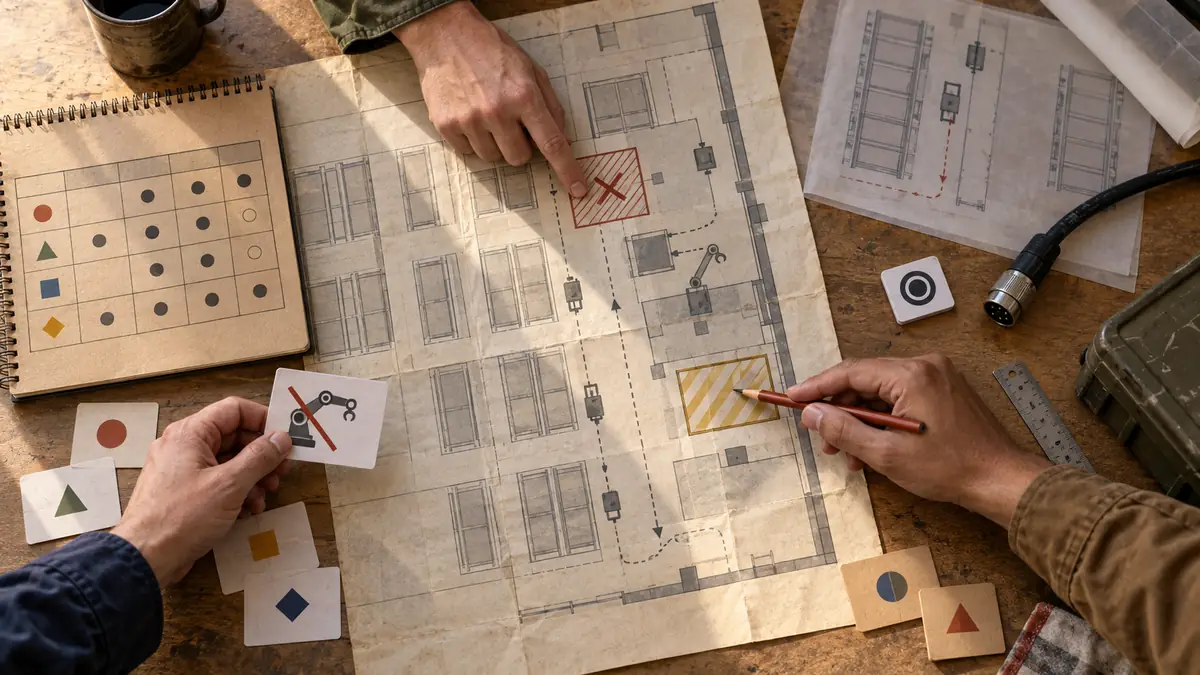
Normal-path testing alone does not cover exception behavior in a warehouse robot control system. A buyer should ask for a scenario-based demonstration using representative maps, task sequences, loads, stations, and operating rules. The test should record the system’s decision, the event received, the visible state, and the recovery action.
Test the map and resource model
Start with the physical constraints. Identify narrow passages, intersections, lifts, transfer points, charging locations, pick stations, staging areas, and areas where people or manual equipment may enter. Confirm that the digital map represents direction, access, capacity, and operating modes. If a location can hold only one load or one vehicle, that limitation must appear in the model rather than in an operator’s memory.
Ask how map changes are governed. A new rack, temporary obstruction, closed aisle, moved station, or maintenance barrier can invalidate a route assumption. The project needs a controlled change process, a versioned map, and a way to confirm that all relevant controllers use the intended version.
Test competing work
Release retrievals, replenishment, returns, urgent orders, and station replenishment at the same time. Observe whether priorities remain understandable and whether one class of work starves another. Ask what happens when a task is accepted by a robot but the destination becomes unavailable before arrival.
The strongest evidence is not a screenshot. It is a trace that shows task creation, assignment, reservation, movement, arrival, handoff, completion, and any retry. The trace should be readable by operations, controls, software, and support teams. If only the software developer can interpret it, the warehouse may struggle to recover during a live event.
Test failure and recovery
At minimum, the workshop should cover a blocked route, a full station, an offline robot, a stale position, a missing load, a failed scan, a duplicate message, a communication interruption, and a manual intervention. Each case should answer five questions: what state is stored, what motion is allowed, what work is paused, what can be reassigned, and who can clear the exception.
The test should include a controller or network restart and check for lost reservations, duplicate commands, or reopened completed work. Recovery evidence should cover both the robot side and the business side. The physical system must return to a known safe state, while the WMS and execution layer must retain a consistent transaction state.
Test observability and support
Operators need a view that explains why work is waiting. Engineers need logs that connect a business task to device commands and sensor events. Managers need service measures that show whether a bottleneck is temporary or structural. Support teams need a controlled method to replay, cancel, reassign, or manually complete a task without editing inventory blindly.
The buyer should request sample alarm text, event payloads, audit records, role permissions, and escalation paths. “Real-time visibility” is too broad to evaluate without naming the state, the timestamp, the owner, and the action that follows.
What an integrator should clarify before committing to a design
The warehouse robot control system is an operational contract as much as it is software. The contract should cover the data, decisions, physical constraints, safety boundary, tests, and support model.
Data and interface ownership
List every upstream and downstream system that creates, changes, or closes work. Define identifiers, timestamps, quantities, load identity, location identity, priority, cancellation, retry, and duplicate handling. Agree on the source of truth for each field. Do not leave a state transition to an informal interpretation of a message name.
Equipment and load compatibility
Document which robot types can carry which loads, enter which zones, use which stations, and operate in which modes. An API alone does not establish the compatibility required for mixed equipment. The buyer should require an explanation of how the execution layer identifies incompatible assignments before a task reaches a device.
Traffic and safety boundary
Draw the boundary between route planning, traffic permission, device control, and protective safety. Name the owner and evidence for each boundary. Ask how a planned route is checked against temporary barriers, people, maintenance states, and safe-stop conditions. Keep safety certification claims tied to the specific machine and approved documentation.
Recovery and manual operation
Define the permitted manual actions. An operator may need to pause a zone, remove a load, confirm a physical position, release a blocked station, or reassign a task. Each action should have a visible audit trail and a path back to automatic operation. Manual mode should be a designed operating state, not an unrecorded workaround.
Expansion and change
Ask how a new robot type, station, zone, shift pattern, or business priority enters the system. The answer should include configuration, interface testing, simulation or emulation where available, site testing, rollback, training, and support. A claim that a system can add robots quickly is incomplete without explaining how maps, reservations, charging, task capabilities, and exception rules change with them.
The related guide to ASRS system integration can help buyers organize these interface and ownership questions. A total-cost discussion should include total cost of ownership for warehouse automation as a planning topic, while warehouse automation ROI can help structure the commercial case. Those pages are reading paths, not substitutes for a project-specific quotation or acceptance plan.
Five questions to ask before selecting a control platform
- Who owns each decision? Ask for a responsibility matrix covering orders, task priority, robot assignment, traffic permission, safety stops, inventory updates, and recovery.
- What is the smallest testable unit? Ask whether the team can trace one task from business release through movement, handoff, completion, and exception closure.
- What happens when a shared resource disappears? Test a closed aisle, full station, unavailable lift, offline robot, and interrupted communication.
- How is scale measured? Require conditions for any capacity statement, including map, load, task mix, station layout, peak release pattern, and failure assumptions.
- Who supports the boundary after launch? Identify the accountable warehouse robot control system owner when a problem crosses WMS, execution, device, network, and safety boundaries.
These questions are a more useful procurement test than a simple count of supported robots. For this article’s buying framework, a fleet number should be assessed with workload, route, station, and recovery conditions before it is related to a shipping promise.
FAQ
Is a warehouse robot control system the same as a WES?
For a project where several applications share execution decisions, use the cited WES and WMS descriptions as a starting point, then verify which application owns equipment and robot-level actions in the project-specific interface and responsibility documents. Some products combine these roles, so compare decision ownership and interfaces rather than labels. Ask the supplier to trace one order from release through robot completion and show which application owns each state. The WES, WMS, and WCS boundaries described in GoASRS’s software-layer article provide a starting framework for that comparison.
Can software guarantee that robots will never collide?
For a project that requires traffic coordination, software can manage planned movement conflicts but cannot, by itself, prove physical safety. Physical safety also depends on robot controls, protective devices, emergency functions, operating procedures, commissioning, and applicable documentation. Ask for a project-specific conflict test plus the separate safety design and commissioning records.
What should robot scheduling software do when a robot fails?
For a process with loads or reserved resources on the failed robot, the software should preserve the last trusted state and apply an approved retry, hold, reassignment, or manual-recovery policy. The exact response depends on the equipment and process. Ask to see an offline-robot demonstration and request the resulting task, inventory, and audit records.
Does adding more robots always increase throughput?
For an operation with shared stations, lifts, charging areas, routes, scan points, interfaces, or exception desks, adding robots may increase competition for the limiting resource. Capacity therefore depends on the workload, layout, task mix, service window, and failure assumptions. Ask for a capacity test that records where work waits before and after the fleet change.
Should the robot supplier or the integrator own the control system?
For a multi-vendor installation, a robot supplier may own local motion and fleet functions while an integrator owns cross-system workflow and responsibility boundaries. The buyer should still require one clearly accountable party for end-to-end task behavior. Ask for a responsibility matrix with named interfaces, escalation rules, and a failed-task handoff demonstration.
The practical conclusion for buyers
A large robot fleet requires the buyer to verify destination assignment, decision ownership, waiting reasons, duplicate-work controls, failure recovery, and the safety boundary. A warehouse robot control system should be assessed while inventory, stations, routes, batteries, devices, people, and priorities change.
For a warehouse considering mixed automation, the next step is to build a small but representative control model. Include the real order patterns, load types, map constraints, stations, equipment states, exception cases, and business cut-off. Then ask the integration team to demonstrate the full loop and document the handoffs. GoASRS’s pages on warehouse automation system overview, how an ASRS system works, and types of ASRS systems provide additional context for framing that conversation.
Planning a Warehouse Automation Project?
Our team has delivered 50+ ASRS systems across retail, manufacturing, and logistics. Tell us about your project and we will get back to you within 24 hours.
Thank you!
We received your message and will get back to you within 24 hours.