
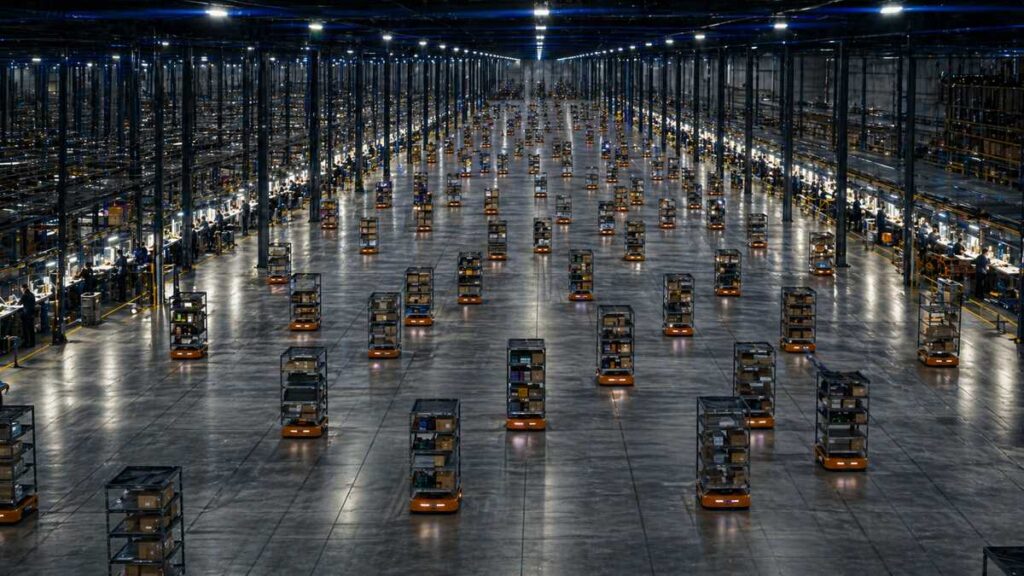
Amazon operates more than 750,000 robots across 175+ fulfillment centers worldwide. That fleet handled over 5 billion packages in 2023 alone. No other company on the planet runs warehouse automation at this scale, and the gap between Amazon and the rest of the industry keeps widening.
But here is what most coverage of Amazon warehouse automation misses: the strategy behind the machines matters more than the machines themselves. Amazon did not just buy robots. They built an automation philosophy — one that mid-size warehouse operators can study and adapt, even on a fraction of the budget.
This article breaks down how Amazon got here, what specific ASRS technologies they deploy, and what practical lessons smaller operations can extract from their approach.
The Timeline: How Amazon Became a Robotics Company
Amazon's automation story has a clear starting point: March 2012, when they acquired Kiva Systems for $775 million. At the time, it was Amazon's second-largest acquisition ever. The price raised eyebrows. The return on that investment silenced every critic.
2012 — The Kiva Acquisition
Kiva Systems built orange, disc-shaped robots that slid under portable shelving units and carried them to human pickers. The concept — goods-to-person picking — was not new, but Kiva executed it at a scale nobody else had attempted. Amazon saw the potential, bought the company, and immediately pulled Kiva robots from all third-party customers. By 2014, every Kiva robot on Earth worked exclusively inside Amazon fulfillment centers.
2015-2019 — Scaling and Renaming
Amazon rebranded Kiva Systems as Amazon Robotics and moved headquarters to Westborough, Massachusetts. During this period, they scaled from roughly 30,000 robots to over 200,000. Each new fulfillment center opened with robots pre-installed — automation was no longer a retrofit, it was the default architecture.
2020-2022 — The Pandemic Acceleration
COVID-19 forced Amazon to hire 400,000 workers in a single quarter. Labor shortages and social distancing requirements pushed automation investment into overdrive. Amazon poured over $1 billion into robotics R&D annually during this period, according to their annual reports.
2023-2024 — The New Generation
Amazon introduced four new robotic systems in rapid succession: Robin, Sparrow, Proteus, and Sequoia. Each one targets a different piece of the fulfillment workflow that was still manual. The goal is clear — automate every step from inbound receiving to outbound shipping.
This timeline reveals a pattern worth noting: Amazon spent 10+ years building their automation stack. They did not automate everything overnight. They started with one proven technology, scaled it, then layered on new capabilities year by year.
What ASRS Technology Does Amazon Actually Use?
Amazon's robotics warehouse runs on multiple types of ASRS systems working together. No single robot handles the entire fulfillment process. Each system owns a specific segment of the workflow.
Kiva / Amazon Robotics Drive Units
The original workhorses. These squat orange robots (now in their sixth generation) carry portable shelving units — called "pods" — from storage areas to picking stations. A single fulfillment center runs 800 to 3,000 of these units. They move using QR codes embedded in the warehouse floor and coordinate through a central traffic management system that prevents collisions across the entire fleet.
Performance data from Amazon's own disclosures: Kiva robots reduced the "click to ship" time from over 60 minutes to roughly 15 minutes. They cut operating costs per fulfillment center by an estimated 20-25%.
Robin — Robotic Arm for Sorting
Robin is a robotic arm with computer vision that picks individual items from totes and sorts them into customer orders. It handles the "singulation" problem — reaching into a mixed tote, identifying the correct item, grasping it without damage, and placing it in the right destination bin. Amazon reported that Robin processes millions of packages per year across their network.
Sparrow — Item-Level Picking
Sparrow took Robin's concept further. Launched in 2022, Sparrow can identify, select, and handle individual products from Amazon's inventory — a catalog of hundreds of millions of unique items in different shapes, sizes, and packaging. This is the hardest problem in warehouse robotics: picking arbitrary items from unstructured environments. Amazon claims Sparrow can recognize and handle over 65% of their product catalog, a number that keeps climbing as the AI models improve.
Proteus — The First Fully Autonomous Mobile Robot
Every previous Amazon robot operated inside fenced-off areas, separated from human workers by safety barriers. Proteus broke that pattern. Launched in 2022, it is Amazon's first robot designed to move freely alongside people. Proteus autonomously transports carts of packages (called GoCarts) through the fulfillment center, handling the repetitive heavy lifting of moving inventory between processing zones.
Sequoia — The Full-System Integration
Sequoia, announced in late 2023, is not a single robot — it is an integrated system that combines robotic arms, mobile robots, and high-density storage into one coordinated workflow. Amazon says Sequoia can identify and store inventory up to 75% faster than previous systems and reduce order processing time by up to 25%. It represents Amazon's shift from deploying individual robots to designing entire automated workflows as unified systems.
Amazon's Three Core Automation Strategies
Looking at 12 years of Amazon warehouse automation decisions, three strategic patterns stand out. These are not just technology choices — they are business decisions that shaped how the entire operation scales.
Strategy 1: Build In-House, Then Scale Vertically
Amazon's decision to acquire Kiva and cut off all third-party customers was ruthless but logical. By owning the robotics company, Amazon controlled the development roadmap, the manufacturing capacity, and the competitive advantage. No competitor could buy the same robots.
This vertical integration extends beyond Kiva. Amazon designs their own robotic arms (Robin, Sparrow), their own autonomous mobile robots (Proteus), and their own integrated systems (Sequoia). They build custom AI models for computer vision and grasp planning. They even manufacture their own chips (Trainium, Inferentia) to run those AI models more efficiently.
The lesson: Amazon treats automation as a core competency, not a vendor relationship.
Strategy 2: Automate Incrementally, Not All at Once
Amazon did not try to build a fully automated, lights-out warehouse on day one. They started with one task — moving shelving units to pickers — and spent years perfecting it before moving to the next bottleneck.
The progression is methodical:
- 2012-2018: Automate inventory transport (Kiva)
- 2019-2022: Automate package sorting (Robin) and item picking (Sparrow)
- 2022-2024: Automate inter-zone transport (Proteus) and full workflow integration (Sequoia)
Each new system addressed the next biggest source of manual labor in the fulfillment process. Amazon measured where humans spent the most time, then built robots for those specific tasks.
Strategy 3: AI-First Automation
Every new Amazon robot relies heavily on artificial intelligence — computer vision for item recognition, machine learning for grasp planning, reinforcement learning for traffic optimization. The Kiva robots from 2012 followed simple programmed paths. Sparrow in 2022 uses neural networks to figure out how to pick up objects it has never seen before.
Amazon's AI investment is what separates their automation from traditional ASRS systems that run on deterministic logic. Their robots get better over time as the models train on more data. A Sparrow arm that handles 65% of the product catalog today will handle 80% next year — without any hardware changes.
What Amazon's Automation Costs (And Why It Matters for Context)
Amazon spent $775 million on the Kiva acquisition alone. Their annual R&D spending on robotics and automation exceeds $1 billion. Reuters reported that Amazon deployed 750,000 robots by mid-2024, up from 520,000 the year before — a 75% increase in a single year.
The total investment over 12 years likely exceeds $10 billion when you factor in R&D, manufacturing, deployment, and the thousands of robotics engineers on payroll.
These numbers are important context, not because mid-size businesses need to match them, but because they explain why copying Amazon's exact approach is the wrong strategy. Amazon can afford to spend a decade and billions of dollars building custom robots from scratch. A company running 2 to 5 warehouses cannot.
The right question is not "how do we do what Amazon does?" It is "what can we learn from Amazon's strategy and apply at our scale?"
Five Lessons Mid-Size Businesses Can Take from Amazon
Amazon's automation playbook contains principles that work at any scale. The specific robots are irrelevant — the thinking behind them transfers directly.
Lesson 1: Start with Your Biggest Labor Bottleneck
Amazon started with goods-to-person transport because walking consumed 50-70% of picker time. They did not automate packaging first, or receiving, or shipping. They measured where the most labor hours went and attacked that point.
For a mid-size warehouse, the same analysis applies. Run a time study. If your pickers spend most of their shift walking, a goods-to-person system is the right first move. If your bottleneck is at packing stations or inbound receiving, start there instead. The point is: measure first, automate second.
Lesson 2: Buy Proven Systems, Do Not Build Custom
Amazon builds in-house because they operate at a scale where custom development pays off. At 750,000 robots across 175+ sites, even a 1% efficiency gain from custom hardware saves hundreds of millions.
Mid-size operations do not have that math. For companies running 1 to 10 warehouses, buying proven, commercially available ASRS systems from established vendors is faster, cheaper, and lower risk than any custom development. The cost of ASRS systems has dropped significantly over the past five years as the technology has matured and more vendors have entered the market.
Lesson 3: Plan for Incremental Deployment
Amazon's 12-year automation timeline is a feature, not a bug. They deployed in phases, learned from each phase, and used those learnings to inform the next investment.
Mid-size businesses should follow the same pattern. A phased approach might look like this:
- Phase 1: Deploy a goods-to-person system for your highest-volume picking zone
- Phase 2: Add automated storage for slow-moving inventory
- Phase 3: Integrate robotic sorting for outbound orders
- Phase 4: Connect everything through a unified warehouse execution system
Each phase generates ROI that funds the next phase. No massive upfront capital outlay required.
Lesson 4: The Software Layer Matters More Than the Hardware
Amazon's biggest competitive advantage is not their robots — it is the software that coordinates them. Their warehouse management and execution systems decide which robot goes where, which orders get prioritized, how inventory gets slotted, and how the entire operation adapts in real time.
For mid-size operations, this means the warehouse execution system (WES) you choose matters as much as the physical hardware you install. A strong WES can coordinate equipment from multiple vendors, optimize workflows dynamically, and scale without requiring you to rip out and replace your existing infrastructure. When we deploy integrated solutions for clients, the WES is always the first component we design — everything else plugs into it.
Lesson 5: Do Not Lock Yourself into a Single Vendor
Amazon builds everything in-house, so vendor lock-in is not their problem. But for everyone else, it is a real risk. If you buy your ASRS from a single vendor and that vendor's roadmap diverges from your needs, you are stuck.
The smarter approach: work with an integrator who can mix and match equipment from multiple manufacturers based on your specific requirements. Need shuttle-based ASRS for small parts and AMR-based goods-to-person for larger items? An integrator builds that hybrid system. Need to swap out one vendor's robots for another's in three years? An integrator's WES already supports both.
This is the exact model we follow at GoASRS. We are a logistics integrator, not a robot manufacturer. We have deployed 6,000+ robots across 50+ enterprise clients — and those robots come from multiple manufacturers, selected based on each client's warehouse layout, throughput requirements, and budget. Our self-developed WES ties it all together.
What an Amazon-Inspired ASRS Setup Looks Like for a Mid-Size Warehouse
Let us get specific. A mid-size e-commerce or 3PL operation processing 5,000 to 20,000 order lines per day can build an automation stack that mirrors Amazon's approach — at a fraction of the cost.
The goods-to-person layer handles your highest-volume SKUs. AMR-based robots carry totes or shelving units to stationary picking stations, just like Amazon's Kiva system. A fleet of 50 to 200 robots covers most mid-size operations. Pick rates jump from 80-120 lines per hour (manual) to 300-600 lines per hour per station.
The dense storage layer handles medium and slow-moving inventory. Shuttle-based or crane-based ASRS stores thousands of SKUs in a compact footprint, retrieving them on demand. This is where you reclaim floor space — dense ASRS uses 60-80% less floor area than traditional shelving for the same number of SKUs.
The software layer ties everything together. A WES coordinates the robots, manages inventory across both storage systems, optimizes pick sequences, and integrates with your existing WMS and ERP. When we work with clients at GoASRS, the WES is built on a microservices architecture that supports plug-and-play device management — add new robots or swap vendors without rewriting the software.
The numbers: A system like this typically costs 40-60% less than what Amazon spends per square foot on their fulfillment centers, because you are buying commercially available equipment instead of funding custom R&D. ROI timelines for mid-size deployments run 2 to 4 years, depending on labor costs in your region and current throughput volumes. For a detailed cost breakdown, see our ASRS system cost guide.
One of our recent deployments for Li Ning, a major sportswear brand, illustrates this approach. The project combined multiple robot types from different manufacturers, coordinated through our WES, to handle high SKU variety and seasonal demand spikes — the same challenges Amazon faces, at a different scale.
Frequently Asked Questions
How many robots does Amazon use in their warehouses?
Amazon operates over 750,000 robots across their global fulfillment network as of mid-2024. That number grew 75% from the previous year (520,000 in 2023). The fleet includes Kiva drive units, Robin and Sparrow robotic arms, Proteus autonomous mobile robots, and the newer Sequoia integrated system.
What is the Amazon Kiva robot system?
The Kiva system (now called Amazon Robotics) uses squat, disc-shaped mobile robots that slide under portable shelving units and carry them to human picking stations. Amazon acquired Kiva Systems in 2012 for $775 million. The robots travel using QR codes on the warehouse floor and are coordinated by a central traffic management system. A single fulfillment center runs 800 to 3,000 Kiva units.
How much did Amazon spend on warehouse automation?
Amazon spent $775 million on the Kiva acquisition in 2012 and has invested over $1 billion annually in robotics R&D since 2020. The total automation investment over 12 years likely exceeds $10 billion including R&D, manufacturing, deployment infrastructure, and engineering headcount.
Can small businesses use the same automation as Amazon?
Not the exact same systems — Amazon's robots are proprietary and not sold to third parties. But the underlying technologies (goods-to-person picking, robotic sorting, AI-driven warehouse execution) are commercially available from multiple vendors. Mid-size businesses can build automation stacks that mirror Amazon's approach at 40-60% lower cost per square foot by working with system integrators who combine best-in-class equipment from different manufacturers.
What is Amazon Sequoia?
Sequoia is Amazon's integrated fulfillment system announced in late 2023. It combines robotic arms, mobile robots, and high-density storage into a single coordinated workflow. Amazon reports that Sequoia identifies and stores inventory 75% faster than previous systems and cuts order processing time by up to 25%. It represents Amazon's shift from deploying individual robots to designing entire automated workflows as unified systems.
How does Amazon warehouse automation affect jobs?
Amazon has consistently stated that their robots work alongside humans rather than replacing them. The company has added over 700,000 full-time employees since the Kiva acquisition in 2012. Automation has shifted the nature of warehouse work — fewer walking-intensive picking roles, more robot monitoring and maintenance positions. The Amazon blog reports that injury rates have decreased in robotics-equipped facilities.
The Bottom Line
Amazon warehouse automation is the most ambitious deployment of robotics in supply chain history. Their 12-year, multi-billion-dollar investment created a fulfillment machine that processes billions of packages per year with speed and accuracy that no competitor has matched.
But the strategic principles behind Amazon's success are not locked behind a billion-dollar budget. Start with your biggest bottleneck. Deploy in phases. Invest in software as much as hardware. Stay flexible on vendors.
If you are evaluating warehouse automation for your operation and want to explore what an Amazon-inspired approach looks like at your scale, reach out to our team. We have helped 50+ enterprises build integrated ASRS systems that borrow the best ideas from the industry leaders — without requiring the industry leader's budget.
Planning a Warehouse Automation Project?
Our team has delivered 50+ ASRS systems across retail, manufacturing, and logistics. Tell us about your project and we will get back to you within 24 hours.
Thank you!
We received your message and will get back to you within 24 hours.