
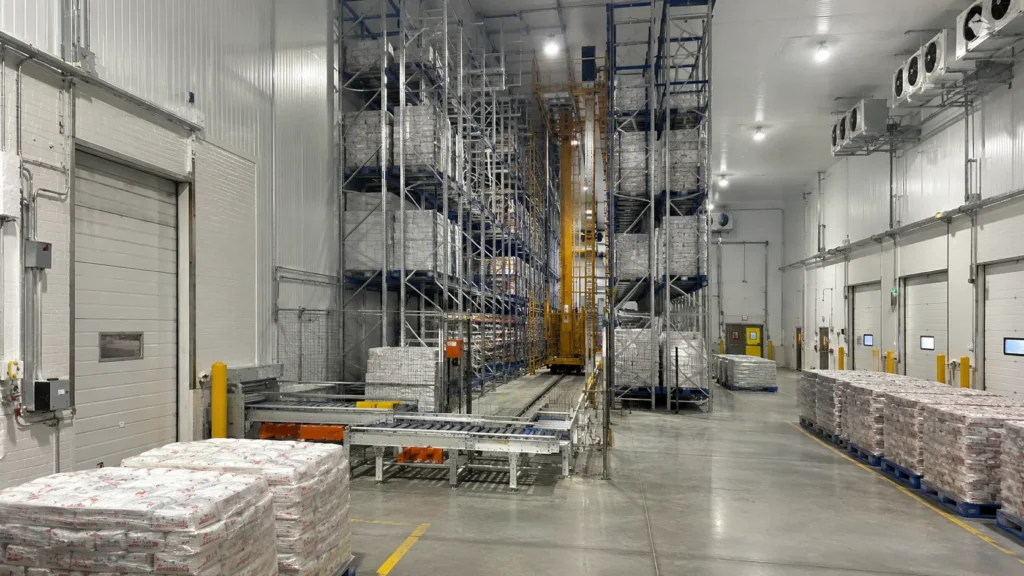
Cold storage ASRS is one of the strongest use cases for warehouse automation because freezer and chilled facilities make manual work harder, slower, more expensive, and more difficult to staff. In a normal ambient warehouse, wasted walking time is costly. In a freezer warehouse, every extra movement also means cold exposure, door openings, frost risk, energy loss, and higher pressure on safety procedures.
For food, beverage, pharmaceutical, seafood, dairy, frozen meal, grocery, and cold-chain 3PL operations, the warehouse is not just a storage building. It is part of the product protection system. If temperature control, inventory accuracy, retrieval speed, or outbound sequencing fails, the business can lose product quality, customer trust, and regulatory confidence.
Short answer: A cold storage ASRS uses automated cranes, shuttles, mobile robots, conveyors, and warehouse execution software to store and retrieve pallets, cartons, totes, or bins in chilled and frozen environments. The main benefits are higher storage density, fewer people inside freezer zones, more stable inventory control, reduced door openings, and more predictable fulfillment during peak demand.
This guide explains where cold storage ASRS fits, which system types work best, how to plan freezer automation, and what buyers should verify before committing to a project.
Why Cold Storage Warehouses Are Hard to Operate Manually
Cold storage creates operational pressure that does not exist in a normal warehouse.
The first constraint is human exposure. OSHA notes that workers in cold conditions may face cold stress risks such as hypothermia and frostbite. Even when the warehouse is designed and managed correctly, freezer work requires clothing, warm-up breaks, training, and close attention to worker condition. That changes labor planning and reduces the practical time a worker can spend doing repetitive travel inside the freezer.
The second constraint is energy. Every door opening, forklift movement, air exchange, and inefficient travel path can increase refrigeration load. A freezer building is expensive to cool, and the cost of storing air is real. If the warehouse has tall clear height but uses low-density manual racking, the operator may be paying to refrigerate unused vertical cube.
The third constraint is accuracy. Cold-chain operations often handle products with shelf-life, batch, lot, expiration, allergen, compliance, or traceability requirements. Inventory mistakes are not just pick errors. They can create product rotation problems, missed shipment windows, or avoidable quality risk.
Common manual cold storage problems include:
- Forklift travel inside low-temperature zones.
- Workers spending too much time in freezer aisles.
- Slow picking because operators wear gloves and heavy clothing.
- Wider aisles that waste refrigerated cube.
- Frost and condensation around doors and transfer points.
- Product dwell time in staging areas.
- First-expired-first-out rules handled inconsistently.
- Hard-to-scale peak demand before holidays or seasonal promotions.
- Higher recruiting and retention pressure for freezer labor.
Automation does not remove every cold-chain challenge. But it can move repetitive travel, storage, and retrieval work away from people and into a controlled system.
What Is a Cold Storage ASRS?
A cold storage ASRS is an automated storage and retrieval system designed to operate in refrigerated, chilled, frozen, or deep-freeze environments. It may store pallets, cases, cartons, trays, totes, bins, or small load units depending on the operation.
MHI defines AS/RS as equipment and controls that handle, store, and retrieve materials with precision, accuracy, and speed under a defined degree of automation. In cold storage, that same principle is applied inside temperature-controlled space.
The system usually includes:
- High-density racking or storage structure.
- Automated storage and retrieval machines.
- Infeed and outfeed conveyors or transfer stations.
- Temperature-compatible sensors, motors, cables, and controls.
- WMS, WES, and WCS integration.
- Safety zones and maintenance access.
- Fire protection, insulation, and refrigeration coordination.
- Exception handling for damaged loads, inventory holds, and quality checks.
The key design question is not "Can automation work in a freezer?" It can. The real question is which process should be automated first: pallet storage, case buffering, goods-to-person picking, replenishment, outbound sequencing, or production line feeding.
For a broader overview of ASRS technology, start with What is ASRS? and Types of ASRS Systems.
Where Cold Storage ASRS Creates the Most Value
Cold storage automation has the highest ROI when the warehouse has repeatable movement, expensive refrigerated space, labor exposure, and strict inventory rules.
| Cold storage problem | ASRS value |
|---|---|
| Freezer labor is hard to recruit | Reduces repetitive travel and time spent in freezer zones |
| Refrigerated space is expensive | Increases storage density by using vertical cube |
| SKU count is growing | Improves location control and retrieval logic |
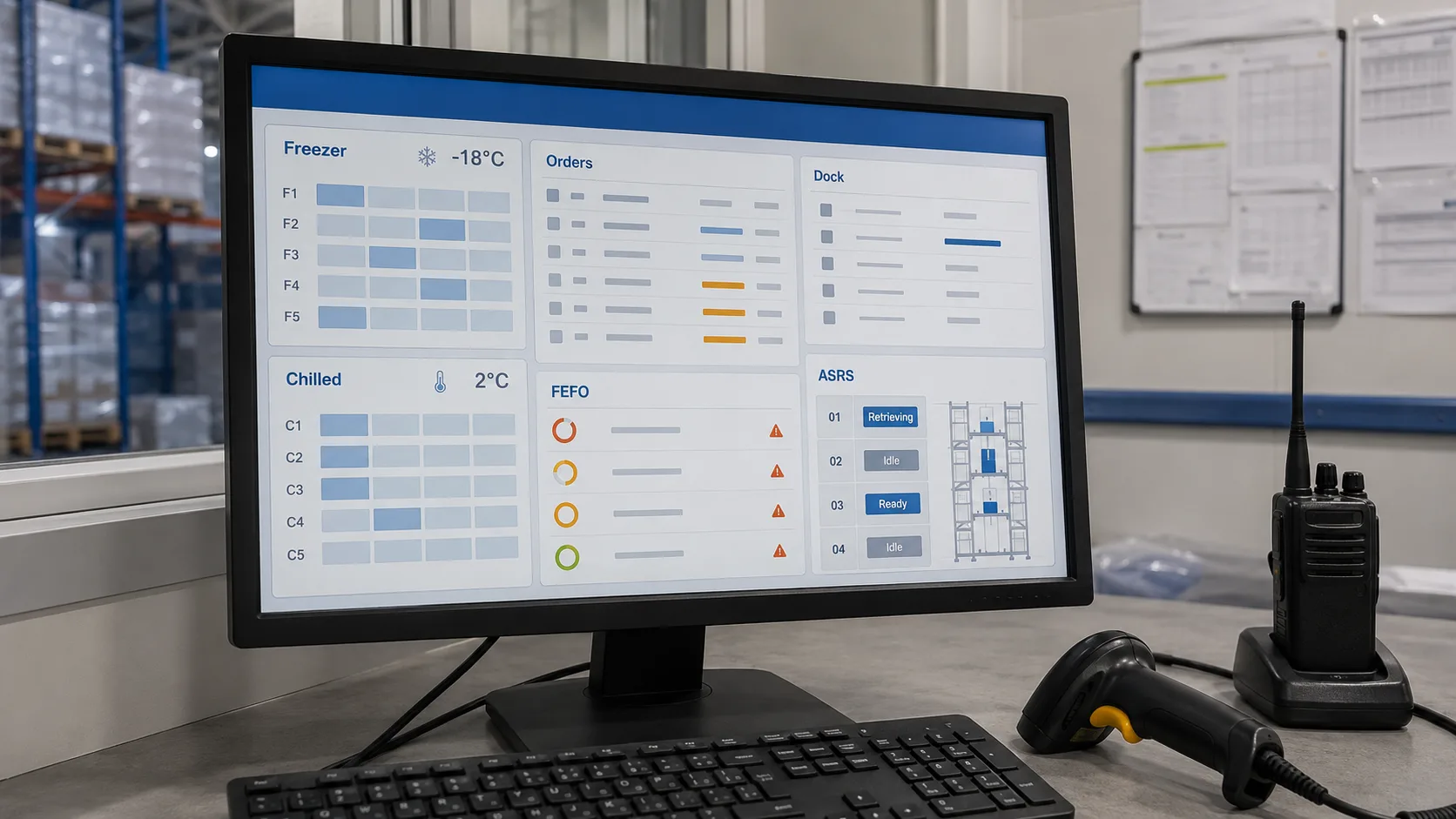
| FEFO rules are hard to enforce manually | Software can prioritize by lot, date, batch, and status |
| Door openings waste energy | Automated buffers can reduce unnecessary traffic |
| Seasonal demand creates congestion | WES can sequence work before docks and picking stations overload |
| Forklift safety risk is high | Separates people from automated storage aisles |
| Product needs traceability | System records movement history and storage location |
Cold storage ASRS is rarely justified by one benefit alone. The business case usually comes from stacking multiple gains: space, labor, safety, energy discipline, accuracy, and service level stability.
Best ASRS Types for Cold Storage
Different cold-chain operations need different automation designs. A frozen pallet reserve warehouse does not need the same system as a grocery ecommerce facility picking mixed-SKU totes.
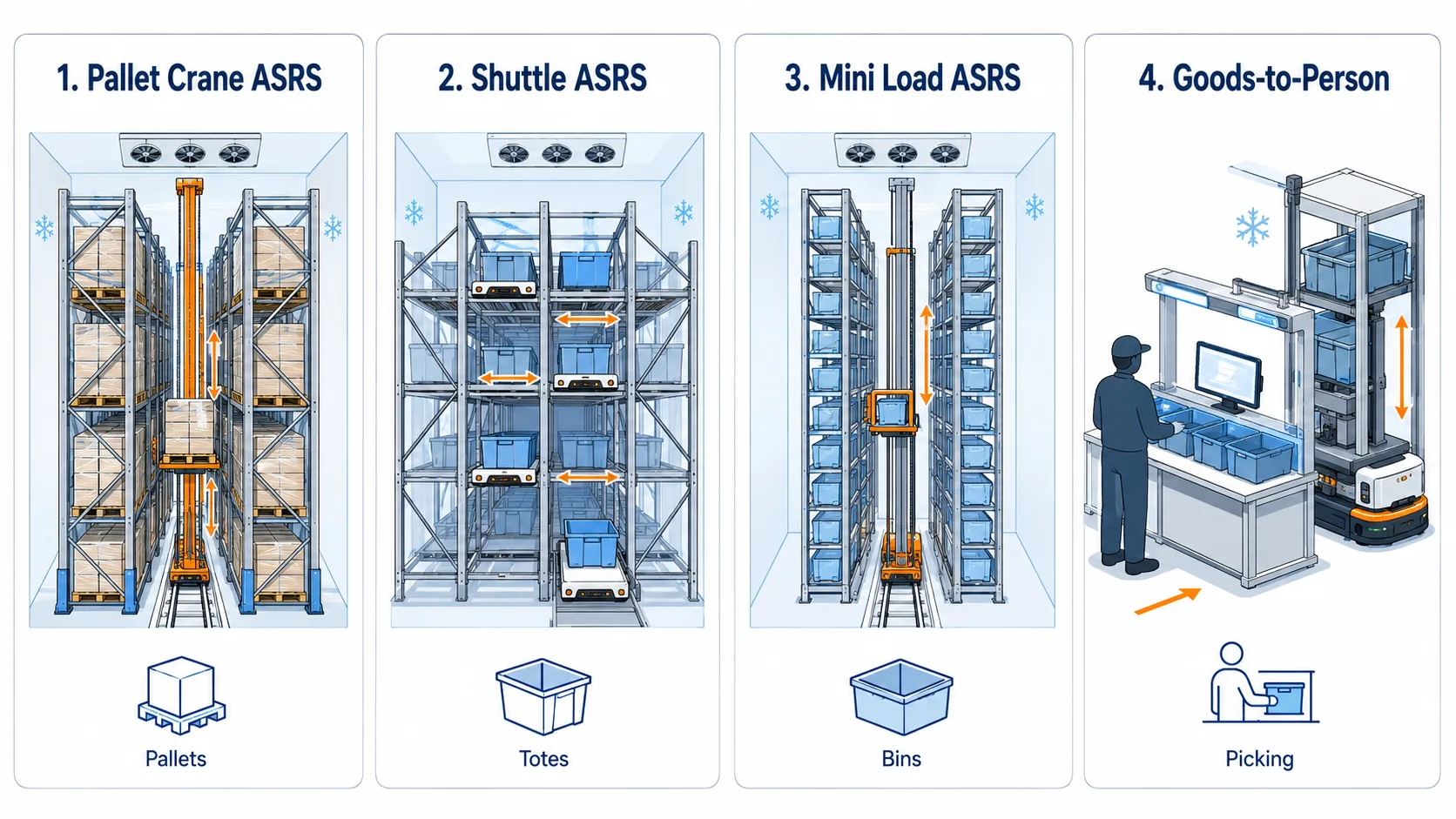
Pallet Crane ASRS
Pallet crane ASRS is a strong fit for high-density frozen or chilled pallet storage. Stacker cranes operate in narrow aisles and store pallets vertically in high-bay racking.
This design works well when:
- Loads are palletized.
- SKU movement is predictable.
- The warehouse needs very high storage density.
- The site has enough building height.
- The operation values stable, long-life infrastructure.
Pallet ASRS is common in frozen food, protein, dairy, beverage, ingredient storage, and production buffer warehouses. It is especially useful when manual forklift aisles waste too much refrigerated cube.
Read more in our pallet ASRS guide.
Shuttle ASRS
Shuttle ASRS is often better when throughput is more important than simple storage density. Shuttles can move totes, cartons, or cases through multiple rack levels and feed picking or sequencing stations.
This design works well when:
- Order volume is high.
- Case or tote handling is required.
- The operation has many SKUs.
- Picking and outbound sequencing matter.
- The system needs scalable throughput.
For cold-chain ecommerce, grocery, prepared food, and pharmaceutical fulfillment, shuttle systems can support faster retrieval and better buffering than a simple pallet-only design.
Compare this option in Shuttle ASRS vs Crane-Based ASRS.
Mini Load ASRS
Mini load ASRS is suitable for smaller cartons, trays, or totes. It can support chilled pharmaceutical, spare parts, food ingredient, lab sample, or high-value SKU storage where accuracy matters more than pallet volume.
This design works well when:
- Loads are smaller than pallets.
- SKU accuracy is critical.
- The operation needs controlled access.
- Picking stations should stay outside the coldest zone.
- Batch and lot tracking are important.
Mini load systems are useful when the warehouse needs precision and storage control but does not need a full pallet crane aisle.
Goods-to-Person Systems
Goods-to-person automation can reduce the time workers spend walking in low-temperature zones. Depending on the design, robots or shuttles bring totes, bins, or cases to picking stations that may be located in a warmer controlled area or in a reduced-exposure picking zone.
This design works well when:
- Order picking is the main labor constraint.
- SKU count is high.
- Orders include mixed cases or eaches.
- Manual freezer picking is slow or unsafe.
- The operation needs ergonomic station work.
For more on this workflow, see Goods-to-Person Picking.
How Cold Storage ASRS Changes Warehouse Flow
The biggest change is that the coldest zone becomes a controlled storage and retrieval engine, not a place where people constantly search, drive, and pick.
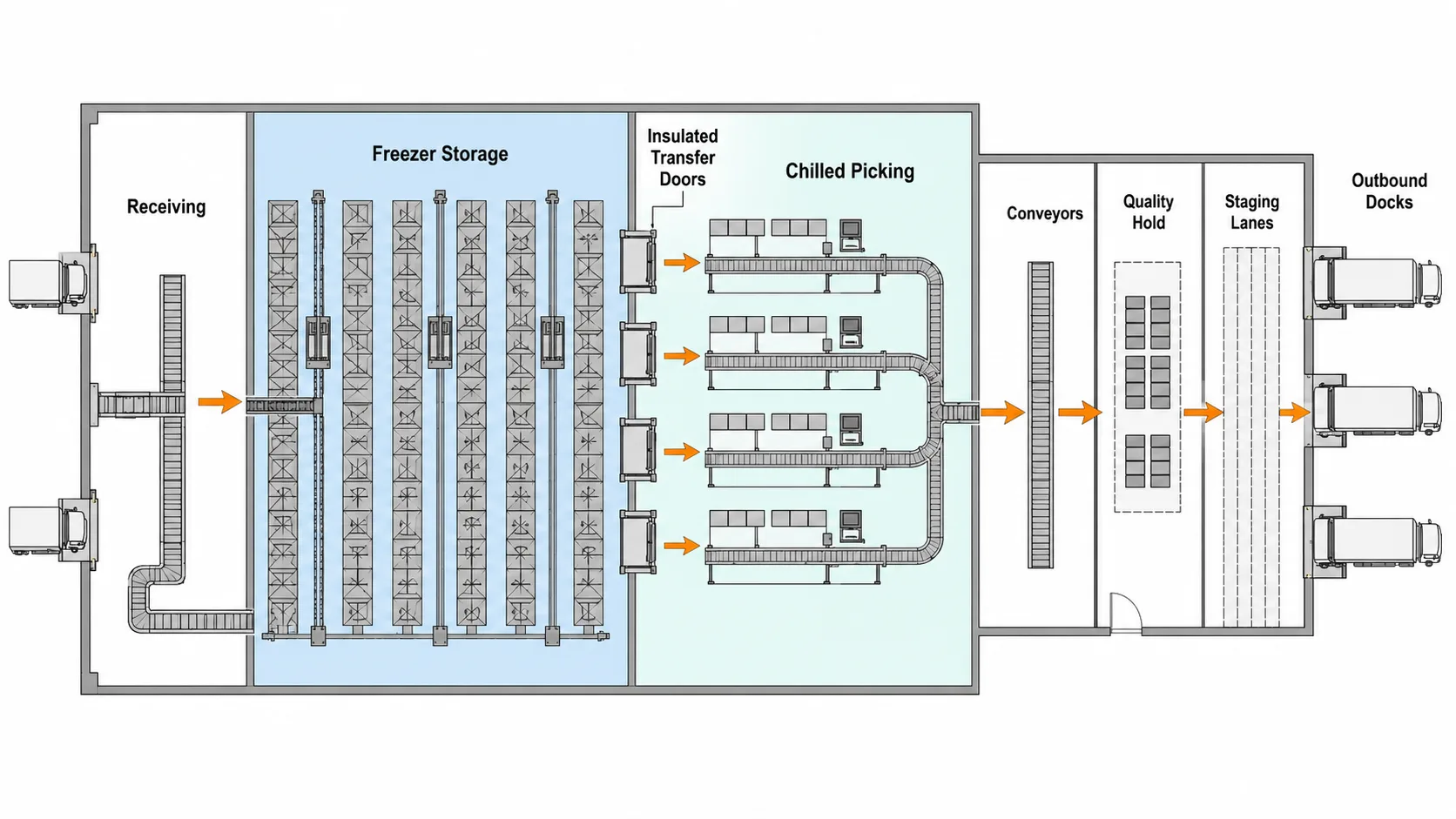
A typical cold storage automation flow may look like this:
1. Goods arrive at receiving. 2. Loads are checked, labeled, scanned, and temperature status is confirmed. 3. The WMS or WES assigns storage based on SKU, lot, expiration, temperature zone, and demand forecast. 4. Conveyors or transfer equipment move the load into the automated storage zone. 5. The ASRS stores the load in a dense rack or storage structure. 6. When an order is released, WES sequences retrieval based on priority, dock time, FEFO rule, and station capacity. 7. The ASRS retrieves the load and delivers it to picking, staging, production, or outbound lanes. 8. Exceptions are routed to inspection, quality hold, rework, or manual handling areas.
The best designs minimize unnecessary temperature transitions. Moving product back and forth between freezer, chilled, and ambient zones creates quality and energy problems. A strong layout keeps each move purposeful.
Software Is Critical in Cold Storage
Hardware moves the product. Software protects the flow.
In cold storage, WMS, WES, and WCS responsibilities must be defined clearly:
- WMS: inventory master data, order management, lot, batch, expiration, status, and customer rules.
- WES: task release, order prioritization, station balancing, retrieval sequencing, exception routing, and peak-hour orchestration.
- WCS: machine-level control for conveyors, cranes, shuttles, lifts, doors, and safety interlocks.
Cold-chain operations need more than "retrieve the next pallet." They need rules such as:
- Prioritize first-expired-first-out when required.
- Hold restricted lots from outbound orders.
- Keep high-velocity SKUs near faster retrieval paths.
- Sequence outbound loads by carrier appointment or route.
- Limit dwell time outside temperature-controlled zones.
- Trigger replenishment before picking stations starve.
- Keep damaged, quarantined, or quality-hold inventory out of normal flow.
This is where WES becomes valuable. A cold storage ASRS without good orchestration can still create bottlenecks at docks, picking stations, or staging lanes. For software layer detail, see WES vs WMS vs WCS.
Energy and Building Design Considerations
Cold storage ASRS should be planned with the building and refrigeration strategy, not added after the layout is already fixed.
Key design considerations include:
- Insulation envelope and freezer wall penetrations.
- Fire protection strategy.
- Floor flatness and slab design.
- Rack-supported or building-supported structure.
- Door opening frequency.
- Conveyor penetrations between temperature zones.
- Frost, condensation, and drainage control.
- Maintenance access without excessive temperature loss.
- Equipment rating for low-temperature operation.
- Emergency recovery and manual access procedures.
The layout should also consider where people actually work. If all picking, quality, and exception tasks remain inside the coldest zone, the automation may not deliver the expected labor and safety benefits. The goal is to move repetitive travel into automation and keep human work in the safest practical location.
Cold Storage ASRS ROI: What to Include
Cold storage ROI should include more than labor savings.
Important cost and benefit categories include:
- Refrigerated building cost per square meter.
- Energy cost of cooling unused space.
- Labor cost, freezer premiums, turnover, and training.
- PPE and cold-exposure management.
- Inventory shrink, spoilage, expiration, and quality holds.
- Picking and staging accuracy.
- Truck loading delays and dock congestion.
- Maintenance cost for low-temperature equipment.
- Downtime risk and redundancy requirements.
- Expansion cost if the site runs out of storage capacity.
In many projects, the strongest ROI driver is avoided expansion. If ASRS allows the operator to store more product in the existing freezer footprint, the project may avoid a second freezer building, external cold storage rental, or frequent transfer between facilities.
Use our warehouse automation ROI guide and ASRS total cost of ownership guide to build the financial model.
Common Mistakes in Cold Storage Automation
Cold storage projects are less forgiving than ambient warehouse projects. Small layout errors can become expensive because every change touches refrigeration, insulation, fire protection, and product safety.
Avoid these mistakes:
- Designing for storage only: Retrieval, staging, picking, and outbound sequence must be included.
- Ignoring door traffic: Every unnecessary opening can affect energy and frost behavior.
- Putting too much manual work in the freezer: Automation should reduce exposure, not only move faster.
- Underestimating maintenance access: Low-temperature equipment still needs inspection and repair.
- Forgetting exception flow: Damaged loads, quality holds, and inventory discrepancies need a safe path.
- Using daily averages: Peak-hour retrieval demand matters more than daily volume.
- Skipping software rules: Lot, batch, FEFO, and temperature-zone rules need system logic.
- Treating chilled and frozen as the same: Each temperature zone has different equipment and process constraints.
Buyer Checklist for Cold Storage ASRS
Before requesting a quotation, prepare these inputs:
- Temperature zones and target ranges.
- Load type: pallet, carton, tote, tray, bin, or mixed.
- Load dimensions, weight, packaging stability, and pallet quality.
- SKU count and SKU velocity curve.
- Storage positions required by zone.
- Daily and peak-hour inbound/outbound movements.
- Order profile: full pallet, case, each, mixed order, production feed, or ecommerce.
- Lot, batch, expiration, FEFO, quality hold, and traceability rules.
- Dock schedule, route sequence, and staging requirements.
- Current labor model and freezer exposure constraints.
- Existing WMS, ERP, WES, WCS, and label systems.
- Building height, slab, fire protection, refrigeration, and expansion limits.
- Manual fallback and maintenance strategy.
If a vendor cannot ask for this information, they are probably quoting equipment before understanding the operation.
Frequently Asked Questions
What is cold storage ASRS?
Cold storage ASRS is an automated storage and retrieval system designed for chilled, frozen, or sub-zero warehouses. It uses cranes, shuttles, robots, conveyors, and software to store and retrieve goods while reducing manual travel inside low-temperature zones.
Is ASRS suitable for freezer warehouses?
Yes, ASRS can be suitable for freezer warehouses when the equipment, controls, sensors, cables, lubrication, safety systems, and maintenance strategy are designed for low-temperature operation. The project must also account for insulation, frost, door openings, and emergency access.
Which ASRS type is best for cold storage?
Pallet crane ASRS is often best for dense frozen pallet storage. Shuttle ASRS is better for high-throughput case or tote flow. Mini load and goods-to-person systems are useful for smaller loads, pharmaceutical products, grocery ecommerce, or SKU-intensive cold-chain fulfillment.
Does cold storage ASRS reduce energy cost?
It can help, especially when it increases storage density, reduces door openings, limits forklift traffic, and avoids expansion into additional refrigerated space. Energy savings depend on building design, refrigeration system, workflow, and how much manual movement the ASRS replaces.
How does cold storage ASRS improve worker safety?
Cold storage ASRS reduces repetitive travel and forklift movement inside freezer zones. Workers can spend more time at receiving, picking, quality, maintenance, and control stations instead of driving or walking through low-temperature aisles for every storage and retrieval task.
What data is needed before designing a cold storage ASRS?
You need temperature zones, load dimensions, SKU velocity, pallet quality, storage positions, peak-hour movement, order profile, lot and expiration rules, dock schedule, building constraints, software systems, and exception handling requirements.
Bottom Line
Cold storage ASRS is not just a faster way to move frozen pallets. It is a way to redesign how a temperature-controlled warehouse uses space, protects workers, controls inventory, and handles demand peaks.
The strongest cold storage automation projects begin with the real constraint: freezer labor, storage density, retrieval speed, energy discipline, product traceability, or outbound reliability. Once that constraint is clear, the ASRS type, software architecture, and building design can be matched to the operation.
If your chilled or frozen warehouse is running out of space, struggling with freezer labor, or missing service levels during peak periods, contact GoASRS. We can help evaluate whether pallet ASRS, shuttle ASRS, mini load ASRS, goods-to-person automation, or a hybrid cold-chain design fits your facility.
References
- MHI: AS/RS Industry Group
- OSHA: Warehousing Hazards and Solutions
- FDA: FSMA Final Rule on Sanitary Transportation of Human and Animal Food
Planning a Warehouse Automation Project?
Our team has delivered 50+ ASRS systems across retail, manufacturing, and logistics. Tell us about your project and we will get back to you within 24 hours.
Thank you!
We received your message and will get back to you within 24 hours.