
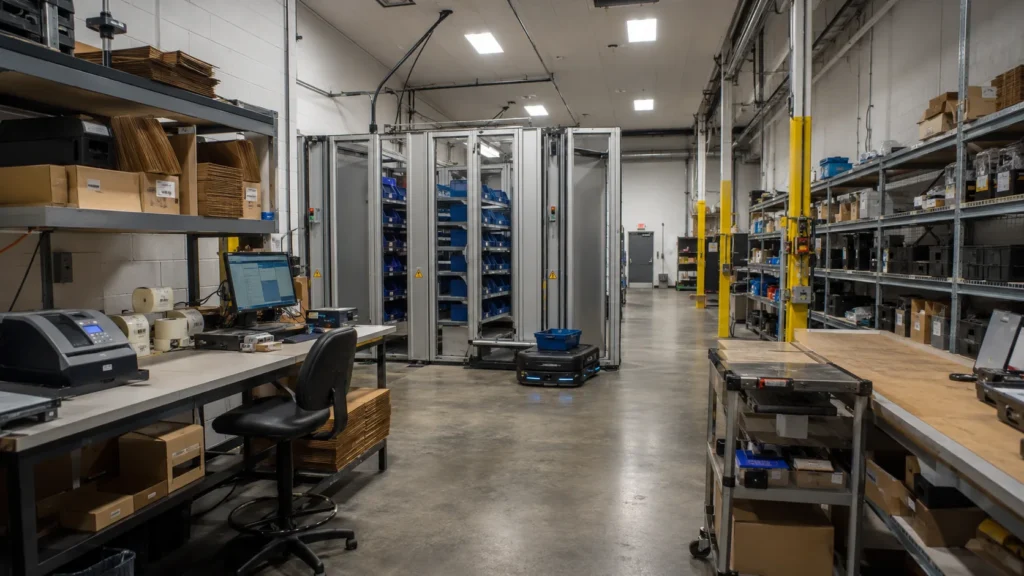
ASRS for small warehouse operations can make sense, but only when the automation solves a specific constraint: limited floor space, high picking labor, inventory errors, SKU growth, slow replenishment, or the need to delay a warehouse move. A small warehouse should not buy automation just because larger competitors use it. It should automate the work that is already limiting growth.
The question is usually framed the wrong way. Buyers ask, "Is my warehouse big enough for ASRS?" A better question is: "Which part of my warehouse is expensive, repetitive, space-constrained, and predictable enough to automate?"
Short answer: ASRS can work in a small warehouse when the facility has enough repeatable storage and retrieval work to justify the system. Compact options such as vertical lift modules, mini load ASRS, bin robots, shuttle systems, and goods-to-person workflows can help small warehouses improve storage density, picking speed, inventory accuracy, and labor productivity without moving to a larger building.
This guide explains when small warehouse automation pays off, which ASRS types fit limited space, how to estimate ROI, and what to avoid before buying equipment.
What Counts as a Small Warehouse?
There is no universal size cutoff. A "small warehouse" could mean a 500 m² parts room, a 1,500 m² ecommerce fulfillment area, a 2,000 m² manufacturing warehouse, or a compact 3PL operation inside a larger building.
For automation planning, size matters less than constraint.
A small warehouse is a strong ASRS candidate when one or more of these conditions is true:
- The warehouse is running out of floor space.
- Workers spend too much time walking between shelves.
- SKU count is growing faster than the layout can handle.
- Picking errors are creating returns or production delays.
- The team cannot add another shift.
- The business wants to avoid leasing a larger building.
- Inventory accuracy is poor because locations are constantly changing.
- High-value parts need controlled access.
- Order volume is volatile but the warehouse footprint cannot expand.
A small warehouse is a weak ASRS candidate when volume is low, SKU count is simple, labor is available, errors are rare, and the current layout has unused capacity. Automation should remove a real bottleneck, not decorate an operation that is still working.
Why Small Warehouses Consider ASRS
Small warehouses usually do not have the luxury of spare aisles, spare docks, spare operators, and spare mezzanine space. One bad layout decision can block the whole operation.
The most common reasons small warehouses look at ASRS are:
Space pressure. Manual shelving and forklift aisles often waste vertical cube. A compact ASRS can use height more effectively and delay expansion.
Walking time. In small warehouses, the absolute distance may look modest, but repeated travel still consumes hours every day. Goods-to-person flow can keep operators at productive stations.
Inventory accuracy. When shelves are crowded, teams start using temporary locations. Temporary locations become permanent confusion. ASRS forces location control.
Labor limits. A small team may not have enough people to receive, pick, pack, count, replenish, and handle exceptions at the same time.
Growth without relocation. Moving warehouses is expensive and disruptive. If automation helps the current site handle two more years of growth, that can be enough to justify the project.
Customer promise pressure. Small ecommerce, spare parts, medical, electronics, or manufacturing warehouses may need same-day or next-day service even without the staff of a large distribution center.
OSHA's warehousing guidance also highlights risks from repetitive lifting, awkward posture, forklift movement, and changing warehouse environments. ASRS does not eliminate safety management, but it can reduce some of the repetitive travel and manual access work that creates exposure.
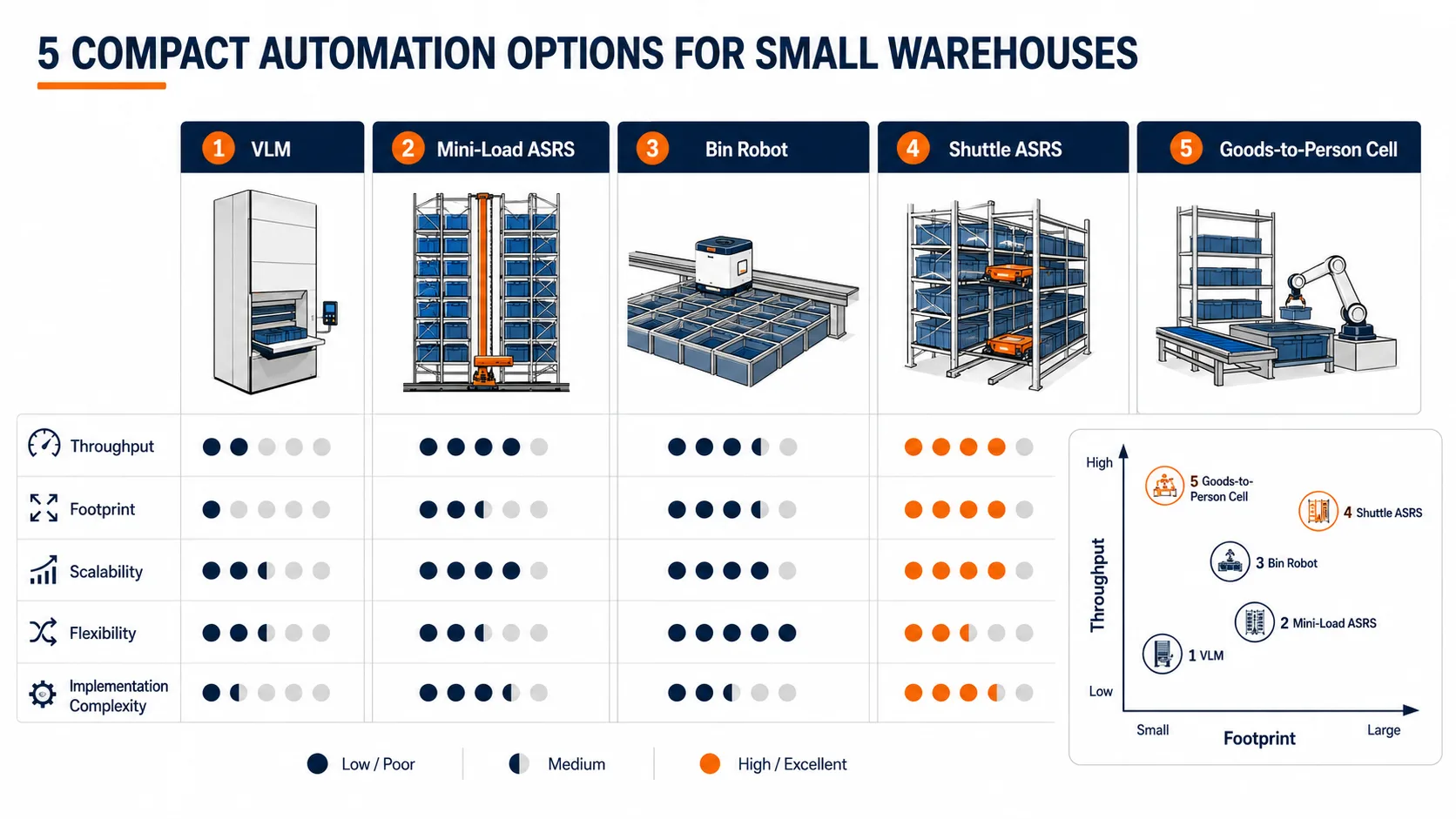
ASRS Types That Fit Small Warehouses
Small warehouses should not start with the largest ASRS category. The right system is usually modular, compact, and focused.
Vertical Lift Module
A vertical lift module, or VLM, stores trays vertically inside an enclosed machine and delivers the correct tray to an operator access window.
Best for:
- Small parts.
- Tools and spare parts.
- Electronics components.
- Medical or lab supplies.
- Maintenance inventory.
- High-value controlled items.
VLMs are often a good first automation step because they use vertical height, have a compact footprint, and can improve picking ergonomics. They are not ideal for very high-throughput ecommerce if order volume exceeds the machine's access speed.
Mini Load ASRS
Mini load ASRS stores totes, cartons, or trays in rack aisles and retrieves them using an automated crane or shuttle.
Best for:
- Small to medium load units.
- SKU-intensive warehouses.
- Parts distribution.
- Manufacturing line-side supply.
- Ecommerce operations with stable SKU profiles.
Mini load systems are stronger when the warehouse needs higher throughput or more storage positions than a single VLM can provide.
Read more in our Mini Load ASRS guide.
Bin Robot System
Bin robots store and retrieve totes or bins from high-density shelving. They can be useful when a small warehouse needs goods-to-person flow without a large fixed crane structure.
Best for:
- Ecommerce fulfillment.
- Apparel accessories.
- Electronics.
- Beauty and cosmetics.
- Spare parts.
- 3PL clients with smaller items.
Bin robot systems can make sense when the operation has many SKUs, limited floor space, and a need to scale picking stations gradually.
Shuttle ASRS
Shuttle ASRS is usually more expensive than a small VLM or simple bin robot deployment, but it can work when the warehouse is small in area yet high in volume.
Best for:
- High order-line density.
- Fast-moving totes or cartons.
- Compact but tall buildings.
- Omnichannel or ecommerce fulfillment.
- Operations that need strong peak-hour throughput.
If the site is small but order volume is intense, shuttle ASRS may be the right answer. If the site is small and volume is modest, it may be oversized.
Compact Goods-to-Person Layout
Goods-to-person is not one machine type. It is an operating model: inventory comes to the worker instead of the worker walking to inventory.
Best for:
- High walking time.
- Small teams.
- Mixed-SKU orders.
- Limited aisle space.
- Ergonomic picking improvements.
This can be implemented with VLMs, bin robots, mini load ASRS, shuttle systems, or AMR-assisted workflows. For the workflow itself, see Goods-to-Person Picking.
When ASRS Is Worth It in a Small Warehouse
ASRS is worth considering when the current warehouse cannot scale through simple process improvement.
Use these practical thresholds as decision signals:
| Signal | What it means |
|---|---|
| Storage locations are above 85% full | The warehouse has little room for receiving, slotting, or growth |
| Pickers spend more time walking than picking | Goods-to-person or compact storage may help |
| Daily order volume is growing but headcount cannot | Automation may stabilize output |
| Inventory accuracy is below target | System-controlled storage may reduce location errors |
| Same-day shipping misses are increasing | Release, picking, and packing flow need redesign |
| Rent or expansion cost is rising | Higher density may be cheaper than relocation |
| SKU count is growing faster than revenue | Layout and slotting complexity may exceed manual control |
| High-value parts are hard to control | Enclosed automated storage can improve access discipline |
One warning: do not automate a broken process too early. If the warehouse has no SKU master data, poor labeling, inconsistent packaging, or unreliable inventory records, fix those foundations before asking an ASRS to run the operation.
When ASRS Is Not Worth It
Small warehouses should be careful. Automation can be the right decision, but it can also become expensive overengineering.
ASRS may not be worth it when:
- Order volume is low and stable.
- The warehouse has plenty of unused space.
- SKU count is small and easy to manage.
- Labor is available and not the main cost driver.
- The products are irregular, fragile, leaking, oversized, or hard to standardize.
- Packaging quality is poor.
- The business expects to move facilities soon.
- Management wants a machine before defining the process.
In these cases, the better first step may be slotting improvement, barcode discipline, rack redesign, pick path optimization, WMS cleanup, or a small AMR pilot.
Automation should follow the constraint. If the constraint is data quality, an ASRS will not solve it.
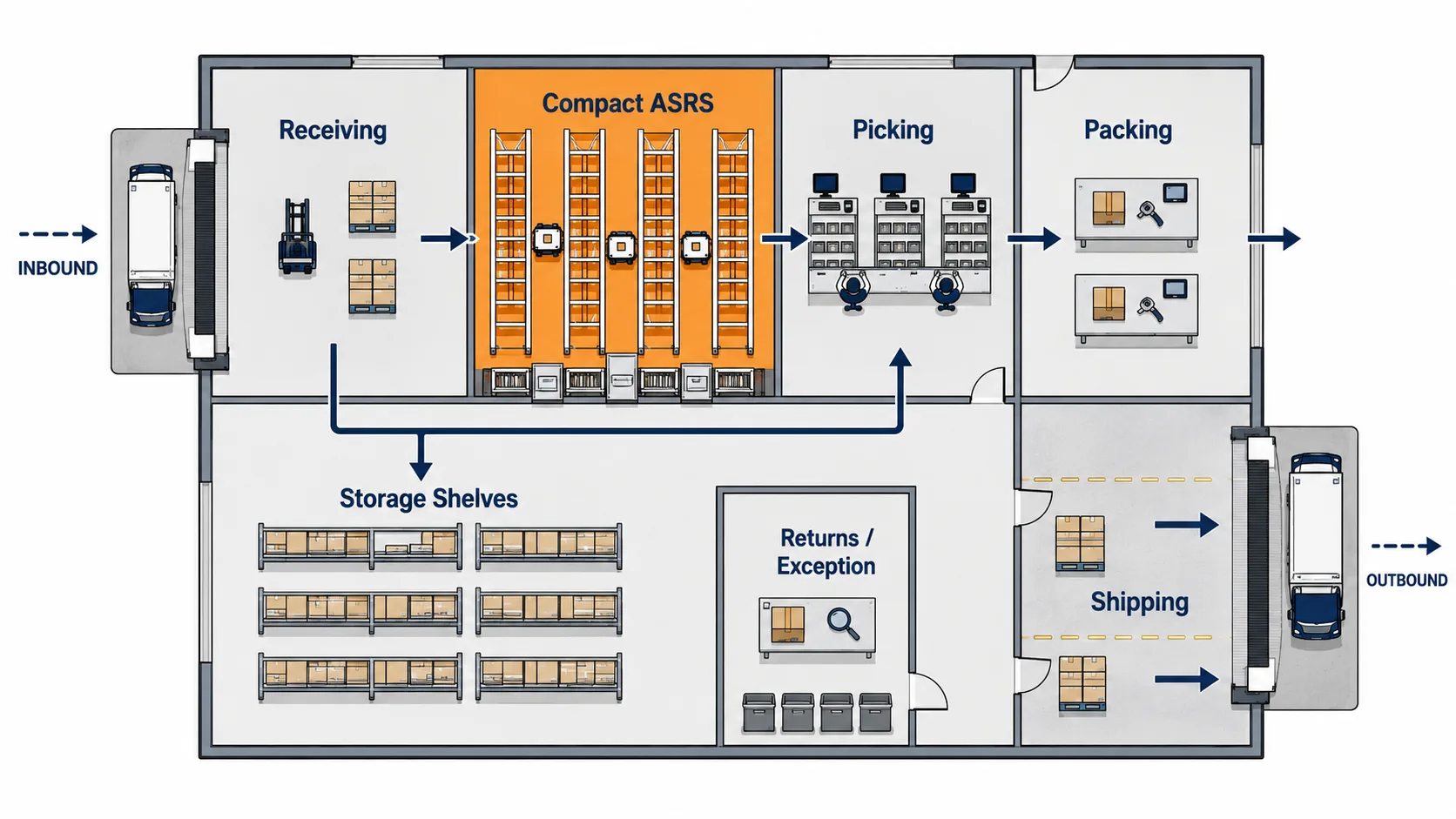
Small Warehouse ASRS Layout Principles
A small warehouse has less margin for layout mistakes. Every meter needs a purpose.
Good layouts usually follow these principles:
Keep receiving separate from picking. If inbound pallets or cartons block pick paths, automation cannot fix the congestion.
Put the ASRS near the work it supports. A compact storage system should feed picking, kitting, packing, or production directly. If every tote needs a long manual transfer after retrieval, the benefit drops.
Plan exception space. Damaged goods, unknown SKUs, quality checks, returns, and count discrepancies need a location. Small warehouses often forget this.
Avoid one-way dependency. If a single machine stops, can urgent orders still ship? The answer may be manual emergency access, bypass lanes, backup storage, or phased deployment.
Design for replenishment. Picking gets attention, but replenishment often limits output. The layout must show how goods enter the ASRS and how empty containers, waste, and exceptions leave.
Leave space for growth. If the system is already maxed out on day one, the project will feel obsolete too quickly.
Software Requirements for Small Warehouse ASRS
Small warehouses often underestimate software. They assume the automation vendor's machine software is enough. Sometimes it is. Often it is not.
At minimum, the system needs to know:
- What SKU is stored.
- Where it is stored.
- Which order needs it.
- Which unit should be picked.
- Which station or operator should receive it.
- What happens when an item is missing, damaged, expired, or blocked.
Depending on complexity, you may need:
- WMS for inventory and order management.
- WES for task release, order batching, station balancing, and exception routing.
- WCS for machine-level control.
- ERP integration for purchasing, production, or finance.
- Barcode or RFID scanning for movement confirmation.
For simple VLM storage, a lightweight inventory interface may be enough. For multi-zone fulfillment, a WES layer becomes more important because it coordinates storage, retrieval, picking, packing, and shipping as one flow.
For software layer context, read WES vs WMS vs WCS.
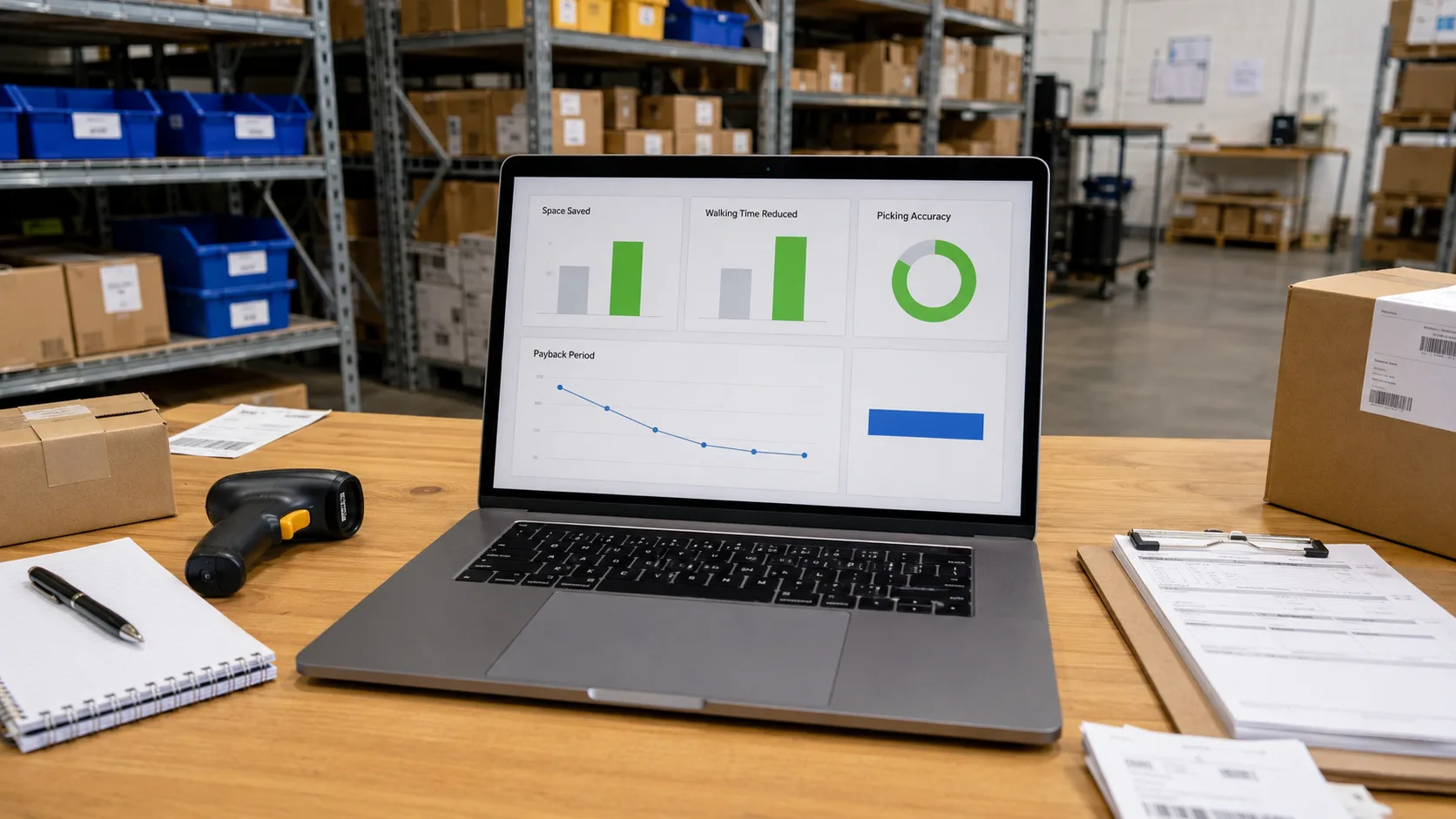
ROI for ASRS in a Small Warehouse
Small warehouse ROI is different from large distribution center ROI. The project may not be justified by massive labor reduction. It may be justified by avoiding a move, protecting service levels, or making a small team more productive.
Include these benefits in the model:
- Avoided warehouse expansion or external storage.
- Labor hours saved from walking, searching, counting, and replenishment.
- Higher picking speed per operator.
- Lower mispick and reshipment cost.
- Better inventory accuracy.
- Reduced overtime.
- Faster new worker training.
- Better use of vertical space.
- Reduced safety exposure from ladders, forklifts, or crowded aisles.
- Higher service levels without adding shifts.
Include these costs:
- Equipment.
- Installation.
- Rack or floor changes.
- Electrical and network work.
- Software integration.
- Training.
- Maintenance.
- Spare parts.
- Downtime during installation.
- Future expansion modules.
For a structured financial model, use our warehouse automation ROI guide and ASRS system cost guide.
A Practical Decision Framework
Before buying ASRS for a small warehouse, answer these questions:
1. What is the main constraint: space, labor, accuracy, speed, safety, or growth? 2. Which SKU group creates most of the work? 3. How many order lines are picked per day and during peak hour? 4. How much time do workers spend walking versus picking? 5. How many storage locations are active? 6. Is inventory data accurate enough for automation? 7. Are product dimensions and packaging stable? 8. Can the building support the system's height, floor load, power, and network needs? 9. What manual fallback exists if the system is down? 10. Will the system still fit the business two years from now?
If the answers are unclear, start with a process study. Measure travel, touches, errors, dwell time, and pick-line demand before selecting equipment.
Common Mistakes Small Warehouses Make
Buying too much system. A small warehouse may need one compact storage zone, not a full automated facility.
Ignoring upstream receiving. If inbound goods are not labeled and verified correctly, the ASRS will inherit bad data.
Forgetting packing capacity. Faster picking can simply move the bottleneck to packing.
Designing only for average volume. Peak hour matters more than daily average.
Skipping operator workflow. The best machine still fails if operators cannot handle containers, labels, exceptions, and replenishment comfortably.
Treating ASRS as a storage project only. The real goal is end-to-end flow: receiving, storage, picking, packing, shipping, and returns.
Frequently Asked Questions
Is ASRS worth it for a small warehouse?
ASRS is worth it for a small warehouse when space, labor, accuracy, or service-level constraints are already limiting growth. It is not worth it when order volume is low, SKU count is simple, and the current layout still has unused capacity.
What is the best ASRS type for a small warehouse?
The best ASRS type depends on load size and throughput. VLMs fit small parts and controlled storage. Mini load ASRS fits totes and cartons. Bin robots fit SKU-intensive goods-to-person picking. Shuttle ASRS fits compact but high-throughput operations.
Can ASRS fit in a warehouse under 2,000 m²?
Yes, ASRS can fit in warehouses under 2,000 m² if the system is selected carefully. Compact VLMs, bin robots, mini load systems, and focused goods-to-person cells can work in limited footprints. The layout must include receiving, picking, packing, exceptions, and maintenance access.
How much volume do I need before considering ASRS?
There is no single minimum volume. A better rule is to measure repetitive work. If workers spend significant time walking, searching, counting, or retrieving the same SKU groups every day, automation may be worth evaluating even before the warehouse becomes large.
Should a small warehouse choose AMR or ASRS?
AMRs are often better when flexibility and low disruption matter most. ASRS is stronger when storage density, inventory control, and high-frequency retrieval matter most. Many small warehouses use a phased approach: improve data and layout first, then add compact ASRS or AMR where the constraint is clearest.
What should I prepare before asking for an ASRS quote?
Prepare SKU data, load dimensions, order history, peak-hour demand, storage locations, picking workflow, error rates, labor hours, building drawings, ceiling height, floor load, power availability, WMS/ERP details, and future growth assumptions.
Bottom Line
ASRS for small warehouse operations should be practical, focused, and constraint-led. The goal is not to build a miniature version of a giant automated distribution center. The goal is to remove the bottleneck that prevents the current warehouse from handling more orders, more SKUs, or better service levels.
For many small warehouses, the right first step is compact automation: a VLM for parts, a mini load system for totes, a bin robot cell for goods-to-person picking, or a focused shuttle zone for high-volume SKU groups. The right choice depends on the work profile, not the size of the company.
If your small warehouse is running out of space, losing time to walking, or struggling to scale with a small team, contact GoASRS. We can help evaluate whether ASRS, AMR, goods-to-person automation, or a phased layout redesign is the right next step.
References
Planning a Warehouse Automation Project?
Our team has delivered 50+ ASRS systems across retail, manufacturing, and logistics. Tell us about your project and we will get back to you within 24 hours.
Thank you!
We received your message and will get back to you within 24 hours.