
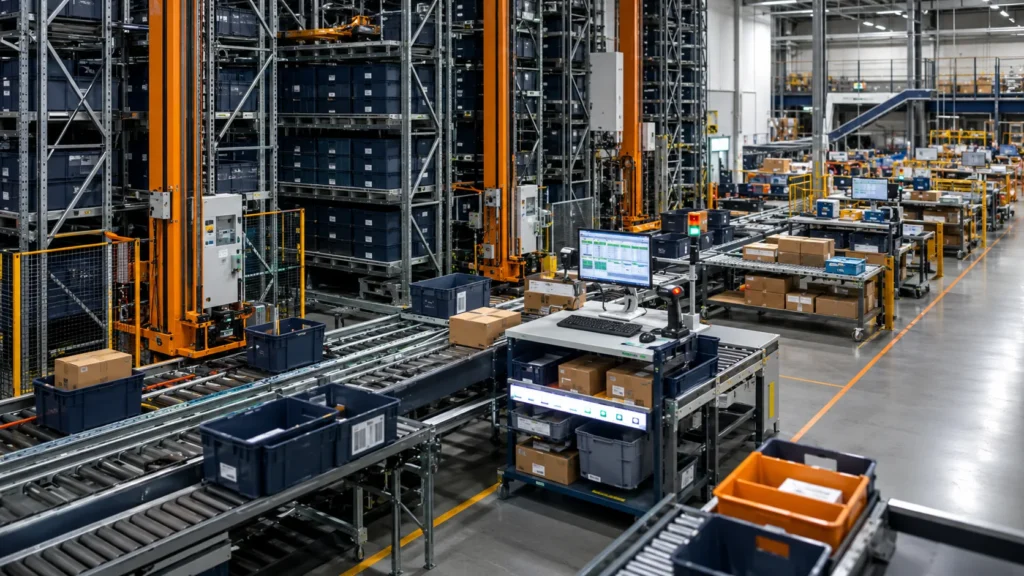
E-commerce fulfillment is harder than normal warehousing. Orders arrive continuously, SKU velocity changes quickly, promotions create sudden spikes, returns flow back into the building, and customers expect fast shipping with almost no picking errors.
That operating pattern is exactly where automated storage and retrieval systems become valuable. ASRS is not only a storage technology for e-commerce warehouses. It is a way to keep inventory dense, accurate, and close to the picking process while software decides which storage zone should fulfill each order line.
Short answer: ASRS for e-commerce fulfillment uses automated storage, goods-to-person picking, shuttles, bin robots, conveyors, and warehouse execution software to move SKUs to operators faster and more accurately. The biggest benefits are higher storage density, faster order picking, lower labor dependency, better peak-season capacity, and more reliable order accuracy.
This guide explains where ASRS fits in an e-commerce fulfillment center, which system types work best, when ASRS should be paired with AMR fleets, and how to decide whether the investment makes sense for your operation.
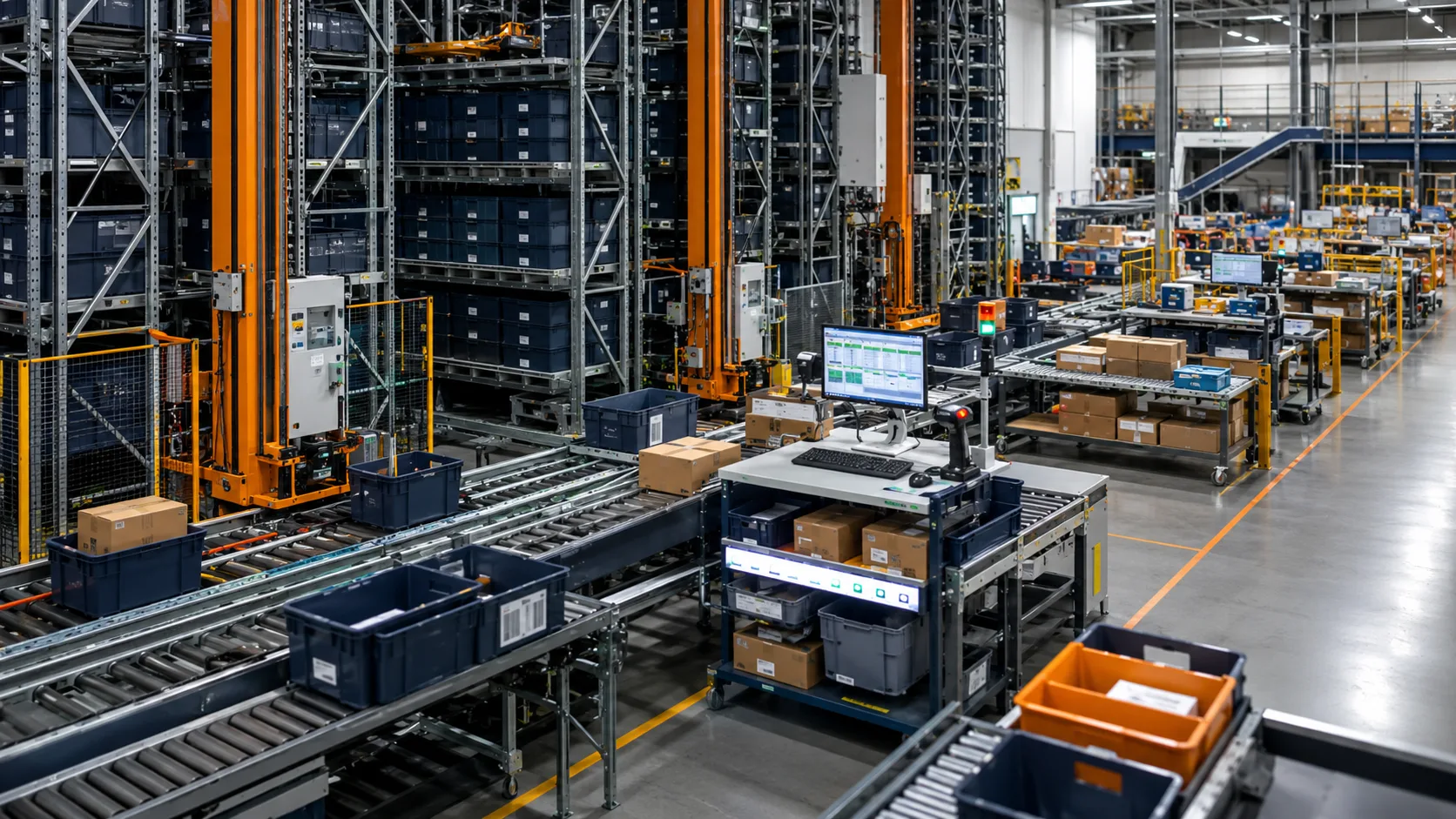
Why E-Commerce Fulfillment Is Different
E-commerce warehouses do not behave like traditional distribution centers. A retail replenishment center may ship pallets or cases to stores on predictable schedules. An e-commerce fulfillment center ships thousands of small orders directly to customers, often with one to three lines per order.
That creates five operating challenges.
High SKU spread. A small number of fast movers may drive volume, but the long tail still needs to be available. If the long tail is stored too far away, pickers waste time walking. If fast movers are not buffered correctly, packing stations starve during order waves.
Order volatility. Promotions, livestream events, influencer campaigns, holiday demand, and marketplace ranking changes can move SKU velocity overnight. A manual slotting plan that worked last week may be wrong by Monday morning.
Accuracy pressure. E-commerce mistakes are visible to the end customer. One wrong color, size, accessory, or bundle component creates a return, a replacement shipment, customer service work, and brand damage.
Peak-season stress. Many operations are sized for average demand and then try to survive peak with overtime and temporary labor. That works until cutoffs are missed or error rates climb.
Returns complexity. Returned inventory must be inspected, reclassified, restocked, scrapped, or routed to secondary channels. If returns are not integrated with storage and picking logic, they become a second warehouse inside the first one.
ASRS helps because it removes unnecessary movement from these workflows. Inventory moves to controlled stations. Software tracks location and status. Storage density improves. The pick path becomes shorter, more predictable, and easier to scale.
What ASRS Means in an E-Commerce Warehouse
ASRS in e-commerce usually means a combination of automated storage hardware, goods-to-person workstations, conveyors, and orchestration software. The system may store totes, cartons, bins, shelves, or pallets depending on the product profile.
The most common e-commerce ASRS configurations are:
- Shuttle ASRS for high-throughput tote or carton storage.
- Mini-load ASRS for dense tote storage with controlled retrieval.
- Robotic goods-to-person systems for flexible picking and high SKU variety.
- Bin robots for high-density storage and tote delivery.
- Pallet ASRS for reserve inventory and store replenishment.
- Hybrid ASRS + AMR layouts where fixed storage handles dense inventory and mobile robots handle variable zones.
If you need the category basics first, read our guide to what ASRS means and the comparison of the main ASRS system types. For e-commerce, the key question is not "which ASRS is best?" It is "which part of the order profile should each automation zone handle?"
How ASRS Improves E-Commerce Fulfillment
In an e-commerce fulfillment center, ASRS improves performance by bringing the right inventory to the right work point at the right time. The value comes from the combined system, not from storage hardware alone.
1. Faster Goods-to-Person Picking
Manual e-commerce picking loses time in walking, searching, scanning, and moving between aisles. A worker may spend more time traveling than actually picking.
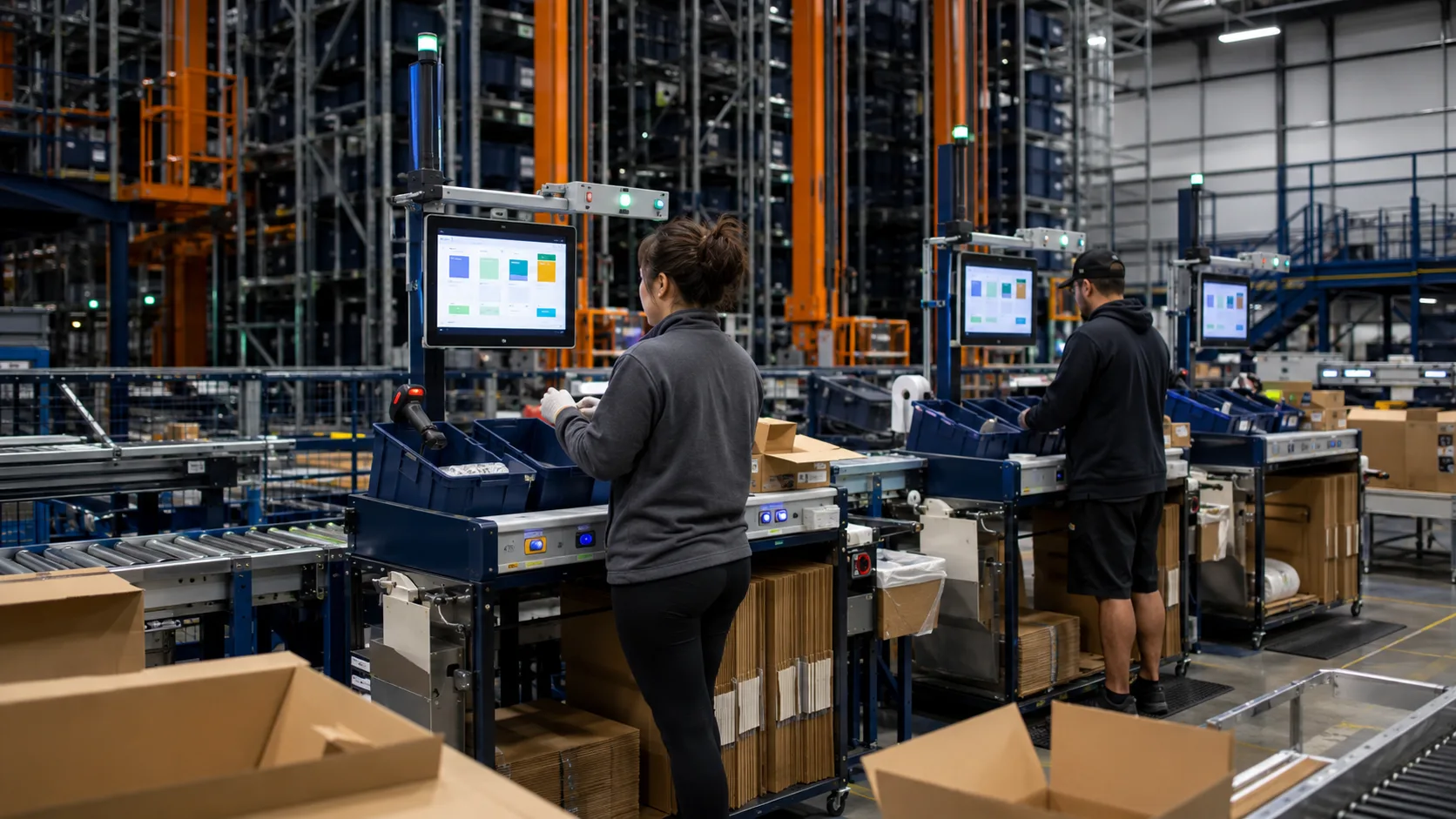
ASRS changes that pattern. Totes or shelves are retrieved automatically and delivered to a picking station. The operator stays in one ergonomic work area while the system sequences inventory based on order priority, station workload, and SKU availability.
This is why goods-to-person picking is so common in e-commerce automation. It improves pick rate by removing walking and reducing search time. The exact rate depends on order profile, station design, SKU size, and confirmation method, but the operating principle is consistent: inventory travels, not the picker.
2. Higher Storage Density
E-commerce warehouses often carry thousands of SKUs across sizes, colors, bundles, accessories, and packaging variants. Manual shelving spreads that inventory across a wide footprint.
ASRS compresses that footprint. Shuttle systems, mini-load systems, and bin robot systems use vertical storage, narrow automated aisles, and dense tote positions. This matters when the warehouse is close to capacity but moving to a larger building would add rent, labor, and disruption.
For e-commerce brands in expensive logistics markets, storage density can be as important as labor productivity. A denser system may let the operation delay expansion, consolidate overflow stock, or add more SKU depth before peak season.
3. Better Picking Accuracy
E-commerce errors are costly because they travel all the way to the customer. A wrong item creates return freight, reshipment, repacking, support tickets, and lost trust.
ASRS improves accuracy by reducing manual search decisions. The system retrieves the correct tote, presents it at a controlled station, and confirms the pick with barcode scanning, light guidance, weight checking, or vision support. The WMS knows what should be picked. The WES knows which station should receive it. The WCS or robot controller executes the movement.
That layered control is why software architecture matters. Our article on WES vs WMS vs WCS explains how the planning, orchestration, and equipment-control layers fit together.
4. Better Peak-Season Capacity
Peak season exposes weak warehouse design. More people do not automatically create more capacity. If the storage area is congested, pick paths are too long, or packing buffers are undersized, extra labor can make the floor slower.
ASRS helps by separating inventory retrieval from human walking capacity. The system can prepare waves, replenish station buffers, run retrieval tasks before the shift, and keep fast-moving SKUs close to the pick process.
For many e-commerce operations, the best peak strategy is hybrid. Dense ASRS handles stable fast movers and high-volume tote flow. AMR or manual-assisted zones handle the volatile long tail, returns, and exceptions. We covered this decision in detail in ASRS vs AMR.
5. More Reliable Inventory Visibility
E-commerce fulfillment depends on accurate available-to-promise inventory. If the site sells stock that the warehouse cannot find, the problem becomes a customer experience issue.
ASRS gives the system a tighter chain of custody. Every storage movement, retrieval task, tote handoff, and workstation presentation can be logged. That makes cycle counting easier, reduces lost inventory, and gives planners a better view of what is physically available.
This is especially important for omnichannel retailers that ship direct-to-consumer orders, replenish stores, and process marketplace orders from the same stock pool.
Best ASRS Types for E-Commerce Fulfillment
Different e-commerce operations need different automation architecture. A beauty products warehouse, a fashion warehouse, and a spare-parts marketplace may all be "e-commerce," but their SKU dimensions and order profiles are not the same.
| E-commerce operation type | Best-fit ASRS approach | Why it fits |
|---|---|---|
| High-volume small parcel | Shuttle ASRS + goods-to-person stations | Fast tote flow and dense SKU storage |
| Apparel and footwear | Bin robots or robotic G2P + WES | High SKU variety, size/color complexity, seasonal changes |
| Omnichannel retail | Shuttle ASRS + AMR + reserve pallet storage | Supports store replenishment and DTC orders in one site |
| Marketplace or 3PL e-commerce | AMR + ASRS hybrid | Handles client variability and changing SKU profiles |
| Heavy or bulky e-commerce | Pallet ASRS + fork AGV + conveyor | Reduces forklift travel and improves reserve storage |
| Returns-heavy operation | Bin robot zone + inspection stations | Supports fast restocking and exception handling |
The table matters because many e-commerce automation projects fail at the category level. A vendor may sell a single system even when the warehouse really needs two zones. Fast movers, slow movers, returns, reserve storage, and value-added services do not always belong in the same automation technology.
A Practical E-Commerce ASRS Workflow
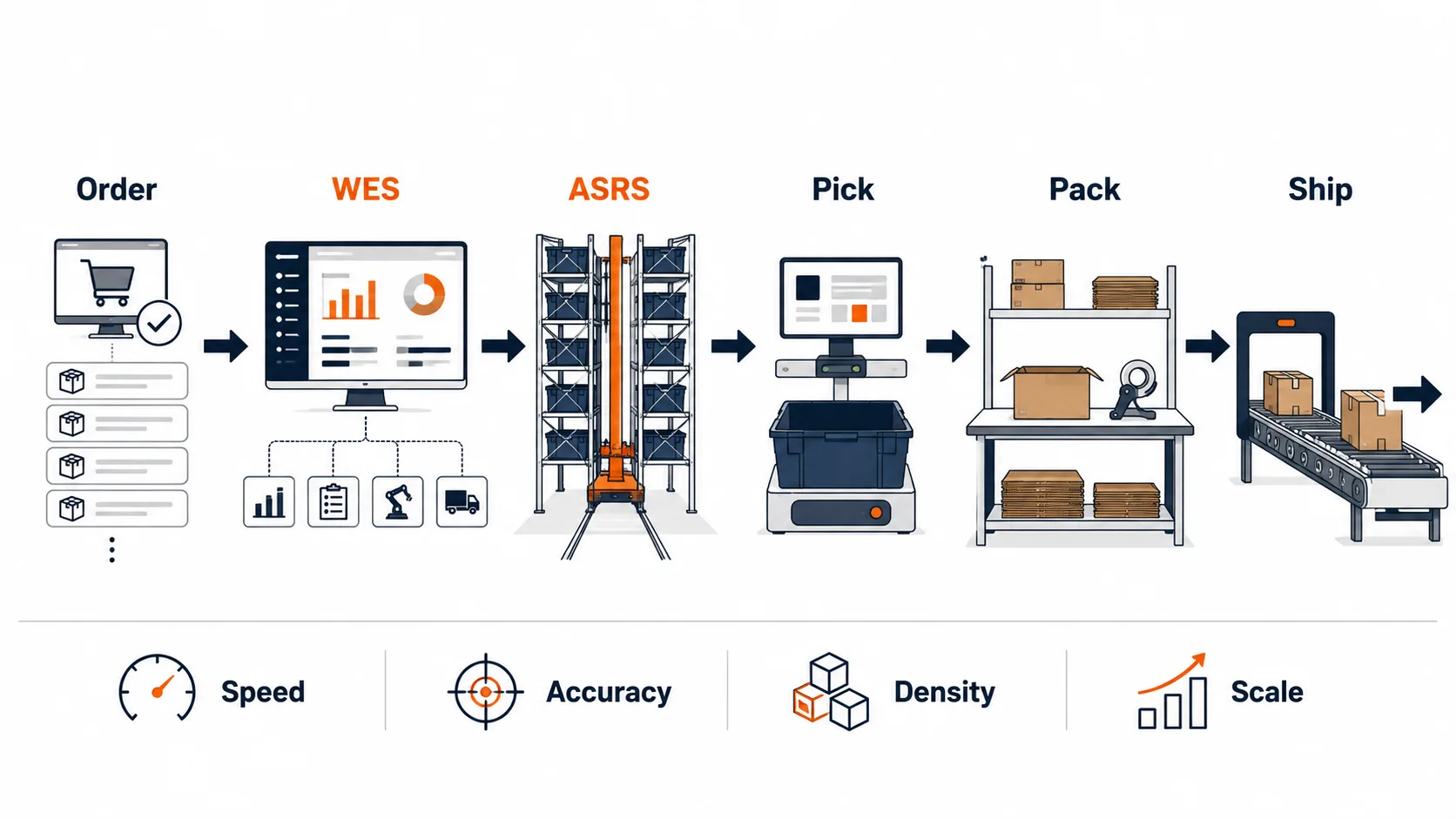
A well-designed e-commerce ASRS workflow usually looks like this:
- Customer orders enter the WMS or OMS.
- The WES groups orders by cutoff, carrier, SKU location, and station capacity.
- ASRS retrieves totes or cartons from dense storage.
- Inventory arrives at goods-to-person picking stations.
- Operators pick into order totes or shipping cartons with scan/light confirmation.
- Completed orders move to packing, labeling, sortation, and outbound staging.
- Returns are inspected and routed back into ASRS storage or exception zones.
This sounds simple, but the sequencing logic is where performance is won. If every station receives the wrong mix of orders, operators wait. If the ASRS retrieves inventory faster than packing can absorb it, buffers overflow. If returns are not prioritized correctly, sellable inventory sits idle while new stock is purchased.
That is why e-commerce ASRS should be designed as a full fulfillment flow, not just a storage project.
ASRS vs AMR for E-Commerce: Which One Fits?
For e-commerce fulfillment, the honest answer is often both. ASRS and AMR solve different problems.
ASRS is stronger when you need density, controlled throughput, vertical storage, and predictable movement. AMR is stronger when you need layout flexibility, quick deployment, and the ability to adjust to changing SKU profiles.
| Decision factor | ASRS usually wins | AMR usually wins |
|---|---|---|
| Storage density | High-density tote or pallet storage | Low-rise flexible shelving |
| Ceiling utilization | Buildings with usable height | Low-ceiling buildings |
| SKU volatility | Stable fast movers | Long-tail or frequently changing SKUs |
| Peak flexibility | Modeled peak capacity | Temporary fleet expansion |
| Deployment speed | Longer but more structured | Faster phased rollout |
| Long-term cost | Better for stable high volume | Better for uncertain early-stage growth |
In many e-commerce sites, the best design is tiered:
- ASRS stores fast-moving and medium-moving SKUs.
- AMRs handle long-tail SKUs, returns, and exception movement.
- Conveyors connect picking, packing, and outbound sortation.
- WES decides which zone fulfills each order line.
That hybrid pattern is becoming the default for mid-to-large fulfillment centers because pure ASRS can be too rigid and pure AMR can be too space-hungry at scale.
When E-Commerce Brands Should Consider ASRS
ASRS is worth serious evaluation when several of these conditions are true:
- Your order volume is growing faster than your ability to hire pickers.
- Your warehouse is running out of storage space.
- You have thousands of active SKUs and frequent order waves.
- Picking errors create expensive returns or customer complaints.
- Peak season requires overtime, temporary labor, or missed cutoffs.
- Your current layout cannot support faster carrier deadlines.
- You need better inventory accuracy across marketplaces and channels.
- You are planning a new fulfillment center or major retrofit.
If only one condition is true, a smaller project may be enough. Slotting cleanup, WMS improvement, pick-to-light, conveyor upgrades, or an AMR pilot can be better first steps. But when space, labor, accuracy, and growth pressure appear together, ASRS becomes a serious option.
What to Measure Before Designing an E-Commerce ASRS
The right ASRS design depends on real operating data. Before asking vendors for proposals, collect these inputs:
| Data input | Why it matters |
|---|---|
| Daily order lines | Sizes picking station count and retrieval throughput |
| Lines per order | Determines batching, tote flow, and packing logic |
| Active SKU count | Sizes storage capacity and slotting model |
| SKU dimensions and weights | Determines tote, bin, carton, or pallet handling |
| SKU velocity curve | Splits fast movers, medium movers, and long tail |
| Peak-hour profile | Sizes ASRS lifts, shuttles, robots, and station buffers |
| Return rate | Determines inspection and restocking capacity |
| Carrier cutoff times | Drives wave release and sortation sequencing |
| Building height and columns | Determines feasible ASRS type |
| Current labor cost and error rate | Builds the ROI baseline |
Do not skip the SKU velocity curve. It is the most useful single chart in an e-commerce automation study. A steep curve points toward dense ASRS for fast movers. A flatter curve may need robotic G2P or AMR support.
Common E-Commerce ASRS Mistakes
The technology is mature, but the project can still underperform. We see the same mistakes repeatedly.
Mistake 1: Designing for average volume instead of peak hour. E-commerce does not fail on average days. It fails during order waves, promotions, and carrier cutoffs.
Mistake 2: Treating returns as an afterthought. Returns need inspection, grading, restocking, and exception logic. If they are not designed into the system, they create manual islands.
Mistake 3: Buying storage without orchestration. Dense storage is useful only if the WES can sequence tasks across picking, packing, replenishment, and shipping.
Mistake 4: Ignoring packing and sortation. Faster picking creates no value if packing becomes the bottleneck.
Mistake 5: Assuming one technology fits every SKU. E-commerce SKU profiles are rarely uniform. Fast movers, long-tail items, bulky goods, returns, and reserve stock may need different handling methods.
ROI: How ASRS Pays Back in E-Commerce
The ROI case for e-commerce ASRS usually comes from five sources:
- More order lines per labor hour.
- Lower picking and shipping error cost.
- Higher storage density in the same building.
- Lower peak-season overtime and temporary labor.
- Better inventory accuracy and fewer stockout/cancelled-order events.
The payback period depends on volume, labor cost, facility cost, system scope, and how much of the operation is automated. In general, higher order volume and higher space pressure make the case stronger.
Use a real baseline. Measure current cost per order, lines per labor hour, error rate, overtime, return cost, space cost, and forecasted growth. Our warehouse automation ROI guide explains the calculation framework.
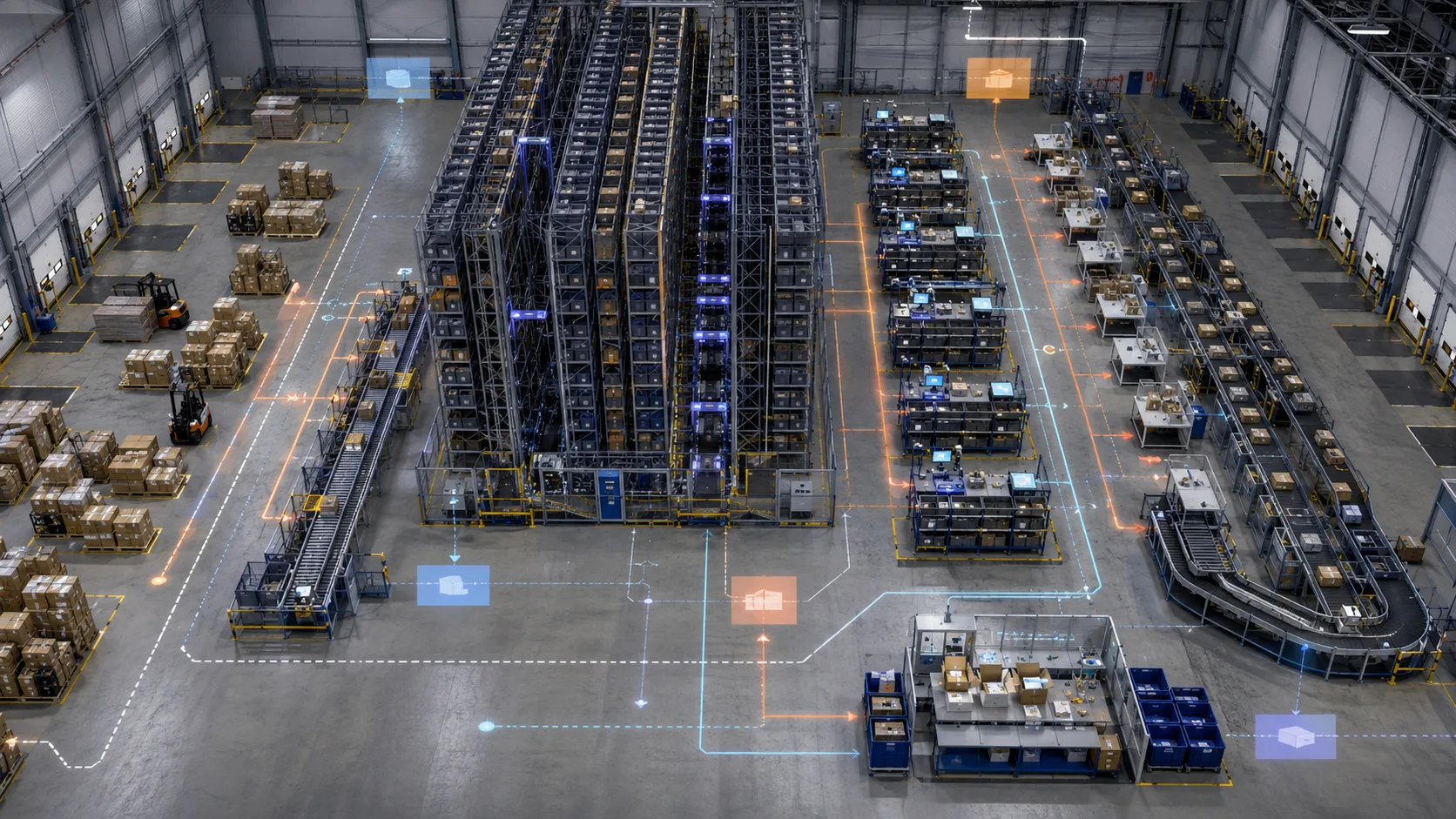
Example Architecture: Mid-Scale E-Commerce Fulfillment Center
For a mid-scale e-commerce operation, we would often start with a layout like this:
- Shuttle or bin robot ASRS for fast and medium movers.
- Goods-to-person stations for high-volume each picking.
- AMR or manual-assisted zone for long-tail SKUs and exceptions.
- Dedicated returns inspection area connected back to storage.
- Conveyor connection from picking to packing and outbound sortation.
- WES orchestration layer between WMS, ASRS, AMR fleet, and packing systems.
This is not the only valid architecture, but it avoids the two common extremes: overbuilding a rigid system for every SKU or relying entirely on flexible robots that consume too much floor space at scale.
If you are comparing system categories, the guides on mini-load ASRS, pallet ASRS, and shuttle ASRS vs crane ASRS will help narrow the options.
Frequently Asked Questions
What is ASRS for e-commerce fulfillment?
ASRS for e-commerce fulfillment is an automated storage and retrieval setup that stores SKUs in dense automated systems and delivers them to picking or packing workflows. It usually combines tote storage, goods-to-person picking, conveyors, warehouse execution software, and sometimes AMR fleets.
Is ASRS better than AMR for e-commerce?
ASRS is better for dense, predictable, high-volume storage and retrieval. AMR is better for flexible layouts, changing SKU profiles, and phased deployment. Many e-commerce fulfillment centers use both: ASRS for fast movers and dense storage, AMR for long-tail inventory, returns, and exceptions.
How does ASRS improve e-commerce picking speed?
ASRS improves picking speed by removing walking and search time. The system retrieves totes or cartons automatically and delivers them to a goods-to-person station where the operator picks with scan, light, or screen confirmation.
Can ASRS handle peak season?
Yes, if peak volume is included in the design. ASRS can support peak season by pre-positioning inventory, feeding picking stations consistently, and coordinating work through WES software. If the system is sized only for average volume, peak performance will still suffer.
What data is needed before designing ASRS for an e-commerce warehouse?
The most important data includes daily order lines, peak-hour order profile, SKU count, SKU dimensions, lines per order, SKU velocity curve, return rate, carrier cutoff times, building constraints, labor cost, and current error rate.
Is ASRS worth it for small e-commerce warehouses?
Sometimes. A small e-commerce warehouse with high SKU complexity, expensive labor, limited space, or strict shipping cutoffs may benefit from compact ASRS or goods-to-person automation. A low-volume site with cheap space may be better served by layout improvement, WMS cleanup, or a smaller AMR pilot first.
Bottom Line
ASRS for e-commerce fulfillment is most valuable when the warehouse needs speed, accuracy, density, and scale at the same time. It helps by reducing walking, compressing storage, improving inventory control, and giving software a more reliable way to sequence order flow.
The best e-commerce automation projects rarely depend on one technology. They use ASRS where density and predictable throughput matter, AMR where flexibility matters, and WES to coordinate the total flow from order release to shipping.
If your fulfillment center is running out of space, missing cutoffs, adding labor faster than revenue, or struggling with picking accuracy, the next step is not to buy a robot. It is to model your order profile and decide which zones should be automated first. Send GoASRS your warehouse profile and we will help map the right ASRS architecture for your e-commerce operation.
Planning a Warehouse Automation Project?
Our team has delivered 50+ ASRS systems across retail, manufacturing, and logistics. Tell us about your project and we will get back to you within 24 hours.
Thank you!
We received your message and will get back to you within 24 hours.