
Konica Minolta — Smart Factory Logistics
About Konica Minolta
Founded in 1936, Konica Minolta operates in 49 countries with over 44,000 employees worldwide. Known for embracing cutting-edge technology, their Dongguan manufacturing facility required a modern approach to line-side material management and production line delivery.
Challenges
- Extensive variety of materials with low picking efficiency
- High material management costs and frequent delivery cycles
- Manual delivery lacked timeliness and imposed heavy physical demands on workers
- Rapid product iterations caused frequent production line layout changes
- Strict requirements for logistics automation equipment stability — precision demands shared by semiconductor manufacturers like SICC
Solution
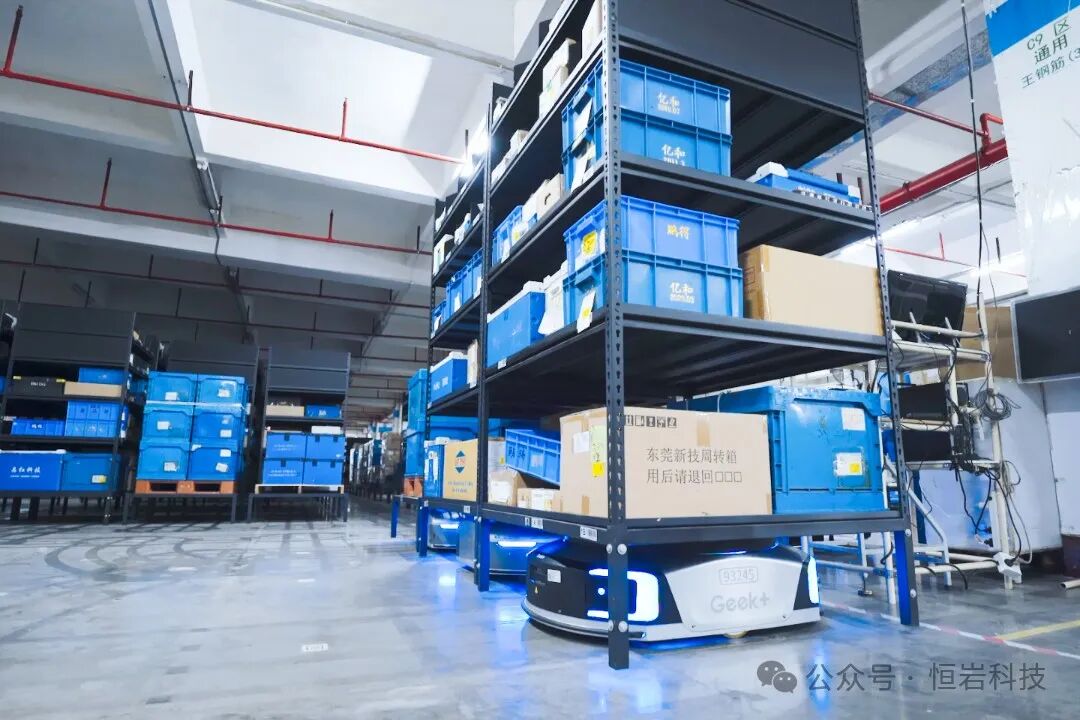
- Line-side Warehouse: Latent jacking AGV “goods-to-person” system for precise material management at the production line edge
- Production Line Delivery: Laser SLAM-navigated robots automatically receive materials from the line-side warehouse and deliver to production stations
- Flexible Deployment: No need for repeated on-site modifications when production layouts change
- GMS Transport Management System: Automatically receives delivery instructions and coordinates robot dispatch
- Simple Interaction: Line-side operators use wireless communication modules for easy human-robot interaction
Results
- Over 5,000 bins per day of material picking and delivery
- Inventory check frequency reduced by 92%
- Storage area reduced by over 32% (more than 634 m²)
- Delivery efficiency improved by 31%
- 14 operators saved through automation
A similar transformation in the 3C electronics sector was achieved at Sony’s Wuxi facility with 49 robots, demonstrating the scalability of this approach across manufacturing environments.
The distance between a warehouse and a production line is short. The technical requirements for crossing it are not.
The Problem With Traditional Line-Side Delivery
In precision electronics manufacturing, production lines consume components at a pace that manual delivery cannot sustain without overstocking. Konica Minolta’s assembly lines pull hundreds of distinct part numbers per shift — connectors, PCBs, optical assemblies, housings — each with different consumption rates and handling requirements.
The traditional approach is buffer stock: pile enough inventory next to each workstation to cover a full shift. That works until you calculate the floor space consumed, the risk of part confusion when 40 similar-looking components sit in open bins, and the write-offs from humidity-sensitive parts sitting exposed for hours.
When we deployed the line-side automation system at Konica Minolta, the goal was not just speed. It was precision delivery — the right part, in the right quantity, at the right workstation, within minutes of the production schedule calling for it. The WES manages this by ingesting the MES production schedule and converting it into a sequenced retrieval plan that stays synchronized with actual line consumption rates.
Handling Requirements for Precision Electronics
Consumer electronics components are unforgiving. Electrostatic discharge damages ICs invisibly — a chip that passes visual inspection fails in the field three months later. Optical components pick up micro-scratches from vibration during transport. Flex cables crease if totes are stacked wrong.
These constraints shaped every design decision. The tote-based retrieval system uses anti-static containers with compartment dividers sized to each component family. Robots maintain controlled acceleration profiles — no sudden stops that shift contents. The conveyor segments between storage and line-side delivery points run at speeds calibrated to prevent vibration damage.
In our experience, the handling specification document for a precision electronics project runs three times longer than a comparable retail fulfillment deployment. Every component category gets its own transport profile, and the WES enforces those profiles at the task level.
Bridging the Gap Between Warehouse and Production
Most ASRS systems are designed for order fulfillment — pick items, pack them, ship them out. Line-side logistics inverts that model. The destination is not a shipping dock but a workstation with a human operator who needs parts delivered in production sequence, not warehouse storage sequence.
That distinction changes the optimization target. A fulfillment warehouse optimizes for orders per hour. A line-side system optimizes for zero-starvation — no workstation should ever wait for parts. The penalty for a late delivery is not a delayed shipment but an idle production line burning thousands of dollars per minute.
Konica Minolta’s system runs a predictive replenishment algorithm. Rather than waiting for a workstation to request parts, the WES tracks consumption velocity and dispatches retrieval tasks before stock reaches the reorder point. The buffer at each workstation dropped from shift-level quantities to under 30 minutes of supply, freeing significant floor space back to production use.
For manufacturers evaluating whether their operation fits this model, the solutions overview covers how we scope line-side projects differently from distribution center automation. The mini-load ASRS guide details the storage system types that pair well with high-frequency, small-quantity retrieval patterns.
Frequently Asked Questions
How does line-side automation handle engineering change orders that alter the bill of materials?
BOM changes propagate from the MES to the WES in real time. When a component substitution takes effect, the WES updates retrieval mappings so the new part routes to the correct workstation automatically. Old stock is flagged for return to storage or quarantine. We built this as a core feature after seeing manual BOM transitions cause line stoppages at other facilities.
What throughput can a line-side system sustain compared to manual kitting?
At Konica Minolta, the automated system delivers components to workstations at roughly 2.5 times the rate of the previous manual kitting operation, with near-zero picking errors. The speed gain matters less than the consistency — manual kitting slows down during shift changes and breaks, while the automated system maintains constant throughput around the clock. The goods-to-person picking approach used here scales linearly with additional retrieval robots.
Is line-side automation only practical for large-scale manufacturers?
Scale helps with ROI timelines, but the trigger is complexity, not size. A manufacturer running 200+ active SKUs on a multi-line operation with shift-based production will see returns faster than a high-volume facility with only 30 part numbers. Contact our team with your line count, SKU depth, and shift structure for a scoping assessment.