

The buyer should test whether stock location, stock status and the outbound queue can diverge during normal and peak work. Inventory may contain many lots, expiry dates, pack sizes, quarantine locations and temperature zones. The buyer should also test whether replenishment, quality release and peak dispatch compete for the same aisle, lift, workstation or interface.
In this article, a pharmaceutical warehouse ASRS system means an automated storage and retrieval arrangement with its material flow, inventory rules, interfaces, records and acceptance evidence. This is a procurement definition, not a regulatory definition. WHO good storage and distribution practices says automated storage and retrieval operations should follow applicable GSP, GDP and GXP guidance, and its storage and distribution recommendations may need adaptation to national or regional conditions.
The buyer’s first task is to separate the business contradiction from the equipment label. A crane, shuttle, tote robot or rack block is one part of a controlled flow. It is not, by itself, proof that product identity, batch, expiry, status, environmental records, exception handling or validation evidence will work at the site.
Short answer
Choose a pharmaceutical warehouse ASRS system by starting with product status, lot and expiry control, temperature and segregation needs, then test the complete flow from receiving to dispatch. Compliance is an evidence question. Accuracy is a set of error classes. Throughput is a measured result under stated order, load, staffing and exception conditions.
At acceptance, the buyer should ask whether the project evidence covers the physical design, software ownership, permissions, records, exception handling and validation evidence. Each selected requirement needs an owner, a test and an approved result.
At a glance: five decisions for the buyer
| Decision area | Question to answer | Evidence to request |
|---|---|---|
| Product and load | What exactly is stored, moved and picked? | Load catalogue, packaging rules and sample loads |
| Quality status | How are quarantine, released, rejected, returned and recalled goods separated? | Status model, location rules and exception procedures |
| Software boundary | Which application owns each order, stock, status and device event? | Interface map, message rules and recovery tests |
| Accuracy | Which errors matter most, and how will each be detected? | Test scripts, trace records and reconciliation results |
| Throughput | What peak pattern must the operation absorb? | A model tied to order mix, duration, resources and constraints |
This table is a buying framework, not a claim that every pharmaceutical warehouse needs the same design. A facility handling pallets for replenishment has a different problem from a distribution centre handling cases, totes or high-value units. The buyer should verify which facility and operating questions remain after the rack layout is defined.
Start with the operating contradiction
The phrase “more automation” is too broad for a pharmaceutical project. The useful starting point is the contradiction the operation must resolve. A facility may need a broad inventory range close to dispatch, yet it may need each lot, expiry date and quality status to remain traceable. It may need rapid peak release, yet every exception may require a deliberate hold and review. It may want fewer manual touches, yet the most sensitive step may still need a trained person with authority to intervene.
That contradiction changes the design conversation. Storage density should be tested separately from usable capacity. Exclude locations that cannot accept the required load, temperature condition or status rule when modelling capacity for a product. Check whether the quality release queue, packing station, scanner, lift or interface limits outbound flow. Include receiving exceptions and manual moves in reconciliation tests rather than treating a clean inventory screen as sufficient evidence of physical accuracy.
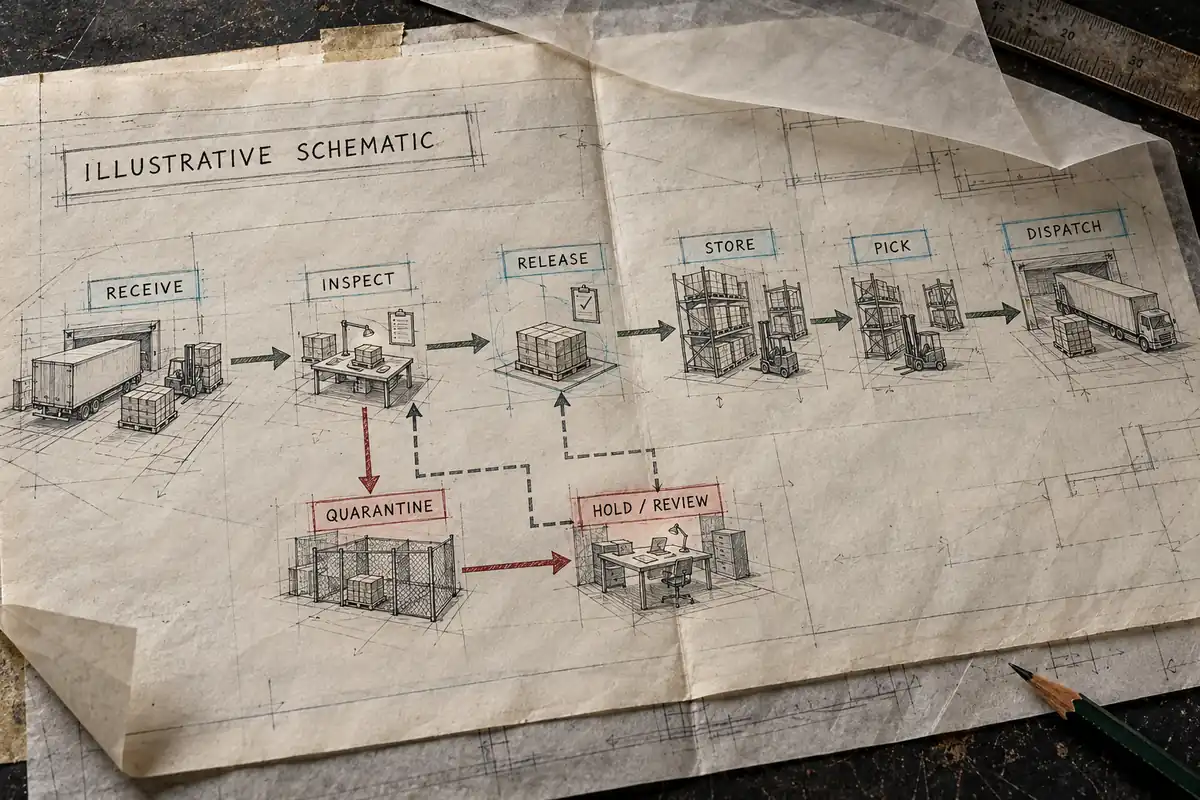
The first workshop should map the product journey rather than begin with a preferred machine. Mark receiving, identification, inspection, quarantine, release, storage, replenishment, picking, checking, dispatch, returns and recall handling. For each step, record the load unit, business status, source of truth, person or system with authority, and evidence created. This map gives the pharmaceutical warehouse automation project a testable boundary.
Pharmaceutical warehouse ASRS system compliance: what a purchase can prove
This article offers a non-regulatory RFQ structure. The buyer should confirm the product, market and process scope with the people who own the approved quality documents and project framework before treating any question here as a project requirement.
“GMP warehouse storage system” is used here as a search and procurement phrase, not as a universal regulatory category. Nothing in this section decides which regulation, quality system or validation approach applies.
Separate the compliance layers
Start with questions for the quality team about the facility and product scope: building constraints, access, monitoring, cleaning, and any controlled area relevant to the operation. The responsible quality organisation should decide which questions apply after confirming the project scope.
The equipment scope should cover sensors, movement, load identification, location confirmation, faults and manual recovery. Test the completed move and recorded response when the expected sequence breaks.
For the RFQ, group software questions under data and status, task and permission, records and interfaces, and recovery. The quality organisation should decide which controls apply after it confirms the product, market and process scope. Each selected control needs an observable test result. “Real-time integration” says too little for acceptance.
Ask the responsible quality organisation whether the configured process requires validation records, change review, named approvers or tests after future changes. Compare any supplier test pack with the buyer’s approved product rules, data flows and release process. A standard supplier pack cannot be assumed to cover a configured pharmaceutical warehouse ASRS system.
Turn each requirement into an observable result
Turn each selected requirement into a trigger, permitted action, record and expected response. The exact response belongs to the approved process and should appear in the test script.
Questions for a compliance workshop include:
- Which product attributes must travel with the load from receipt through dispatch?
- Which status changes require a quality decision, and which system records that decision?
- Which users may create, approve, cancel or override a task?
- What records are retained for normal moves, manual moves, faults and corrections?
- Which changes require review, testing, approval and controlled release?
Use these questions as an RFQ conversation starter. They are not a regulation, certification claim or complete requirements list.
Make accuracy measurable instead of rhetorical
“High accuracy” hides the event that failed. A useful acceptance model asks separate questions about the physical load, its recorded location, product identity, lot, expiry, quality status and order line.
A system proposal should be tested against record and reconciliation questions, not awarded on a single accuracy percentage.
Use separate error classes
For the RFQ, ask about receiving against the expected receipt, location against the physical load and record, and attributes such as product, lot, expiry and status. Separate cases can cover allocation, picking, dispatch and the point at which a transaction is complete. The project parties should write a pass condition for each selected case in the acceptance script. This article supplies no project threshold because no applicable project test report is available.
Keep recovery visible rather than folding it into a normal-run score. The project parties can decide how to treat a damaged label, duplicate message, failed scanner, cancelled task, manual move, device fault or broken connection. The acceptance script should name the authorised recovery and the record that proves reconciliation.
Test the decisions that carry the most risk
Build the test set around difficult decisions, not only common transactions. Candidate cases, if applicable to the site, include several lots, near-expiry stock, partial quantities, quarantine, release, rejection, returns, recalls and manual intervention. The buyer should decide which cases reflect the site and which are included because their consequences would be serious.
For every case, record the starting data, requested action, physical check, system response, exception response and final reconciliation. A summary percentage may be useful after the breakdown is visible, but it should not replace it. No accuracy percentage, zero-error claim or “GMP accuracy” result is stated here because no first-hand project test evidence was available.
Batch, expiry, status and recall control
The inventory model must carry more than a product number. WHO says records for receipt, storage, issue and distribution should include product identity, quantity, batch number and expiry date. It says containers should show product name, batch number, expiry or retest date and specified storage conditions.
That requirement changes the acceptance path. A putaway test should confirm the load identity, location, status and recorded attributes. A picking test should confirm that the allocation rule uses the approved product and status logic. A dispatch test should confirm the final identity and record. The buyer may ask the system to show why a candidate load was not selected.
WHO defines FEFO as using or distributing stock with the earliest expiry before identical stock with a later expiry. Treat FEFO as a rule to be confirmed against the approved process, not as a reason to assume every product follows one identical allocation pattern.
A buyer should test returned and recalled-goods paths from physical receipt to system status and back to an authorised release or disposition decision.
Recall testing should answer a practical question: can the team identify the relevant product, batch and containers, locate their current status, prevent ordinary allocation and produce the records needed for action?
Define pharmaceutical warehouse ASRS system throughput as a condition
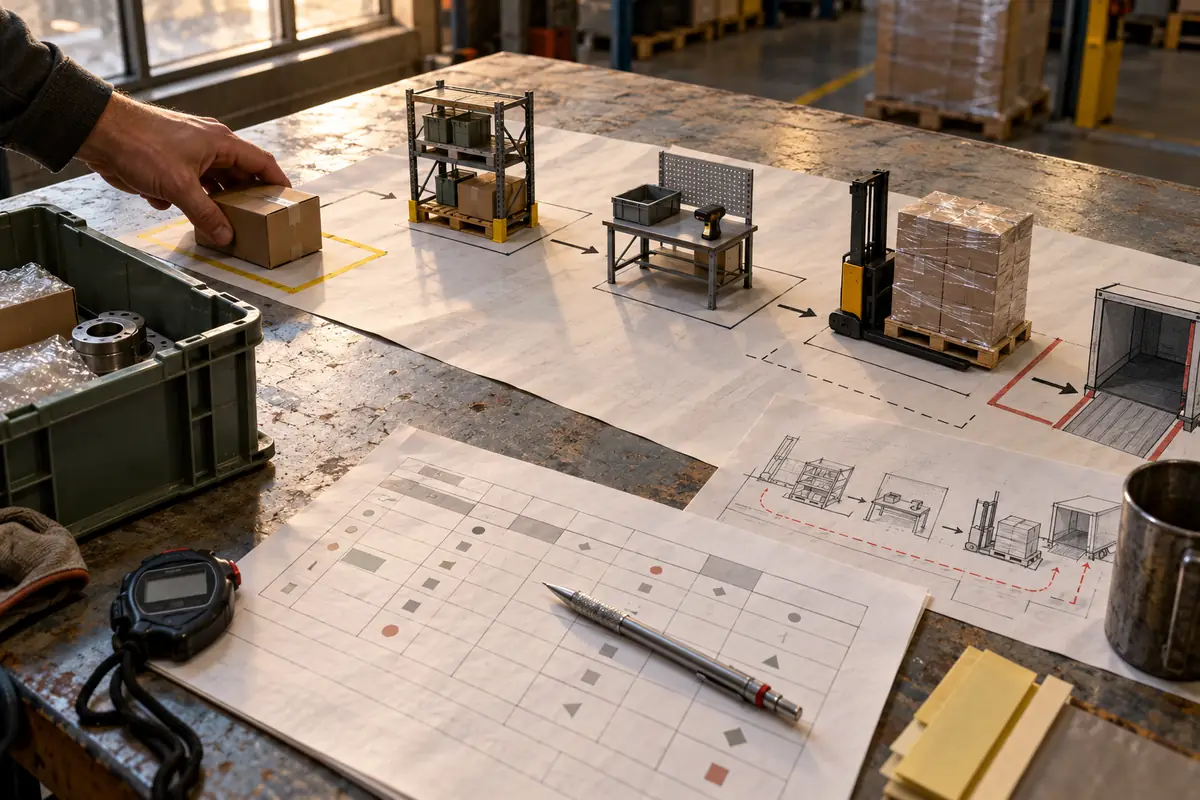
An hourly figure is useful only when the buyer can reproduce the question behind it. Mark whether the measured path includes receiving, putaway, replenishment, picking, returns or dispatch. For each path, identify the load unit, confirmation event, queue and limiting resource used in the test.
Ask the project team to state the order profile, load dimensions, storage depth, workstations, temperature zones, operating window, peak duration and exception rate. The result should say whether it counts moves, loads, order lines or completed orders, and whether release, scanning, packing and handover are included. These are proposed inputs for a comparable test, not a universal parameter set.
The model should show where time is spent. The buyer should test whether a lift, workstation, interface, quality hold or manual recovery step limits the path when the storage machine has spare time. Put those conditions beside the headline result and state the boundary in the same line. This article does not set a cycles-per-hour benchmark.
Ask for a scenario-based performance test
Agree the test scenario before accepting a performance claim. Define representative loads, the mix of transaction types, the peak period, the active workstations, the integration messages, the treatment of faults and the definition of a completed transaction. Record exclusions and agree each measurement boundary before testing.
Run a normal scenario and a stressed scenario. The stressed scenario can represent the condition the site actually fears, such as a concentrated dispatch wave, a large replenishment requirement or a recovery period after an interruption. The point is not to invent a universal benchmark. The point is to make the proposed pharmaceutical warehouse automation solution answer the buyer’s own operating question.
If a supplier presents a throughput number without the load, order mix, peak duration, resource count and measurement boundary, record it as an unqualified claim. Do not turn it into a design input until the missing conditions are supplied and accepted. No GoASRS throughput figure is stated here because no current company fact or project test report was available.
Give each software layer a clear responsibility
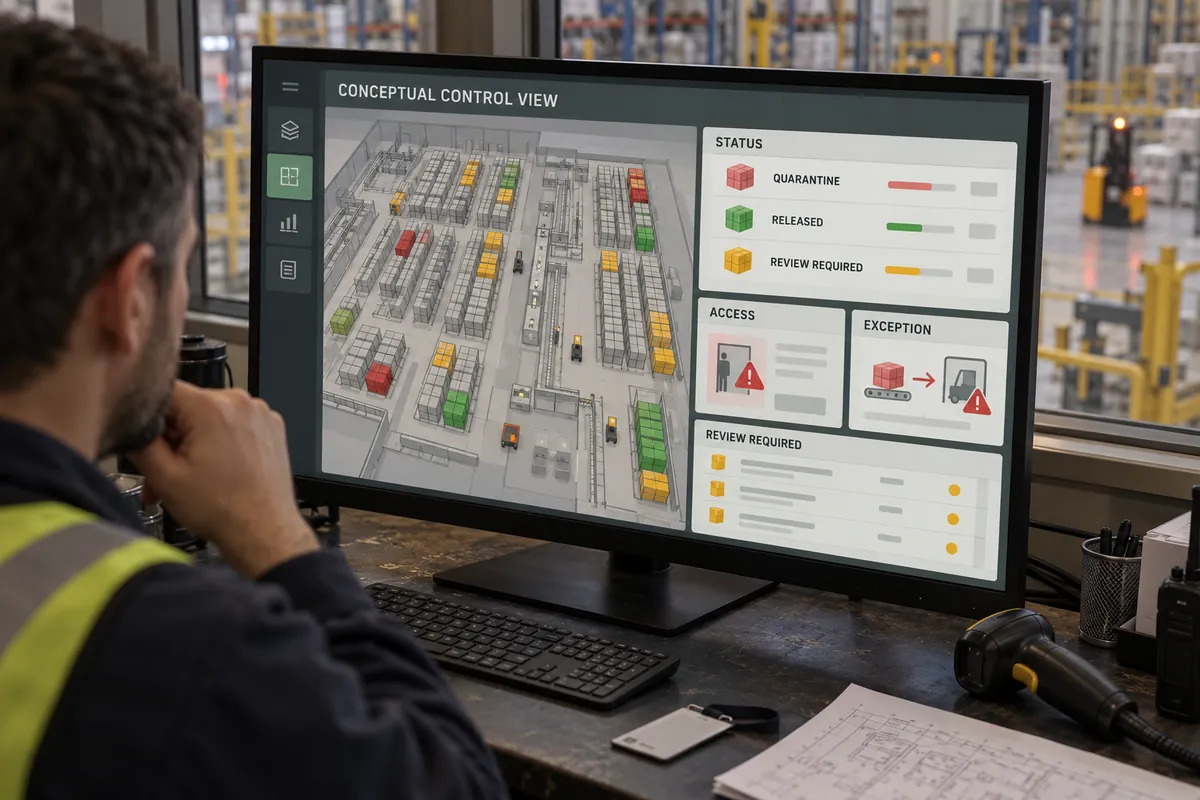
Within the procurement boundary, define the pharmaceutical warehouse ASRS system together with the relevant business applications, execution logic, equipment control and facility signals. The names WMS, WES, WCS, ERP and environmental monitoring can describe different products in different projects, so the buyer should define responsibility by event rather than by software label.
One possible allocation puts orders and commercial status in a business layer, stock identity and quality status in an inventory layer, sequencing in an execution layer, and equipment commands in a control layer. Environmental signals may be another input. This is an architecture example for discussion; the approved project design should assign the actual ownership.
The key design question is: for every important fact, which system is authoritative, which system acts on it, which system records the event and which person can approve an exception? A diagram that only shows arrows between applications does not answer that question.
Test the difficult messages
Interface acceptance should cover normal and abnormal communication. A message may arrive twice, arrive late, fail halfway through processing or be rejected because master data is incomplete. A user may cancel an order after a task has been released. A device may confirm a move after the business system has timed out. A network interruption may occur between physical movement and status update. Each case needs an agreed result.
The interface test should cover physical duplication and duplicate records, not only a successful message. Show how a task is labelled when open, confirmed, cancelled, held or awaiting reconciliation. Name the role allowed to release a blocked task and the record created by that decision. During recovery, record how the team checks the load location and quality status.
In a purchase, the buyer should agree document ownership, review rights, configuration records, change handling and support boundaries before handover.
Readers who need a broader software comparison can use the site’s WES, WMS and WCS software layers guide. The related warehouse system integration overview can support an early discussion about interfaces and ownership. Those pages are reading paths, not evidence for a pharmaceutical validation claim.
Link pharmaceutical warehouse ASRS system temperature control to the flow
Temperature control should not be presented as an automatic property of a storage machine.
A pharmaceutical warehouse ASRS system project should separate facility HVAC, sensors, alarms, data records and automated storage task handling.
Ask the quality team which product and facility conditions apply. For each confirmed condition, ask how it changes locations, sensors, doors, task release, user access or recovery. Ask how a temperature alarm affects open tasks, held loads, dispatch decisions and deviation records. The answer belongs to the approved process and site design, not to a generic equipment description.
The article does not convert environmental guidance into an unverified sensor count, range, alarm delay or cold-chain capability claim.
Ask whether segregation must be physical, logical or a combination. The approved process should decide whether a software status is enough. A useful test begins with a status change and follows allocation, movement, picking, checking and dispatch to see whether the change reaches every step.
Qualification, validation and data integrity
Because the retrieved European Commission document is a revision or consultation document, it must not be described as a currently effective, universal regulation.
For a procurement plan, the evidence chain may include an approved requirements set, risk assessment, configuration baseline, interface specification, test scripts, executed results, deviations, corrective actions, training records, release decision and change records. That is a proposed menu, not a complete validation package. The buyer’s approved quality documents and confirmed project framework decide which records and approvals apply.
Include audit trail and access questions
Use audit-trail and access-control topics as questions for the confirmed project scope: which roles can change a status, override a task, correct a record, approve a release or alter a rule?
Backup and recovery deserve their own tests. The buyer should define the required backup, restoration and recovery checks in the confirmed project framework.
Choose technology for a pharmaceutical warehouse ASRS system after the load study
The right equipment depends on what must be stored and how it must move. In the load-study workshop, ask what handling questions apply to pallets, cases, totes and individual units. The study should check whether load dimensions, weight distribution, packaging stability, label position, presentation orientation and allowable contact affect the proposed handling method. The buyer should verify whether product status and environmental conditions change the practical options.
Treat a pallet-focused design for a replenishment or reserve flow as a hypothesis to confirm in the load and process study. Treat a bin or tote-focused design for a smaller-unit picking process as another option to evaluate against site evidence. A shuttle or crane arrangement should be evaluated against the storage block’s specific depth and movement pattern. These are categories for investigation, not recommendations for every pharmaceutical warehouse.
The site’s pallet ASRS guide and mini-load ASRS guide provide general reading for comparing load forms. The types of ASRS systems comparison can support an early options workshop. The selection decision still requires site-specific load samples, process rules, environmental conditions and an agreed validation boundary.
A practical selection and acceptance sequence
The sequence below is a planning aid for comparing proposals. It is not a pass certificate for a supplier or equipment type.
1. Freeze the operating vocabulary
Agree what counts as a load, move, order line, completed pick, exception, release and dispatch. Define terms used by operations, quality, IT and the supplier. If one team calls a load complete at the storage location and another calls it complete only after confirmation, the throughput model will disagree before testing begins.
2. Build a representative data set
Use real operating categories where the project permits. Include product families, packaging forms, lot and expiry patterns, quality statuses, load dimensions, weight ranges, order profiles, returns and recall scenarios. Remove confidential identifiers and preserve behaviour that affects design. Make sure the data set includes difficult cases rather than omitting them from a larger list.
3. Write the exception paths
List label damage, unreadable identification, duplicate messages, failed scans, cancelled tasks, blocked locations, temperature alarms, power loss, network loss, manual moves and recovery after an interrupted transaction. For each path, state who can act, what the system records, how the physical load is checked and what allows the normal flow to resume.
4. Align the performance model
Put load unit, order mix, peak duration, active resources, interface boundary, manual steps, exception assumptions and completion definition beside every performance result. Ask bidders to use the same scenario or to state exactly where their scenario differs. No universal throughput figure can replace this comparison because no suitable project conditions or GoASRS test report are available.
5. Agree the evidence package
Ask for the documents needed to connect approved requirements, design choices, configuration, testing, deviations, training, release and later changes. The buyer’s quality organisation should decide which documents are required and who approves them. The evidence package should identify the configured version tested, not only the equipment family named in a brochure.
When comparing bidders, ask each one to show how it will connect the business process, selected equipment, software ownership, exception handling and lifecycle responsibilities. Request process, software and lifecycle evidence in addition to a hardware catalogue. The site’s storage automation selection framework can be used beside the pharmaceutical-specific questions in this article.
What to put in the request for quotation
An RFQ should make the operating question specific enough that bidders price and test the same proposed boundary. Include building constraints, the load catalogue, operating hours, inbound and outbound profiles, status controls, interfaces, workstations, training, maintenance and evidence expectations. Keep confirmed requirements separate from questions awaiting the quality organisation.
Do not send a generic “GMP warehouse storage system” request without the process behind it. The buyer should check whether bidders use the same product mixes, quality assumptions and throughput definitions when presenting offers in a similar format. Make those assumptions visible before comparing totals.
Require each bidder to state assumptions and exclusions in plain language. Ask for separate descriptions of hardware, software, integration, facility work, validation support, spares, training and ongoing service. Ask what information is still needed before the design can be confirmed. For comparison, keep each unresolved condition visible beside any number that depends on it.
Cost should be treated as a boundary question. The site’s ASRS system cost breakdown and ASRS total cost of ownership guide can help organise categories. This article does not provide a price, payback period or cost percentage because no comparable pharmaceutical project quotation with stated conditions was available.
Common procurement mistakes
Treating certification language as a complete solution
Check what a certificate, claim or compliance label covers before applying it to the configured process. Ask which organisation issued it, what version or scope applies, and how it relates to the proposed site. Keep the distinction between a supplier’s qualification and the buyer’s process validation.
Comparing hourly figures without their boundary
One proposal may count equipment cycles and another may count completed order lines. One may test a short burst and another may measure a sustained window. One may exclude scanning, checking or replenishment. Put every figure beside its load, order, resource, duration and completion definition before using it in a decision.
Assuming a clean screen proves clean stock
The buyer should check the physical load, location, identity, status and event trail alongside the inventory view. Include manual work and interrupted transactions. The buyer needs a recovery story that a shift team can follow, not only a dashboard.
Frequently asked questions
Is a pharmaceutical warehouse ASRS system automatically compliant?
No. Automation alone does not answer the compliance question. The buyer first needs the applicable product, market and quality scope from the responsible quality organisation. The configured physical and software process, records, user controls, change controls and accepted evidence can then be assessed against that confirmed scope. A supplier proposal may support the work, but it does not replace approved quality documents or validation decisions.
What should accuracy mean in a pharmaceutical warehouse?
For this article’s proposed RFQ method, accuracy can be separated into identification, location, product attribute, lot, expiry, status, allocation, picking, dispatch and exception recovery. The project acceptance plan should select relevant classes and define the data, trigger, expected response and record for each case. A single average rate should not hide a serious status or traceability error.
How should throughput be compared between proposals?
Compare results measured against the same operating question. Align the load unit, order mix, peak duration, active resources, interface boundary, manual steps, exception assumptions and definition of completion. If any are missing, treat the result as an open assumption rather than a comparable performance commitment.
Does a high-density storage design fit every pharmaceutical operation?
No. Density must be considered with access frequency, load form, status segregation, temperature conditions, replenishment, picking, checking and recovery. The buyer should test whether a design that stores more units creates an unacceptable queue at a workstation or makes a required status process difficult to control.
What should a buyer ask an integration partner?
Ask the partner to show the proposed process boundary, system ownership, equipment choices, interface behaviour, exception paths, test conditions, evidence package and lifecycle responsibilities. Ask for assumptions in writing. Ask which claims are based on a named project or test and which are design expectations still requiring confirmation by the buyer’s quality organisation.
A better definition of success
After the applicable scope is approved, the buyer can compare each pharmaceutical warehouse ASRS system against the product flow, status model, data ownership, recovery path and measured capacity. The decision should be explainable to the people who approve, operate and maintain the process.
Begin with the inventory and dispatch tension. Write down the load and status model. Assign ownership for each software event. Split accuracy failures into named cases. Measure flow under stated conditions. Test routine work as well as recovery. Keep the proposed boundary visible from RFQ to later changes, as the responsible quality organisation decides which framework applies.
For the first project meeting, bring the load catalogue, process map, order profile, status rules, interface list, environmental questions and acceptance questions. A buyer may ask for an integration-review deliverable that separates known facts, assumptions to test and evidence needed before acceptance. That is a proposed procurement output, not proof that a supplier or integrator completed a qualified review or that the project meets a quality framework.
Planning a Warehouse Automation Project?
Our team has delivered 50+ ASRS systems across retail, manufacturing, and logistics. Tell us about your project and we will get back to you within 24 hours.
Thank you!
We received your message and will get back to you within 24 hours.