

Warehouse automation systems are no longer reserved for the largest distribution centers. Labor pressure, SKU growth, faster delivery promises, and tighter warehouse space have pushed automation into mid-sized warehouses, manufacturing plants, cold storage facilities, and third-party logistics operations.
The hard part is not deciding whether automation sounds useful. The hard part is deciding which system belongs in your building. A conveyor upgrade, an ASRS, an AMR fleet, a warehouse execution system, and a robotic picking cell all solve different problems. Buying the wrong one can make the warehouse more complex without removing the real bottleneck.
Short answer: Warehouse automation systems include storage automation, transport automation, picking automation, sortation, packing automation, and warehouse software. The right system depends on load type, order profile, throughput target, building constraints, labor availability, integration scope, and ROI. Start with the operational constraint first, then choose the automation layer that removes that constraint at the lowest total cost.
This guide explains the major types of warehouse automation systems, how they fit together, what costs to expect, how to estimate ROI, and how to choose a system architecture that can scale.
What Are Warehouse Automation Systems?
Warehouse automation systems are technologies that reduce manual movement, manual decision-making, or manual data entry inside a warehouse. Some systems move inventory. Some store inventory. Some guide operators. Some control equipment. Some coordinate the entire operation.
In practice, most warehouse automation projects combine several layers:
- Storage automation: ASRS, shuttle systems, mini-load systems, pallet cranes, vertical lift modules, and bin robots.
- Transport automation: conveyors, AMRs, AGVs, transfer vehicles, sorters, and automated pallet movement.
- Picking automation: goods-to-person stations, pick-to-light, put walls, robotic picking, voice picking, and scan validation.
- Packing and sortation automation: cartonization, print-and-apply, automated sorters, dimensioning, weighing, and outbound routing.
- Warehouse software: WMS, WES, WCS, robot fleet managers, integration middleware, and analytics dashboards.
The category is broad, which is why many buyer conversations become confusing. A vendor may call its product a warehouse automation solution, but the solution may only cover one layer. A real project needs to define which physical flows and software decisions are being automated.
If you are new to automated storage, start with what ASRS means and the main types of ASRS systems. ASRS is one important family inside warehouse automation, but it is not the whole category.
Why Companies Invest in Warehouse Automation
Most projects start because a warehouse has hit a constraint that manual operations cannot solve cleanly.
Labor is becoming the limit. Many warehouses can still hire people, but not enough skilled operators for peak periods, night shifts, cold environments, or high-walking picking work. Automation reduces the amount of walking, searching, scanning, lifting, and forklift travel required per order.
Space is running out. When inventory grows faster than the building, warehouse teams often add overflow space, off-site storage, or wider manual staging areas. Dense storage automation can recover vertical cube and reduce travel distance.
Order profiles are changing. A warehouse built for pallet or case movement may now need each-picking, e-commerce fulfillment, marketplace orders, or more frequent mixed-SKU replenishment.
Accuracy matters more. A wrong pick, missing component, or inventory mismatch can create returns, production delays, customer service work, and expedited shipping cost.
Cycle times are shrinking. Same-day shipping, tighter production windows, and carrier cutoff pressure leave less time for manual searching and exception handling.
The best automation projects are not technology-led. They are constraint-led. The project starts with a measurable operational problem, then uses automation to remove that problem without creating a worse one downstream.
Main Types of Warehouse Automation Systems
There is no single best warehouse automation system. Each type is designed around a specific movement pattern, load type, and control requirement.
| Automation type | Best fit | Common limitation |
|---|---|---|
| ASRS | Dense storage, predictable retrieval, vertical cube | Higher upfront design and integration effort |
| AMR | Flexible transport, goods-to-person, phased growth | Lower storage density and charging/fleet management overhead |
| AGV | Repetitive pallet or cart movement on stable routes | Less flexible than AMRs in changing environments |
| Conveyors | High-volume fixed material flow | Layout rigidity and bottlenecks if poorly balanced |
| Sortation | Parcel, carton, tote, or order routing | Requires clean induction and downstream capacity |
| Pick-to-light / put walls | Fast manual-assisted picking and consolidation | Still depends on human station productivity |
| Robotic picking | Repetitive item handling with stable product range | Challenged by irregular SKUs and edge cases |
| WMS / WES / WCS | Inventory, task orchestration, equipment control | Requires clean process ownership and integration |
A mature warehouse rarely uses only one of these. A typical automated fulfillment center may use ASRS for dense storage, conveyors for transport, a WES for task orchestration, put walls for consolidation, and AMRs for exception movement or flexible zones.
The goal is not to automate everything. The goal is to automate the flow that limits the business.
ASRS: Automated Storage and Retrieval Systems
ASRS is the core automation layer when the main problem is storage density, retrieval speed, inventory accuracy, or forklift reduction. ASRS systems store inventory in structured racks, bins, totes, trays, or pallets and retrieve it automatically through cranes, shuttles, lifts, or robots.
Common ASRS types include:
- Pallet ASRS for full-pallet storage and reserve inventory.
- Mini-load ASRS for totes, trays, cartons, and small parts.
- Shuttle ASRS for high-throughput tote or carton movement.
- Bin robot systems for high-density goods-to-person picking.
- VLM and carousel systems for compact parts storage.
ASRS works best when the warehouse has enough volume, repeatability, or space pressure to justify fixed infrastructure. It is especially strong in high-bay pallet storage, spare parts warehouses, e-commerce fast movers, manufacturing buffers, cold storage, and high-accuracy environments.
For deeper selection guidance, see our ASRS buyer's decision framework and the pallet ASRS guide.
AMR and AGV Systems
Mobile robots automate movement across the floor. AGVs usually follow fixed or semi-fixed routes. AMRs navigate more dynamically using sensors, maps, and fleet management software.
AMRs are strong when the operation needs flexibility. They can support goods-to-person picking, replenishment, cart movement, returns, kitting, and point-to-point transport without installing rails or fixed conveyors. That makes them useful in existing buildings, seasonal operations, and warehouses where the layout may change.
AGVs are often better for repetitive industrial transport. If the task is moving pallets between receiving, production, storage, and shipping on predictable paths, AGVs or fork AGVs can be simpler and more controlled than a general AMR fleet.
The trade-off is density. Mobile robots need floor space, charging areas, traffic rules, and exception handling. They can scale by adding units, but that does not mean capacity grows linearly. Congestion and station design become important as fleet size increases.
If you are comparing fixed storage automation with mobile robots, read ASRS vs AMR.
Conveyor, Sortation, and Material Flow Systems
Conveyors and sorters are still the backbone of many warehouse automation systems. They are not new, but they remain effective when the flow is stable and volume is high.
Conveyors work well for:
- Moving cartons, totes, or pallets between fixed zones.
- Connecting ASRS retrieval points to picking or packing.
- Feeding sorters, print-and-apply stations, or outbound lanes.
- Reducing forklift or manual cart movement.
Sortation systems route items, cartons, totes, or parcels to the correct lane, station, dock door, or order consolidation point. They matter most when outbound volume is high and manual sorting becomes a cutoff risk.
The risk is rigidity. A conveyor can be excellent when the flow is known. It can be expensive to modify when the SKU mix, building layout, or order profile changes. That is why modern designs often combine conveyors for stable high-volume paths and AMRs for variable transport.
Picking and Packing Automation
Picking is usually the largest labor area in a warehouse. That makes it a common target for automation, but there are several levels of automation.
Goods-to-person picking brings inventory to the operator instead of sending the operator through aisles. This can be powered by ASRS, shuttle systems, bin robots, or AMRs. It usually improves productivity by reducing walking and search time. Our goods-to-person picking guide explains the workflow in more detail.
Pick-to-light and put-to-light guide operators with visual cues. They are useful when the operation still needs human handling but wants faster confirmation and fewer errors.
Put walls consolidate multi-line orders into cubbies or destinations. They are common in e-commerce and retail fulfillment where items arrive from different storage zones.
Robotic picking can reduce repetitive manual handling, but it needs a realistic SKU profile. Items with irregular shapes, reflective packaging, deformable bags, or frequent changes are harder to automate reliably.
Packing automation includes cartonization logic, automated weighing and dimensioning, print-and-apply labels, void-fill support, and shipping sortation. It should not be ignored. Faster picking creates little value if packing becomes the new bottleneck.
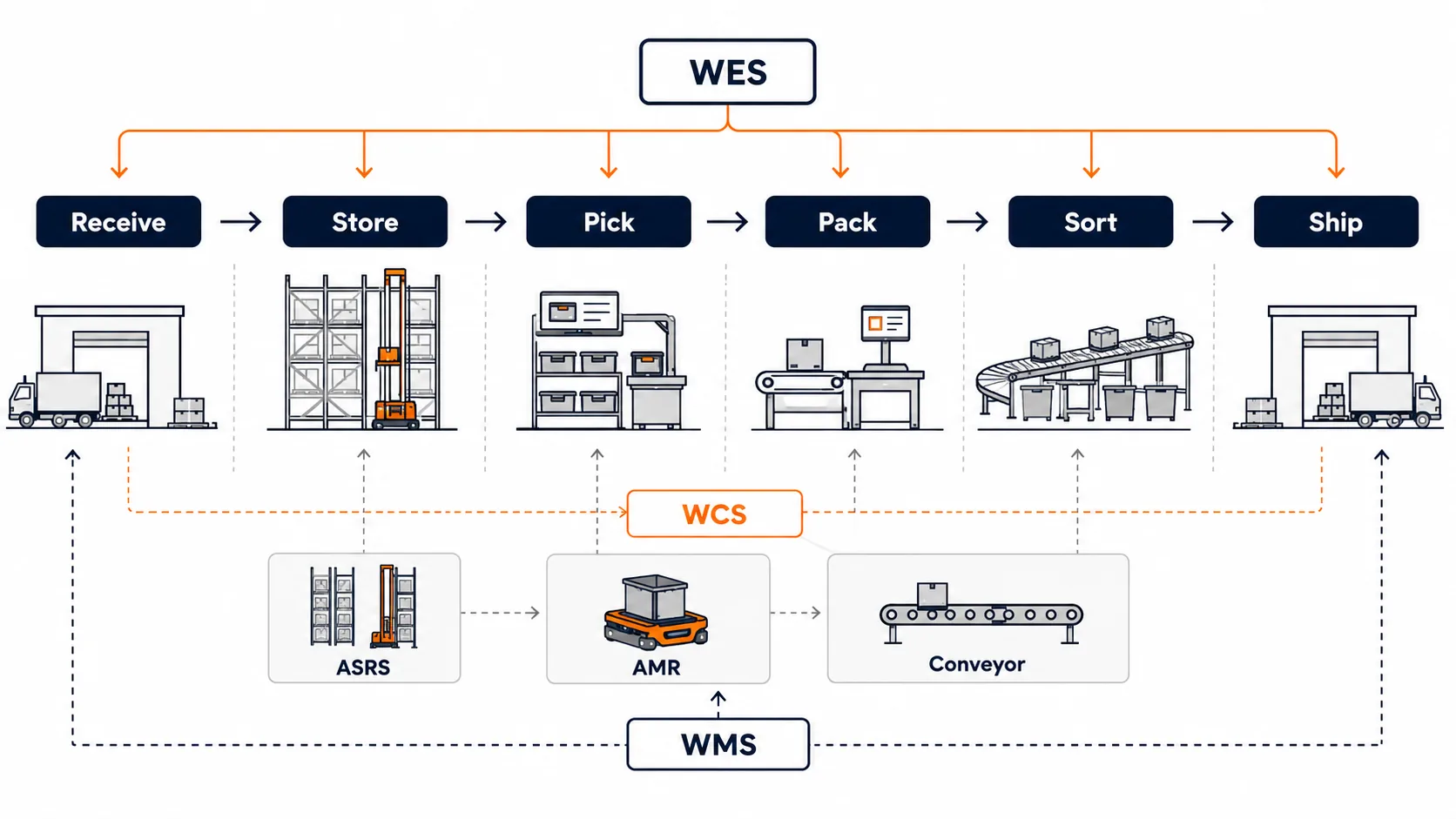
Warehouse Software: WMS, WES, and WCS
Warehouse automation is only as good as the software that coordinates it. Hardware moves inventory, but software decides what should move, when it should move, and what should happen when something goes wrong.
The three most important software layers are:
- WMS: owns inventory records, receiving, allocation, order management, shipping logic, and warehouse transactions.
- WES: orchestrates real-time work across ASRS, AMRs, conveyors, picking stations, packing, replenishment, and exceptions.
- WCS: controls equipment-level execution for conveyors, cranes, shuttles, sorters, scanners, PLCs, and local automation.
In small projects, these boundaries may be simple. In large projects, unclear ownership can break the system. If the WMS releases work too early, buffers overflow. If the WES cannot balance stations, operators wait. If the WCS cannot report exceptions clearly, recovery becomes manual.
Our WES vs WMS vs WCS guide goes deeper, but the buyer rule is simple: do not buy automated equipment without defining the software ownership model.
How Warehouse Automation Systems Fit Together
A practical warehouse automation architecture usually has multiple zones.
One zone stores dense inventory. Another handles fast movers. Another handles long-tail SKUs. Another handles returns or exceptions. Another handles packing and outbound sortation. The automation system should connect these zones without forcing every product through the same path.
For example, an e-commerce fulfillment center may use:
- Shuttle ASRS for fast-moving totes.
- AMRs for long-tail SKUs and flexible picking.
- Conveyors from picking to packing.
- Put walls for order consolidation.
- WES to decide which zone fulfills each line.
- WMS to maintain inventory and shipping records.
A manufacturing warehouse may use:
- Pallet ASRS for raw materials and finished goods.
- Fork AGVs for pallet movement.
- Mini-load ASRS for components and spare parts.
- WCS for equipment control.
- ERP integration for production orders and inventory status.
This is why the best design is usually a system map, not a product list.
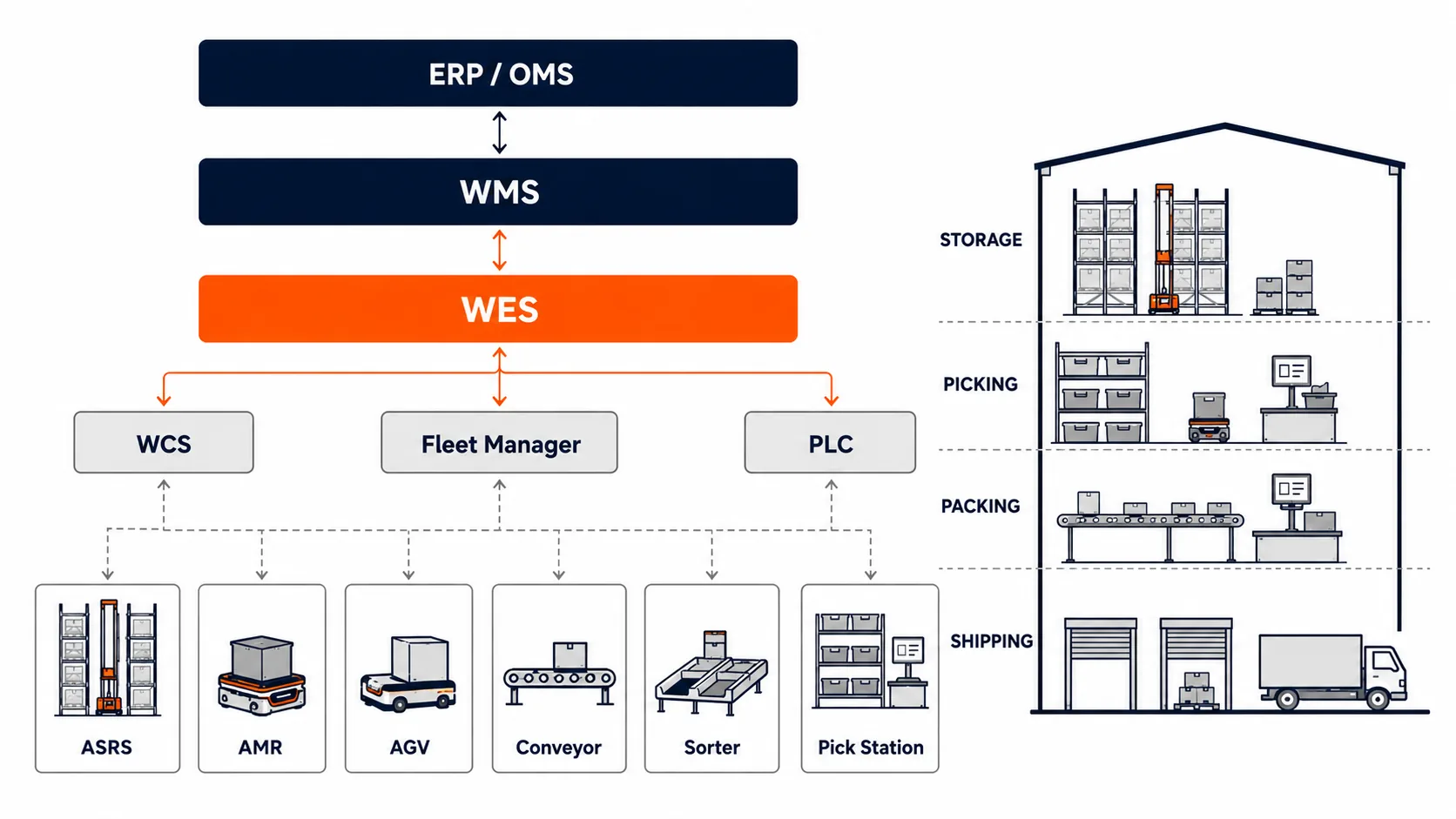
Warehouse Automation System Costs
Warehouse automation cost varies widely because scope varies widely. A small pick-to-light project is not comparable to a high-bay pallet ASRS. A 20-robot AMR pilot is not comparable to a full fulfillment center automation program.
Instead of asking for one average price, break cost into layers:
| Cost layer | What it includes |
|---|---|
| Equipment | ASRS hardware, robots, conveyors, sorters, stations, scanners, safety systems |
| Storage structure | Racking, mezzanines, rack-supported building elements, fire protection changes |
| Software | WMS, WES, WCS, fleet managers, dashboards, licenses, subscriptions |
| Integration | ERP, WMS, OMS, TMS, PLC, barcode, label, carrier, and reporting interfaces |
| Facility work | Electrical, floor work, network, compressed air, charging, guarding, layout changes |
| Implementation | design, installation, commissioning, testing, training, go-live support |
| Operations | maintenance, spare parts, support contracts, energy, system tuning |
The biggest hidden cost is often integration. A system that looks cheaper in hardware can become expensive if it requires custom interfaces, manual workarounds, or operational tuning after go-live.
For ASRS-specific cost ranges and cost drivers, use our ASRS system cost guide. For broader financial modeling, use the warehouse automation ROI guide.
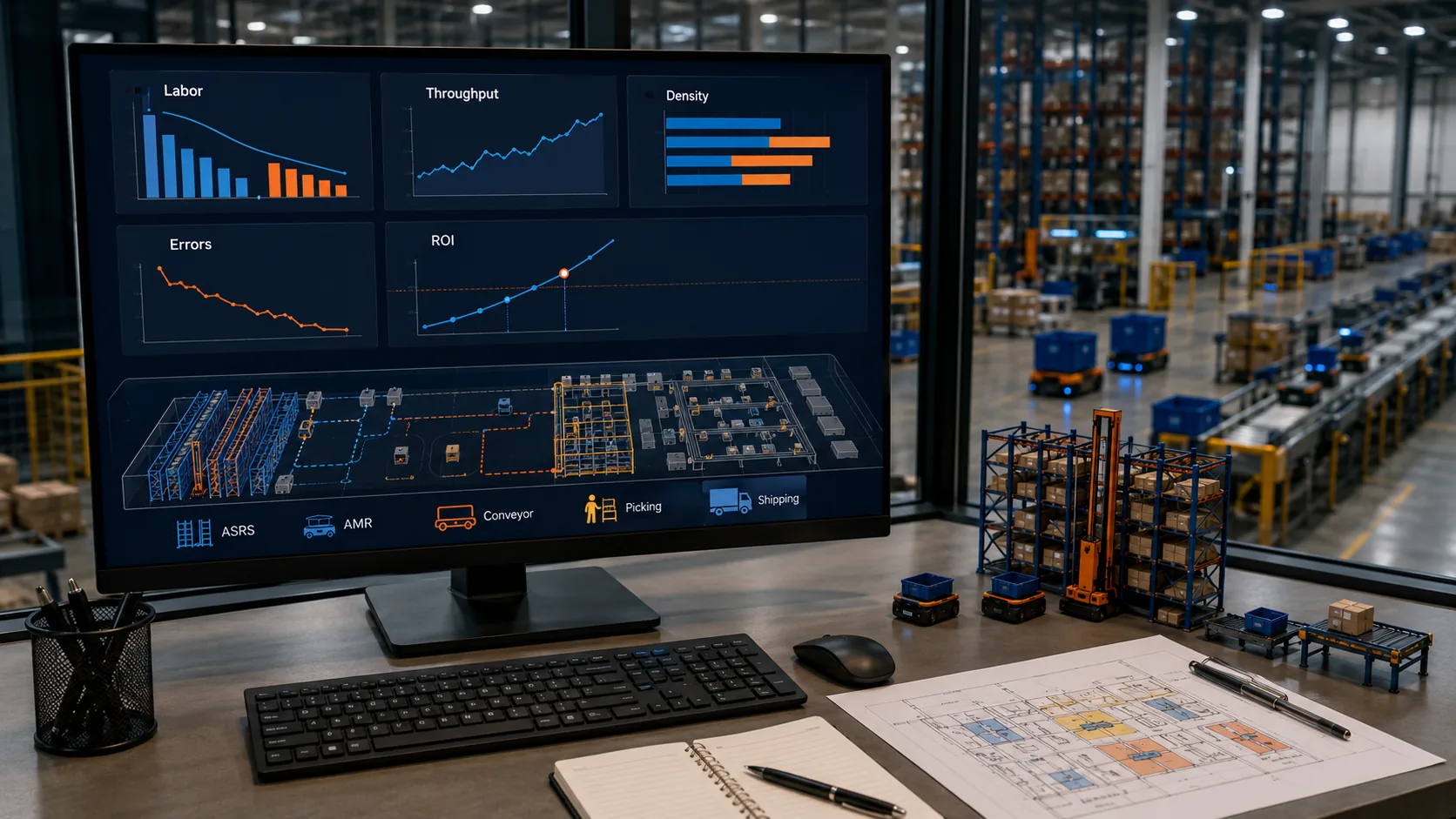
How to Calculate Warehouse Automation ROI
Warehouse automation ROI should compare the automated future state against the current baseline. Do not compare it against an ideal manual operation that does not exist.
Start with these baseline metrics:
- Current labor hours by process.
- Lines picked per labor hour.
- Orders shipped per day and peak hour.
- Error rate and cost per error.
- Overtime and temporary labor cost.
- Storage cost per pallet, tote, bin, or SKU.
- Forklift cost, damage cost, and safety incidents.
- Current building capacity and expansion cost.
- Inventory accuracy and stockout/cancelled-order cost.
Then model the automated state:
- Labor removed or redeployed.
- Throughput increase.
- Storage density improvement.
- Error reduction.
- Overtime reduction.
- Avoided building expansion.
- Maintenance and software cost.
- Energy and spare parts.
- Depreciation or financing assumptions.
The strongest ROI cases usually combine several benefits. A project based only on labor savings can be fragile. A project that combines labor productivity, avoided real estate, fewer errors, better peak capacity, and safer traffic often has a more resilient business case.
How to Choose the Right Warehouse Automation System
Use a decision process before talking to vendors. The goal is to avoid designing around a product demo.
1. Define the constraint
Write one sentence that describes the problem:
Template: We need to automate [process] because [constraint] is limiting [business outcome].
Examples:
- We need to automate pallet storage because floor space is limiting inventory growth.
- We need to automate e-commerce picking because labor capacity is limiting carrier cutoff performance.
- We need to automate component storage because inventory accuracy is delaying production orders.
2. Map load and order profiles
Document what moves through the warehouse. Pallets, cartons, totes, bins, trays, hanging garments, and irregular products all lead to different system choices.
Then document how often they move. Daily averages are not enough. You need peak hour, SKU velocity, lines per order, order release rules, returns, replenishment, and future growth assumptions.
3. Match the system to the flow
Use the flow to narrow options:
- Dense pallet storage: pallet ASRS or high-bay automation.
- Tote storage with controlled throughput: mini-load ASRS.
- High-throughput each picking: shuttle ASRS or goods-to-person automation.
- Flexible long-tail picking: AMR or robotic G2P.
- Repetitive point-to-point transport: AGV or conveyor.
- High outbound parcel volume: sortation and packing automation.
- Multi-zone automation: WES-led architecture.
4. Validate building constraints
Check clear height, floor load, flatness, column grid, dock locations, fire protection, power, network, charging space, maintenance access, and expansion area. A system that fits the spreadsheet may not fit the building.
5. Model failure modes
Ask what happens if a crane, shuttle, robot, conveyor segment, station, scanner, or integration service is unavailable. A good design degrades predictably and gives operators a recovery path.
6. Compare total cost of ownership
Evaluate the system over seven to ten years, not only purchase price. Include maintenance, software renewals, spare parts, battery replacement, support, expansion, downtime risk, and internal staffing.
Common Mistakes in Warehouse Automation Projects
Starting with vendor demos instead of warehouse data. Demos are useful, but they show ideal conditions. Your SKU profile, building, labor model, and order volatility matter more.
Automating a broken process. If receiving rules, slotting, inventory accuracy, or replenishment logic are weak, automation can make the weakness move faster.
Ignoring downstream bottlenecks. A faster ASRS can overwhelm packing. A new sorter can overwhelm dock staging. A robot fleet can overwhelm pick stations.
Underestimating software integration. Hardware is visible, but integration decides whether the system behaves as one operation.
Designing for averages. Warehouses fail at peaks: carrier cutoff, shift change, promotion waves, production release, and month-end shipping.
Forgetting change management. Operators, supervisors, maintenance teams, and IT staff need new skills. A technically strong system can still underperform if people do not trust it.
External References
For neutral category definitions, the MHI AS/RS industry group is a useful reference for automated storage and retrieval systems. For safety planning around warehouse traffic, forklifts, automated equipment, and pedestrian routes, review OSHA warehousing guidance before layout changes or go-live.
Warehouse Automation Systems Checklist
Use this checklist before approving a project scope:
- Primary warehouse constraint is defined.
- Load profile is complete.
- Order profile includes peak-hour demand.
- SKU velocity curve is available.
- Building constraints are validated.
- Downstream bottlenecks are included.
- WMS, WES, and WCS ownership is defined.
- Integration points are documented.
- Failure modes and recovery paths are modeled.
- ROI uses real baseline metrics.
- TCO includes software, maintenance, and expansion.
- Operators, maintenance, and IT are included in change planning.
FAQ
What are warehouse automation systems?
Warehouse automation systems are technologies that automate storage, movement, picking, packing, sortation, equipment control, or software decision-making inside a warehouse. Examples include ASRS, AMRs, AGVs, conveyors, sorters, goods-to-person stations, WMS, WES, and WCS.
What is the best warehouse automation system?
There is no universal best system. ASRS is best for dense storage and predictable retrieval, AMRs are best for flexible movement, conveyors are best for stable high-volume flow, and WES is best for coordinating multi-zone automation. The best system is the one matched to the warehouse constraint.
How much do warehouse automation systems cost?
Cost depends on scope, load type, throughput, building work, software, and integration. A small guided-picking or AMR pilot can be much smaller than a full ASRS or sortation project. Buyers should compare total cost of ownership, not only equipment price.
How do warehouse automation systems improve ROI?
They improve ROI by reducing labor hours, increasing throughput, improving storage density, lowering error cost, reducing overtime, improving inventory accuracy, and avoiding facility expansion. Strong projects usually combine several of these benefits.
Do I need WMS, WES, and WCS for warehouse automation?
Not always, but you need clear software ownership. WMS usually owns inventory and orders, WES coordinates real-time work across zones, and WCS controls equipment. Complex automation projects often need all three layers or equivalent functionality.
Should I choose ASRS or AMR first?
Choose based on the constraint. If density, vertical storage, and predictable high-volume retrieval are the problem, start with ASRS. If flexibility, phased rollout, and changing layouts are the problem, start with AMR. Many warehouses use both.
Bottom Line
Warehouse automation systems work when they are designed around the actual constraint, not around a technology trend. Start with load profile, order profile, building constraints, software ownership, and ROI. Then choose the system architecture that improves the whole flow from receiving to shipping.
If you are comparing ASRS, AMR, conveyors, or warehouse software for a new facility or retrofit, contact GoASRS with your operation profile. We can help map the right automation path before you commit to a vendor shortlist.
Planning a Warehouse Automation Project?
Our team has delivered 50+ ASRS systems across retail, manufacturing, and logistics. Tell us about your project and we will get back to you within 24 hours.
Thank you!
We received your message and will get back to you within 24 hours.