
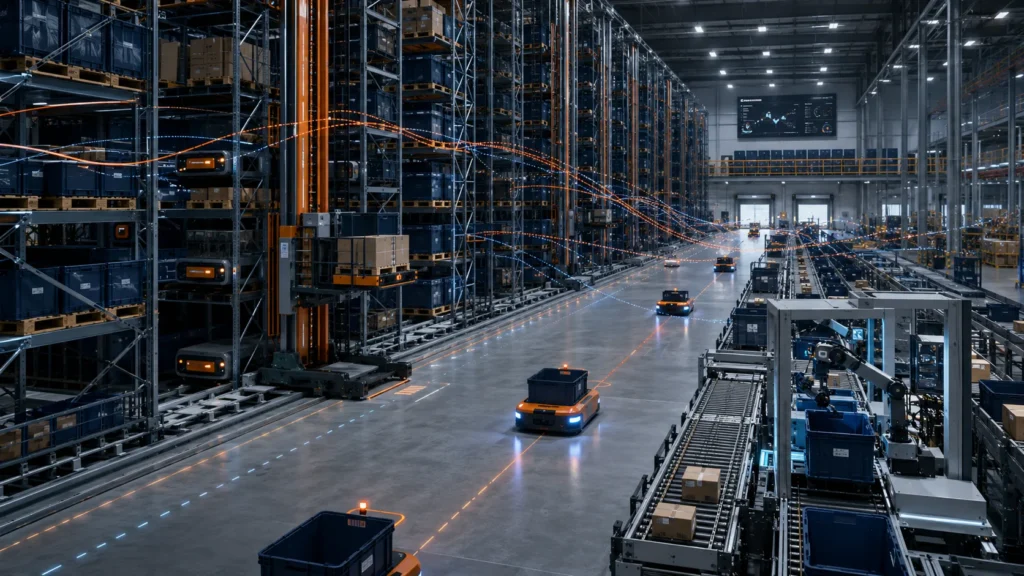
Warehouse leaders rarely invest in automation because it looks modern. They invest when the current operation has reached a hard limit: not enough space, not enough labor, too many picking errors, rising order volume, or a service-level promise the manual process cannot protect anymore.
That is where automated storage and retrieval systems earn their place. An ASRS is not just a faster rack. It changes how inventory is stored, retrieved, sequenced, tracked, and delivered to operators or downstream automation. The value shows up across the full warehouse P&L: labor, space, accuracy, safety, throughput, inventory control, and long-term scalability.
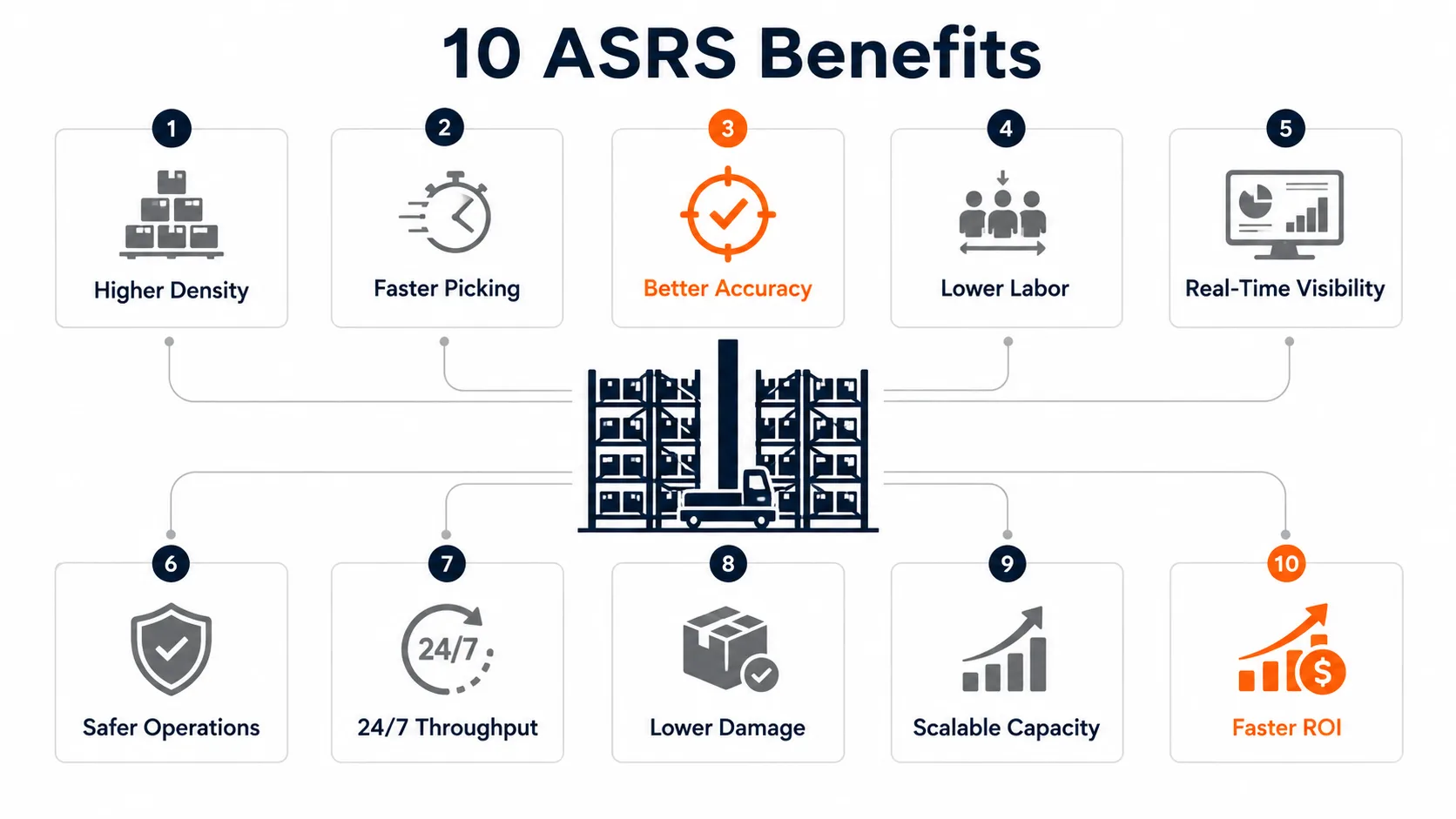
Short answer: The main benefits of ASRS systems are higher storage density, faster picking, better inventory accuracy, lower labor dependency, safer operations, real-time visibility, 24/7 throughput, less product damage, scalable capacity, and a clearer path to warehouse automation ROI.
This guide explains those benefits from a buyer's point of view, with practical numbers from GoASRS project work and public industry benchmarks.
What Counts as an ASRS System?
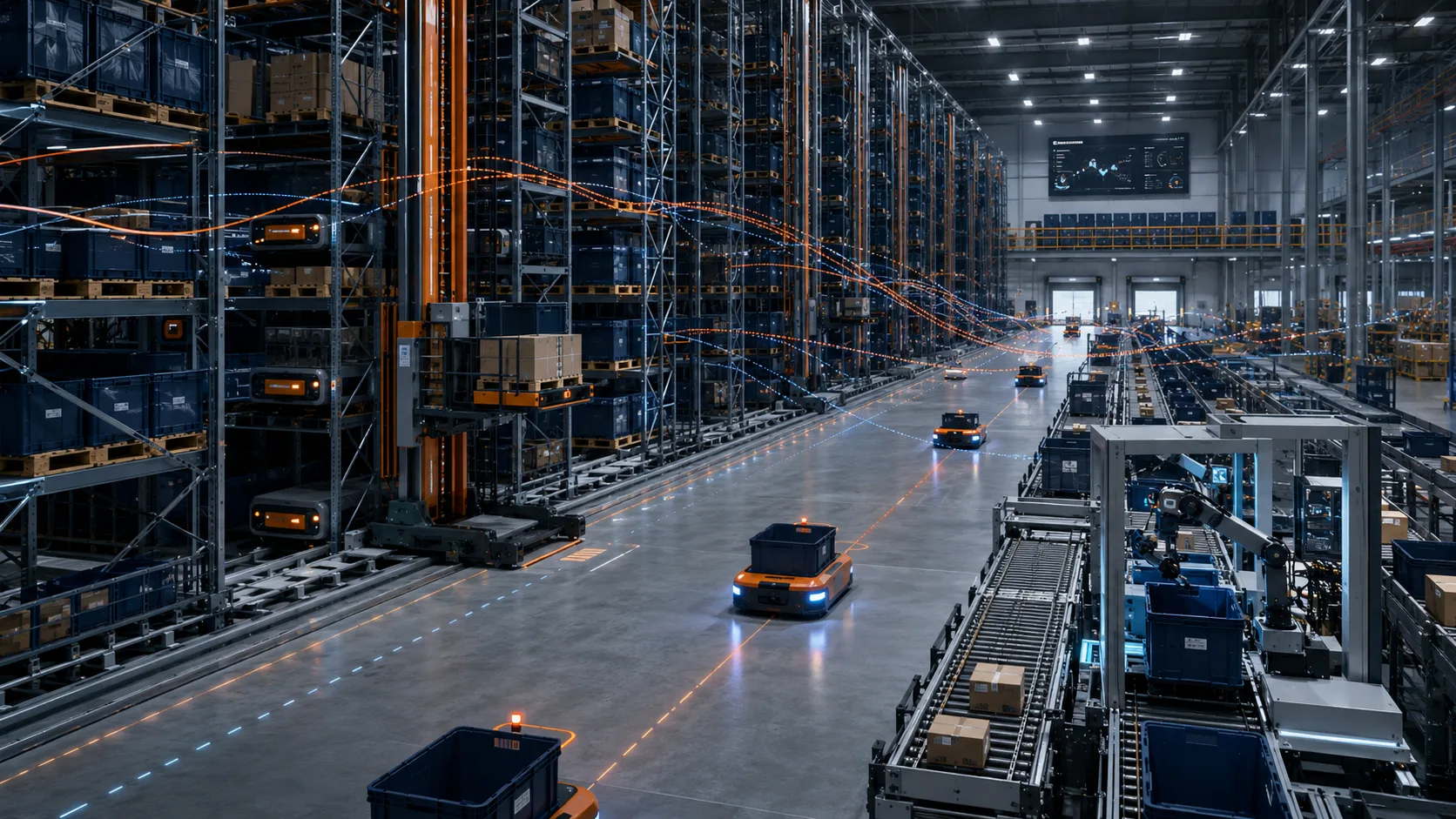
An automated storage and retrieval system is a warehouse technology that automatically stores and retrieves pallets, totes, cartons, trays, or bins from a defined storage structure. Depending on the load type and throughput target, the system may use stacker cranes, shuttles, mini-load cranes, robotic goods-to-person systems, pallet cranes, vertical lift modules, or hybrid robot fleets.
If you need the fundamentals first, read our full guide on what ASRS means and our breakdown of the main ASRS system types. This article focuses on the business impact after the system is live.
The benefits below apply across most ASRS categories, but the strength of each benefit depends on design. A pallet ASRS delivers a different value profile than a mini-load ASRS or a shuttle system. The important point is to connect the benefit to the right operating constraint.
1. Higher Storage Density
Storage density is usually the first ASRS benefit buyers notice because it is visible on the floor plan. Manual racking needs wide forklift aisles, pedestrian walkways, staging lanes, and safety buffers. ASRS replaces much of that with narrow automated aisles, vertical storage, and controlled access points.
In high-bay pallet storage, an ASRS can use 20 to 40 meters of clear height that conventional forklift operations cannot safely or efficiently reach. In tote systems, dense rack structures can hold thousands of SKUs in a footprint that would otherwise support a much smaller manual picking area.
The impact is not just "more inventory in the same building." It can change the real estate decision. A facility that is running out of space may be able to defer a warehouse expansion, avoid a second building, or consolidate overflow inventory back into the main operation.
In GoASRS project planning, we commonly see ASRS storage density improvements in the 2x to 4x range compared with conventional shelving or selective pallet racking. ERAL's fashion retail deployment is a good example: the automated storage design helped the operation reach roughly 3x storage density within the existing footprint.
2. Faster Picking and Retrieval
Manual picking loses time in walking, searching, scanning, waiting for equipment, and moving between zones. ASRS reduces that waste by bringing inventory to the point of work or by moving pallets and totes directly to the next process step.
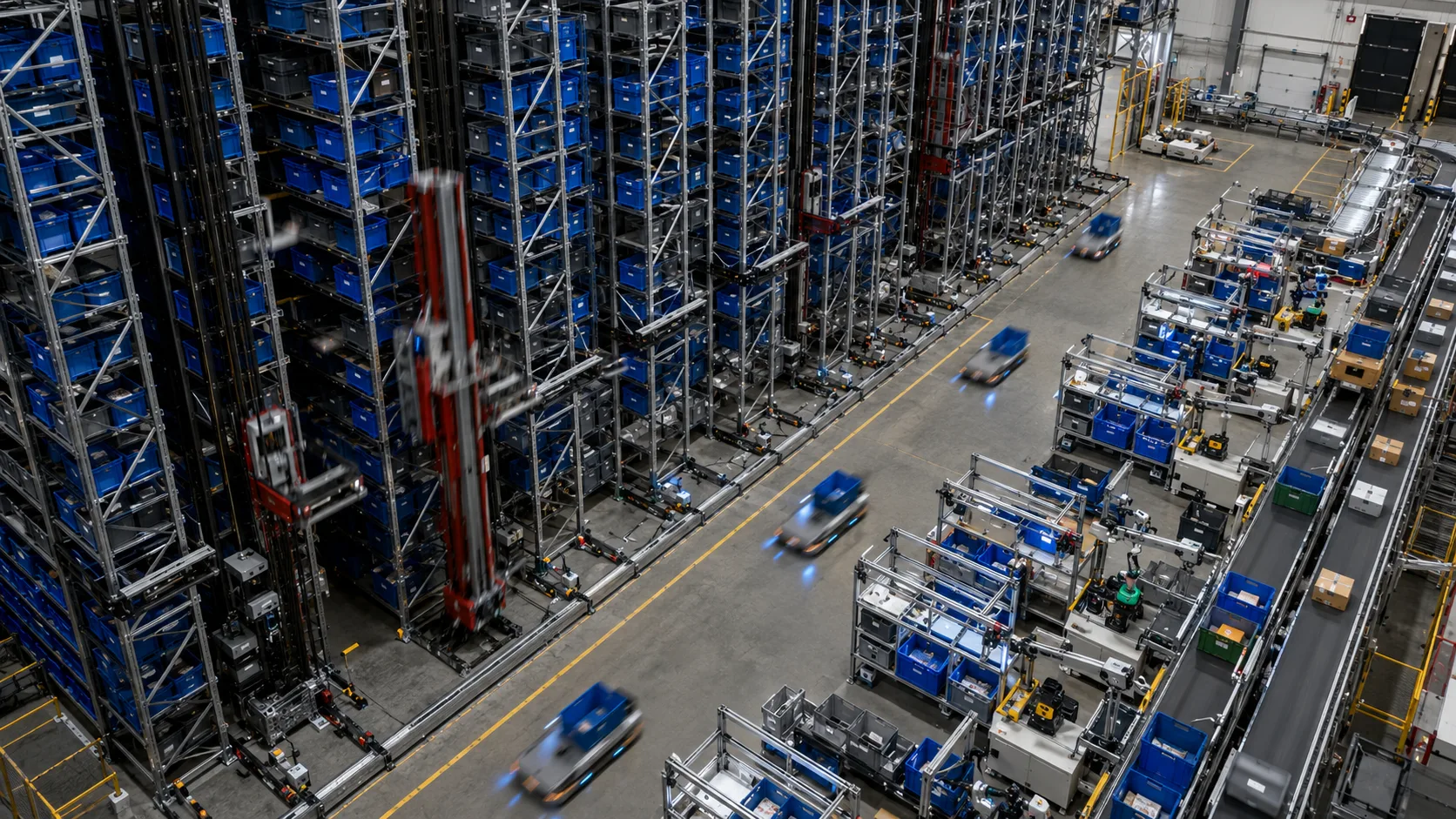
The effect is strongest in goods-to-person picking. Instead of a worker walking the aisles, the system delivers the required tote to a station. The operator stays in one ergonomic work area while software controls the retrieval sequence.
For many piece-picking operations, goods-to-person workflows can support 150 to 300+ order lines per hour per station, depending on SKU size, order profile, station design, and replenishment logic. That is often several times higher than manual cart picking in a large warehouse.
The real gain is not only speed per worker. It is predictability. A manual picker may perform well in the morning and slow down after hours of walking. An ASRS feeds the station at a modeled rate, and the warehouse execution system can balance work across stations in real time.
3. Better Picking Accuracy
Picking errors are expensive because the cost does not stop at the warehouse door. A wrong item creates returns, customer service work, replacement shipments, lost trust, and sometimes chargebacks or SLA penalties.
ASRS improves accuracy by reducing the number of manual decisions inside the pick path. The system knows the storage location, retrieves the right tote or pallet, presents the item at a controlled station, and confirms the action through barcode scanning, put-to-light, pick-to-light, weight checks, or vision systems.
In high-SKU operations, this matters more than most ROI spreadsheets admit. A 1% error rate across 20,000 daily order lines means 200 bad lines per day. Even if the direct correction cost is modest, the downstream cost compounds quickly.
GoASRS projects typically target 99.5%+ inventory and picking accuracy once the system is stabilized. In Shengyun's electronics warehousing project, automation helped improve picking accuracy by about 40% against the previous manual baseline. The exact number depends on the starting process, but the direction is consistent: fewer human search decisions means fewer errors.
4. Lower Labor Dependency
Labor is still the biggest operating cost in many warehouses. The issue is not only wage inflation. It is hiring, training, overtime, turnover, attendance variation, and the difficulty of staffing peak seasons.
ASRS reduces labor dependency in two ways. First, it removes walking and forklift travel from many workflows. Second, it lets a smaller team supervise a larger volume of inventory movement. Operators shift from searching and transporting to exception handling, station work, replenishment planning, and system monitoring.
The labor reduction varies by process. A pallet ASRS may reduce forklift travel and staging labor. A tote-based goods-to-person ASRS may reduce manual pick labor by 50% to 70% in the automated zone. A hybrid system may keep some manual stations but reduce the walking workload substantially.
This does not mean people disappear. Good automation changes the work. The remaining roles become more system-oriented: station operator, maintenance technician, shift supervisor, WES analyst, inventory control specialist. For operations that struggle to hire enough pickers or forklift drivers, that shift is often the business case.
5. Real-Time Inventory Visibility
Manual warehouses often know what the system thinks is on hand. They do not always know what is physically true at this second. Cycle counts, exception notes, lost pallets, mislabeled totes, and delayed scans create a gap between system inventory and floor reality.
An ASRS narrows that gap because every storage and retrieval movement is system-directed. The storage location is known. The movement task is logged. The handoff point is confirmed. The WMS, WCS, and WES layers can share status updates so planners see what is stored, what is moving, what is queued, and what is blocked.
This visibility is especially important for lot control, FIFO, FEFO, cold storage, electronics, pharma, food, and high-value components. It also helps finance. When inventory records are trustworthy, buyers can reduce safety stock, planners can allocate orders more confidently, and warehouse teams spend less time hunting for stock.
Real-time visibility is one reason software architecture matters. A standalone machine control system is not enough. The ASRS needs to connect cleanly with your WMS and ERP, and the WES needs to translate equipment movement into operational status that planners can use.
6. Safer Warehouse Operations
Safety is not a soft benefit. Forklifts, pedestrian traffic, manual lifting, long walking routes, and congested staging areas all create risk. The U.S. Occupational Safety and Health Administration has long treated powered industrial truck safety as a major warehouse hazard category, and most operations leaders have their own near-miss history to prove the point.
ASRS improves safety by separating people from high-frequency material movement. Pallets move inside controlled aisles. Totes travel through guarded systems and defined stations. Forklift traffic drops. Workers spend less time walking through active storage areas and less time reaching, bending, or lifting in awkward positions.
In a good design, operators work at ergonomic stations with clear lighting, controlled presentation height, and reduced travel. Maintenance teams still need safe access procedures, lockout/tagout discipline, and training, but the day-to-day exposure profile changes materially.
Safety benefits are also linked to accuracy and damage reduction. When the system controls the movement path, there are fewer dropped pallets, rack strikes, mis-staged loads, and rushed forklift maneuvers during peak periods.
7. 24/7 Throughput Capacity
Manual throughput is limited by shifts, attendance, overtime budgets, and human fatigue. ASRS equipment can run continuously when maintenance, charging, and upstream/downstream capacity are planned correctly.
That does not mean every ASRS should run 24/7. Some warehouses only need one or two shifts. But the option matters. When demand spikes, automated retrieval can extend into off-hours, replenish pick buffers overnight, prepare outbound waves before the morning shift, or support late carrier cutoffs without adding the same amount of labor.
For manufacturing, this can be the difference between storage keeping pace with production and storage becoming the bottleneck. For e-commerce, it can protect next-day shipping promises. For cold storage, it can reduce the amount of time people spend in sub-zero environments while keeping product flow steady.
The limiting factor is usually not the ASRS hardware alone. It is the total system: receiving, replenishment, picking stations, packing, sortation, shipping dock capacity, and software orchestration.
8. Less Product Damage
Product damage often hides inside other cost categories: shrinkage, returns, rework, write-offs, customer claims, and labor spent repacking damaged goods. Manual handling creates many chances for damage, especially when inventory is heavy, fragile, temperature-sensitive, or high value.
ASRS reduces touches. A pallet or tote enters the system, is stored in a known position, and is retrieved through a controlled movement path. There is less forklift handling, less re-stacking, less temporary staging, and less emergency searching during peak.
This benefit is especially strong in electronics, medical devices, automotive parts, cosmetics, apparel, food, and cold chain. In semiconductor and precision manufacturing logistics, the value of preventing mishandling can exceed the value of pure labor savings.
Damage reduction also supports brand experience. For e-commerce and retail, the customer does not care that the warehouse was busy. They care whether the item arrives correct, clean, and on time.
9. Scalable Capacity Without Linear Headcount Growth
Manual operations scale in a mostly linear way. More orders require more pickers, more carts, more forklifts, more supervisors, more staging space, and often more building area. That growth works until labor or space becomes the constraint.
ASRS creates a different scaling curve. Capacity can be added by expanding aisles, adding shuttles, adding picking stations, increasing robot count, tuning WES logic, or extending operating hours. The right method depends on the system type, but the key is that volume can grow without adding labor at the same rate.
This is not automatic. The original design must reserve expansion paths. If lifts are saturated, adding shuttles will not help. If packing is undersized, faster retrieval just moves the bottleneck. If the WES cannot balance tasks across zones, more hardware may create congestion.
The best ASRS projects model several future states before the first purchase order is signed: base volume, peak season volume, three-year growth, equipment fault, SKU mix change, and labor shortage. That modeling is where a strong integrator earns its fee.
10. Faster and More Defensible ROI
The final benefit is not a single operating metric. It is the way ASRS turns several small advantages into a stronger business case.
Storage density reduces real estate cost. Picking speed reduces labor per order. Accuracy reduces returns. Visibility reduces inventory waste. Safety reduces risk. Damage reduction protects margin. Scalability protects future growth. Together, those benefits create a return profile that is often stronger than any single metric suggests.
In many mid-scale ASRS projects, payback lands in the 2 to 4 year range when the operation has enough volume, labor cost, and space pressure. The range can be shorter for high-labor, high-error, high-growth operations, and longer for low-volume sites or sites with uncertain demand.
The important discipline is to calculate ROI against the real baseline. Do not compare ASRS to a perfect manual warehouse. Compare it to your actual cost per order, actual error rate, actual overtime pattern, actual rent, actual headcount, and actual growth forecast. Our warehouse automation ROI guide walks through that calculation in more detail.
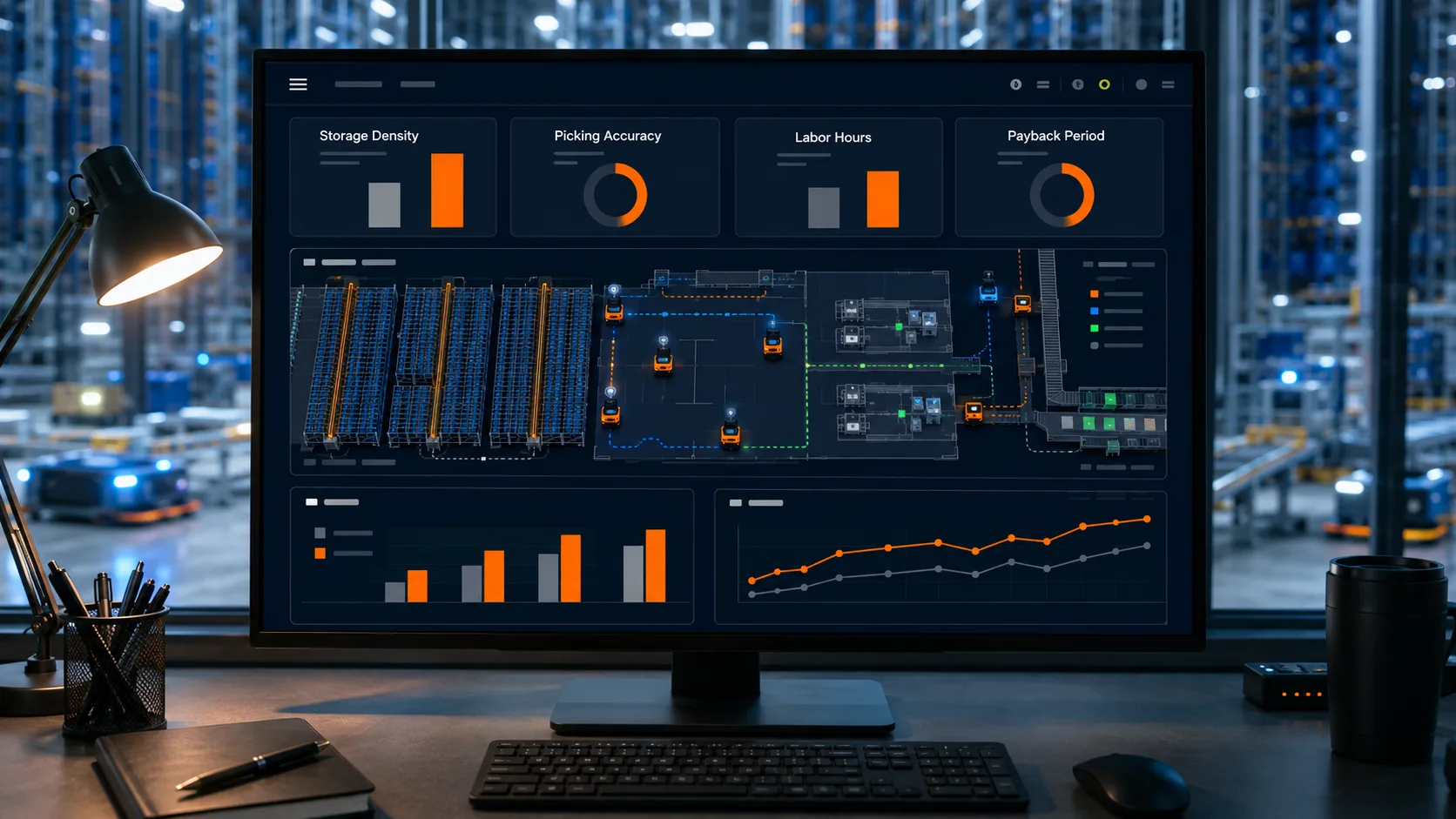
ASRS Benefits by Business Problem
| Business problem | ASRS benefit that matters most | What to measure |
|---|---|---|
| Warehouse is running out of space | Higher storage density | Pallet/tote positions per square meter |
| Picking labor is hard to hire | Lower labor dependency | Order lines per labor hour |
| Error rate is hurting customers | Better accuracy | Mis-picks, returns, claims |
| Peak volume misses cutoffs | Faster throughput | Lines per hour, order cycle time |
| Inventory records are unreliable | Real-time visibility | Inventory accuracy, cycle count variance |
| Forklift traffic is risky | Safer operations | Incidents, near misses, forklift hours |
| Expansion is expensive | Scalable capacity | Cost per added order line |
| ROI case is unclear | Combined cost reduction | Payback period, 7-year TCO |
Where ASRS Delivers the Most Value
ASRS is not equally valuable in every warehouse. It delivers the strongest return when at least three of these conditions are true:
- You have high SKU count or frequent inventory movement.
- You are constrained by building space or ceiling height is underused.
- Labor cost, turnover, or availability is a serious problem.
- Picking errors create high downstream cost.
- Order volume has clear peaks that stress manual workflows.
- You need better traceability, FIFO, FEFO, or lot control.
- Your facility will grow over the next three to five years.
If none of those conditions are true, a full ASRS may be premature. Process improvement, slotting, WMS cleanup, pick-to-light, conveyor upgrades, or a smaller goods-to-person pilot may be the better first step.
If several are true, the case becomes much stronger. At that point, the main question is not whether automation creates value. It is which ASRS type fits the load, building, throughput, and software environment.
What Can Reduce the Benefits?
ASRS benefits are proven, but they are not guaranteed. We see four common reasons projects underperform.
Poor data quality. If SKU dimensions, order profiles, and velocity curves are wrong, the system will be sized around the wrong reality.
Undersized software integration. Hardware can meet specification while the total warehouse misses SLA. That happens when the WMS, WCS, WES, and downstream processes are not coordinated.
No expansion plan. A system that is perfect for year-one volume may become tight by year three if lift capacity, station space, or conveyor connections were not reserved.
Weak change management. Operators and supervisors need training, new KPIs, and a clear exception process. Automation changes the work; it does not remove the need for management.
These problems are avoidable, but they need to be addressed before vendor selection. A strong business case should include data validation, simulation, integration design, go-live support, and post-launch tuning.
Frequently Asked Questions
What is the biggest benefit of ASRS?
The biggest benefit depends on the site. For space-constrained warehouses, storage density is usually the largest driver. For e-commerce and retail fulfillment, labor productivity and picking accuracy often matter more. For manufacturing and cold storage, predictable 24/7 movement and reduced forklift handling can be the strongest benefits.
How much space can ASRS save?
Many ASRS designs improve storage density by 2x to 4x compared with conventional manual storage, depending on ceiling height, load type, aisle design, and SKU profile. High-bay pallet ASRS can produce especially large space savings when the building height is available.
Does ASRS eliminate warehouse labor?
No. ASRS reduces labor dependency and changes the type of work. Operators move from walking, searching, and forklift travel into station work, exception handling, maintenance, supervision, and system monitoring. The best projects reduce repetitive travel while keeping people focused on tasks where human judgment is useful.
How long does ASRS ROI take?
For operations with enough volume, labor cost, and space pressure, ASRS payback often falls in the 2 to 4 year range. Low-volume warehouses or sites with uncertain growth may see longer payback. ROI should include labor, space, accuracy, damage, safety, inventory, uptime, and software costs, not hardware alone.
Is ASRS worth it for small warehouses?
Sometimes, but not always. A small warehouse with high SKU complexity, expensive labor, or severe space pressure may justify a compact ASRS or goods-to-person system. A low-volume warehouse with cheap space and stable labor may get better returns from layout improvement, WMS cleanup, or selective automation first.
Bottom Line
The benefits of ASRS systems are not theoretical. They show up in the operating numbers: more inventory in the same space, more order lines per labor hour, fewer errors, safer movement, better visibility, and a warehouse that can grow without adding people and floor area at the same rate.
But the value depends on fit. ASRS works best when the system type, software stack, building constraints, SKU profile, and growth plan are designed together. Buying hardware first and hoping the benefits appear later is how automation projects become expensive disappointments.
If you are evaluating whether ASRS makes sense for your operation, start with your constraints: space, labor, accuracy, throughput, and growth. Then model which system type solves the constraint at the lowest total cost. If you want a second opinion, send GoASRS your warehouse profile and we will walk through the numbers with you.
Planning a Warehouse Automation Project?
Our team has delivered 50+ ASRS systems across retail, manufacturing, and logistics. Tell us about your project and we will get back to you within 24 hours.
Thank you!
We received your message and will get back to you within 24 hours.