
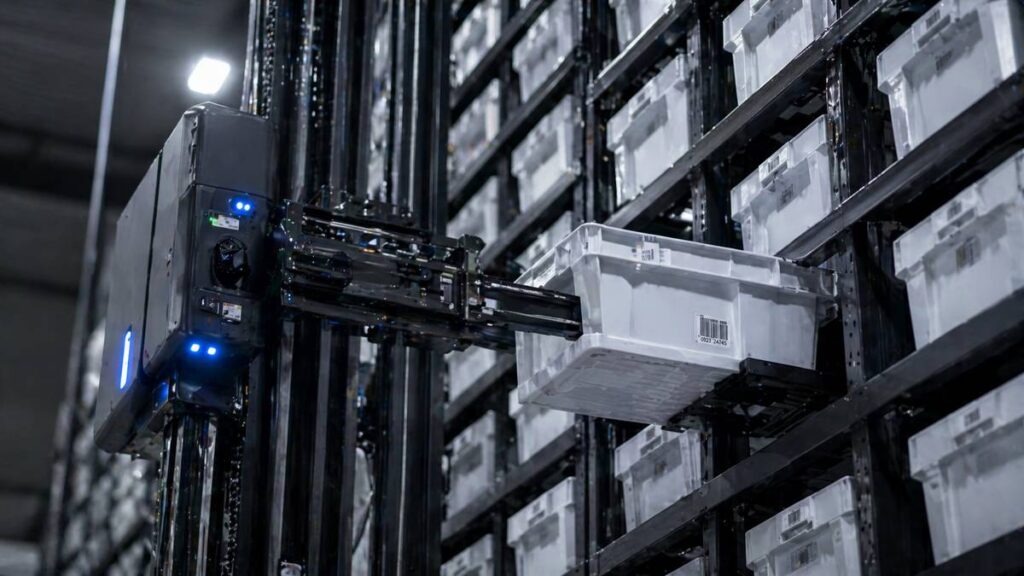
Hai Robotics is the company that coined the term ACR — Autonomous Case-handling Robot — and built an entire product category around it. Founded in 2016 in Shenzhen, China, the company has deployed over 1,500 projects across 30+ countries, making it one of the fastest-growing warehouse robotics firms in the world. If you have attended ProMat, LogiMAT, or CeMAT in the past three years, you have almost certainly walked past their booth.
The ACR concept is straightforward: a mobile robot that travels autonomously through a warehouse, reaches up into standard racking, and retrieves individual totes or cartons without any fixed infrastructure — no rails, no conveyors, no grid. The robot brings the container to a picking station, the operator picks, and the robot returns it to storage. It is a goods-to-person picking approach, but with a twist that sets it apart from shelf-carrying robots and cube-based systems.
This article breaks down how Hai Robotics ACR technology works, what their product lineup looks like, where ACR fits against other types of ASRS systems, and when it makes sense to go with a single-vendor ACR deployment versus a multi-technology integrated approach.
What Is an ACR and How Does It Work?
ACR stands for Autonomous Case-handling Robot. The "case-handling" part is what distinguishes it from other warehouse robots. Where Amazon-style shelf-carrying robots (like those from Geek Plus or Quicktron) lift entire shelving units and bring them to a station, an ACR robot reaches into existing racking and extracts a single tote, carton, or bin. The robot handles the case, not the shelf.
Here is the operating sequence:
- Task assignment — The fleet management system (Hai Robotics calls theirs HAIQ) receives pick orders and assigns retrieval tasks to individual robots based on location, battery status, and workload balance.
- Navigation — The ACR robot travels autonomously across the warehouse floor using a combination of QR code navigation and onboard sensors. No guide rails, no embedded wires, no fixed paths.
- Vertical reach — The robot arrives at the target racking location and extends a telescopic lifting mechanism upward. Depending on the model, this mechanism can reach heights of 5 to 10 meters, accessing totes stored on multiple racking levels from a single ground-level position.
- Case extraction — The extractor grips the target tote or carton and pulls it onto the robot's carrying platform. Some models carry a single tote; others carry multiple totes per trip using a multi-level payload design.
- Transport to pick station — The robot carries the tote to a designated picking workstation. Traffic management algorithms coordinate the fleet to prevent collisions and minimize congestion.
- Picking and return — The operator picks items from the tote, confirms the pick, and the robot returns the tote to storage. The system may reassign the tote to a different location based on demand frequency — fast movers get positioned closer to pick stations over time.
The entire cycle — from task assignment to tote delivered at the station — typically runs 60 to 120 seconds depending on warehouse layout and fleet density. A single Hai Robotics ACR robot handles roughly 25 to 40 tote movements per hour, and throughput scales linearly with fleet size: 50 robots means 50 times the single-robot output, minus some efficiency loss from traffic management overhead.
What makes this architecture interesting from an engineering perspective is the absence of fixed infrastructure. A mini load ASRS crane runs on rails bolted to the floor. A shuttle system needs dedicated lifts and level-specific tracks. An ACR robot just needs flat floors and standard racking. That changes the deployment math significantly.
Hai Robotics Product Lineup
Hai Robotics has expanded well beyond a single robot model. Their current lineup covers different payload capacities, reach heights, and use cases. Here is what the product family looks like as of 2026.
HaiPick A42 — The flagship model. Reaches up to 5.2 meters, carries a single tote (up to 30 kg), and operates in aisles as narrow as 1.2 meters. This is the robot you see in most Hai Robotics marketing materials and the one deployed in the majority of their projects.
HaiPick A42T — A taller variant designed for higher racking. Reaches up to 7 meters with the same footprint as the A42. Built for warehouses that want to maximize vertical storage without widening aisles.
HaiPick A3 — The multi-tote carrier. This model can transport up to 8 totes per trip, which dramatically improves throughput per robot cycle. The trade-off is a larger footprint and slightly slower navigation speed due to the increased payload weight.
HaiPick C8 — A carton-handling variant optimized for case-level picking in distribution centers. Designed to handle standard shipping cartons directly from pallet racking without requiring totes as an intermediary.
HaiPick W series — Wall-mounted variants for specific use cases where floor space is constrained and racking is positioned against walls.
Each model connects to HAIQ, Hai Robotics' proprietary fleet management and warehouse execution platform. HAIQ handles task allocation, traffic coordination, charging management, and integration with upstream WMS systems.
ACR vs Other ASRS Technologies: A Direct Comparison
The ACR is not the only way to automate tote and carton handling. It competes directly with mini load cranes, shuttle-based ASRS, and cube-based bin robot systems (like AutoStore). Each technology makes different trade-offs between density, throughput, flexibility, and cost.
We have deployed all of these system types across different warehouse environments, so the comparison below comes from real project data, not vendor spec sheets.
| Feature | ACR (Hai Robotics) | Mini Load Crane | Shuttle ASRS | Cube-Based (AutoStore) |
|---|---|---|---|---|
| Infrastructure required | Flat floor + standard racking | Rails, enclosed racking | Rails, lifts, enclosed racking | Aluminum grid structure |
| Max reach height | 5-10 m (model dependent) | 12-20 m | 12-25 m | 5-8 m (grid depth) |
| Throughput per unit | 25-40 totes/hr per robot | 200-400 totes/hr per crane | 400-1,000+ totes/hr per aisle | Scales with robot count |
| Storage density | Medium (uses standard racking) | High (narrow aisle, tall) | High (narrow aisle, tall) | Very high (no aisles) |
| Scalability model | Add robots | Add aisles + cranes | Add shuttles per level | Add robots to grid |
| Deployment speed | 2-8 weeks | 6-12 months | 6-12 months | 4-8 weeks (grid assembly) |
| Flexibility | High (racking reconfigurable) | Low (fixed rails) | Low (fixed rails + lifts) | Medium (grid expandable) |
| Capital cost per position | $80-$250 | $100-$350 | $120-$400 | $150-$400 |
| Maintenance model | Swap robots (modular) | Crane servicing (specialized) | Many moving parts | Swap robots (modular) |
Three patterns stand out from this comparison.
ACR wins on deployment speed and flexibility. Because there is no fixed infrastructure beyond standard racking, a Hai Robotics ACR system can go live in weeks rather than months. For operations that need automation fast — a new 3PL contract, a seasonal peak, a facility move — that timeline advantage is real. And if the layout needs to change six months later, you move the racking and reprogram the robots. Try doing that with a crane-based system.
ACR loses on raw throughput and storage height. A single ACR robot handles 25-40 totes per hour. A single mini load crane handles 200-400. A shuttle aisle handles 400-1,000+. For high-volume distribution centers processing 10,000+ order lines per day from a single system, ACR requires a very large fleet to match the throughput of fixed-infrastructure alternatives. And the 5-10 meter reach ceiling means you cannot exploit the full vertical height of a 20-meter warehouse the way a crane or shuttle system can.
ACR occupies a middle ground on density. It is denser than manual shelving (robots use narrower aisles than forklifts or pickers), but less dense than cube-based systems where bins are stacked directly on top of each other with no aisles at all. For operations where storage density is the primary constraint, a cube-based system or a tall mini load installation will pack more inventory into the same footprint.
For a deeper breakdown of how all these system types compare, see our complete ASRS comparison guide.
Hai Robotics vs Geek Plus: How the Two Compare
This is one of the most common questions we hear from warehouse operators evaluating robotic automation. Both Hai Robotics and Geek Plus are Shenzhen-based companies, both have global operations, and both sell goods-to-person robotic systems. But they solve different problems.
Geek Plus built its business on shelf-to-person robots — autonomous mobile robots that slide underneath portable shelving units, lift them, and carry the entire shelf to a picking station. This is the same concept Amazon uses with its Kiva (now Amazon Robotics) fleet. Geek Plus has since expanded into sorting robots, forklift AGVs, and their own version of case-handling robots, but shelf-to-person remains their core.
Hai Robotics built its business on case-to-person robots — the ACR category. The robot reaches into fixed racking and extracts individual totes rather than moving entire shelves.
The practical difference matters:
- Shelf-to-person (Geek Plus core) works best when SKU density per shelf is high and you want to present many SKUs to a picker in a single shelf delivery. Fashion, small parts, and e-commerce with broad catalogs are strong fits.
- Case-to-person (Hai Robotics core) works best when you need to access specific totes without disturbing adjacent inventory, when racking heights exceed what a shelf-carrying robot can handle, and when you want to use existing racking infrastructure rather than buying proprietary portable shelves.
Neither approach is universally better. The right choice depends on your SKU profile, order structure, ceiling height, and existing infrastructure. In several projects, we have deployed both shelf-carrying and case-handling robots in the same facility — shelf robots for the high-velocity zone and ACR robots for the deep-storage zone — coordinated through a single warehouse execution system.
Where Hai Robotics ACR Fits Best
Based on the deployments we have seen and participated in, Hai Robotics ACR technology is strongest in these scenarios:
Brownfield retrofits with existing racking. If you already have a warehouse full of standard pallet racking or shelving and you want to automate without ripping it out, ACR is one of the few technologies that works with what you have. No structural modifications, no new foundations, no 12-month construction timeline.
Mid-volume operations (1,000-5,000 order lines per day). This is the throughput sweet spot for ACR. Below 1,000 lines, the ROI timeline stretches. Above 5,000, you start needing fleet sizes that create traffic management challenges, and fixed-infrastructure systems become more cost-effective per tote movement.
Facilities with moderate ceiling heights (5-10 meters). ACR robots cannot reach the 15-20 meter heights that crane and shuttle systems exploit. But for standard warehouses with 8-10 meter clear heights, ACR uses the available vertical space effectively without requiring the structural reinforcement that heavy crane systems demand.
Operations that expect layout changes. 3PL providers who rotate clients, companies that are growing fast and may relocate within 3-5 years, or seasonal operations that need to reconfigure zones between peak and off-peak periods. The portability of ACR is a genuine operational advantage in these situations.
Multi-temperature environments. Hai Robotics offers cold-storage variants rated for environments down to -25 degrees Celsius. For food and pharmaceutical operations that need automation across ambient, chilled, and frozen zones, ACR robots can move between temperature zones — something fixed-infrastructure systems cannot do.
Limitations to Consider
No technology is right for every situation, and ACR has clear boundaries that are worth understanding before you commit.
Throughput ceiling per robot is low. At 25-40 totes per hour per robot, you need a large fleet to match the output of a single crane or shuttle aisle. A 100-robot fleet is not unusual for a mid-size deployment, and fleet management complexity grows with scale. Traffic congestion in aisle intersections becomes a real constraint above certain fleet densities.
Storage density is not best-in-class. ACR uses standard racking with aisles between rows. Cube-based systems like AutoStore eliminate aisles entirely by stacking bins in a grid. For pure storage density — maximum totes per cubic meter — ACR does not compete with grid-based architectures.
Heavy items are out of scope. Most ACR models cap at 30-50 kg per tote. If your operation handles heavy industrial parts, automotive components, or full cases of beverages, you need a system designed for heavier payloads. Unit load ASRS or heavy-duty shuttle systems are the right tools for those applications.
Single-vendor software dependency. Hai Robotics systems run on HAIQ, their proprietary fleet management platform. Integrating HAIQ with your existing WMS, ERP, and other automation equipment requires API work that varies in complexity depending on your software stack. If you run multiple automation technologies from different vendors in the same facility, you need an integration layer — a warehouse execution system — that sits above HAIQ and coordinates across all subsystems.
WES integration is not trivial. This is the point that gets underestimated most often. A Hai Robotics ACR deployment does not exist in isolation. It needs to talk to your WMS for order data, your conveyor system for tote handoffs, your labeling stations, your shipping sorters, and potentially other robotic systems in the same building. The robot hardware is the visible part; the software integration is where projects succeed or stall.
When You Need More Than ACR
Hai Robotics builds excellent robots for a specific set of problems. But warehouses rarely have just one problem.
A typical mid-to-large distribution center handles multiple load types (totes, cartons, pallets), multiple temperature zones, multiple order profiles (e-commerce single-piece picks, wholesale case picks, store replenishment), and multiple throughput tiers across different zones of the building. No single robot type — ACR or otherwise — covers all of that.
This is where the integrator perspective matters. When we design a warehouse automation system, the starting point is never "which robot should we buy?" It is "what does the operation need to do, and which combination of technologies gets there most efficiently?"
In practice, that often means:
- ACR robots for the mid-velocity tote zone where flexibility and fast deployment matter
- Shuttle ASRS for the high-throughput core where 1,000+ tote movements per hour are non-negotiable
- Pallet ASRS or AGVs for the bulk storage and replenishment layer
- A unified warehouse execution system that coordinates all of it as a single operation
We have built systems that include Hai Robotics ACR alongside shuttle systems, conveyor networks, and robotic arms — all managed through one WES platform. The Li-Ning sportswear project is a good example: a multi-technology deployment where different automation types handle different zones of the same facility, with a single software layer making it all work together.
The question is not whether Hai Robotics ACR is good technology. It is. The question is whether ACR alone solves your whole problem, or whether you need a system that combines ACR with other technologies — and a partner who can make that combination work.
For a detailed look at how we approach multi-technology integration, visit our solutions overview or explore our hardware capabilities.
Frequently Asked Questions
What does ACR stand for in warehouse automation?
ACR stands for Autonomous Case-handling Robot. It is a category of warehouse robot that autonomously navigates to standard racking, extracts individual totes or cartons using a telescopic lifting mechanism, and delivers them to picking stations. Hai Robotics created the ACR category in 2016 and remains the largest vendor in this space.
How much does a Hai Robotics ACR system cost?
A complete Hai Robotics ACR deployment — including robots, racking, picking stations, HAIQ software, and installation — typically ranges from $500,000 to $5 million depending on fleet size, facility layout, and integration complexity. Individual robots are priced in the $40,000-$80,000 range depending on the model. For context on how this compares to other automation approaches, see our ASRS system cost guide.
How many robots do I need for my warehouse?
Fleet sizing depends on your throughput requirements, warehouse layout, and operating hours. A rough starting point: divide your required tote movements per hour by 30 (the average single-robot throughput) and add 15-20% for charging rotation and traffic overhead. A facility processing 3,000 order lines per day across two shifts might need 40-60 ACR robots.
Can Hai Robotics ACR work with my existing racking?
In most cases, yes. ACR robots are designed to work with standard selective pallet racking and shelving systems. The racking needs to accommodate the robot's extractor mechanism and meet certain dimensional tolerances, but major racking modifications are usually not required. This is one of the primary advantages of ACR over crane-based or shuttle-based systems that require purpose-built racking.
Is Hai Robotics ACR better than AutoStore?
They solve different problems. AutoStore maximizes storage density by stacking bins in a grid with no aisles — it is the densest tote storage system available. Hai Robotics ACR offers more flexibility (works with standard racking, faster deployment, easier reconfiguration) but lower storage density. AutoStore is typically better for operations where space is the primary constraint. ACR is typically better for brownfield retrofits and operations that need layout flexibility. Many facilities benefit from a combination of technologies rather than choosing one over the other.
Does Hai Robotics operate globally?
Yes. Hai Robotics has offices and service centers in the United States, Europe, Japan, South Korea, Southeast Asia, and Australia, in addition to their headquarters in Shenzhen, China. They have completed over 1,500 projects across 30+ countries as of 2026.
Next Steps
If you are evaluating Hai Robotics ACR for your warehouse — or trying to figure out whether ACR is the right technology at all — the most productive next step is a conversation about your specific operation. Throughput targets, SKU profiles, facility constraints, and growth plans all factor into the technology decision.
We work with ACR, shuttle, crane-based, and cube-based systems across multiple hardware platforms. Our job is to match the right technology to the right problem, not to sell you a specific robot.
Talk to our team about your warehouse automation project.
Planning a Warehouse Automation Project?
Our team has delivered 50+ ASRS systems across retail, manufacturing, and logistics. Tell us about your project and we will get back to you within 24 hours.
Thank you!
We received your message and will get back to you within 24 hours.