
If you are researching automated storage and retrieval systems, Dematic is probably on your shortlist. They should be. As one of the largest warehouse automation suppliers on the planet, Dematic has installed thousands of systems across six continents and handles projects ranging from single-aisle mini load setups to fully automated distribution centers processing millions of orders per week.
But "largest" does not always mean "best fit." We work as an independent logistics integrator, and a significant portion of our client conversations start with the same question: "We got a proposal from Dematic — should we go with them, or is there a better option for our situation?" The honest answer depends on your project size, budget, timeline, and how much flexibility you need after go-live.
This guide gives you a factual breakdown of Dematic's ASRS product line, where they perform well, where they have limitations, and how to think about the choice between a global OEM like Dematic and an independent integrator that assembles best-of-breed components. No sales pitch — just the information you need to make a good decision.
Who Is Dematic?
Dematic is a subsidiary of KION Group, a German multinational that also owns Linde Material Handling and STILL. KION reported supply chain solutions revenue of over 4 billion euros in 2025, and Dematic accounts for the bulk of that segment. The company traces its roots back to 1819 (originally as Demag), making it one of the oldest names in material handling.
Headquarters are in Atlanta, Georgia, with engineering and manufacturing facilities in the US, Germany, the Netherlands, China, and Australia. Dematic employs roughly 10,000 people globally and operates in more than 35 countries.
What matters for your evaluation: Dematic is not a startup or a niche player. They have the engineering depth, manufacturing capacity, and global service network to handle large, complex projects. The question is whether that scale works in your favor or against it for your specific project.
Dematic ASRS Product Lines
Dematic offers a broad portfolio of ASRS technologies. Here is what each system does and where it fits.
Dematic Multishuttle System
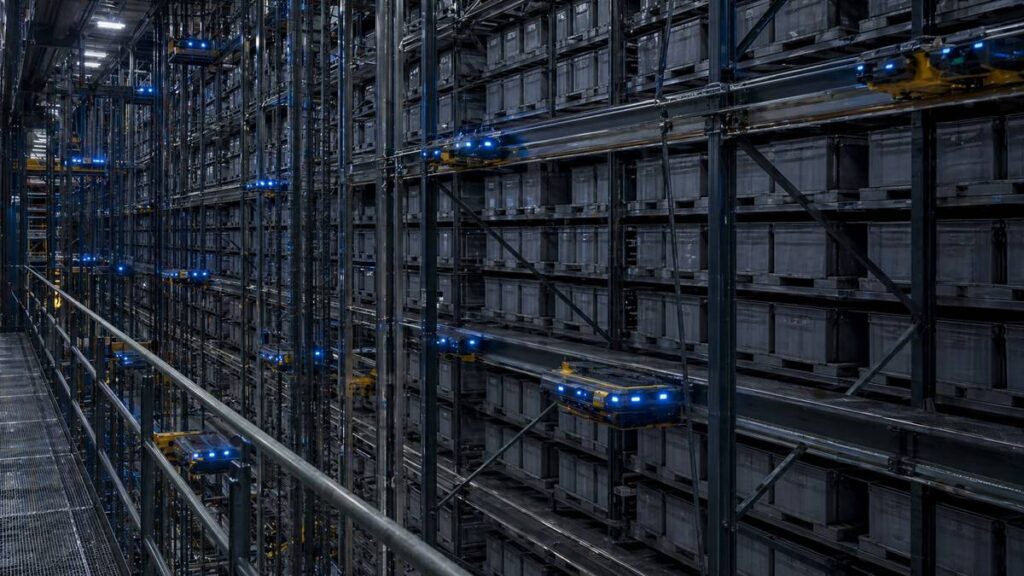
The Dematic Multishuttle is their flagship goods-to-person system. It uses autonomous shuttle vehicles operating on multiple levels within a racking structure, with vertical lifts connecting the levels to conveyor systems and picking stations.
Key specs:
- Handles totes and cartons up to 50 kg
- Throughput scales by adding shuttles — systems can reach 10,000+ tote movements per hour
- Racking heights up to 24 meters
- Supports single-deep and multi-deep storage configurations
The Multishuttle competes directly with systems from SSI Schaefer (Navette), TGW (Stingray), and Knapp (OSR Shuttle). It is a proven platform with hundreds of installations worldwide, particularly strong in grocery, retail, and e-commerce fulfillment.
If you are comparing shuttle-based systems, our guide on types of ASRS systems covers how shuttle architectures differ from crane-based and robotic alternatives.
AutoStore Partnership
Dematic is one of the largest global distribution partners for AutoStore, the Norwegian cube-based storage system. Rather than manufacturing the robots themselves, Dematic designs, sells, installs, and services AutoStore grids as part of their solution portfolio.
AutoStore uses a grid of bins stacked on top of each other, with small robots running on top of the grid to retrieve bins and deliver them to picking ports. The system is known for extreme storage density — up to 4x more positions per square meter than conventional racking.
Worth noting: when you buy AutoStore through Dematic, you are paying Dematic's margin on top of AutoStore's hardware cost. Independent AutoStore partners and other integrators (including us) can offer the same hardware, often with more competitive pricing and faster project timelines. The robots and grid are identical regardless of who installs them.
Pallet ASRS
Dematic's pallet ASRS systems use automated stacker cranes for high-bay storage of full pallets. These are traditional unit-load systems designed for bulk storage in manufacturing, beverage, cold chain, and distribution environments.
Typical configurations:
- Single-deep, double-deep, or multi-deep racking
- Heights up to 45 meters in purpose-built facilities
- Throughput of 20-60 pallet movements per hour per aisle
- Integration with pallet conveyor, AGVs, and truck loading systems
This is mature technology that Dematic has been delivering for decades. Performance is reliable and well-documented. For a detailed cost comparison across pallet ASRS options, see our ASRS system cost breakdown.
Pouch System
The Dematic Pouch System is a specialized overhead conveyor that stores individual items in hanging pouches. Each pouch travels on a monorail track and can be sorted, buffered, and sequenced automatically. It is designed for fashion, apparel, and returns processing where items vary in size and shape.
This is a niche product. If your operation handles garments, shoes, or other soft goods that do not fit neatly into totes, the pouch system solves a real problem. For most other applications, tote-based or pallet-based ASRS is a better fit.
Where Dematic Warehouse Automation Performs Well
Credit where it is due. Dematic has genuine strengths that matter for certain project profiles.
Global service coverage. If you operate warehouses on multiple continents and need a single vendor to support all of them, Dematic's footprint is hard to match. They have service teams in 35+ countries, which means local spare parts, local technicians, and local project management. For a multinational retailer running distribution centers in the US, Europe, and Asia, this is a real operational advantage.
Full-stack capability. Dematic builds hardware, writes software (their Dematic iQ platform), and handles system integration in-house. For companies that want a single vendor responsible for everything from racking steel to WMS integration, this simplifies procurement and accountability.
Large-scale project experience. Dematic has delivered some of the largest automated distribution centers in the world. If your project involves 500,000+ square feet, multiple ASRS zones, miles of conveyor, and integration with automated truck loading, Dematic has done it before. That experience reduces execution risk on mega-projects.
Financial stability. Backed by KION Group (a publicly traded company with 11+ billion euros in annual revenue), Dematic is not going anywhere. For a 15-year capital investment, vendor viability matters. You will not wake up to find your ASRS supplier has gone bankrupt and left you without spare parts.
According to a 2024 report by Interact Analysis, Dematic consistently ranks among the top three warehouse automation vendors globally by revenue, alongside Daifuku and Vanderlande.
Where Dematic ASRS Has Limitations
No vendor is perfect for every project. Here are the trade-offs you should weigh.
Premium pricing. Dematic is not the low-cost option. Their proposals typically come in 20-40% higher than comparable solutions from mid-tier integrators or direct-from-manufacturer purchases. Part of this premium pays for their global infrastructure and brand. Part of it is margin. For a $5 million project, that difference can mean $1-2 million in additional cost — money that could fund extra capacity, better software, or a faster ROI.
We have seen this firsthand. When clients bring us a Dematic proposal for comparison, the scope is usually similar, but the price gap is consistent. The hardware performs the same job. The difference is in who assembles it and what margin sits on top.
Vendor lock-in risk. Dematic prefers to sell complete solutions using their own hardware and software stack. Their Dematic iQ software is proprietary, and switching to a different WES or WCS after installation is painful and expensive. If you want to add equipment from a different manufacturer later — say, AMRs from a robotics company that Dematic does not partner with — integration becomes your problem.
This is the fundamental trade-off of buying from a large OEM. You get a tightly integrated system on day one, but you lose flexibility for day 1,000. Independent integrators like us build on vendor-agnostic WES platforms specifically to avoid this lock-in.
Customization constraints. Dematic's strength in standardization becomes a weakness when your operation does not fit their standard templates. Their engineering process is optimized for repeatable configurations. If your warehouse has unusual ceiling heights, non-standard floor loads, legacy conveyor that needs to stay, or workflow requirements that fall outside their typical project profile, expect longer timelines and higher engineering costs.
Long lead times. Large organizations move at large-organization speed. From initial proposal to system go-live, Dematic projects commonly take 18-30 months. Some of that is manufacturing lead time (which affects all vendors), but a significant portion is internal engineering review, approval cycles, and resource scheduling. Smaller integrators can often compress timelines by 3-6 months through leaner project management and faster decision-making.
Attention allocation. Dematic prioritizes large accounts. If your project is under $3 million, you may not get their top engineering and project management resources. This is not a criticism — it is rational resource allocation for a company managing hundreds of concurrent projects. But it means mid-market companies sometimes feel like a small fish in a very large pond.
When to Choose Dematic vs an Independent Integrator
The decision is not about which option is "better" in the abstract. It is about which option fits your specific situation.
Dematic is likely the right choice when:
- Your project budget exceeds $10 million and involves multiple automation zones
- You operate distribution centers in 3+ countries and need unified vendor support
- You want a single vendor accountable for the entire system, including software
- Your timeline is flexible (18+ months to go-live is acceptable)
- You are a publicly traded company where vendor brand recognition matters for board-level approval
An independent integrator is likely the better choice when:
- Your budget is $1-8 million and cost efficiency is a priority
- You want to select best-of-breed hardware from multiple manufacturers
- You need a vendor-agnostic WES that can control equipment from different brands
- Your project timeline is aggressive (12-15 months or less)
- You anticipate changing or expanding your automation mix over the next 5-10 years
- Your warehouse has non-standard constraints that require creative engineering
For a practical example: one of our clients, a sporting goods retailer, initially received a Dematic proposal for a Multishuttle system at $6.2 million. We designed an alternative using shuttle hardware from a specialized European manufacturer, integrated with our WES platform, and delivered equivalent throughput for $4.1 million — with a go-live date 4 months earlier. The Decathlon case study covers a similar project profile if you want to see how multi-vendor integration works in practice.
Dematic ASRS Cost vs Independent Integrator: A Breakdown
Cost is the factor that drives most of these decisions. Here is how the numbers typically break down.
| Cost Category | Dematic (Typical) | Independent Integrator (Typical) |
|---|---|---|
| Hardware (racking, shuttles, conveyors) | Dematic-manufactured or Dematic-sourced | Best-of-breed from multiple manufacturers |
| Software (WES/WCS) | Dematic iQ (proprietary, included) | Vendor-agnostic WES (licensed separately) |
| Engineering and design | 8-12% of project cost | 6-10% of project cost |
| Installation and commissioning | Included in turnkey price | Included or subcontracted |
| Annual maintenance | 3-5% of system value | 2-4% of system value |
| Total project cost (mid-size) | $4M-$8M | $2.5M-$5.5M |
| Typical timeline | 18-30 months | 12-20 months |
The hardware itself accounts for 50-65% of total project cost regardless of who supplies it. The difference comes from margin structure, software licensing, and overhead. Dematic's global infrastructure costs money to maintain, and that cost is built into every proposal.
One area where Dematic can be more cost-effective: very large projects with high standardization. When you are deploying the same system design across five distribution centers, Dematic's ability to replicate configurations and leverage volume purchasing can close the price gap. For one-off or highly customized projects, the gap widens.
For detailed pricing data across all ASRS types, our ASRS cost analysis breaks down numbers by system size and technology.
How to Evaluate a Dematic ASRS Proposal
If you already have a Dematic proposal in hand, here is a practical checklist for evaluating it.
1. Break down the line items. Ask for a detailed cost breakdown separating hardware, software, engineering, installation, and commissioning. Dematic proposals sometimes bundle these into a single turnkey number, which makes comparison difficult. You need the breakdown to benchmark against alternatives.
2. Clarify software ownership. Understand what happens to the Dematic iQ software license if you ever want to switch vendors. Is it a perpetual license or subscription? Can you run it independently, or does it require Dematic's cloud infrastructure? What are the annual maintenance fees after year one?
3. Check the throughput guarantees. Dematic should provide contractual throughput commitments — not just theoretical maximums. Ask for guaranteed sustained throughput under your actual order profile (not a best-case scenario with uniform tote sizes and perfect order batching).
4. Ask about spare parts pricing. Post-installation spare parts and service contracts are where margins get wide. Get a 5-year spare parts price list upfront and compare it against aftermarket or direct-from-manufacturer alternatives.
5. Get a second opinion. This is not about playing vendors against each other for sport. A credible independent integrator can review your requirements and tell you whether Dematic's proposed configuration is right-sized, over-engineered, or missing something. We do this regularly — sometimes we tell clients to go with Dematic because it genuinely is the best fit. Reach out for a free consultation if you want an objective second look.
Dematic ASRS System: Frequently Asked Questions
Is Dematic the largest ASRS manufacturer in the world?
Dematic is one of the top three, depending on how you measure. By revenue, Daifuku (Japan) typically leads the global market, with Dematic and Vanderlande (also KION Group) close behind. By number of installations in North America, Dematic is arguably the leader. The ranking matters less than whether their specific product line matches your requirements.
Can I buy Dematic hardware without their software?
Technically yes, but Dematic does not make it easy. Their systems are designed to run on Dematic iQ, and purchasing hardware-only means you lose their standard commissioning support and warranty terms may change. If you want Dematic-class hardware with independent software, a better path is sourcing equivalent shuttle or crane hardware from manufacturers who sell through open channels and pairing it with a vendor-agnostic WES.
How does Dematic compare to SSI Schaefer?
Both are European-headquartered, full-stack automation providers with global reach. SSI Schaefer tends to be stronger in manual and semi-automated racking solutions alongside their ASRS line, while Dematic leans more heavily into software and robotics integration. Pricing is comparable. The choice often comes down to which company has a stronger local presence in your region and which product line better fits your throughput profile.
What is the typical ROI timeline for a Dematic ASRS system?
Dematic projects typically achieve payback in 3-5 years, consistent with the broader ASRS market. The variables are labor cost savings (the primary driver), throughput improvements, accuracy gains, and reduced real estate costs. Projects in high-labor-cost markets (Western Europe, US coastal cities, Japan) tend to hit ROI faster. For a detailed ROI framework, see our ASRS cost analysis.
Is Dematic a good choice for small warehouses?
Not usually. Dematic's sweet spot is projects above $3-5 million. For smaller operations — say, under 20,000 square feet or fewer than 5,000 SKUs — the overhead of working with a global OEM does not make economic sense. A mini load ASRS from a specialized manufacturer, integrated by a mid-market partner, will deliver better value and faster implementation.
Can Dematic integrate with my existing WMS?
Yes. Dematic iQ supports standard integration protocols (REST APIs, message queues, EDI) and has pre-built connectors for major WMS platforms including SAP EWM, Manhattan Associates, Blue Yonder, and Oracle. That said, integration complexity and cost vary. If your WMS is older or heavily customized, budget for additional integration engineering.
Making the Right Choice for Your Warehouse
Dematic builds solid ASRS systems. That is not in question. The real question is whether their approach — large-scale, vertically integrated, premium-priced — aligns with what your operation needs right now and where it is heading over the next decade.
If you are running a massive, multi-site distribution network and want one vendor to own the entire stack, Dematic belongs on your shortlist. If you are a mid-market operation looking for cost efficiency, flexibility, and the ability to mix hardware from different manufacturers under a single intelligent WES platform, an independent integrator will likely serve you better.
We have helped companies on both sides of this decision. Some of our clients came to us after outgrowing a Dematic system that could not adapt to their changing needs. Others came to us first, and we helped them build a goods-to-person picking system or shuttle-based solution that delivered the same throughput at a lower total cost.
The best next step is a conversation. Bring your requirements, bring your Dematic proposal if you have one, and we will give you an honest assessment of your options.
Get a free warehouse automation consultation
Planning a Warehouse Automation Project?
Our team has delivered 50+ ASRS systems across retail, manufacturing, and logistics. Tell us about your project and we will get back to you within 24 hours.
Thank you!
We received your message and will get back to you within 24 hours.