
Sundan — Omni-Channel Smart Retail Fulfillment
About Sundan
Sundan is a premium consumer electronics retailer founded in Shenzhen with over 20 years of brand history. With stores in prime locations across Beijing, Shanghai, Suzhou, and other major cities, Sundan is known for its customer-centric experiential retail approach — a model that demands the kind of agile fulfillment only warehouse automation can deliver.
Challenges
- Enormous product variety across phones, computers, cameras, and home electronics
- Complex mixed operations: online mall orders, in-store orders, and flash delivery orders processed simultaneously
- Need to handle sudden order spikes from flash delivery services
- Goal to unify the entire data chain, reduce inventory, and improve per-square-meter revenue
Solution
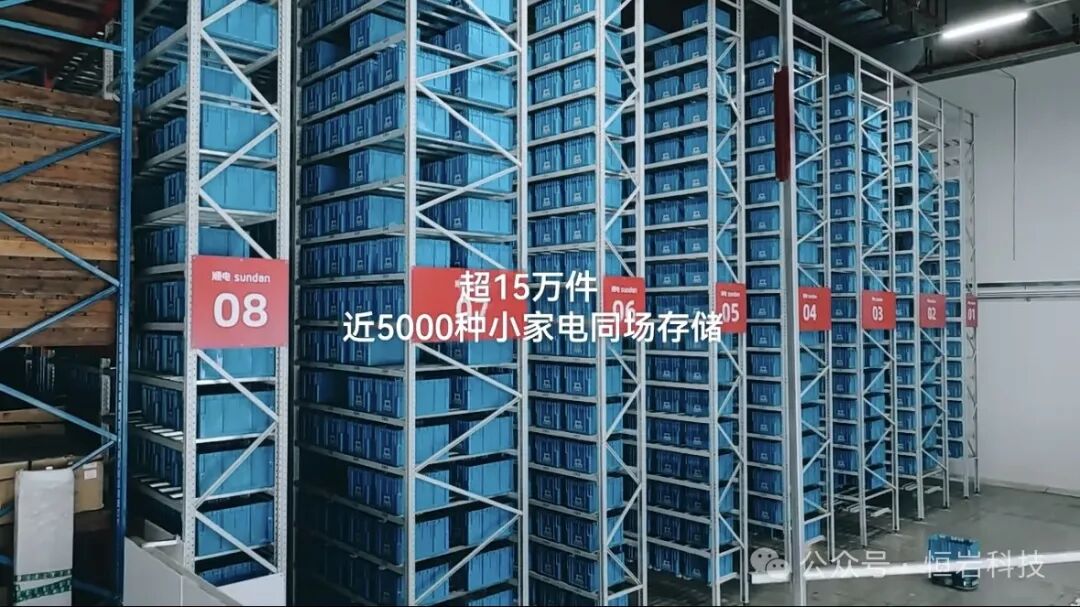
We deployed the HaiPick System 3 — an ACR + AMR collaborative solution at Sundan’s Dongguan distribution center:
- ACR Bin Robots: Handle bin retrieval and in-zone inventory management on 9-meter tall racking
- AMR Transport Robots: Manage bin inbound/outbound transport between zones
- Sky Bridge Racks: Installed above 5.8 meters in the aisles to maximize vertical space
- 18 bins per m²: High-density storage across the facility
- Custom WES System: Extends upward into WMS functionality and downward into business strategy
- Pure Robot Dispatch: Direct integration with equipment manufacturers for streamlined robot coordination
Results
- 150,000 items and nearly 5,000 SKUs stored and managed in a single facility
- Efficiency improved by 85% beyond original design targets
- Throughput reaching 289 bins per hour
- Successfully handles flash delivery order spikes in real time
- 18 bins per square meter storage density on 9-meter racking
In the electronics sector, Sony and Konica Minolta have deployed similar robotic solutions to transform their manufacturing logistics.
Retail distribution centers that handle everything from phone cases to refrigerators face a picking problem that single-category warehouses never encounter.
The Mixed-Category Challenge
A consumer electronics retailer’s catalog spans items that weigh 20 grams and items that weigh 80 kilograms. Phone screen protectors ship in padded envelopes. Washing machines ship on pallets. Between those extremes sit thousands of SKUs — headphones, laptops, small appliances, cables, batteries — each with different storage requirements, handling constraints, and order frequencies.
Sundan’s previous manual operation handled this range by splitting the warehouse into zones staffed by specialized teams. The small-item team picked accessories. The mid-size team handled boxed electronics. The heavy-goods team used forklifts for appliances. Coordination between zones was manual — a multi-category order waited at the packing station until all zones completed their portions.
The 85% efficiency gain came not from making each zone faster, but from eliminating the coordination overhead between zones. The WES orchestrates retrieval across all categories simultaneously, sequencing picks so that items from different zones arrive at the consolidation point within minutes of each other. No order waits for a straggler zone.
Why Goods-to-Person Works Differently for Electronics
Goods-to-person picking in a fashion warehouse means totes of soft goods arriving at a station where an operator grabs items by hand. Electronics adds constraints that soft goods do not have.
Lithium batteries require storage separation and handling protocols. High-value items like laptops and cameras need secure storage with access logging. Fragile items — screens, optical drives, glass components — demand cushioned totes and controlled conveyor speeds. The picking station itself must accommodate items ranging from a USB cable to a microwave oven.
When we configured Sundan’s system, each product category received a handling profile in the WES. The hardware layer routes items through paths matched to their sensitivity — fragile goods travel on cushioned conveyor segments at reduced speed, while robust items like cable spools take the standard high-speed path. The operator at the picking station sees items arrive in pack-sequence order, with fragile items last so they sit on top in the shipping carton.
Measuring the 85% Gain
Efficiency metrics in warehouse automation are easy to inflate by cherry-picking the comparison baseline. Sundan’s 85% improvement measures end-to-end order cycle time: from order receipt to shipping-ready carton. That metric captures everything — retrieval speed, pick accuracy (fewer re-picks), zone coordination (no waiting), and packing throughput (items arrive in pack sequence).
The per-task speed improvement was closer to 40%. The remaining gains came from eliminating dead time — the minutes each order spent waiting for cross-zone synchronization, the walks between zones for split orders, and the re-work cycles from picking errors that ran 3-4% in the manual operation and dropped below 0.2% after automation.
For retailers evaluating similar transformations, the types of ASRS systems guide covers which architectures handle mixed-category inventories. The cost analysis page models efficiency gains against investment timelines. The Comix case shows a comparable high-SKU deployment with different product characteristics.
Frequently Asked Questions
How does the system handle promotional bundles that combine items from different categories?
The WES treats bundles as composite orders with linked pick tasks. When a bundle order enters the queue, the system dispatches retrieval tasks to all relevant zones simultaneously and sequences arrivals so bundle components reach the packing station together. The operator receives a bundle instruction on screen showing the kit contents and pack configuration. No pre-kitting step is needed — bundles are assembled at the point of packing.
What happens when a high-value item is damaged during automated handling?
Machine vision stations at key transfer points inspect items for visible damage. If damage is detected, the item is diverted to a quality inspection lane, the order is flagged, and the WES automatically retrieves a replacement unit if stock is available. The damaged item enters a returns workflow for vendor claim processing. Damage rates in the automated system run below 0.05% — roughly one-tenth of the manual operation’s rate.
Can this system support same-day delivery commitments for a retail operation?
Yes, and that was a core design requirement for Sundan. Orders flagged for same-day shipping receive priority queue status in the WES, jumping ahead of standard orders in the retrieval sequence. The system maintains a cutoff-time buffer — orders received before the cutoff are guaranteed to complete processing within the shipping window. Contact us with your delivery SLA requirements and daily order volume for a feasibility assessment.