
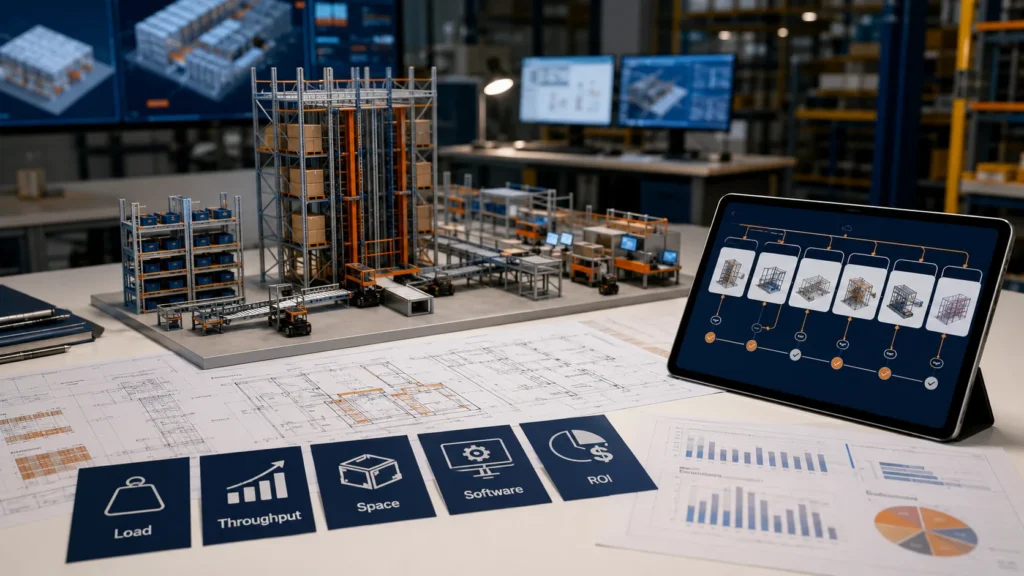
Many buyers start by asking how to choose ASRS system options, but the better question is what warehouse constraint the system needs to solve. Two warehouses can both need automated storage and retrieval, but one may require pallet cranes, another may need shuttle ASRS, and a third may perform better with bin robots or a hybrid ASRS + AMR layout.
The wrong choice usually happens when buyers start with the machine instead of the operation. They compare crane speed, robot count, rack height, or vendor price before they have defined the load profile, order profile, throughput target, integration scope, and expansion path.
Short answer: To choose the right ASRS system, first define what the system must store, how fast it must retrieve, how orders flow through the building, and what constraints the site has. Then match the ASRS type to load size, SKU velocity, peak throughput, building height, software integration, maintenance capability, and ROI. The best ASRS is the one that solves the actual bottleneck at the lowest total cost over its operating life.
This guide gives you a practical decision framework for selecting an automated storage and retrieval system, whether you are planning a new warehouse, retrofitting an existing facility, or comparing vendor proposals.
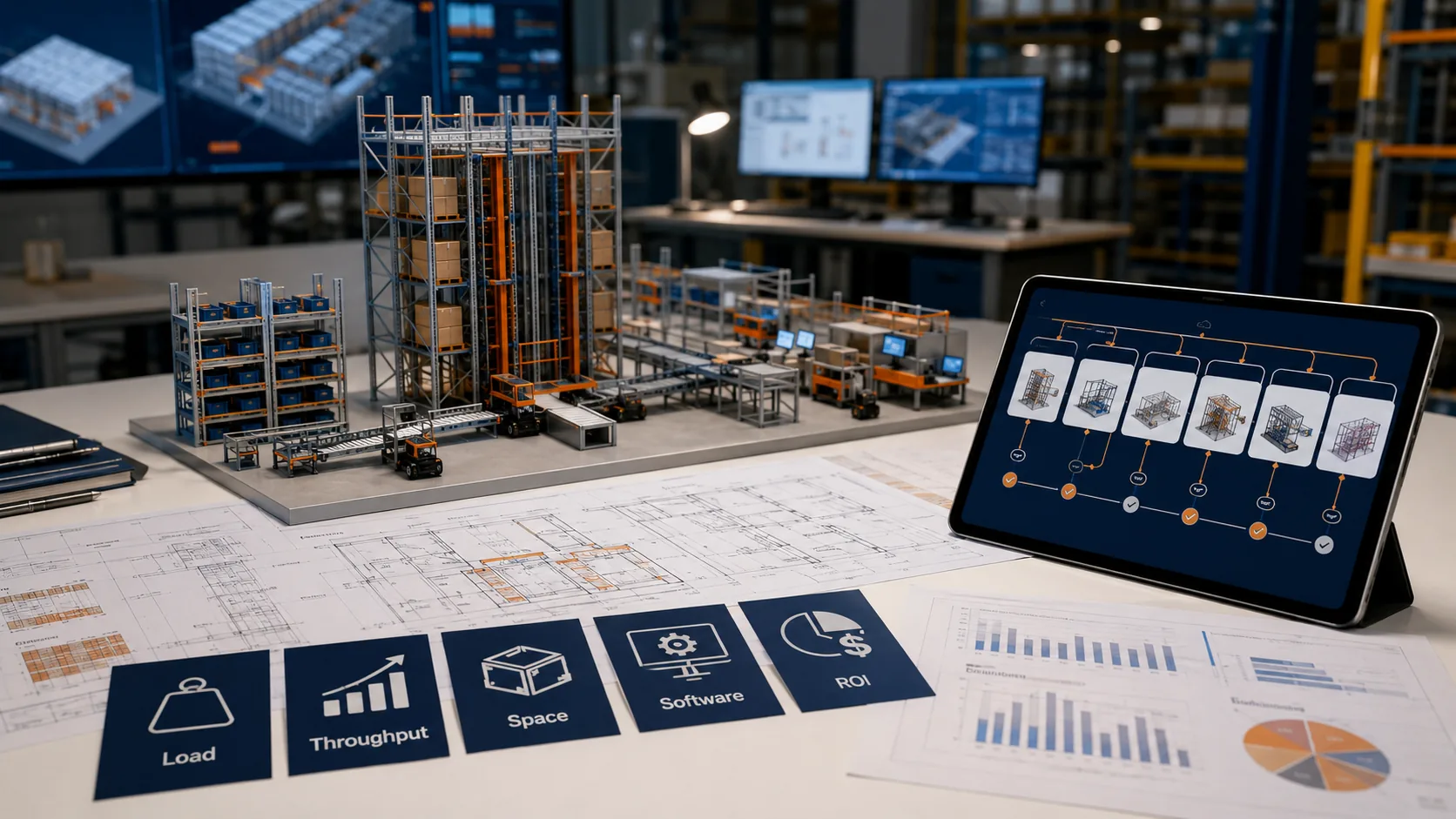
Step 1: Define the Problem Before Choosing the Technology
The first question is not "which ASRS should we buy?" The first question is "what operating constraint are we trying to remove?"
Most ASRS projects begin because one or more constraints have become visible:
- The warehouse is running out of storage space.
- Picking labor is too expensive or difficult to hire.
- Forklift travel is slowing throughput or creating safety risk.
- Order volume is growing faster than the manual process can support.
- Inventory accuracy is causing stockouts, mis-picks, or production delays.
- Peak-season capacity depends too heavily on overtime and temporary labor.
- A new warehouse design needs automation from day one.
Each constraint points toward a different automation design. If the issue is pallet density, a high-bay pallet ASRS may be appropriate. If the issue is each-picking speed, a tote-based goods-to-person system may matter more. If the issue is SKU volatility, a flexible robotic layout may outperform fixed infrastructure.
Before you compare vendors, write one sentence that defines the project outcome:
We need an ASRS system that helps us [primary goal] while staying within [site constraint] and supporting [future growth requirement].
That sentence keeps the project grounded. Without it, the buying process can drift into feature comparison instead of operational design.
Step 2: Map Your Load Profile
ASRS selection starts with the physical unit being stored. A system designed for pallets is not a system designed for totes. A system designed for uniform cartons may struggle with fragile, irregular, or mixed-size goods.
Build a simple load profile before talking to suppliers:
| Load question | Why it matters |
|---|---|
| Are you storing pallets, totes, cartons, trays, bins, or mixed units? | Determines the ASRS category |
| What are the minimum and maximum dimensions? | Determines rack design and handling equipment |
| What is the weight range? | Determines crane, shuttle, robot, and conveyor capacity |
| Are items fragile, temperature-sensitive, or regulated? | Affects handling speed, traceability, and safety logic |
| Is storage single-SKU or mixed-SKU? | Affects picking workflow and inventory control |
| Are there overhang, deformation, or packaging issues? | Affects automation reliability |
This sounds basic, but it is where many projects start to go wrong. If the load data is incomplete, the system may be oversized, undersized, or designed around an idealized SKU profile that does not match the warehouse.
For palletized operations, compare your needs against a pallet ASRS architecture. For totes, cartons, or small parts, read the mini-load ASRS guide and the broader comparison of ASRS system types.
Step 3: Understand Your Order and Movement Profile
The load profile tells you what the ASRS must handle. The order profile tells you how fast and how often it must move.
For a buyer, the most important movement data includes:
- Daily inbound units.
- Daily outbound units.
- Peak-hour storage and retrieval movements.
- Lines per order.
- Orders per day.
- SKU velocity curve.
- Peak-to-average ratio.
- Replenishment frequency.
- Returns or reverse logistics volume.
- Required cutoff times.
Do not size the system only around daily averages. Warehouses fail during peaks, not during averages. An ASRS that looks sufficient on daily volume may become a bottleneck during carrier cutoff, production shift change, promotion waves, or month-end shipping.
The SKU velocity curve is especially important. A steep curve means a small number of SKUs drive much of the movement. That often supports a dense high-throughput zone for fast and medium movers. A flatter curve means many SKUs move at similar rates. That may favor a more flexible goods-to-person or hybrid design.
Step 4: Choose the ASRS Category That Fits the Work
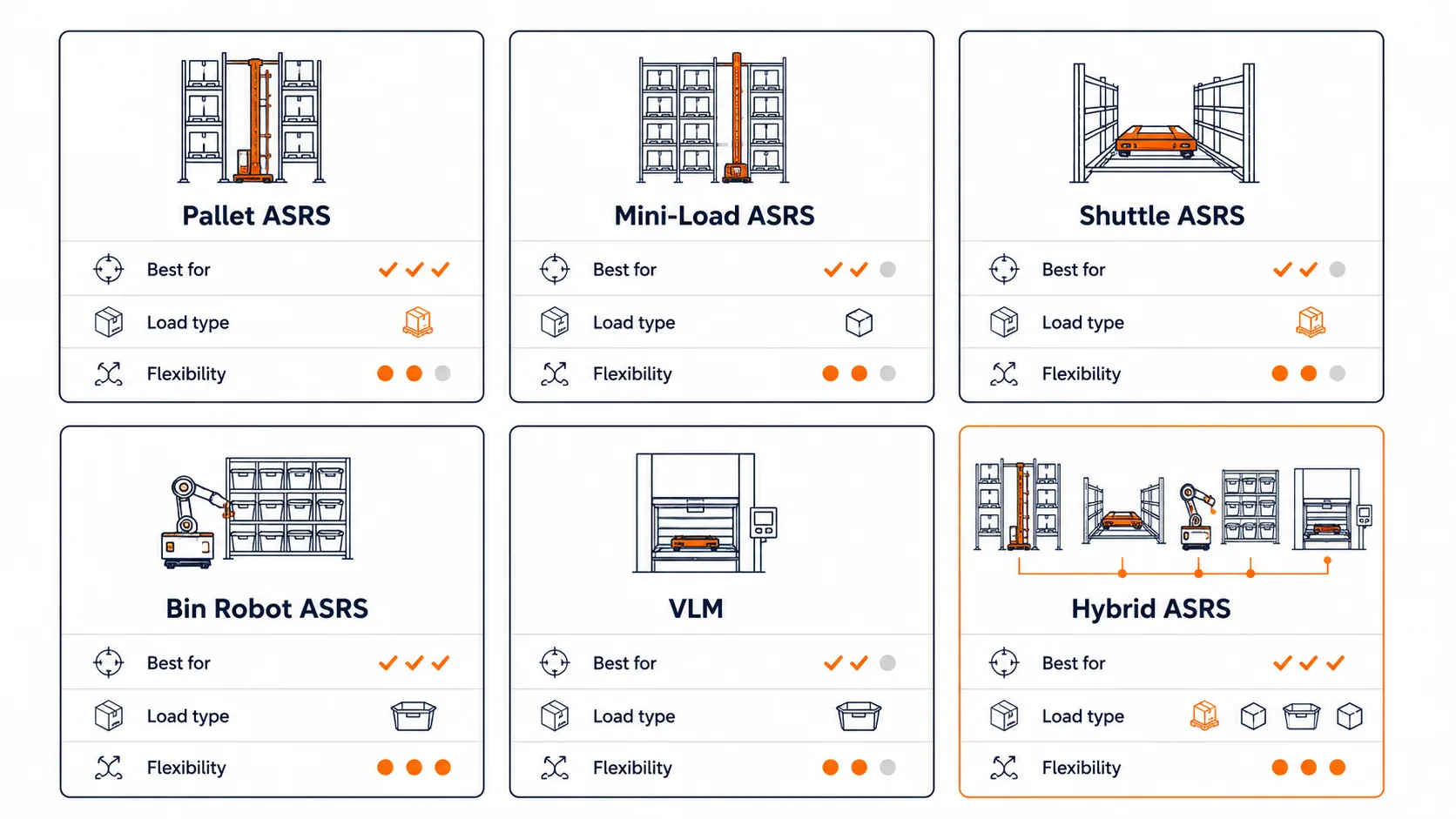
There is no universal "best ASRS." Each type solves a different problem. Use the table below as a first-pass decision guide.
| If your operation looks like this | Start with this ASRS type | Why |
|---|---|---|
| Full pallets, high storage density, predictable pallet flow | Pallet ASRS / unit-load ASRS | Best fit for dense pallet storage and controlled forklift reduction |
| Totes or cartons, moderate throughput, controlled SKU set | Mini-load ASRS | Good for dense tote storage and stable retrieval workflows |
| Totes or cartons, high throughput, e-commerce or retail flow | Shuttle ASRS | Scales movement rate by adding shuttles, lifts, and stations |
| High SKU variety, goods-to-person picking, changing demand | Bin robot or robotic G2P ASRS | Flexible for SKU complexity and phased scaling |
| Mixed zones with fast movers, long tail, returns, and exceptions | Hybrid ASRS + AMR | Lets each zone use the right automation method |
| Small parts, tools, maintenance inventory, limited footprint | VLM or carousel | Compact storage for lower-volume controlled access |
This table is a starting point, not a final design. Many real warehouses need a combination. A large e-commerce site may use shuttle ASRS for fast movers, AMRs for long-tail SKUs, conveyors for packing flow, and pallet ASRS for reserve inventory. A manufacturer may use pallet ASRS for raw materials and mini-load ASRS for components.
If you are comparing mobile robots and fixed automated storage, the ASRS vs AMR guide explains where each category wins.
Step 5: Check Building Constraints Early
An ASRS system has to fit the building, not just the process model. Before detailed design, validate the physical constraints:
- Clear height.
- Floor flatness and load capacity.
- Column grid.
- Fire protection requirements.
- Seismic or local building rules.
- Dock locations.
- Existing conveyor or production line connections.
- Temperature zones.
- Maintenance access.
- Expansion space.
Building height is often the first filter. A high-bay pallet ASRS needs enough vertical cube to justify the infrastructure. A shuttle or mini-load system may fit lower buildings but still needs clean rack geometry and access for lifts, conveyors, and service areas. Robotic goods-to-person systems can work in more existing buildings, but they still need floor quality, charging space, traffic lanes, and station layouts.
Retrofitting an existing warehouse is possible, but the design must respect the building. Sometimes the right answer is not the tallest system. It is the system that improves throughput and density without turning installation into a construction project that disrupts the whole operation.
Step 6: Decide Whether You Need Fixed Automation, Flexible Automation, or Both
ASRS buyers often frame the decision as fixed automation versus mobile robots. That is too narrow.
Fixed ASRS systems such as pallet cranes, mini-load cranes, and shuttle systems usually win on density, predictable throughput, and long-term control. They are strong when the product flow is stable and the building can support dedicated automation zones.
Flexible automation such as AMR-based goods-to-person systems usually wins on phased deployment, layout adaptability, and changing SKU profiles. It is strong when the operation expects frequent change or does not want to commit the whole building to fixed infrastructure.
Hybrid designs are common because warehouses are not uniform. Fast movers may need dense automated storage. Slow movers may need flexible picking. Returns may need human inspection. Bulky products may need separate handling. Reserve pallets may not belong in the same system as each-pick totes.
The practical rule is simple: use fixed automation where the flow is stable enough to justify density and speed, and use flexible automation where variability would make fixed infrastructure expensive or rigid.
Step 7: Evaluate Software Integration, Not Just Hardware
ASRS performance depends heavily on software. The hardware stores and moves goods, but the software decides what should move, when it should move, and how tasks should be sequenced.
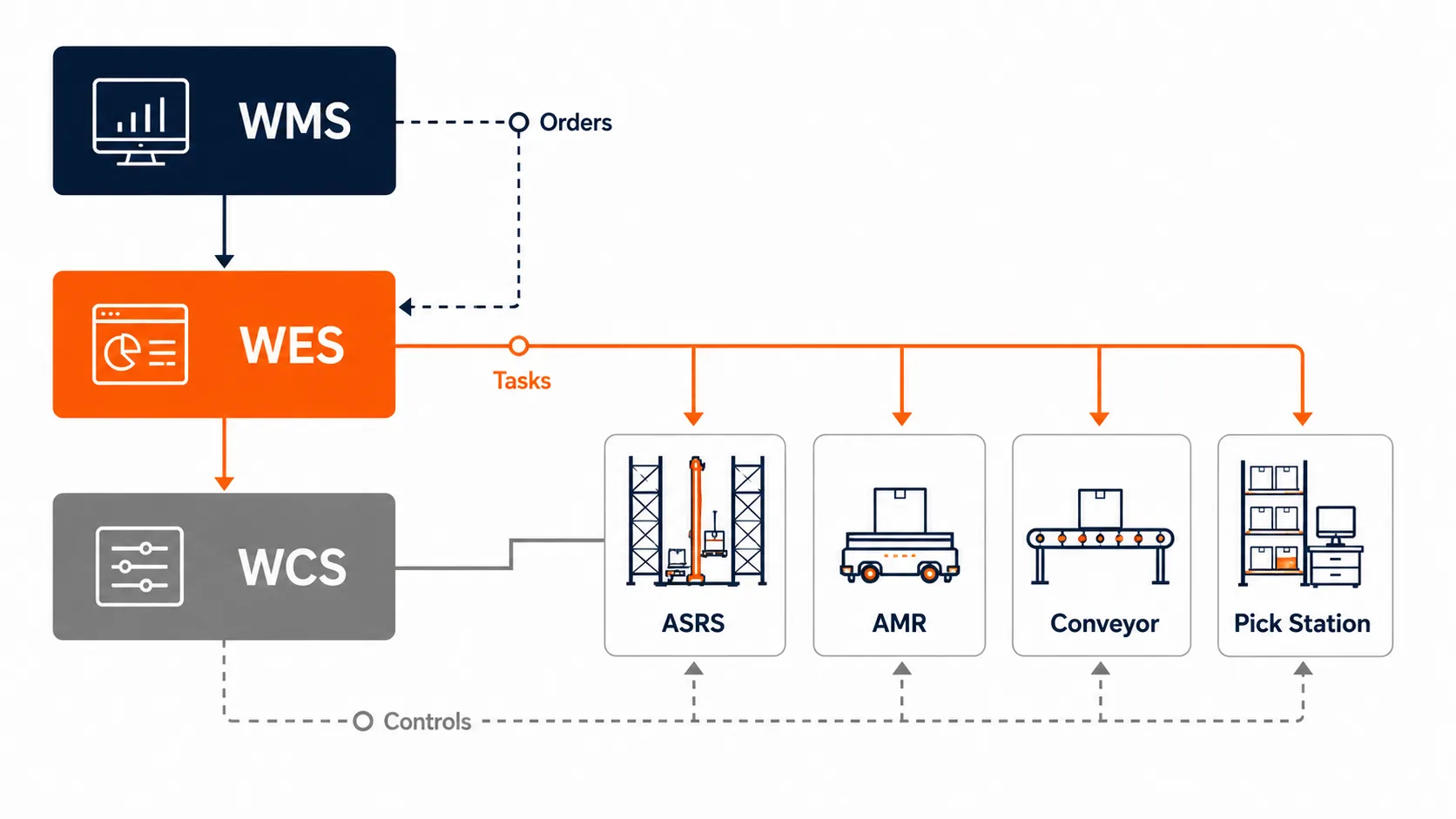
Most projects involve three software layers:
- WMS: inventory, orders, allocation, receiving, shipping, and warehouse records.
- WES: real-time orchestration across ASRS, robots, conveyors, picking stations, replenishment, and exceptions.
- WCS: equipment-level control for conveyors, cranes, shuttles, scanners, PLCs, and local automation.
If you want a deeper breakdown, read WES vs WMS vs WCS. For ASRS selection, the key point is this: a technically strong machine can still underperform if task release, station balancing, exception handling, and downstream flow are poorly integrated.
Ask vendors these questions:
- How does the ASRS receive tasks from our WMS or ERP?
- What system owns inventory location changes?
- How are retrieval tasks prioritized during peak periods?
- How are exceptions handled when a tote, pallet, scanner, or station fails?
- Can the WES balance work across multiple automation zones?
- What data is available for dashboards and reporting?
- Who supports the integration after go-live?
Do not leave integration as a late project detail. In many ASRS projects, software integration is where the real operational design happens.
Step 8: Build a Real ROI Model
ASRS ROI is not only labor savings. A serious model should include the full operating impact:
- Labor reduction or labor redeployment.
- Storage density and avoided real estate cost.
- Picking accuracy and lower return/error cost.
- Throughput and service-level improvement.
- Lower forklift travel and safety exposure.
- Inventory visibility and reduced search time.
- Product damage reduction.
- Maintenance and spare parts.
- Software licensing and support.
- Energy use.
- Installation, commissioning, and training.
Our warehouse automation ROI guide gives a detailed framework, but the buyer discipline is straightforward: compare ASRS against your actual baseline, not against a perfect manual operation.
Use your current cost per order, lines per labor hour, overtime pattern, rent, error rate, inventory variance, and growth forecast. If those numbers are unknown, pause the vendor comparison and collect them. A weak baseline makes every proposal look more precise than it really is.
Step 9: Compare Total Cost of Ownership
The lowest upfront quote is not always the lowest-cost ASRS. Total cost of ownership matters more than purchase price.
Evaluate:
- Hardware cost.
- Racking and structural work.
- Conveyors, scanners, stations, and safety equipment.
- Software license or subscription.
- Integration services.
- Installation and commissioning.
- Training.
- Maintenance contract.
- Spare parts availability.
- Energy cost.
- Future expansion cost.
- Downtime risk.
Ask each supplier to separate the cost of base deployment from the cost of expansion. A system that is inexpensive for phase one may become expensive if every future increase requires major mechanical changes. A system with a higher first price may be cheaper over seven to ten years if it scales cleanly and has better support.
Step 10: Plan for Growth and Failure Modes
Good ASRS design includes future growth and imperfect conditions. Warehouses change. Demand rises. SKU profiles shift. Equipment needs maintenance. Software rules need tuning. New channels appear.
Before selecting a system, model these scenarios:
- Normal day.
- Peak day.
- Peak hour.
- Three-year growth.
- Five-year growth.
- One lift, shuttle, robot, or crane unavailable.
- One picking station unavailable.
- WMS integration delay.
- Returns spike.
- SKU mix change.
- New customer or sales channel.
This does not mean overbuilding everything. It means identifying where the system has headroom and where it has hard limits. If a lift becomes the bottleneck, adding shuttles may not help. If packing is the bottleneck, faster ASRS retrieval may create congestion. If WES logic cannot prioritize correctly, more hardware may only move the problem faster.
Common Red Flags in ASRS Proposals
When comparing ASRS proposals, watch for these warning signs:
The proposal leads with equipment count but not process design. Robot count, crane count, or shuttle count means little without order profile, peak-hour movement, and station balancing.
The vendor does not ask for detailed SKU and order data. If the design can be quoted without understanding your operation, it is probably generic.
Software integration is described vaguely. Phrases like "standard interface" or "easy WMS connection" need detail. Ask for message flows, ownership boundaries, exception logic, and support responsibility.
The design ignores downstream bottlenecks. ASRS retrieval is valuable only if picking, packing, sortation, shipping, and replenishment can absorb the flow.
The expansion path is unclear. If growth requires rebuilding the core system, the initial design may be too narrow.
Maintenance access is missing from the layout. A dense system that cannot be serviced efficiently will create avoidable downtime.
External References for ASRS Buyers
If you are building an internal business case, it helps to compare vendor proposals against neutral industry references. The MHI AS/RS industry group is a useful starting point for understanding how the material handling industry defines automated storage and retrieval systems. For safety planning, the OSHA warehousing guidance is also worth reviewing before changing forklift traffic, automated storage zones, pedestrian routes, or maintenance access.
ASRS Selection Checklist
Use this checklist before moving from vendor conversations to a purchase decision:
- Primary business constraint is clearly defined.
- Load profile is complete and validated.
- Order profile includes peak-hour movement, not only daily averages.
- SKU velocity curve has been reviewed.
- Building constraints are confirmed.
- ASRS type is matched to load, throughput, and variability.
- WMS, WES, and WCS responsibilities are defined.
- Exception handling is documented.
- Downstream packing, sortation, and shipping are included in the flow.
- ROI model uses actual current baseline data.
- Total cost of ownership includes maintenance and expansion.
- Growth and failure scenarios have been modeled.
- Go-live support and post-launch tuning are included.
This checklist is intentionally practical. It prevents a common mistake: buying automation before the operating model is ready.
Example: Matching ASRS Type to Warehouse Scenario
Consider three different warehouses.
Scenario A: Beverage manufacturer. The site stores full pallets, has steady inbound and outbound volume, and wants to reduce forklift travel while using more vertical height. A pallet ASRS or unit-load ASRS is likely the first option to model.
Scenario B: E-commerce fulfillment center. The site ships many small orders, carries thousands of active SKUs, and faces sharp peak waves. Shuttle ASRS, bin robot ASRS, or a hybrid ASRS + AMR system may fit better than a pure pallet solution. Our guide to ASRS for e-commerce fulfillment covers that pattern in more detail.
Scenario C: Spare parts warehouse. The site handles many low-volume SKUs, needs accuracy, and has limited floor space. Mini-load ASRS, VLM, or robotic goods-to-person may be more appropriate than high-throughput shuttle infrastructure.
The lesson is not that one technology is superior. The lesson is that each system type becomes "right" only when the operating profile supports it.
Frequently Asked Questions
What is the first step in choosing an ASRS system?
The first step is defining the operational problem. Identify whether the main constraint is storage density, picking speed, labor availability, inventory accuracy, safety, peak capacity, or future growth. Then collect load, order, SKU, building, and software data before comparing ASRS types.
Which ASRS system is best?
There is no single best ASRS system. Pallet ASRS is best for dense pallet storage, mini-load ASRS is strong for tote and carton storage, shuttle ASRS fits high-throughput e-commerce and retail, robotic goods-to-person fits SKU variety and flexible scaling, and hybrid systems fit mixed warehouse profiles.
How do I know if I need ASRS or AMR?
Choose ASRS when density, controlled throughput, vertical storage, and predictable movement are the main priorities. Choose AMR when flexibility, phased deployment, and changing layouts matter more. Many warehouses use both: ASRS for dense storage and AMR for long-tail picking, returns, or exceptions.
What data is needed for an ASRS proposal?
An ASRS proposal should be based on load dimensions and weights, SKU count, SKU velocity, daily and peak-hour movements, order lines, replenishment volume, returns volume, building height, floor capacity, dock locations, software systems, growth forecast, labor cost, and current error rate.
How important is WES when choosing ASRS?
WES is critical when the ASRS must coordinate with multiple stations, conveyors, AMR fleets, WMS tasks, packing lines, or exception workflows. The WES layer decides task priority and balances work across the operation, so it often determines whether the ASRS performs well in real conditions.
Should I choose the cheapest ASRS proposal?
Not automatically. The cheapest proposal may exclude integration, expansion, maintenance access, spare parts, or downstream bottlenecks. Compare total cost of ownership, not just purchase price. A higher upfront system can be cheaper over time if it scales better and reduces operational risk.
Bottom Line
The right ASRS system is the one that matches your load profile, order profile, building constraints, software environment, and growth plan. Start with the warehouse problem, not the equipment catalog.
If you are early in the process, define the constraint, collect the data, and narrow the system type before requesting final proposals. If you already have proposals, compare them against the checklist above. The strongest option should explain not only what hardware it uses, but why that architecture fits your operation.
GoASRS designs ASRS projects across pallet storage, mini-load systems, shuttle systems, bin robots, AMRs, conveyors, and WES integration. If you want a second opinion on your warehouse profile, send us your current operation data and we will help you identify which ASRS approach is worth modeling first.
Planning a Warehouse Automation Project?
Our team has delivered 50+ ASRS systems across retail, manufacturing, and logistics. Tell us about your project and we will get back to you within 24 hours.
Thank you!
We received your message and will get back to you within 24 hours.