
Olympic Circuit — PCB Smart Warehouse Automation
About Olympic Circuit
Olympic Circuit (世运电路) is a major PCB (Printed Circuit Board) manufacturer serving the global electronics industry, with annual production capacity exceeding 4 million square meters and annual revenue surpassing 3.3 billion RMB. Driven by the rapid growth of new energy vehicles and 5G technology, PCB demand has surged — and with it, the volume of finished goods flowing through their warehouse. With a vast product catalog spanning thousands of SKUs and demanding production schedules, Olympic needed to modernize its warehouse operations to keep pace with growing order volumes and complexity, making the shift from traditional to automated warehousing essential.
Challenges
- Manual material transport required 24-hour multi-shift operations with extremely high labor intensity
- Massive SKU variety in PCB products requiring precise storage and rapid retrieval
- Flat warehouse storage with low space utilization and rising labor costs
- Promotional peak periods creating sudden surges in order volume and picking demand
- Disconnected warehouse operations from ERP system causing inventory discrepancies
- Need for round-the-clock operation to meet tight production and delivery schedules
Solution
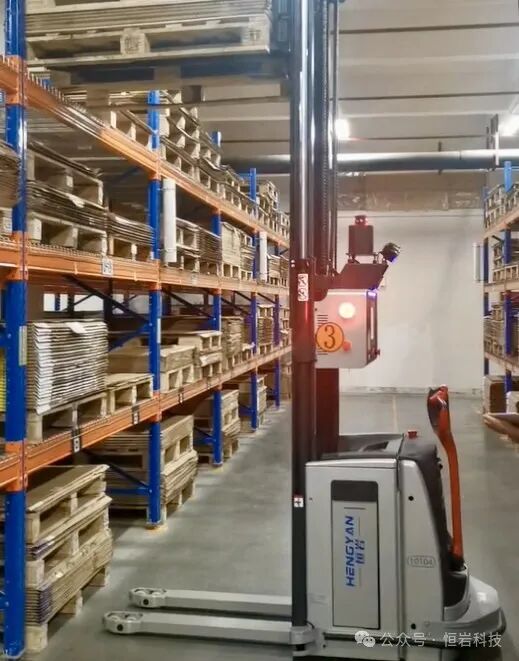
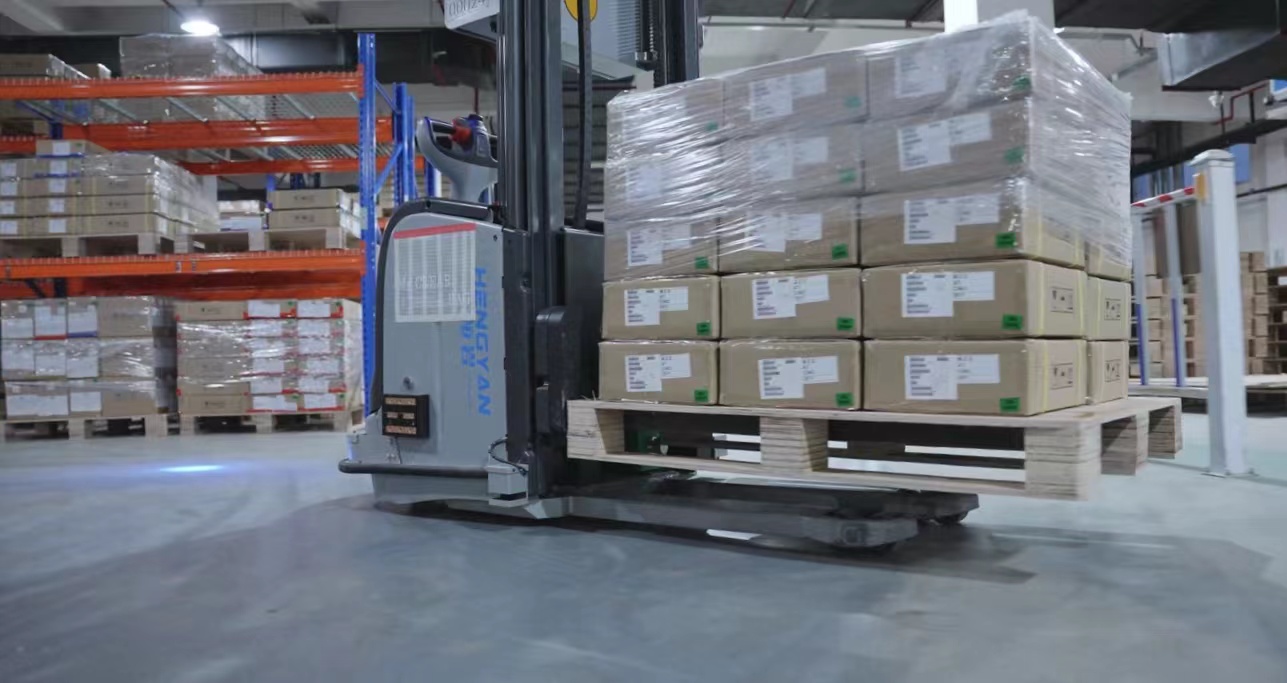
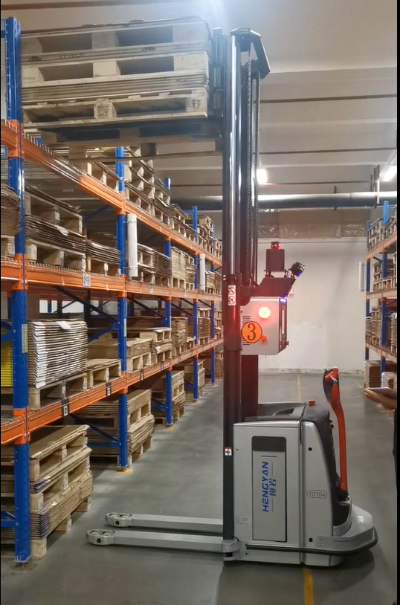
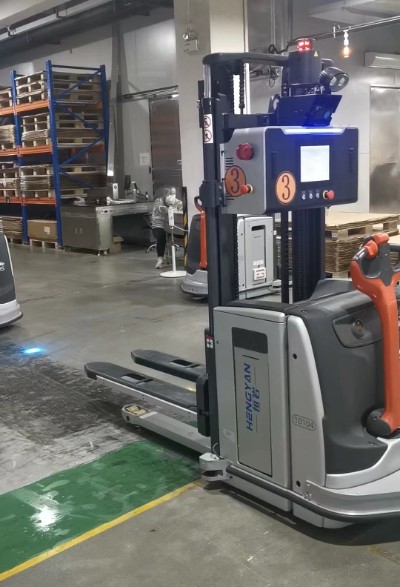
- Laser SLAM Forklift AGV: Autonomous forklift AGVs with Laser SLAM navigation replace manual forklifts for fully automated pallet-level storage and retrieval, improving safety and throughput
- Vertical Racking: Replaced flat storage with high-density narrow-aisle multi-level racking to maximize storage capacity within the existing facility footprint
- ERP Deep Integration: Our warehouse automation solutions ensure seamless connection between the warehouse automation system and existing ERP for real-time inventory synchronization and order accuracy
- Intelligent Task Scheduling: WES optimizes AGV routing and task allocation based on real-time demand, minimizing idle time and maximizing throughput
- Automated Sequencing: System automatically determines priority order, eliminating human error in shipment scheduling
- 24/7 Unmanned Operation: Fully automated workflows enable continuous operation without shift-based manual labor
Results
- 30% efficiency improvement in warehouse operations through automated Laser SLAM forklift AGV deployment
- 40% reduction in warehouse personnel, freeing staff for higher-value production roles
- 24/7 automated operation — continuous unmanned logistics supporting round-the-clock PCB production
- Peak-ready capacity — system handles promotional surges without additional temporary labor
- Full ERP integration — real-time inventory accuracy eliminates manual reconciliation and reduces errors
- Automatic priority sequencing eliminates manual scheduling errors across thousands of SKUs
- Industry-leading integration of logistics and information flow for high-mix PCB manufacturing
In the electronics sector, CMCC achieved similar automation breakthroughs for their semiconductor component warehousing, while SICC deployed smart wafer storage with an integrated robot and WES solution.
Olympic Circuit’s factory floor was not designed for automation. The AGV system had to work within that constraint, not around it.
Why PCB Factories Are Hard to Automate
PCB manufacturing facilities evolve over decades. Production lines get added, rearranged, and extended as product mix changes. The result is a floor plan that makes sense historically but defies the clean grid layouts that most automation vendors assume.
Narrow aisles between chemical processing stations. Elevation changes where additions were built at slightly different floor levels. Shared corridors where production staff, material handlers, and maintenance crews all compete for space. Olympic Circuit’s facility had all of these, plus the added constraint that production could not stop for a multi-month automation installation.
When we deployed the forklift AGV system, the robots had to work within the facility as it existed — not a cleaned-up version of it. The WES maps the actual floor geometry including permanent obstacles, variable-width corridors, and zones where human traffic is heavy at shift changes. The AGVs use this map for path planning while their onboard sensors handle the real-time surprises: a pallet left slightly out of position, a maintenance cart parked in a corridor, a door that is sometimes open and sometimes closed.
The Economics of Forklift AGV vs. Conveyor Systems
The conventional approach to automating material transport in a factory is fixed conveyors. Conveyors are fast, reliable, and well-understood. They are also permanent infrastructure that requires cutting floors for foundations, running power and controls along every route, and committing to a material flow pattern that is expensive to change.
Forklift AGVs trade peak throughput for flexibility. They follow programmed routes but can be reprogrammed in hours when production layouts change. They use existing floors without modification. They coexist with manual forklifts during phased rollouts — Olympic Circuit ran both in parallel for three months while validating the automated system.
The 30% efficiency improvement and 40% labor reduction came from consistency, not speed. The AGVs do not take breaks, do not vary their route efficiency based on operator experience, and do not damage product through rough handling. In our experience, the damage reduction alone — fewer scrapped PCB panels from forklift impacts — covered a meaningful portion of the annual operating cost savings.
Heavy-Load Handling in Electronics Manufacturing
PCB panels are not fragile in the way finished electronics are, but they are not forgiving either. A stack of raw laminate panels weighs hundreds of kilograms. Finished panels with populated components are sensitive to shock and vibration. Chemical processing baths require precise positioning of heavy racks.
The AGV hardware deployed at Olympic Circuit handles loads up to the facility’s maximum pallet weight with positioning accuracy within millimeters. That precision matters at the chemical bath stations where racks must align with dipping mechanisms, and at the drilling stations where panel stacks feed into CNC machines with tight intake tolerances.
For manufacturers evaluating AGV vs. conveyor vs. hybrid approaches, the solutions page covers how we assess transport automation by facility profile. The Sony case shows a different AGV deployment pattern in electronics with higher robot counts. Our ASRS system types guide explains how transport automation integrates with storage systems.
Frequently Asked Questions
How do AGVs and human-operated forklifts share the same corridors safely?
The AGVs run proximity detection systems that identify obstacles — including human-operated forklifts — and adjust speed or stop based on distance and closing rate. Designated crossing zones have signal lights that indicate AGV approach. During the parallel operation phase at Olympic Circuit, zero safety incidents occurred between automated and manual vehicles. The WES schedules AGV routes to minimize corridor sharing during high-traffic periods like shift changes.
What happens when the production layout changes and AGV routes need updating?
Route updates are a software operation. A technician walks the new path with a mapping tool, the WES validates the route for clearance and traffic conflicts, and the fleet receives the updated map. The entire process takes hours, not weeks. Olympic Circuit has modified routes four times since deployment to accommodate new production line additions — each change was completed over a weekend without production impact.
How does the ROI timeline compare between forklift AGV and fixed conveyor systems?
Forklift AGVs typically show faster payback because installation costs are 40-60% lower — no civil works, no power routing, no floor modifications. Conveyors win on throughput for fixed, high-volume routes. Olympic Circuit’s mixed-route environment with frequent layout changes made AGVs the clear choice. The cost analysis page models both options. Contact our team with your facility layout and transport volume for a comparative assessment.