
YKK — Goods-to-Person Automated Storage
About YKK
YKK is the world’s leading manufacturer of zippers, fasteners, and architectural products, with operations spanning over 70 countries. Managing a vast inventory of small components — zippers in countless sizes, colors, and specifications — presents unique warehousing challenges. YKK sought a fully automated solution to handle case-level storage and picking with minimal human intervention.
Challenges
- Extremely high SKU variety — thousands of zipper specifications requiring precise storage and retrieval
- Case-level operations demanding accuracy in both inbound and outbound processes
- Labor-intensive manual picking with high error rates for small, similar-looking items
- Need for 24/7 unmanned operation to meet global supply chain demands
- Integration with existing production scheduling and ERP systems — a challenge also addressed by Olympic Circuit in their PCB manufacturing facility
Solution
- Goods-to-Person (GTP) System: Bin robots autonomously retrieve and deliver bins to picking stations, eliminating manual walking and searching
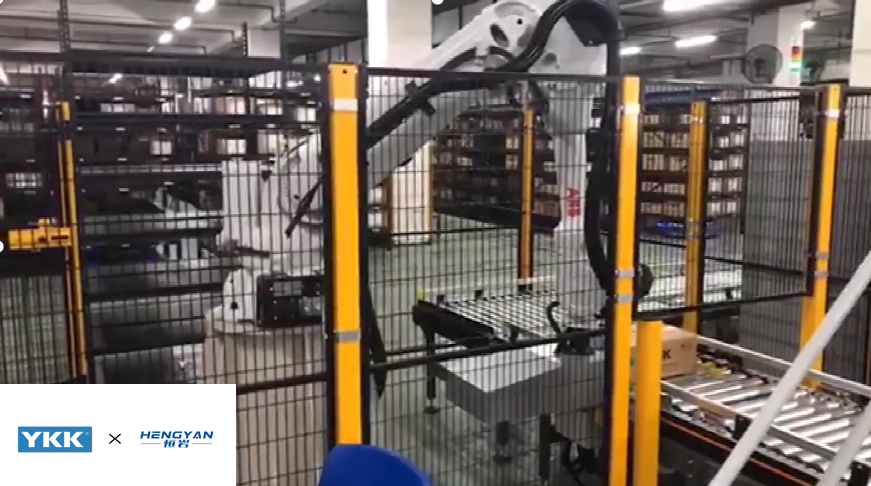
- Robotic Arm Integration: Industrial robotic arms handle case-level picking and placement, achieving fully automated storage and retrieval without human touch
- WES Unified Scheduling: Warehouse Execution System coordinates bin robots, robotic arms, conveyors, and workstations as a single integrated system
- High-Density Storage: Compact racking design maximizes vertical space utilization for small-component storage
- Intelligent Slotting: AI-driven inventory placement optimizes retrieval paths and minimizes robot travel time
Results
- Fully unmanned operation — 24/7 automated storage and picking with zero manual intervention
- Near-perfect accuracy in case-level picking, virtually eliminating mis-picks
- Significant labor reduction in warehouse operations, freeing staff for higher-value tasks
- Benchmark project for goods-to-person + robotic arm integrated automation in manufacturing
- Scalable architecture ready for replication across YKK global facilities
In the building materials sector, Seagull implemented a cross-floor bin robot system with a similar integrated automation approach for their multi-story warehouse.
24/7 Unmanned Warehouse Operations: The Technical Bar Is Higher Than You Think
Running a warehouse without human operators around the clock sounds futuristic. For YKK, it’s been operational reality.
What Lights-Out Actually Requires
Most warehouse automation reduces labor. YKK’s project eliminated it from the picking operation entirely. That distinction matters because removing the last human from the loop raises the technical bar in ways that partial automation does not.
In a staffed warehouse, people absorb exceptions silently. A picker sets aside a damaged item. A supervisor corrects a misplaced tote. A forklift driver works around a minor jam without filing a ticket. When no one is inside the storage zone, every one of those micro-decisions needs a programmed response.
The WES we built for YKK maintains a decision tree covering hundreds of exception scenarios — damaged items flagged by machine vision and routed to quarantine, misidentified SKUs triggering re-scan cycles, mechanical jams activating clearing sequences with escalation timers. In our experience, getting exception handling right consumed as much engineering effort as the primary pick-and-place workflow.
Lights-out operation also demands infrastructure redundancy that staffed warehouses can skip. Power flickers that a human team barely notices can strand robots mid-transit and freeze arms mid-pick. YKK’s facility runs on redundant power feeds with uninterruptible supplies and recovery protocols that resume every robot from its exact pre-interruption state.
How Robotic Arms Close the Last-Mile Gap
Goods-to-person systems have been around for years — robots retrieve totes and deliver them to picking stations. The station itself is where most deployments still rely on a human operator.
YKK’s system replaces that operator with a robotic arm equipped with 3D cameras and configurable end-effectors. The arm identifies items using pattern recognition matched against the SKU database, selects the grip strategy based on item geometry, and executes the pick-and-place cycle.
Fastener products turned out to be a strong fit. Zippers, pulls, and tape rolls have consistent shapes and rigid packaging — items where machine vision outperforms human hands on speed and accuracy, especially distinguishing SKUs that differ only in length or color shade. Products with flexible packaging or extreme size variation present harder challenges and may still need human operators.
The coordination between retrieval robots and the arm is where the WES earns its keep. Tote arrivals are sequenced so the arm always has work queued but never faces a pileup. The entire loop — order in, totes retrieved, items picked, order out — runs continuously with no human in the chain.
Manufacturing vs. E-Commerce: Different Automation Calculus
Manufacturing warehouses operate under constraints that change the ROI math compared to retail fulfillment.
The upstream supply is continuous. A factory running three shifts produces output around the clock. If the warehouse only accepts goods during staffed hours, finished products back up on the production floor. Unmanned 24/7 operation eliminates that bottleneck.
Order profiles are B2B with high line-item counts — a single YKK order might contain 30-50 SKUs. The WES optimizes retrieval sequences to minimize tote presentations per order, grouping co-ordered SKUs in adjacent storage positions.
Uptime is non-negotiable. A retail warehouse offline for four hours catches up the next morning. A manufacturing warehouse that stops accepting production output forces the factory to halt. The redundancy engineering described above is not optional here — it is the baseline.
For a comparison of how different ASRS system architectures map to manufacturing vs. retail, that guide covers the decision framework. Our cost analysis page helps model the labor-replacement ROI for manufacturing automation.
Frequently Asked Questions
What maintenance does a lights-out warehouse still need?
The system is unmanned, not unmaintained. Predictive monitoring tracks battery health, arm calibration drift, vision clarity, and conveyor tension. Maintenance staff work scheduled daytime shifts based on these alerts — replacing components before they fail. The WES routes work around affected zones so the facility keeps running during service windows.
Can any product type work with robotic arm picking?
Product characteristics determine feasibility. Items with consistent shapes, rigid packaging, and moderate weight — fasteners, electronics components, boxed pharmaceuticals — are strong candidates. Products with variable shapes or deformable packaging push current vision and gripping limits. The Decathlon case shows a deployment handling a broader product range with a different picking approach.
How does the cost of unmanned operations compare to three manual shifts?
Automation cost is fixed; labor cost scales with hours. Three shifts means three crews plus overtime, shift differentials, higher turnover on nights, and seasonal temp hiring. The robotic system costs the same per hour at 2 AM as at 2 PM. For most manufacturing operations with multi-shift requirements, payback falls in the 2-4 year range. Contact us with your shift structure and volume numbers for a specific projection.