
Comix — Multi-Robot Smart Warehousing
About Comix
Comix is one of China’s largest B2B office supply procurement platforms, headquartered in Shenzhen and serving all 31 provinces. As digital government and enterprise procurement surged, order volumes grew exponentially — and the sheer diversity of office products pushed traditional warehousing to its limits.
Challenges
- Over 130,000 SKUs annually with wildly varying sizes and packaging
- Traditional manual picking made it extremely difficult to locate items
- Frequent mis-shipments affecting service quality and customer satisfaction
- Mixed business types: whole-pallet, full-case, and piece-level picking all required — exactly the kind of challenge our industry-specific solutions are designed to address
- High employee training costs and management complexity
Solution
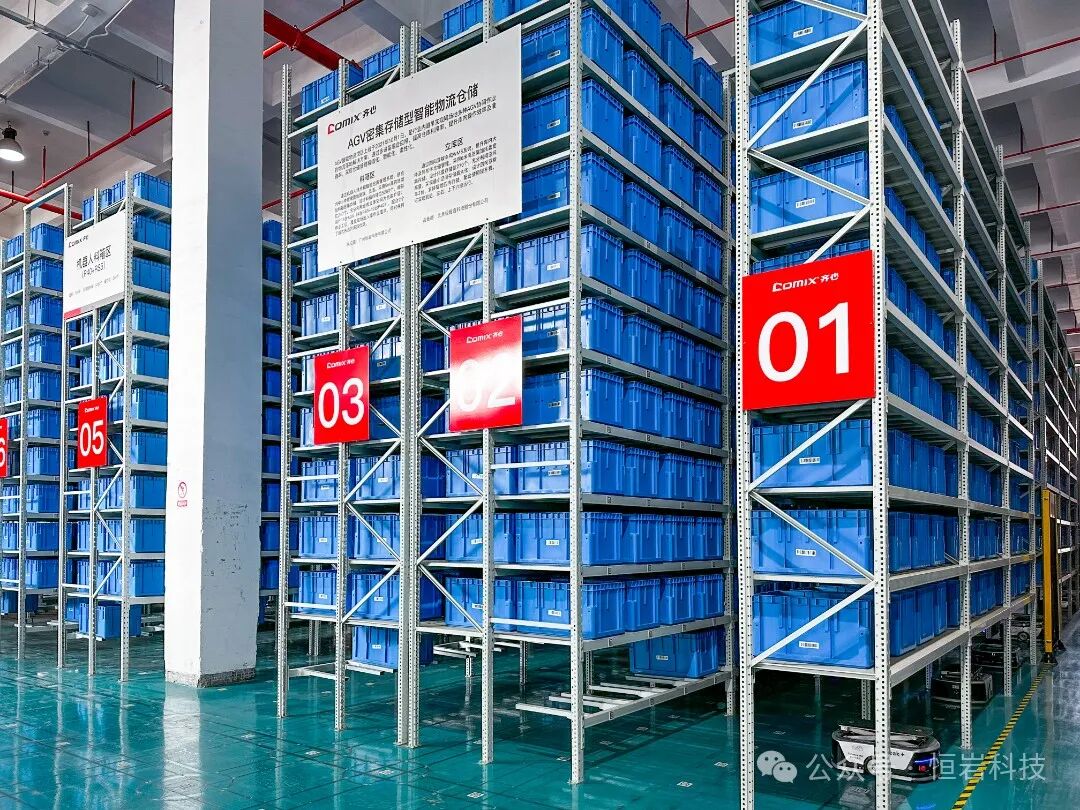
We deployed a multi-robot combination system that addresses all storage and picking scenarios in one integrated solution:
- RS5 Bin Robots + P40 Goods-to-Person Robots: Handle high-volume small and medium item piece-level picking
- Four-way Shuttle System: Manages high-storage, low-throughput full-case and large item picking
- AI-Powered Slotting: Automatically adjusts inventory distribution 24/7 based on item heat maps
- Ergonomic Design: P40 robots automatically raise bins to comfortable picking height
- Flexible Deployment: All-robot transport eliminates rigid conveyor line designs; robots can be added or removed as demand changes
Results
- Over 130,000 SKUs managed within a 1,500 m² warehouse
- AI auto-slotting runs 24/7, continuously optimizing inventory placement
- Full supply chain traceability with automated inbound/outbound management
- Flexible scaling: robots can be added or removed to match seasonal demand
- Significant reduction in mis-shipments and improved service timeliness
For 3PL providers facing similar multi-SKU complexity, Olympic Circuit Logistics demonstrates how automation scales across diverse client portfolios.
At 130,000 active SKUs, Comix hit a wall that no amount of additional labor could fix. The problem was not speed — it was findability.
The Inventory Complexity Ceiling
Office supplies seem simple until you count the variations. A single pen model comes in 12 colors, 3 tip sizes, and 4 packaging quantities. Multiply that across staplers, binders, paper stocks, desk accessories, printer cartridges, and thousands of other product families, and you reach a SKU count that breaks conventional warehouse logic.
In a manual warehouse with 130,000+ SKUs, the pick list becomes the bottleneck. A human picker staring at a handheld scanner showing aisle G, rack 47, shelf 3, position 12 will find the right item — eventually. But “eventually” multiplied by 50 lines per order and thousands of orders per day produces a throughput ceiling that adding more pickers cannot raise. The aisles are already full of people.
When we built Comix’s system, the first design decision was removing humans from the search problem entirely. The goods-to-person architecture brings totes to operators who confirm and pack — they never walk, never search, never wonder which of three nearly identical items is the right SKU.
Multi-Robot Collaboration at Scale
A single robot type cannot serve 130,000 SKUs efficiently. Small items like pen refills and paper clips need dense tote storage with fast retrieval cycles. Bulky items like paper reams and chair mats need different handling entirely. Comix’s system runs multiple robot fleets coordinated through a single WES layer.
The coordination challenge grows non-linearly with fleet size. Two robot types sharing a facility need one integration interface. Four types need six. Each interface handles task handoffs, traffic deconfliction, and exception routing. In our experience, the WES orchestration layer consumes more engineering effort than any individual robot deployment when the fleet count exceeds three.
Comix’s multi-robot setup assigns each fleet to zones optimized for their strengths — ACR tote robots handle the high-SKU, small-item zones where retrieval frequency is highest, while other automation handles bulk storage and replenishment flows. The WES merges picks from multiple zones into unified orders at consolidation stations, so the packing team sees a complete order regardless of how many robot fleets contributed to it.
What 130K SKUs Teach About Storage Strategy
At this SKU depth, static slotting is impossible. No human planner can maintain optimal positions for 130,000 items as demand patterns shift weekly. The system runs continuous re-slotting algorithms that analyze order frequency, co-occurrence patterns (items frequently ordered together get stored near each other), and seasonal velocity changes.
The hardware infrastructure supports this fluidity — totes are interchangeable, positions are addressable by coordinate rather than fixed assignment, and robots do not care whether position A4-2207 held printer paper yesterday and holds desk lamps today.
For operations approaching the complexity ceiling, the types of ASRS systems guide covers which architectures handle extreme SKU counts. The ERAL case shows a high-SKU fashion deployment with different density requirements. Our solutions page outlines how we scope projects where inventory complexity is the primary driver.
Frequently Asked Questions
How does the system prevent picking errors when SKUs look nearly identical?
The WES presents only the target tote at the picking station, with the specific compartment highlighted on the operator’s screen. The operator never chooses between similar items — the system has already made that selection during retrieval. Barcode verification at the packing station provides a second check. Error rates at Comix run below 0.1%, compared to 1-2% in their previous manual operation.
What happens during new product launches when thousands of SKUs are added simultaneously?
New SKU onboarding is a data operation, not a physical reorganization. Product master data feeds into the WES, which assigns initial storage positions based on projected velocity (estimated from similar product categories). As actual sales data accumulates over the first two weeks, the re-slotting algorithm adjusts positions to match real demand. The mini-load ASRS page covers the storage mechanics that make rapid SKU onboarding practical.
Can this approach work for distributors with even higher SKU counts?
The architecture scales to 200,000+ SKUs without fundamental redesign — the limiting factor is physical storage capacity, not system logic. Industrial distributors and MRO suppliers running 300,000+ SKUs use the same WES framework with expanded storage footprints. Contact us with your SKU count and order profile for a capacity assessment.