
Li-Ning — Smart Warehouse Transformation
About Li-Ning
Li-Ning is one of China’s leading sports brands, operating over 5,000 retail stores nationwide with a thriving online and offline business. As the brand scaled rapidly, its East China warehouse — spanning 50,000 square meters — needed a fundamental transformation from traditional “person-to-goods” operations to intelligent “goods-to-person” and even “shelf-to-person” scenarios.
Challenges
- Massive SKU variety across sports shoes, apparel, andessories requiring flexible storage and picking
- Traditional manual operations could not keep pace with growing omni-channel demand from 5,000+ stores and e-commerce — a challenge also faced by ERAL in the fashion industry
- Need for full-process coverage: whole-pallet, full-case, and piece-level storage, inbound, and picking
- High labor costs and difficulty maintaining consistent efficiency across shifts
Solution
We deployed a comprehensive multi-robot collaborative system — hundreds of robots working in concert across the entire warehouse workflow:
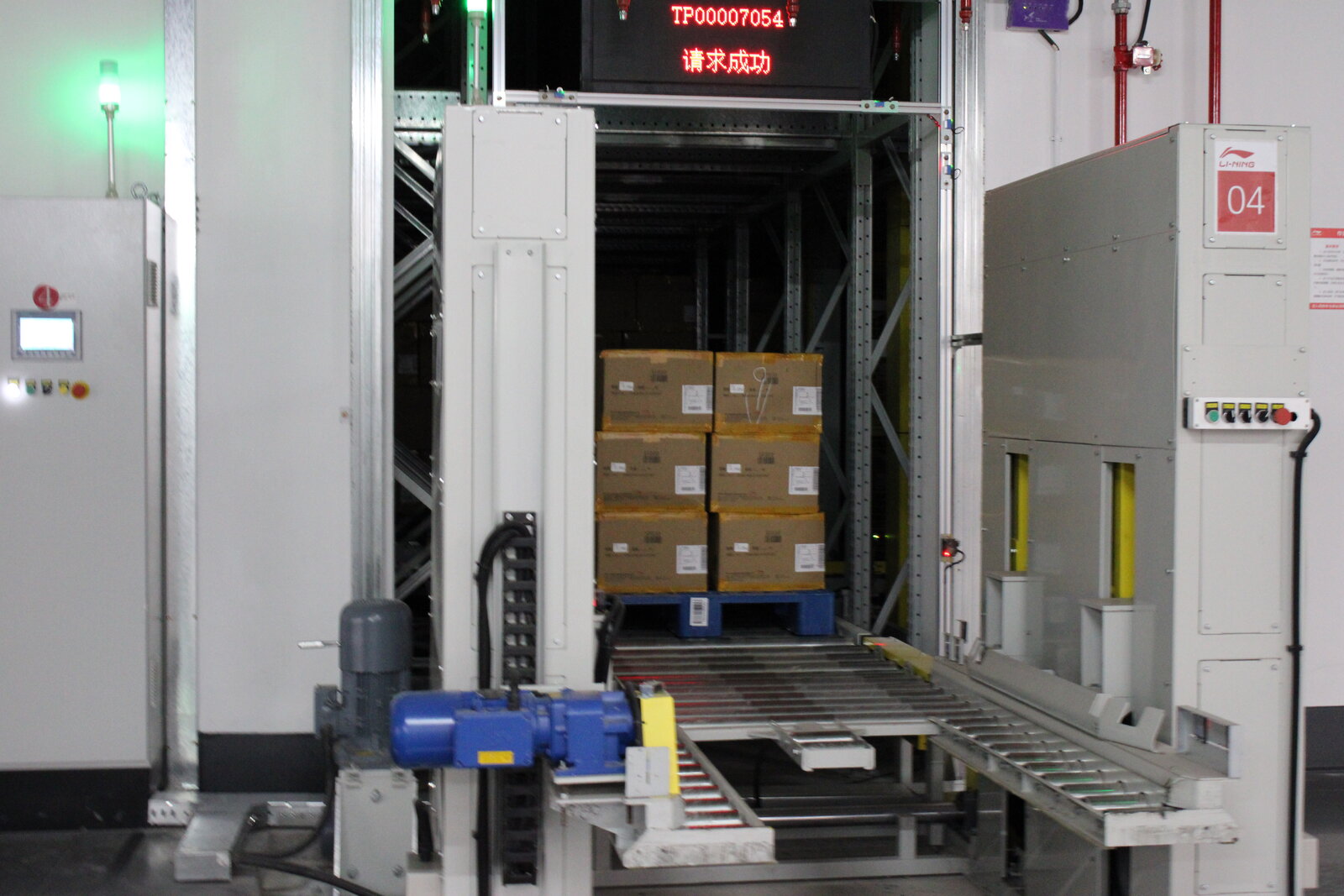
- Four-way Shuttle System: High-density pallet-level storage for bulk inventory
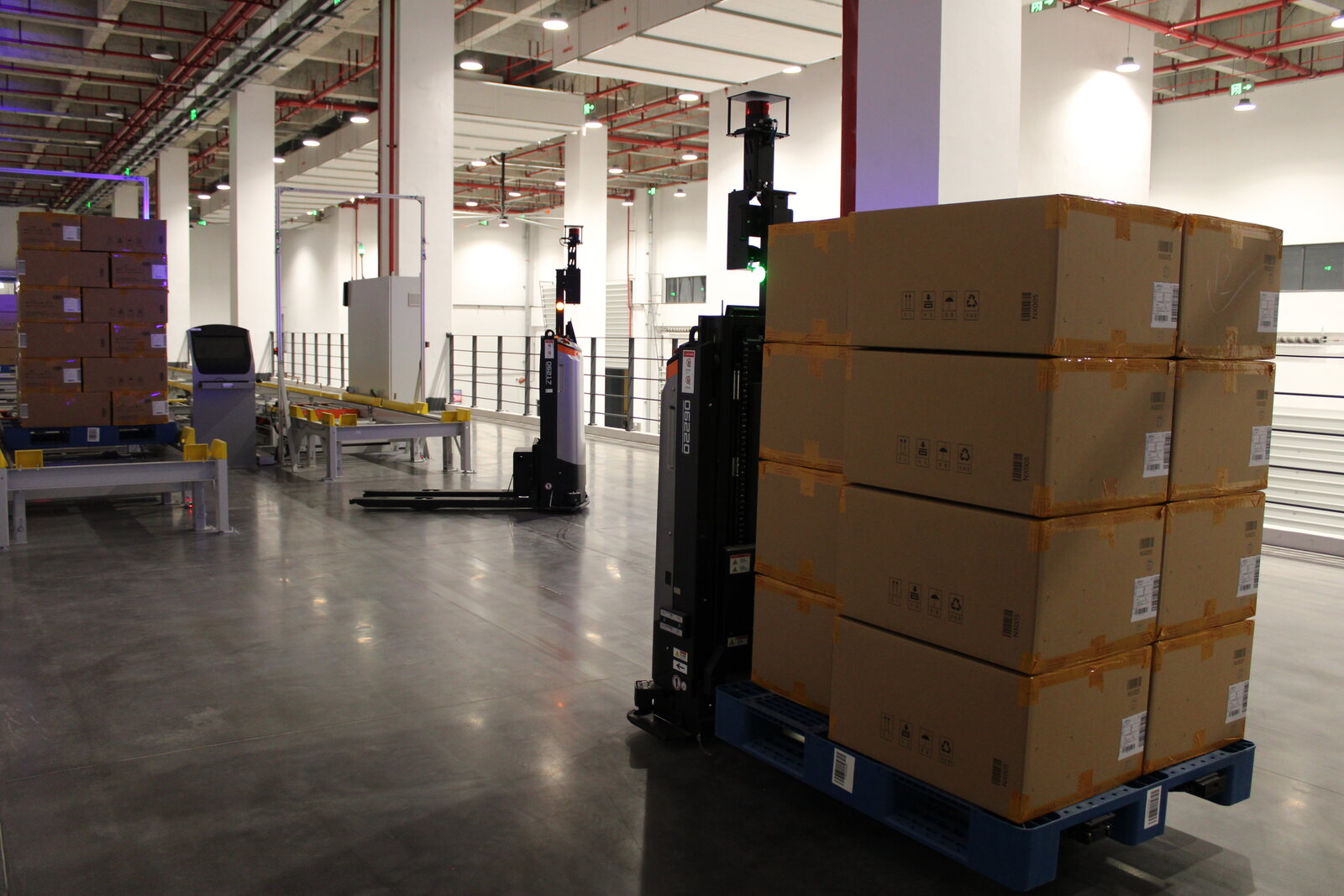
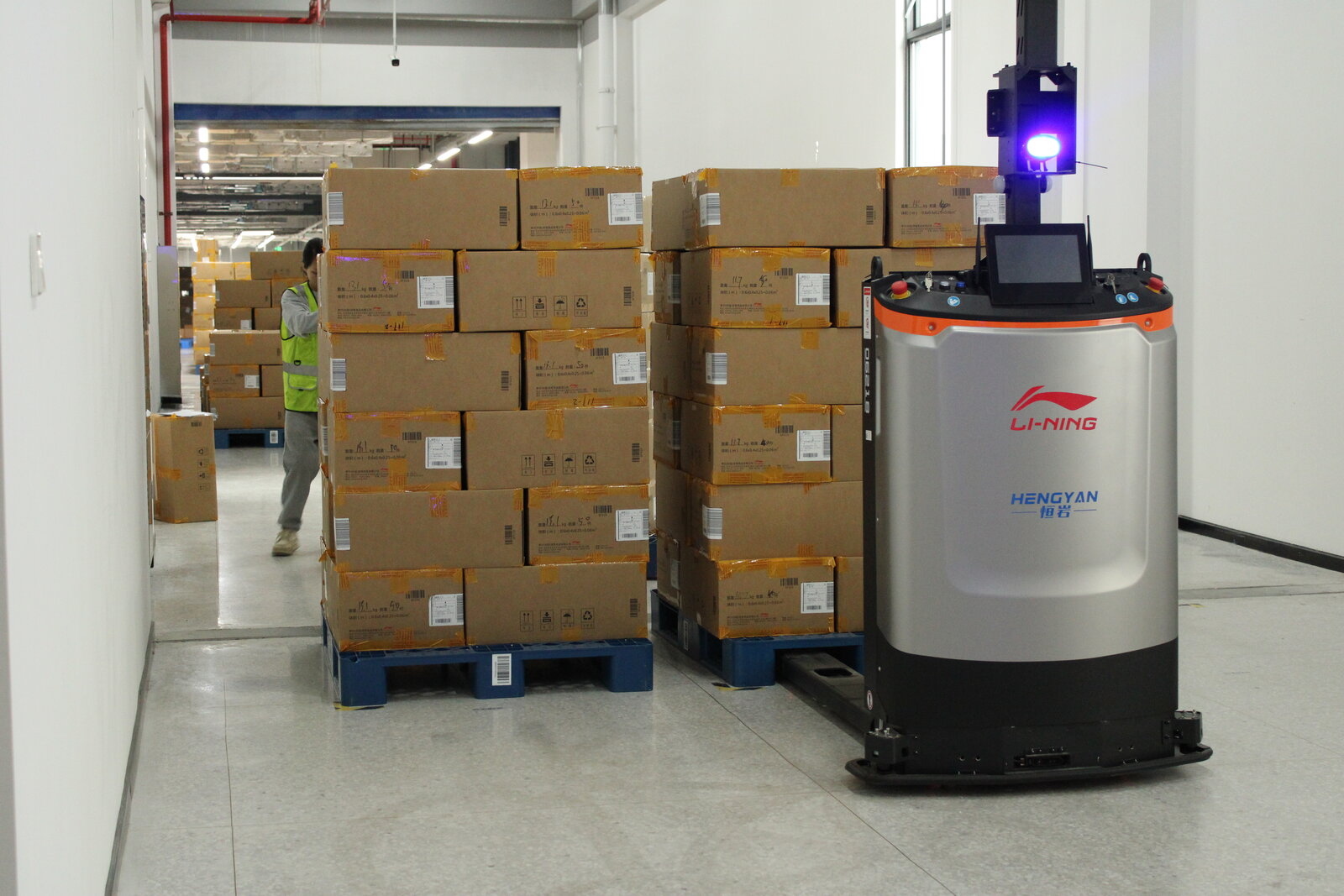
- Latent Jacking AGV: Goods-to-person picking for flexible order fulfillment
- ACR Bin Robots: 48,160 bin positions for piece-level storage and retrieval
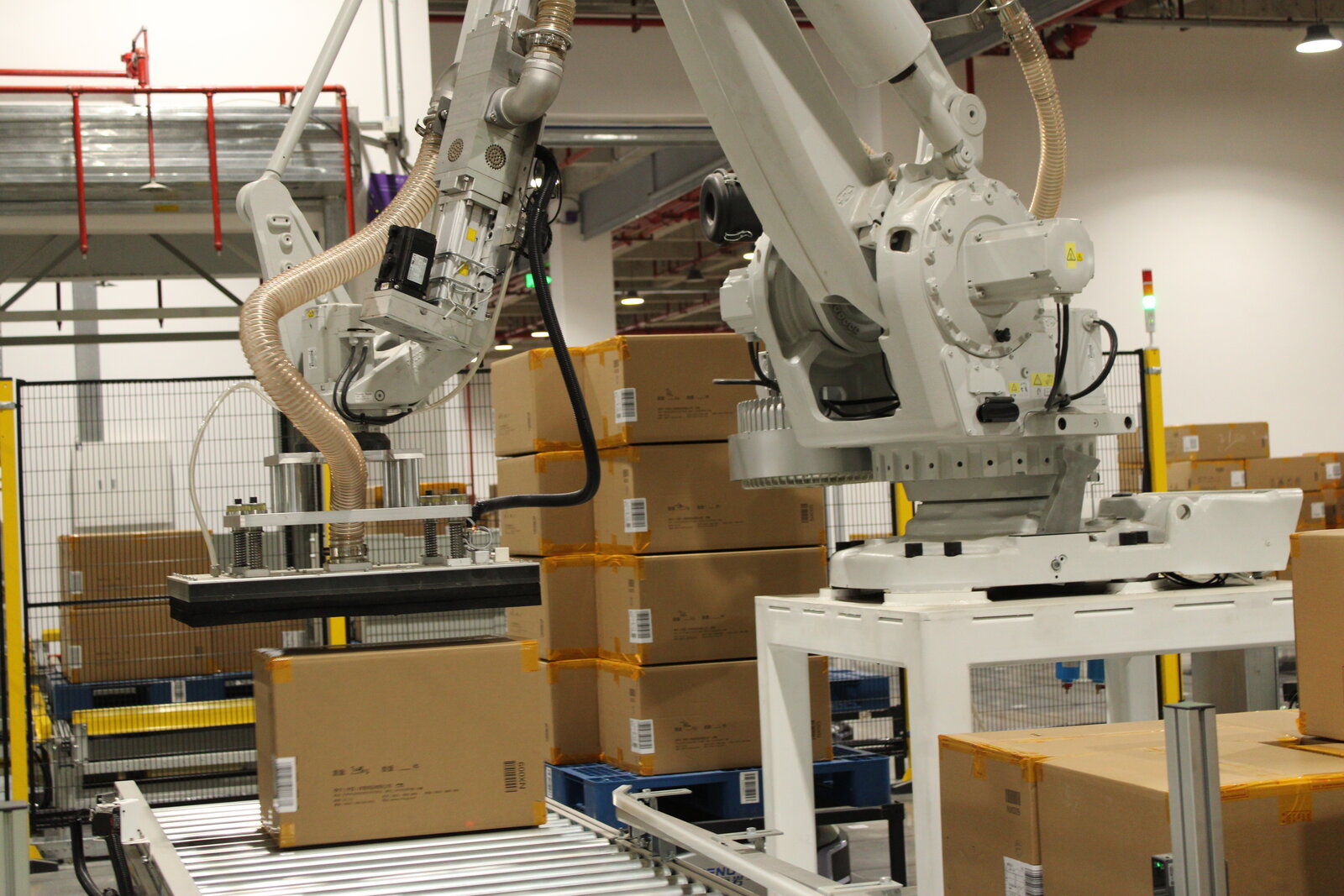
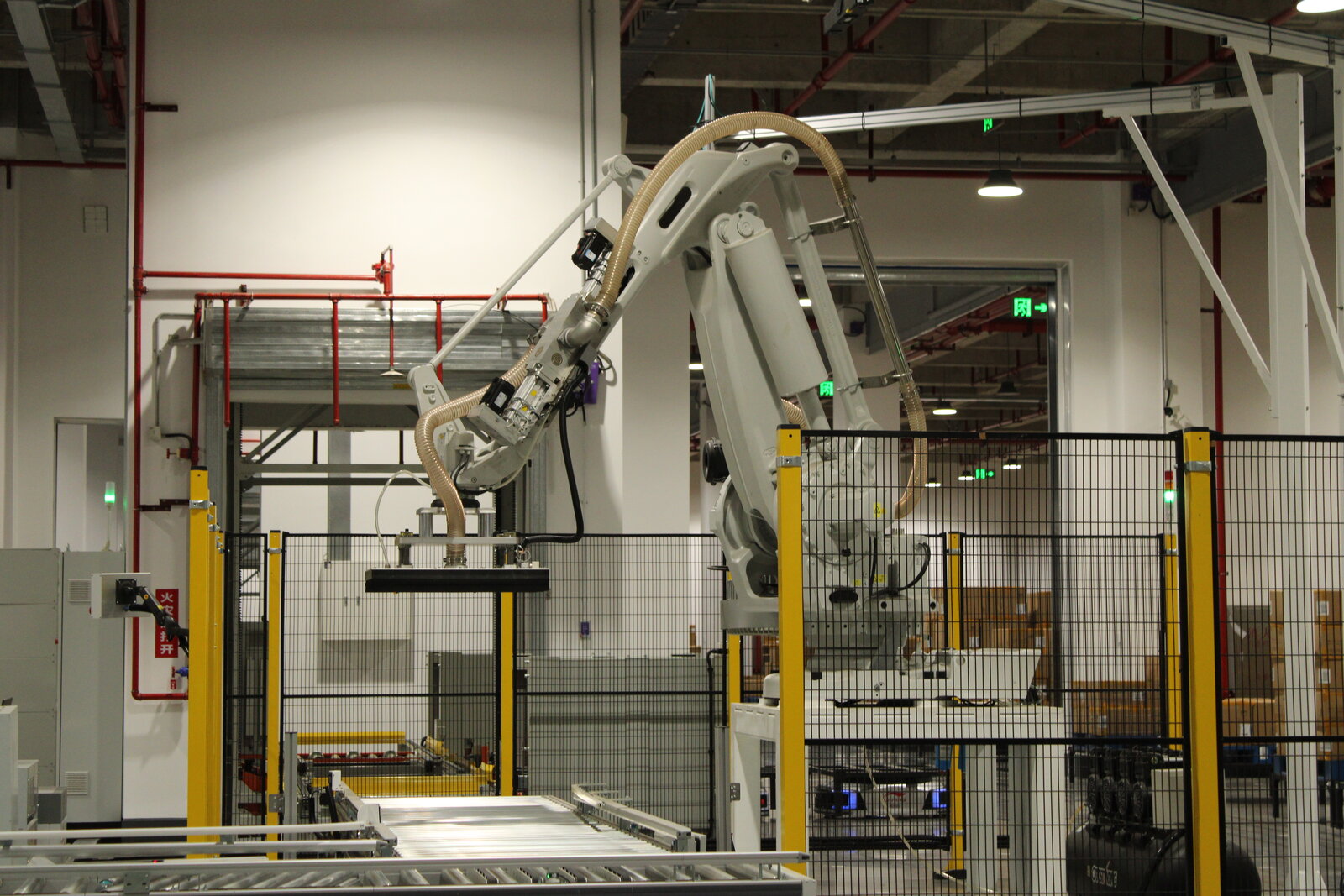
- Robotic Arms: Automated sorting and packing operations
- Conveyor & Sorting System: Integrated conveyor lines, elevators, auto-sealing, and auto-labeling
- Custom WES System: Unified orchestration of all robot types and equipment
Latent Jacking AGV transporting shelves
Goods-to-person picking station
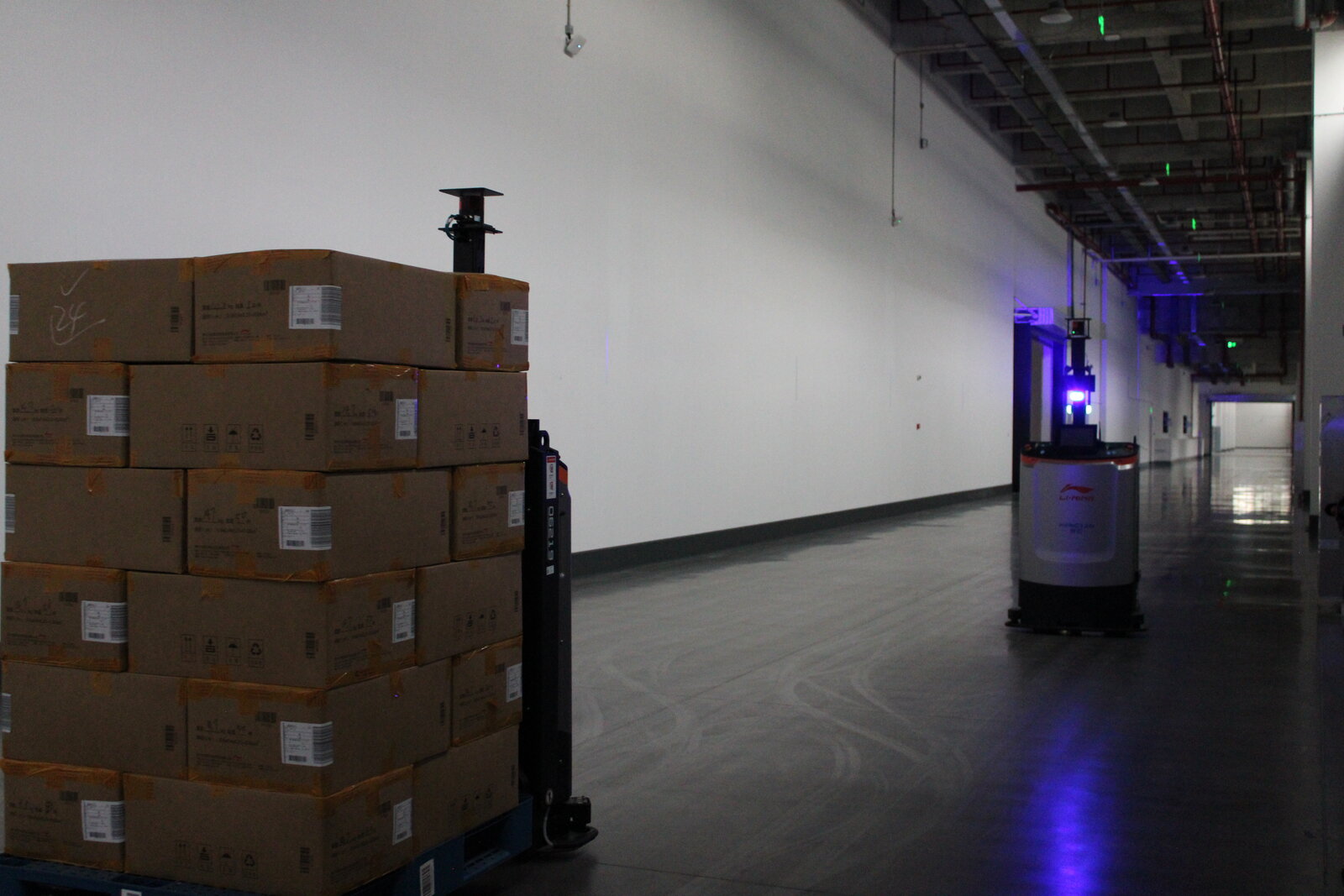
Integrated conveyor and sorting line
The solution covers all product categories — sports shoes, apparel, and accessories — with whole-pallet, full-case, and piece-level operations fully automated. A Flash Climb system was later added to further boost efficiency.
Results
Full-scale view of the 50,000 m² smart warehouse
- Inbound efficiency improved by 630% compared to manual operations
- Average picking efficiency improved by 560%
- Storage capacity per unit area increased by approximately 90%
- Storage space efficiency improved by 64.5%
- Inventory accuracy approaching 98%
- Flash Climb system processes 9,120 items/day, with 180 bins/hour inbound and 420 bins/hour outbound
- Flash Climb further boosted manual operation efficiency by 70-80%
This project has become a benchmark for smart warehousing in the footwear and apparel industry, establishing a long-term strategic partnership between Li-Ning and our team. Similarly, Decathlon achieved remarkable results with 1,000+ robots across their global warehouse network.
Multi-Robot Collaboration: The Integration Challenge Behind Li-Ning’s Smart Warehouse
The Li-Ning project wasn’t just about deploying robots — it was about making five different automation technologies work as one system.
Five Technology Stacks, One Orchestration Layer
Four-way shuttle cars, AGVs, ACR tote robots, robotic arms, and conveyor-sortation lines each come from separate engineering traditions. Shuttle cars operate on rail-based coordinate systems with deterministic pathing. AGVs use SLAM-based navigation that recalculates routes dynamically. ACR robots follow a hybrid model — grid-based movement with obstacle avoidance. Robotic arms run motion-planning algorithms unrelated to mobile robot navigation. And conveyor lines are pure PLC logic on fixed timing sequences.
The WES we built for this project had to speak all five languages simultaneously — protocol adapters for each vendor’s API, normalized task formats across systems that define “pick complete” differently, and a unified state machine tracking every robot, tote, and handoff point. The hardest part was not any individual integration. It was the combinatorial complexity of five systems interacting at thousands of touchpoints per hour.
Why No Single Vendor Could Build This
I get this question in almost every client meeting. The answer comes down to specialization economics.
Building a competitive shuttle system requires years of mechanical engineering focused on rail tolerances and dense-lane storage. Building a competitive ACR robot requires a completely different team focused on autonomous navigation and fleet coordination in open floor space. A company that tries to build all five robot types ends up with three mediocre products and two decent ones.
The manufacturers know this. Major shuttle car companies do not sell ACR robots, and leading AGV companies do not manufacture robotic arms. Each vendor optimizes for their core technology and relies on integrators to make their product work alongside others. Our hardware product pages show the range of robot categories we work with across projects like this.
What This Means for Other Sportswear and Apparel Brands
Not every brand needs five robot types. Li-Ning sits at the high end of complexity because of deep-lane pallet storage, case-level e-commerce picking, and high-speed sortation — all in one facility serving both retail replenishment and direct-to-consumer orders.
A mid-size sportswear brand doing 10,000-30,000 order lines per day could start with ACR robots and a goods-to-person picking workflow, skip the shuttle layer, and add sortation only when volume justifies it. The critical decision is whether your WES architecture can absorb additional robot types later without a full redesign.
Brands managing size-color matrix complexity hit a ceiling with manual operations faster than they expect. The ERAL case study shows a similar pattern in fashion retail. For a breakdown of how different ASRS system types map to operational profiles, that guide covers the decision framework. Our cost analysis page helps quantify the investment math before committing to a robot mix.
Frequently Asked Questions
How does the WES handle conflicts when multiple robot types need the same floor space?
The WES maintains a real-time spatial reservation system. Before any robot moves, its planned path is checked against reservations held by other fleets. If a shuttle car is crossing a zone an AGV needs, the AGV receives a hold command until the path clears. This happens at the millisecond level — without it, cross-fleet traffic would deadlock within minutes during peak throughput.
What happens when a robot vendor pushes a firmware update that breaks integration?
We learned this the hard way. Vendor updates can change API response formats, timing behavior, or error codes without warning. Our WES includes a compatibility layer that validates responses against expected schemas before processing. When a mismatch is detected, the system falls back to the last known-good protocol version and alerts our engineering team. We now require all vendor updates to pass integration testing in staging before production deployment.
Is multi-robot orchestration worth the complexity for smaller warehouses?
It depends on your order profile, not your square footage. A 15,000 m² facility processing both B2B pallet shipments and B2C single-item orders may need three robot types. A 40,000 m² facility doing only full-case store replenishment might run fine with one. Reach out to our team with your throughput numbers and order mix — the assessment takes days, not months.