

When we got the call that HengYan had been selected for the 2025 Tech Innovation Award for Excellence in Warehouse Robotics, the reaction around the office was a mix of pride and "about time." Not because we think awards define a company — they don't — but because this one recognized something specific: the engineering work behind integrating robots from multiple manufacturers into a single, coordinated warehouse operation. That is the problem we have spent years solving, and it felt good to see it acknowledged on a public stage.
The award was presented at the annual Smart Logistics & Supply Chain Innovation Summit, where a panel of industry judges evaluated companies based on original research output, real-world deployment scale, and measurable impact on warehouse productivity. HengYan stood out for its approach to warehouse automation — not as a robot manufacturer competing on hardware specs, but as a logistics integrator building the software and systems layer that makes diverse robot fleets work together.

The Company Behind GoASRS
HengYan Technology was founded in Guangzhou, China, with a clear thesis: the warehouse robotics market did not need another robot manufacturer. What it needed was a company that could take robots from different vendors — each with its own strengths — and orchestrate them into a unified operation tailored to each customer's specific workflow.
Today, the company employs over 200 people, with roughly 60% of the team in engineering and R&D roles. The headquarters in Guangzhou houses the core software development, algorithm research, and project management teams, while regional offices and partner networks support deployments across more than 30 countries in Southeast Asia, the Middle East, Europe, and Latin America.
HengYan holds certifications as a National High-Tech Enterprise and a Specialized-Refined-Differentiated-Novel (SRDN) enterprise — two designations from the Chinese government that require demonstrated R&D investment, patent portfolios, and revenue thresholds. The company has accumulated over 50 patents and software copyrights covering robotic scheduling algorithms, multi-agent coordination, storage optimization, and safety systems. These are not decorative credentials. Every patent maps to a feature running in production warehouses today.
The GoASRS brand serves as HengYan's international arm, handling everything from initial consultation and system design to installation, commissioning, and long-term technical support for customers outside China. When you work with GoASRS, you are working with HengYan's full engineering depth — just through a team structured for global service delivery.
Why a Logistics Integrator, Not a Robot Maker
This distinction matters more than it might seem at first glance.
Most warehouse automation vendors build their own robots and sell complete systems anchored to their proprietary hardware. That model works — until a customer needs a combination of capabilities that no single manufacturer covers well. A fashion retailer might need ACR (Autonomous Case-handling Robots) for tote storage, AMRs (Autonomous Mobile Robots) for pallet transport, and conveyor-based sorting for outbound — all from different vendors, all needing to share tasks and coordinate movements in real time.
That is where HengYan operates. Instead of locking customers into a single hardware ecosystem, we evaluate the full market of available robots and select the best fit for each function within a warehouse. Then our WES platform ties them together.
In practice, this means a customer gets the density advantages of one vendor's storage robots, the payload capacity of another vendor's transport AGVs, and the picking speed of a third vendor's robotic arms — all managed through a single software layer that handles task allocation, traffic management, and performance monitoring.
We have seen this approach cut project costs by 15-25% compared to single-vendor solutions, because customers are not paying a premium for a manufacturer's weaker product lines just to stay within one ecosystem. More importantly, it gives operations the flexibility to swap or add robot types as their business evolves, without rebuilding the entire control stack.
The WES Platform: Where the Real Innovation Lives
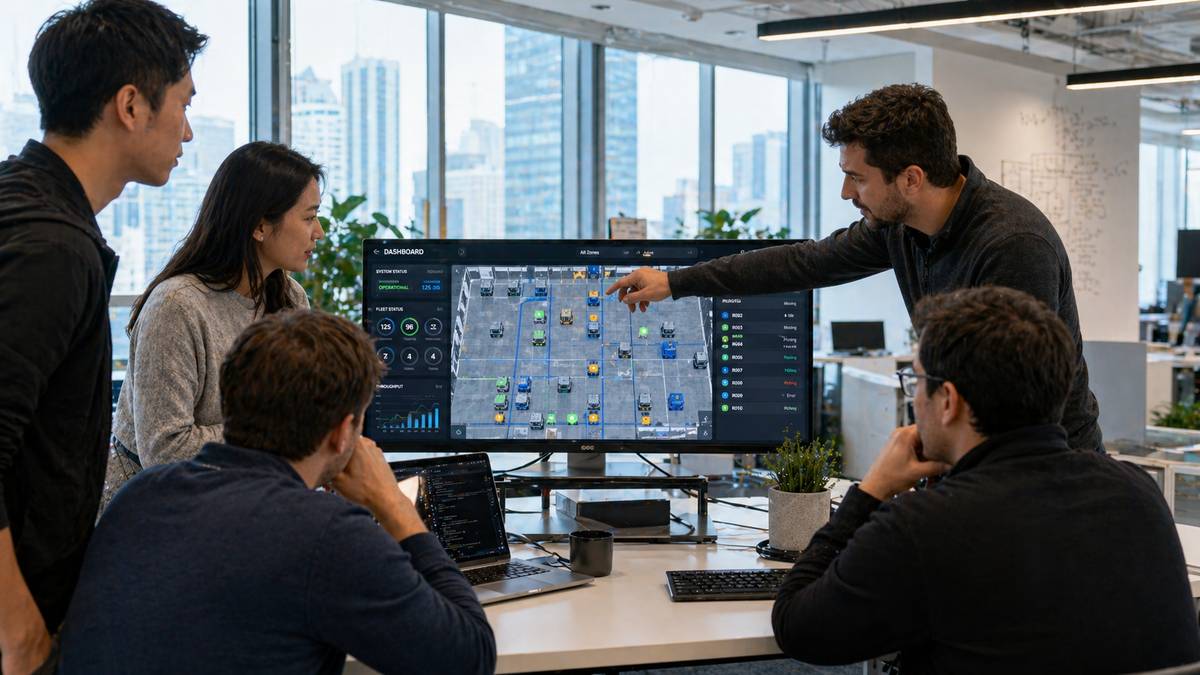
The award committee specifically cited HengYan's Warehouse Execution System as a differentiating factor, and for good reason. In our experience deploying over 6,000 robots across 500+ projects, the WES is where warehouse automation projects succeed or fail. The robots themselves are increasingly commoditized — the intelligence that coordinates them is not.
Our WES is built on a microservices architecture, which means each functional module (task scheduling, path planning, inventory tracking, device communication, analytics) runs as an independent service. This design choice has three practical consequences that matter to customers:
Plug-and-play device management. When we onboard a new robot type from a manufacturer we have not worked with before, we write a device adapter — a communication module that translates between our WES protocol and the robot's native API. The rest of the system does not change. We have built adapters for robots from Hikrobot, Geek+, Quicktron, HAI Robotics, and several other manufacturers. Adding a new one typically takes two to three weeks of development, not months of system redesign.
Independent scaling. If a warehouse needs more scheduling throughput during peak season but the inventory tracking module is running fine, we scale just the scheduler. This keeps infrastructure costs proportional to actual demand rather than forcing blanket upgrades.
Fault isolation. If the analytics service goes down, robots keep moving. If a single device adapter crashes, only that robot type pauses — everything else continues operating. In a 24/7 warehouse, this kind of resilience is not optional.
The algorithm layer sits on top of these services. Our path-planning engine handles real-time collision avoidance for mixed fleets — robots of different sizes, speeds, and turning radii sharing the same floor space. The task allocation engine uses priority queuing with dynamic rebalancing, so urgent orders get processed first without starving regular workflow. And the slotting optimizer continuously repositions inventory based on actual pick frequency data, keeping fast-movers close to outbound stations.
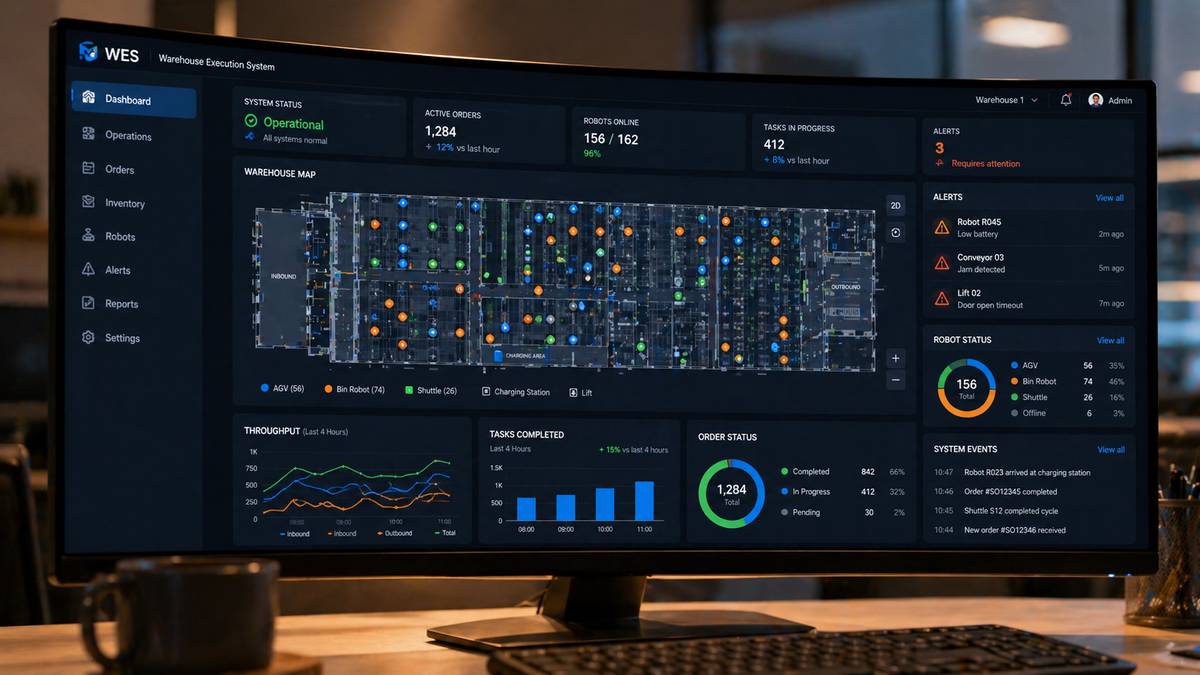
When we deployed a mixed fleet of 80+ robots for a sportswear client, the WES was coordinating three different robot types from two manufacturers, processing over 4,000 order lines per hour, and maintaining a pick accuracy rate above 99.97%. That kind of performance does not come from the robots alone — it comes from the software orchestrating them.
Projects That Prove the Model
Awards are nice. Deployed projects that run every day are better. Here are four that represent the range of what HengYan and GoASRS deliver.
Li-Ning: 630% Efficiency Gain in Sportswear Fulfillment
Li-Ning, one of China's largest sportswear brands, needed to overhaul its distribution center to handle surging e-commerce demand. The existing manual operation could not keep pace with order volumes during promotional events, and accuracy was suffering under the pressure.
We designed and deployed a multi-robot system combining ACR units for tote-based storage with AMRs for pallet movement. The WES managed task allocation across the mixed fleet, optimizing pick sequences to minimize robot travel time and maximize workstation utilization.
The result: a 630% improvement in picking efficiency compared to the previous manual operation. Order accuracy climbed above 99.9%, and the facility now handles peak promotional volumes without temporary labor surges. You can read the full breakdown in our Li-Ning project case study.
Decathlon: 1,000+ Robots in a Single Facility
Decathlon, the global sporting goods retailer, operates some of the most demanding warehouse environments in retail — high SKU counts, seasonal demand swings, and a product mix that ranges from tiny accessories to bulky fitness equipment.
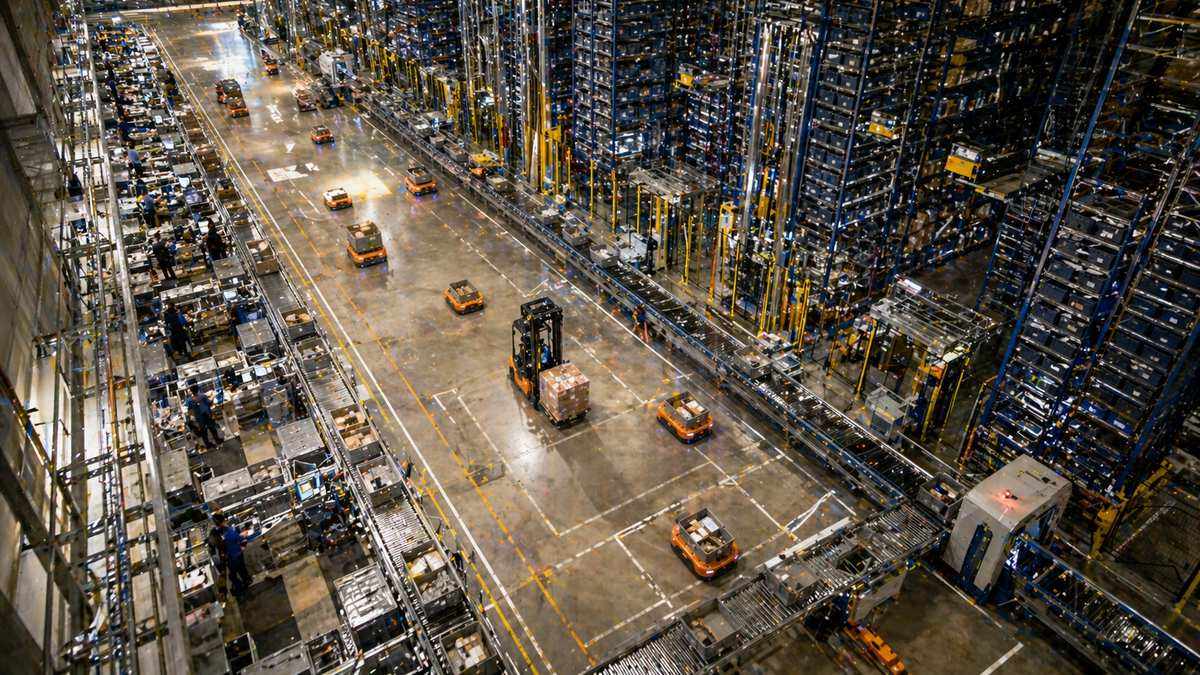
For their large-scale distribution center, we deployed over 1,000 robots operating simultaneously on the same floor. This is where multi-vendor integration becomes critical: no single robot type handles every product category efficiently. The WES coordinates the entire fleet, managing traffic flow to prevent congestion, balancing workloads across zones, and dynamically reassigning robots as order priorities shift throughout the day.
The Decathlon deployment remains one of the largest single-site robot fleets we have managed, and it runs at sustained throughput levels that would be impossible without the kind of software coordination our WES provides.
Sony: Precision Automation for Electronics
Electronics warehouses have their own set of challenges — ESD (electrostatic discharge) sensitivity, high-value inventory requiring strict accountability, and product dimensions that vary wildly from tiny components to large displays.
For Sony's warehouse operation, we deployed 49 robots in a configuration optimized for precision handling and inventory accuracy. The WES tracks every container movement with full audit trails, supporting Sony's quality management requirements. The system maintains near-perfect inventory accuracy while processing throughput targets that previously required significantly more manual labor.
The Sony installation demonstrates that our approach scales down as effectively as it scales up — the same WES platform that manages 1,000+ robots for Decathlon runs a tightly controlled 49-robot operation for Sony without over-engineering the solution.
YKK: 24/7 Unmanned Operation
YKK, the world's largest zipper manufacturer, needed a warehouse that could operate around the clock without human intervention during off-hours. Their product — small, uniform components in massive quantities — is ideal for full automation, but the "unmanned" requirement raised the bar on system reliability.
We built a fully automated storage and retrieval operation where robots handle inbound putaway, storage, retrieval, and outbound staging without operator involvement. The WES monitors system health continuously, automatically rerouting tasks if a robot needs charging or maintenance, and alerting remote operators only when intervention is genuinely required.
The facility has been running 24/7 unmanned shifts since deployment, with human staff present only during daytime hours for exception handling and system oversight. For a company that ships billions of zipper components annually, the consistency and reliability of automated operation translates directly to supply chain predictability for their global customer base.
What This Award Signals About the Industry
The warehouse automation market is going through a structural shift that this award, in a small way, reflects.
For the past decade, the dominant model was vertical integration: robot manufacturers building complete systems around their own hardware. That model produced impressive technology, but it also created vendor lock-in, limited flexibility, and situations where customers paid for robots that were "good enough" at certain tasks because switching vendors meant rebuilding the entire control layer.
The market is now moving toward a more modular approach. Warehouse operators want to pick the best robot for each job function, mix hardware from multiple suppliers, and manage everything through a unified software platform. This is the same pattern that played out in enterprise IT — from mainframes to best-of-breed software stacks — and it is happening in warehouse robotics for the same reasons: cost efficiency, flexibility, and reduced risk.
Research from LogisticsIQ projects the global warehouse automation market will reach $41 billion by 2027, growing at roughly 15% annually. A significant portion of that growth is coming from mid-market companies — businesses with 10,000 to 100,000 square foot warehouses that need automation but cannot justify the cost or complexity of a fully custom, single-vendor mega-system. These are exactly the customers who benefit most from an integrator model: right-sized solutions assembled from proven components, deployed faster, and adaptable as needs change.
For anyone evaluating ASRS system pricing, this shift has practical implications. Integration-based projects often come in 15-30% below equivalent single-vendor quotes because the integrator is not subsidizing an entire hardware R&D operation through each project's margin. The savings come from competitive sourcing, right-sizing robot counts, and avoiding the "platform tax" that vertically integrated vendors build into their pricing.
Understanding the different types of ASRS systems available today is the first step toward making an informed decision about which approach fits your operation.
Where Warehouse Robotics Goes from Here
The next wave of warehouse automation will be defined by intelligence, not just movement. Robots that can pick and place are table stakes now. The competitive edge is shifting to systems that can predict, adapt, and optimize autonomously.
Here is what we are building toward at HengYan and GoASRS:
Predictive inventory positioning. Using historical order data and external signals (weather, promotions, seasonal patterns) to pre-position inventory before demand materializes. When we tested early versions of this capability with a retail client, pick station idle time dropped by 22% because the right totes were already staged before orders hit the system.
Adaptive fleet management. Algorithms that learn from daily operational patterns and automatically adjust robot assignments, charging schedules, and traffic routing without manual configuration. The goal is a warehouse that gets measurably better every week without anyone touching the settings.
Cross-facility orchestration. As customers operate multiple automated warehouses, the WES needs to make allocation decisions across sites — routing orders to the facility with the best combination of inventory availability, robot capacity, and shipping proximity. We are extending our platform to handle this multi-site coordination natively.
Tighter integration with upstream systems. The WES should not wait for a WMS to tell it what to do. By connecting directly to ERP and order management systems, we can start warehouse preparation activities — staging, pre-picking, replenishment — earlier in the order lifecycle, compressing fulfillment times without adding robots.
These are not speculative roadmap items. Each one has active development teams and pilot deployments either running or scheduled. The mini load ASRS technology we deploy today will look fundamentally different in capability — if not in physical form — within two to three years as these software layers mature.
What This Means for Your Operation
If you are evaluating warehouse automation — whether for a new facility or a retrofit of an existing one — the HengYan and GoASRS approach offers a few things worth considering:
You are not locked into a single robot vendor. Our AMR hardware lineup includes robots from multiple manufacturers, and our WES integrates them into a single coordinated operation. If a better robot comes to market next year, we can add it to your fleet without replacing what is already working.
You get a software platform built for mixed environments. The WES platform is not a bolt-on — it is the core of every system we design. It handles the hard problems of multi-vendor coordination, real-time optimization, and operational analytics that determine whether a warehouse automation project delivers its promised ROI.
You get deployment experience across industries. From sportswear to electronics to industrial components, our team has seen the edge cases and failure modes that only show up in production. That experience is baked into our project methodology, our software defaults, and our commissioning checklists.
The Tech Innovation Award is a milestone, not a destination. The real measure of HengYan's work is whether the warehouses we automate run better tomorrow than they did yesterday. Based on the data from 500+ deployments and 6,000+ robots in the field, we are confident the answer is yes.
Browse our full range of industry solutions to see how we approach different warehouse challenges, or partner with us directly to discuss what automation could look like for your operation.
Planning a Warehouse Automation Project?
Our team has delivered 50+ ASRS systems across retail, manufacturing, and logistics. Tell us about your project and we will get back to you within 24 hours.
Thank you!
We received your message and will get back to you within 24 hours.