
Decathlon — Sports Retail Smart Warehousing
About Decathlon
Decathlon is the world\s largest sporting goods retailer, operating over 1,700 stores across 60+ countries. With a vast product range spanning more than 80 sports categories and tens of thousands of SKUs, Decathlons warehouse operations face extreme complexity in storage, picking, and distribution. As e-commerce orders surged and omnichannel fulfillment demands grew, traditional manual warehousing could no longer keep pace.
Challenges
- Massive SKU count (tens of thousands) across 80+ sports categories requiring complex storage logic
- Surging e-commerce orders demanding faster picking speed and accuracy
- High labor costs and difficulty recruiting warehouse workers
- Need for flexible scaling to handle seasonal peaks (e.g., major sporting events, holiday promotions)
- Integration with existing ERP and WMS systems across global operations
Solution
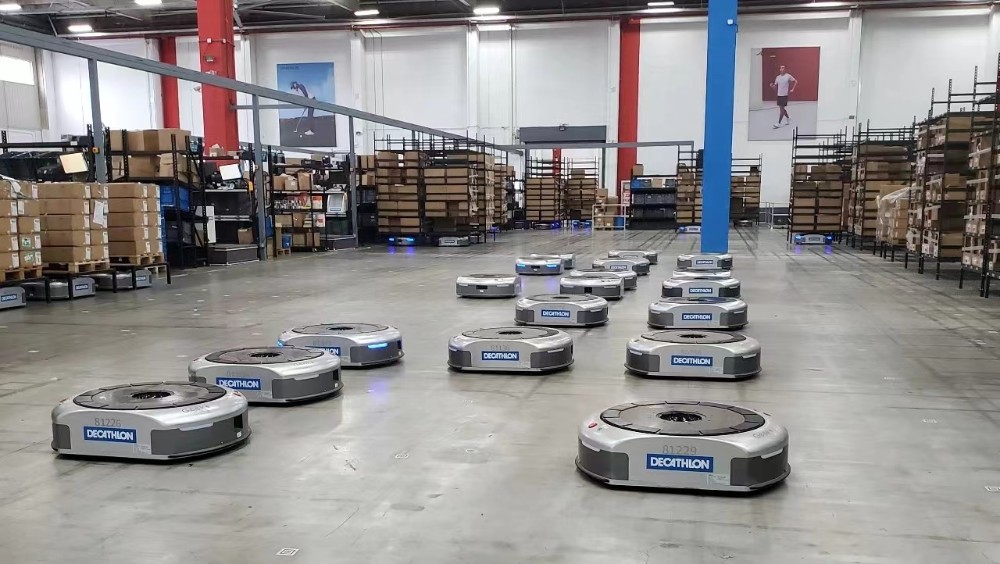
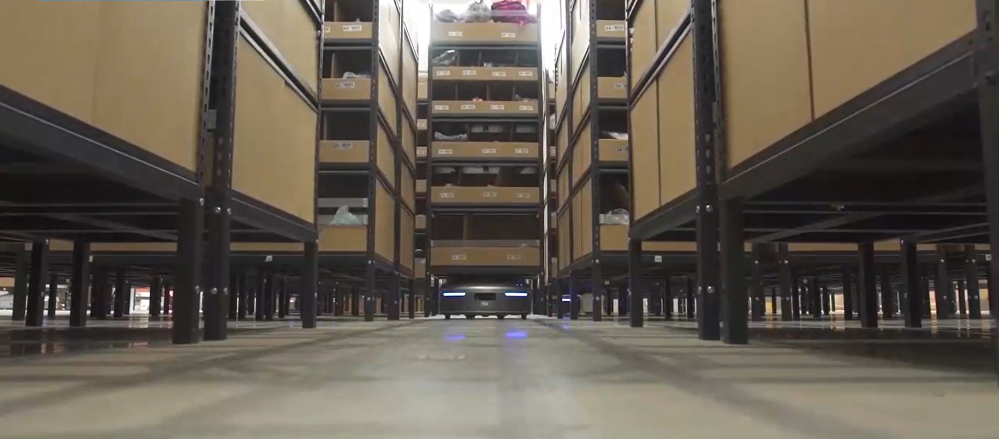
- 1,000+ Bin Robots: Massive fleet deployment in a single warehouse, with intelligent scheduling ensuring smooth multi-robot collaboration and zero congestion
- RFID Integration: Learn more about how ASRS systems work. Full RFID-based inventory tracking for real-time stock visibility and near-perfect inventory accuracy
- Flexible Scaling: Modular robot fleet design allows adding or removing robots based on seasonal demand without infrastructure changes
- WES Unified Scheduling: Warehouse Execution System coordinates robots, conveyors, and workstations for optimal throughput
- Global Replication: Standardized deployment model successfully replicated across 25+ Decathlon warehouses worldwide
Results
- 3x productivity increase compared to traditional manual picking operations
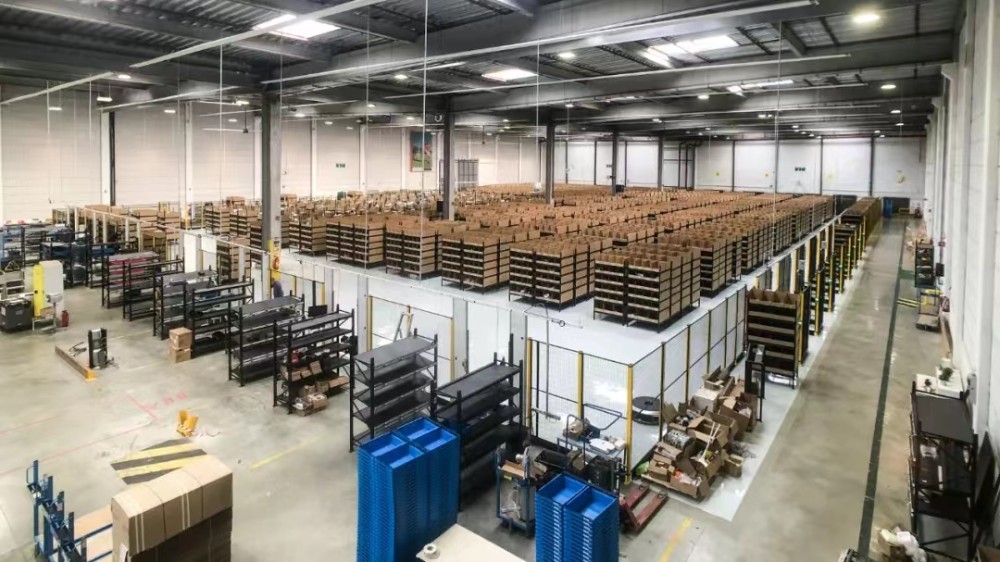
- 40% more storage capacity achieved through high-density racking and intelligent slotting
- ROI under 3 years with ongoing labor cost savings and efficiency gains
- 25+ successful deployments across Decathlon global warehouse network
- Seamless peak handling — robot fleet scales dynamically for promotional events
In the sportswear sector, Li-Ning achieved a 630% efficiency gain with a similar multi-robot approach across their 50,000 m² warehouse.
Global Warehouse Automation: Standardization vs. Local Reality Across 25+ Decathlon Sites
Deploying automation in one warehouse is an engineering project. Deploying it across 25+ facilities in multiple countries is a logistics strategy.
The Core Tension in Multi-Site Rollouts
Every country Decathlon operates in presents different constraints. Ceiling heights vary from 8 to 18 meters. Some facilities are greenfield builds designed around robots from day one; others are brownfield retrofits where automation coexists with manual processes during a months-long transition. Labor regulations, electrical standards, and ambient temperature ranges differ site to site.
The temptation is to custom-design each facility from scratch. That works for site one. By site five, you have five different WES configurations, five integration playbooks, and an operations team that cannot transfer staff between facilities without weeks of retraining. We learned early that the deployment framework matters more than any individual site design.
Our solution: standardize three layers — the WES software core, the integration methodology, and the RFID data pipeline — while customizing two: robot type selection and physical layout. That split let Decathlon scale from a handful of sites to 25+ without project management overhead growing at the same rate.
Why RFID Beat Barcodes for This Use Case
Decathlon committed to RFID across its supply chain years before the automation program started. That existing investment changed the architecture in ways a barcode-based operation could not replicate.
In a barcode system, inventory state updates only at scan points. Between scans, a tote is a black box. RFID eliminates that assumption — as totes pass through portals on conveyors, at robot handoff points, and at picking stations, every item inside is read without stopping the flow.
The practical impact: accuracy above 99.8%, continuous cycle counting instead of periodic shutdowns, and shrinkage detection in real time instead of quarterly audits. At Decathlon’s volume, the gap between 99% and 99.8% translates to thousands of fewer mispicks monthly.
Retailers evaluating barcode vs. RFID should consider the compounding effect. RFID tagging has a per-item cost, but paired with robotic handling through a unified hardware ecosystem, the gains pay back faster than most finance teams expect.
Building a Repeatable Deployment Template
After the initial pilot, we documented every decision — robot selection criteria by facility profile, racking rules based on ceiling height and SKU mix, conveyor routing patterns by building footprint, and WES parameter sets by throughput tier. New sites start from this template and adjust only what local conditions require.
Deployment timelines shortened by roughly 30% between the first wave and recent sites. The operations team manages the entire network from a single platform because every site runs the same WES core. Staff transfers between facilities require days of orientation, not weeks.
The Li-Ning case study shows what a single high-complexity site looks like, while the YKK case demonstrates unmanned operations. Our solutions page outlines how we structure programs across verticals and scales.
Frequently Asked Questions
How long does each new Decathlon site take to deploy after the first one?
The first site took over 18 months. Recent deployments run 10-13 months for comparable scope. The savings come from reusable WES configurations, pre-validated vendor integrations, and a commissioning playbook executed dozens of times. Brownfield retrofits take longer because the facility continues operating during installation.
Can a mid-size retailer apply the same framework without Decathlon’s scale?
Yes — the economics actually favor starting the template approach early. A retailer with 3-5 warehouses benefits from standardized WES software just as much as one with 25 sites. The per-site cost of custom engineering is proportionally higher at smaller scale, making a repeatable framework even more valuable. Our mini-load ASRS guide covers system types that work well for mid-size operations.
What happens when a site breaks the standard template?
It happens on roughly one in four deployments. Unusual ceiling constraints, non-standard power grids, or SKU profiles outside existing configurations require modifications. We fork the template for that site, make minimum changes, then evaluate whether those changes should fold back into the master template. The goal is controlled divergence — every deviation documented, not ad hoc. Contact our team to discuss how your facilities map to the framework.